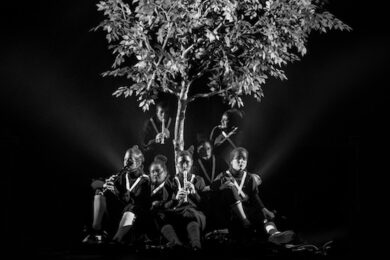

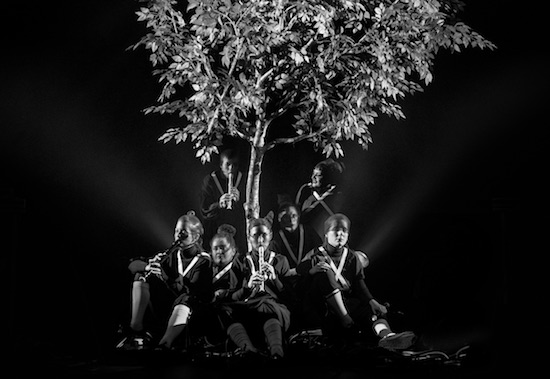
NYX photographs by Jamie Cameron
Mark E Smith sometimes alluded to a psychic like ability that he described as akin to a pre cognitive intuition. He named his 1980s label after the feeling it gave him: Cog Sinister. On 2018’s masterful Pastoral Gazelle Twin (Elizabeth Bernholz) gave many listeners a similar feeling. Here was England’s past and near future condensed: distilled to punishingly abrasive sour spirit essence – the seething; the pettiness; the unrestrained idiocy; the rage; the sadness. Swaddled in abrasive noise, propelled by clanking beats, chopped and spliced vocals, juddering subs and creeped out melody, it was a masterpiece that summed up the caustic, corrosive effect of bitterness and repression – not to mention a mawkish obsession with an imagined past – on the national psyche.
Coming after the Brexit vote, it felt like Bernholz was sonically propelling England back into its own ruddy cheeked, absurd face like a jester flinging a curling, three week old cake concealing a half brick. It’s a record that has since taken on a life of its own, a pre-cognitive momentum, as our political and social situation has continued to darken, continued to sour.
Deep England, a collaboration between Gazelle Twin and the NYX drone choir, expands Pastoral’s arrangements into immersive, sinister, beautiful dronescapes underpinned by the rich, sonorous vocalisation and electronics of the NYX choir.
A six piece all female collaborative choir that speaks to ambient, noise and electronics through polyphonic vocalisation and a welter of analogue and digital processing chains, NYX are committed to the idea of ‘voice as instrument’ and, on Deep England, underpin the glitched miasma of Pastoral with the ancient bearing of the choirs electronically augmented vocal drones and chants. Springing from a series of gigs performed in 2018 with Gazelle Twin at venues including Oval Space, Pickle Factory and the Queen Elizabeth Hall, Deep England plays like Pastoral’s ancient shadow sister dancing across our scissored isle. We spoke to Sian O’Gorman about the project.
How did Deep England come about initially, as a record? Did it spring from those 2019 collaborative gigs?
Sian O’Gorman: It was at the end of 2017 when we first formulated the idea for the group. NYX been jamming together for a while and we got some funding together to do a collaborative series with four different female electronic artists. Elizabeth was one of the artists we collaborated with. We did four different performances over the space of a couple of months which was an absolutely wild undertaking and the one with Elizabeth was initially meant to be in the Pickle Factory but it sold out quickly, and got shifted to Oval Space.
At that time we hadn’t called it ‘Deep England’. We’d made a list of people we wanted to work with and Elizabeth was top of my list. We emailed her and – without having heard it or met any of us – she said she was really keen. While we were talking she said ‘I’ve just written this album Pastoral which links very well to choral expansion’. She sent me some of the tracks and I was just like, ‘Holy shit, this is incredible: this is exactly the kind of stuff that we want to do.’
I took a number of the pieces and expanded them out from three to four minute tracks to these epic 15 minute dronescapes. I was trying to replace any digital instrumentation with vocal loops or manipulation; get the voices through guitar pedals or through Abelton or vocal processing units.
Then we did the Oval Space show, and as soon as we did that we thought, ‘We have to do this again.’ A year later we got some Arts Council funding to put it on again at the South Bank Centre and we thought, ‘Lets’s just go into the studio a couple of days after’ – and it was literally just a couple of days after the show – we went into the studio with Marta Salogni and recorded the entire thing in about a day and a half, although it took about half a day to set up the recording room because it’s seven of us with so much equipment [laughs]. There was a bit of chopping and changing and post production but what you hear on the album is almost all full live takes.
What kind of steer, if any, did Elizabeth give to the recording?
SOG: The arrangements aren’t too dissimilar to the Pastoral arrangements but there were a couple that we changed for the recording. Just before we went in and recorded ‘Better In My Day’ I thought, ‘Why don’t we replace the beat track with all of us making guttural noises and clicks?’ So we went round in a circle with a click track in our ears and did it one by one [mimics vocalisations], each doing a different vocal, then onto the next person. We gave it to Elizabeth and Shireen Qureshi, who are really good on Push and sampling, and they went away and created a backing track sampling all the different elements, pitch shifting them. That was the funnest one – when the final mix came in we had a little Zoom party, all of us online, and everybody had it playing in their ears hearing it for the first time. It was funny watching people’s reactions.
Can you tell me a little bit about the technical side of things? You’re using a pretty wide range of gear between the six of you, right?
SOG: It’s a sound checking nightmare. Whenever we turn up at a festival they’ll say, ‘Is half an hour soundcheck ok?’ And we’ll say, ‘We’ll need two and a half hours!’ I always wanted it to be a mixture of analog and digital. I love the tactile element of pushing and touching and thrashing that you can’t get so much with laptops. That said, I’m often on the Abelton side of things and on screen it’s almost like my score, like I’m conducting; I know what’s coming.
My background is in choral music and I was always really fascinated with the timbres of people’s voices; how people could tune themselves up or down or flatten themselves; or the way you’d get a really reedy voice next to a breathy voice, the way they’d balance each other out. Also, using people’s natural voices and then giving them a whole new capacity for different timbres by manipulating their voices. It’s been a bit trial and… well, no errors actually [laughs] but it has been a full blown trial and trial again of voices and personalities and equipment. Everybody has been drawn to particular things.
We’ve got some people singing with us and the high bits of their voices are gorgeous; some who have real power down low, and we run them through these epic octave shifters that give them a really intense sub bass. Pretty much all of the bass on the record, especially the moving bass, is done by voice. Almost all of the instruments on the album – apart from the field recordings, a couple of recorder loops and some synth drones – is all voice.

Does everybody in the choir come from a vocal background?
SOG: Somebody who was at the Pickle Factory show – the first time she had ever sung in front of people was at that show. And it’s phenomenal to watch somebody who hasn’t sung in front of anybody before do something like that. It’s new to all of us – it’s a shared experience for all of us – but when you’ve come from a place where you’ve never sung in front of anybody before and all of a sudden you’re performing to a sold out audience… it’s amazing. She initially focussed on the technology side as she was fearful that her voice wasn’t good enough, when actually her voice is phenomenal, and the way that her singing has developed has been incredible. But some people are slightly more drawn to the electronic side and other people do more voice stuff and slightly less triggering and sampling.
But when we started we had two – I’m not going to call them non singers, because everybody is singing and that’s why we came together; to make beautiful music with our voices, so it’s definitely singing but it’s more playing your voice as an instrument. But everything is a new experience for us. We’ve slowly but surely taught each other, and supported each other, and we’ve had really amazing support from Abelton. They’ve given us training and we’ve really started a model of, ‘You don’t have to know.’ So people can say to each other, ‘I don’t know how to do that’ or ‘I do know how to do that and I can help you.’
How does the idea of the drone play into what you do? Because on one level the music you make is beautiful and transcendent and psychedelic but the source material, Pastoral, comes from the idea of a country in dissolution; an angry, dark, bleak place. You’ve spent a lot of time in England; was this important in connecting to Pastoral?
SOG: I was born in New Zealand but a lot of my family are Scottish and Irish and I’ve spent time living in England for many years. I connected completely to Pastoral. When I first listened – just purely on a musical level, aside from the incredible lyrical source material – I could hear a drone in all of it. I could hear this underlying, undulating throb going on underneath… almost like a beating from the centre of the earth. And the original Pastoral is hyper electronic – grating, jarring, twisted – and it’s almost like that image of the jester is in it. I hear the jester.
I feel very connected to the pagan side of it, what was coming out through that and that is what I was bringing to the expansion of it. To me it feels like the jester and the hobby horse, and all these strange pagan traditions, were coming through. And I can’t believe she wrote it in 2017, who would have thought of the future that would come straight out of it?
We’ve lost an ability to honour and respect the darkness and there is this something in ancient times – we’re talking about the England of ancient times – that seems to have been washed down into this really repressed thing and I thought, ‘How can we honour and respect and bring back the creative expression of this darkness?’ because people find it too disgusting to face, and it’s become externalised, and people can’t bring it back into themselves and realise that it’s a part of all of us and we are the reason for it. We’re chucking all this shit onto politicians and situations but its like, ‘No, we’ve done this.’ It feels to me like an ancient pagan celebration of the darkness and that comes through to me a lot with drone music. What I found interesting when talking to Elizabeth about ‘Glory’ – that was one of the first songs I wanted to expand out – she said to me, ‘You know I wrote that with a drone; that’s how I write a lot of my music. I create a drone and sing over the top and then maybe deconstruct it or cut the drone away’ but I could hear that instantly. I find it fascinating.
What kind of state do you get into during performance? Because there is a real hypnotic element in what you do vocally. Does that carry over to the gig?
SOG: It feels like a dance. We work with an amazing embodiment director, Imogen Knight. She’s incredible and works with film and television. A lot of what she does is about coming into the body; we do a shaking exercise before we go on; the girls bring that onto the stage and sometimes there’s nervous energy.
It’s about not denying that, but mixing it into the music. But I like to always bring in the drone as we begin, and it will run for at least 50 percent of the performance before we cut it off. I find it dramatic; I think in these performances we share a lot with the audience because the drone is the element that is connecting all of us. There is a sense of simultaneous tension and catharsis and relaxation to a drone. There is that element of, ‘What’s going to happen here?’ but it’s also very relaxing; it’s a balance of catharsis and fully being in the music. I position people in a very considered way. We always have to be able to see each other and, sometimes, have the safety of being able to sing into each other and create a centred circle. We feel each other’s energy a lot. If somebody is feeling tense, then the whole thing tenses up and it becomes a constant attempt to try to keep it steady. It’s almost like rehearsed improvisation – my part will trigger your part which will trigger another part. But each part could go on as long as we want, considering the feeling of the room or where we are. There are moments when everybody has to be 100% together, so it’s a bit of a trip. It becomes very hypnotic, particularly on the sections where we just go off on one. We just explode and everybody gets very vast, and the high bits get very high, like at the end of ‘Deep England’ there’s a high part where everything gets very big and we keep going with that. Sometimes people aren’t looking, but they know when to stop intuitively because everybody is feeling the air, the frequencies flying around.