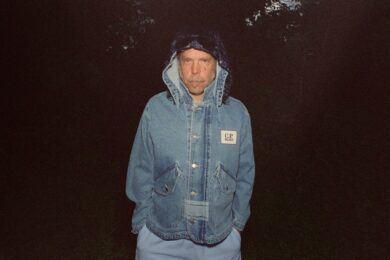


“We both have a very deep interest in non-human life on Earth,” says Guttersnipe guitarist and vocalist Uroceras Gigas, “and the movements and systems of organisation that occur in termite colonies or ants or shoals of fishes.” Gigas, sitting in her home in Leeds, her walls adorned with gig posters from sets she’s played, speaks with an exuberant expansiveness that matches the vibrancy of her attire and multi-coloured hair, eager to springboard from any given topic out into a dozen tangential tendrils. In this case, it’s not long before she ties this aside back into Guttersnipe’s xenofeminist compositional ideology. “In Western music, everything has to adhere to this system of measuring time that has been formalised in the conservatory standard of how we count rhythms. But we’re very interested in rhythms that are not linear that occur in nature – that sense of things going through a cycle, or an ebb and flow, or an expansion or contraction.”
The discussion then starts to follow the logical threads of physicality in performance, invitations for movement and dance from an audience, rock music and its nomenclature arriving from the act of sexual gyration. But Gigas senses that her bandmate, drummer and vocalist Tipula Confusa, might have something to add. Confusa, calling in from Berlin, just before a planned return to Leeds, speaks with more deliberation and concision, and often lets Gigas run with the conversational baton first. Knowing this, Gigas asks, “Do you have anything else to say about that?”
Confusa opens their mouth, eyes shut in great focus. “I had a few thoughts,” they begin. “When you were talking about…” They trail off into silence. After a moment, they look into the camera, beaming and laughing. “I was just thinking about worms.”
As Confusa explains, we’ve been delving into the supposed dichotomy between the visceral and the cerebral, the academic and, as they say, the “dumb,” propped up by musicians or thinkers who seem to see these qualities as mutually exclusive, that to reach toward the highbrow must mean forsaking those most primitive qualities. “But then every other lifeform on Earth that we know of,” Confusa adds, “is experiencing their existence in that state.”
As a xenofeminist noise rock group, this emphasis on pulling from the non-human world is baked into Guttersnipe’s very ideals. A theory first proposed by Laboria Cuboniks, and then pushed into an animal framework by Bogna M. Konoir, xenofeminism seeks to dismantle the discriminatory boundaries of constructed social identity, and push toward social emancipation, with an emphasised application on gender-expansive futures.
“Humanity sees itself as superior and advanced and the most evolved, but we’re not really that much,” Gigas says. “A lot of our sensory perceptual capacities are very similar to most of the other organisms on Earth. This idea that’s often pushed in these academic circles is that there’s this upper echelon of ‘advanced music’ for people to enjoy in this very well-behaved, civilised way, which usually means upper-class and white and respectable and sat quietly in a chair thinking. The idea that something could be intellectually advanced but not make you want to dance around or take you back into the mud with the worms, squirming… I completely reject the idea that those two things are not one and the same world. We’re all sensory organisms. If you have to explain any kind of art or music too much for people to get it, then maybe it’s just not that good.”
This has always been the thrust behind Guttersnipe’s work, but it’s never been truer than on Extinction Burst!, their second full-length eight years in the making. The songs thresh and mutate, screech and snarl, roil and crash, but their shapes are carefully disordered, deliberately gnarled into alien forms. On the scene-setting opener ‘Alive On Tuesday’, Gigas and Confusa wrestle their individual parts against and around each other, at times in the realms each their own, but constantly resynchronising around a central motif across 10 minutes.
As the band explains, their state on Extinction Burst! is emblematic of their process: record improvisations, listen back to the recordings, take pieces of the recordings and chop them up into a composition, and then learn to play the song they’ve written via this abstraction. The first version released of ‘Alive On Tuesday’ was a livestreamed early take from 2020, divided into three distinct parts over the course of 45 minutes; the recording on Extinction Burst! is the clearest example of how thoroughly the band refines through work through repeated performance and reflexivity.
It’s these very considered factors – thematically and compositionally – that are part of why it has taken Guttersnipe eight years to follow up their debut, 2018’s My Mother The Vent. “We’re a bit of a temporally challenged group,” Gigas admits, though some factors – such as an amicable romantic breakup between the duo, COVID’s halting of in-person gigs from 2020 to 2022, and a difficulty in finding a place to rehearse after losing a jam space – necessitated more time than the band had been used to before. “Our songwriting process actually takes quite a long time,” Gigas adds. “I was playing this venue in Lyon with another band that I’m in, they were like, ‘We love Guttersnipe, but what happened to you guys?’ And we were like, ‘We’re still going! We just can’t rehearse, so we can’t really write any new songs.’”
Eventually, it was Lyon’s own Grrrnd Zero that offered Guttersnipe a low-cost two-week residency to write and rehearse new material. “We were paying €10 a day for 24-hour access to the facilities and a place to stay and a kitchen,” says Gigas. “It was completely invaluable, because we hadn’t had that.” Though ‘Alive On Tuesday’ and closer ’Skräckblandad Förtjusning’ were written and performed before this span, it was this fortnight that birthed the remainder of Extinction Burst!

Of course, Guttersnipe is still a Leeds band through and through. Though some of the formative figures in the scene since the group’s last interview with tQ have come and gone, the punk and avant-garde ethos to the city’s underground culture is what still keeps Guttersnipe tethered there. Per Gigas, “the community in Leeds has got this nice balance where we’re serious about what we do, but we’re not ‘cool.’ It’s not like a city where people are trying to make it, or just automatically think they’re somebody because they’re in that city, which is true of a lot of other cities in the UK that get a lot of money.” In her case, especially, she still voices gratitude for how welcoming the Leeds scene was to her as a trans woman interested in extreme music, “Which is something I’d never known from any other scene up until that point.”
Transfeminism and queer theory are, to be expected, crucial elements that a band with Guttersnipe’s membership would draw upon. But their arrival at these threads is never so obvious as to betray nuance or subversion; Gigas describes her lyrical approach – which she attributes to being an autistic, ADHD person – as both synesthetic and surrealistic, and is quick to note the fact that the latter is always an artistic movement that is inherently political. “I’ve always related a lot to the surrealist painters who were using this psychedelia to talk about the horrors of fascism and war,” she explains. Her words are the ones stylishly scrawled out on the lyric sheet for Extinction Burst!, full of playful neologisms and turns of phrase like “girlfagocyte” and “transferral / trans feral.”
But this is just Gigas’ side of things, after all. As conversation drifts to Confusa’s lyrics for their vocals, a complicating flipside is revealed: Gigas claims she has no idea what Confusa’s lyrics even are. Neither does Confusa, who wrote a set of lyrics for the recording sessions, and lost the notebook shortly thereafter. “I didn’t feel too bad about it,” they reassure me. “I think I’m mostly howling like an animal anyway, like a dog.”
“For us,” Gigas says, “it’s about being fine with the fact that we’re singing about completely different things at the same time, and that we’re not even necessarily aware of what the other one is saying.”
“It’s about the freedom in the uncertainty,” Confusa adds.
As is eminently clear from almost two hours with Gigas and Confusa, Extinction Burst! is an album whose threads, influences, and topicalities run as dense as the layers of noisy guitars and drums and electronics that most immediately strike the senses. Much of it spills out of the duo’s focus on the concept of “crisis energy,” a term coined by China Miéville in Perdido Street Station, where as Gigas and Confusa put it, “there’s a rupture on the edge of chaos and collapse, and this maximum potential for energy release is at this moment where you’re on this threshold.” “Extinction burst,” a psychological term that rests along a similar frequency, felt like the most apt way for Guttersnipe to define how their music is meant to feel, on that deepest visceral level.
“We were pushing towards the fact that these moments and spaces are ultimately transformative,” Gigas elaborates. “And if what comes afterwards is somehow encoded in that extinction event, how do those patterns play out when things calm down again? Our record doesn’t have much of these calm spaces, because it’s definitely held in that crisis moment, that hysterical lunacy where everything is tearing apart and collapsing and deconstructing, but also the will to hold onto the old way is a pressure that holds it together.”
She goes on to describe the scenario she envisions as an underclass fighting what feels like an almost-certain losing battle against an unstoppable force, “but doing it with honour.” As she’s had time to reflect on the world’s rapid descent into dystopia, she returns to these kinds of metaphors as a guiding force for understanding the place her art can hold now especially. “It’s better to fight with the spirit than it is to just be absorbed into it,” she says. “I do think it’s really important to keep doing this stuff where you’re like, ‘No, I fucking refuse that as the truth! There is an alternative!’ And even if that’s becoming a more difficult path to tread, it’s crucial that we don’t lose faith.”
I feel compelled to inquire about the nods that song titles on Extinction Burst! have toward the repressive, neo-conservative technological culture we find ourselves in this decade, permeated with references to the self-censoring algorithm-pleasing term “unalive” or allusions to the “memetic bottleneck” that inhibits the breach of progressive ideas. After all, Gigas herself was cited as “vehemently [denouncing] the internet and technological post-modern culture in general” in the band’s last interview with tQ.
“My vitriol has in no way quelled,” she assures me of her feelings in 2026. “In fact, if anything, the pyre has continued to grow.” She laments the times that Guttersnipe were booked alongside bro-y power electronics bands who seemed to clash against the group’s openly political and queer views, and the ways she sees technological culture failing queer people especially. She gives the example of certain spheres of contemporary trans culture where artists will take a standard pop song and put “extreme dance music beats” over it. “By this point, it’s asymptotically so close to the actual thing that you’re not really [doing anything radical to it]. There’s not any continuation or progression. It’s just very much a derivation.”
But progression is baked into the core of what Guttersnipe seeks to do with the various histories and movements that the band synthesizes. Gigas refers to the group as a “rock band” first and foremost, albeit one that works in “alien” or “sci-fi” sounds and textures. Still, she mentions that, when writing Extinction Burst!, she and Confusa found themselves asking, “‘Does this rock?’”
She views rock music as in a particularly tenuous place at the moment: a genre that still has relevance and room for new territory for queer people, but is at a place where it feels very threatened, not least of which because the rock music that she learns that young queer and trans people are interested in is “super fucking commercial.”
And so, there emerges the ways in which Guttersnipe aims to push rock music into an unpredictable, progressive, unfamiliar future, less resembling capital-driven arena riffs than it is transmuting Ornette Coleman’s concept of harmolodic music or Sun Ra’s ‘Cosmo Drama’. In Guttersnipe’s xenofeminist vision, rock music, too, is free of the suppressive boundaries that only serve to wall off anyone outside the norm. “It’s being comfortable with elements playing against one another,” Gigas says, “but also existing in this space where there’s not one singular truth. I feel like a lot of that is very relevant to the whole experience of being somebody who doesn’t fit in. We’re supposed to choose one gender, or one sexual orientation. But no, you can be a mutant.” Just as the best in noisy music is never pure chaos for chaos’ sake, and as the best in rock music is never purely shallow cocksure bravado, Guttersnipe’s arrangement of noise rock is a colossal, expansive beast, offering an exhilarating alternate path forward for a field in danger of stagnancy.
Guttersnipe, in spite of the formidable sounds at their disposal, are also adamant about offering a space for physical expression above all else. Gigas is passionate about the fundamental physicality that rock & roll is meant to inhabit (“I get bored to tears by seeing someone bending over some pedals – that’s not embodied, that doesn’t encourage you to dance and move around”), and Extinction Burst! pushes that to its furthest extremes. Both Confusa and Gigas’ studies involved embodied experiences – Confusa went into modernism and abstraction, with a fixation on the work of Bridget Riley, whose op art can tangibly affect a person’s psychology, “just by putting black and white lines next to each other”; Gigas went into psychology, and studied embodied cognition, delving into the inevitability that “there’s just certain things that you can’t explain rationally, and you just have to experience.” For all the theoretical talk that Gigas and Confusa have about the record’s themes, they want one thing to be stressed above all else: that the work of Guttersnipe is explicitly physical, biological, and embodied. It is not just something to be analysed; it is something to be felt, in the deepest sense.
To a listener, the most purely physical moment on Extinction Burst! is one that they might not even perceive as such at first. Midway through closer ‘Skräckblandad Förtjusning’, the duo’s barrage of guitars and drums cease. Some footsteps and creaking are audible, for a handful of seconds, before Confusa starts another assault of a blast beat into the finish. In that near-silent sequence, the two have actually been doing a kind of physical performance, akin to a dance, which the recording captures the audio of in real time (and is visually shown in the record’s liner notes). Gigas describes the moment as depicting fragmented states of psyche and being that she and Confusa have felt, ones that can only be portrayed as going “beyond [their] instruments.” The song title, a Swedish term that defies easy translation, is often best summarized as “delight mixed with terror.” After the song was gifted that name by David Hantelius of Cuntroaches, it stuck as a perfect shorthand for the moment, and Guttersnipe as a whole. As Confusa says they took away from studying Bridget Riley, it’s about “initiating a response that’s confusing but enjoyable, beautiful but startling.”
Which brings us back to the worms. Toward the end of our conversation, Gigas points out the cover of Extinction Burst!, displaying a dead, bleached coral reef, and that xenofeminism is as much about an acceptance that human life might be at an end as it is what we can learn from the non-human in that outlook. “We’d probably do well to learn from creatures, without having to use any of the methods that we think make us so special. I’ve always felt like the attitudes that the world has towards non-human organisms reflects a lot about how people who don’t fit into respectable, straight society are treated. We’re not just talking about some fantasy. We’re living in a fucking crisis, and we’ve felt this affinity with organisms on Earth that aren’t humans, but are all suffering. We are the soft-bodied, many-legged, undesirable creepy-crawlies of the human race. If they’re all under threat, then we’re all under threat for the same exact reasons.”
And so, in seeking to better understand what those creatures face, Gigas finds herself “always trying to find a worm – just going back to that state of pure sensory perception and interaction with what’s there in the environment.”
Once the last questions have been asked, and the time for musing on theory and psychology and compositional experimentation has come to an end, Gigas vows to do just that. “It’s an uncommonly sunny day in Northern England right now,” she says. “So I’m going to go and find myself a worm.”
Guttersnipe’s new album Extinction Burst! is released on 8 May via Night School