


As a founding member of Can, and a composer with an illustrious soundtrack career, Irmin Schmidt is a man who needs little introduction to Quietus readers. Now approaching his 89th year, and residing in the Luberon region of France, he has recently recorded a new album, Requiem, in his home studio. A meditative, poignant work of piano and field recordings, it is one of Schmidt’s most affecting and inspiring records to date and adds to a discography that encompasses over a dozen solo albums and the opera, Gormenghast, based on the speculative novels of Mervyn Peake.
Preceding his work with Can, Schmidt (like his bandmate Holger Czukay) was a student of Karlheinz Stockhausen, a scholarship grounded in a classical education, where he learned how to conduct and compose, whilst being exposed to modernist Teutonic forms. There are echoes from this period in Requiem that follows his previous album, 5 Klavierstücke (2018). His final live performance of this composition at Huddersfield Contemporary Music Festival appeared two years later as Nocturne. Spontaneity and invention were always a key component in his creative philosophy, alongside the unpredictable alchemy of live performance. “I have difficulty with my fingers and hands now,” he confesses. “I can’t move any more, and I’ve lost any virtuosity that I had. I’m 88 years old, so it’s a matter of age, but it’s senseless to deplore and lament about it. I’m happy that I could get this far.” In Rob Young’s biography of Can, All Gates Open, Schmidt’s dream diary provides some insight into the inner workings of his subconscious. Since the book’s publication, he notes that he has barely dreamt at all, aside from dreams of conducting an orchestra, “I was very lucky. I finally could have a rehearsal again.”
As a teenager in Dortmund, Schmidt was encouraged to become a musician by his parents, who nurtured his early promise. “My mother was consciously singing arias when pregnant with me. She couldn’t fulfil her dream to become an opera singer. She had an amazing voice, and she knew all this music, she could sing it and had studied a little but then she couldn’t go on, her parents didn’t want to support it.” Against the backdrop of this musical household came the revelatory experience of sitting in an art gallery for ten hours one day, observing a sculpture exhibition by Alberto Giacometti. Was this a landmark moment – as Camus quoted – where “a man’s work is nothing but this slow trek to rediscover through the detours of art those two or three great and simple images in whose presence his heart first opened”? “Definitely,” he enthuses. “It was a kind of epiphany, because I wasn’t prepared for it. This was a period after the Nazis, there was still not a lot of contemporary art which had happened in the 30s and 40s, and it certainly didn’t happen in Germany. It was not a natural tradition. Painting and sculpture influenced me greatly. You start to see the world, the outside, everything around you, the tone, with the eyes of seeing a picture that’s framed. In the course of a life, this becomes your second nature.”
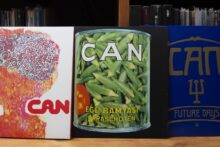
In the 1960s, Schmidt organized exhibitions and was an informal curator of post-expressionist art. He recalls that when he proposed an image by Cy Twombly for the original cover of Tago Mago the rest of the band vehemently disagreed, believing it to be too pretentious, a decision as bad as “quoting Proust in a press release.” Twombly’s ‘romantic symbolism’ remains a powerful force in Schmidt’s compositions even to this day, “I can’t put my fingers exactly on why – you never can. At the time even my painter friends didn’t understand why I was so fascinated by Twombly’s early paintings. I’m still fascinated by whatever he did.” What was it about Twombly’s work that resonated? “It’s an emotional thing that has something to do with the way I write music,” says Schmidt. “And he does things very spontaneously but insists that it has to be very controlled. And sometimes it looks like anybody can do that. But that’s not true of course.”
This sense of controlled spontaneity ran through the albums of Can, and onwards into Schmidt’s solo career. He once described Can as being a collage band, perhaps the musical equivalent of Kurt Schwitters, who glued bus tickets together in Hanover and helped invent the concept in visual art. Does he still agree with that? “Collage is one of the basic concepts of modern art, music, even literature. But it wasn’t that much of an essential element in music, as it was in the arts back then. For us it was very important and even now with Requiem, it collages things, one after the other and together.”
Schmidt cites Atonin Artaud’s 1938 manifesto, ‘Theatre Of Cruelty’, as another influence in the band’s formation. Artaud argued that the true function of theatre was to rid humanity of its repressions, and he proposed removing the barrier of the stage and audience to encourage spectacles of shouts, groans, apparitions, pulsating lighting effects, masks and puppets and the language of dreams. This primal, unbridled experience of performance fed into Schmidt’s vision for how Can could proceed. “This type of unpredictability didn’t exist in the classical music I was writing before,” he says. “With music like that of Pierre Boulez, he hated spontaneity and improvising at that time. Everything was constructed and I got bored of that. There were too many rules, it felt quite overly structured. Artaud has a sort of aggressiveness in it, but that’s overestimated. It was aggressive at the time in relation to what existed, to the very rigid formal attitude of the period.”
Despite his earlier reservations about Boulez, he admits to returning to his catalogue in recent times, “I’ve been listening to classical music more than ever since my youth, when I wanted to become a conductor. I love listening to Brahms’ symphonies and I’m rediscovering what I heard at the time before Can, such as Berlioz and especially Boulez’s Pli selon Pli, which has fascinated me in a different way. Now I hear it with more consciousness of its depth.”
Schmidt concedes that he is revisiting the music of his younger years and hearing it with fresh ears. “In any music, such as a symphony of [Robert] Schumann, there are things to discover,” he explains. “In the last two years, I’ve been listening to music from when I was conducting. It’s natural that in the moment I’m hearing it again, it brings back memories.” Considering his formal music education, did he ever reach a point where he tried to ‘unlearn’ his musical training or dismantle it? “I was in a way, a very static musician so I was conscious of doing something where I could be an amateur and start again. I was quite confident, and there was a lot of trust in the other band members. I considered a musician like Jaki Liebezeit also to be my teacher. I always loved to make music with people who knew something I didn’t, so I could learn from them.”
However, this collaborative atmosphere wasn’t always an easy ride for its members, Schmidt recalls the often-combative atmosphere that surrounded the band. He laughs, “I am from the School of Pain, which is called Can! We four criticized each other pitilessly, but especially Jaki. It’s like giving birth to something which is painful but absolutely worth it. Otherwise it wouldn’t have existed.”
In 2024, Schmidt finished the mastering of a series of live albums by Can. Having recently returned to those performances, how did it feel to listen back to those recordings from the 1970s? “It’s gone. It’s had its own life. I have quite a distance to it. I listened to it like it is another group. Except sometimes I hear something that I did, which I think is awful. Why the hell did I do that?”

Having recently celebrated their 64th anniversary, Schmidt believes that without his wife Hildegard (Can’s manager and the force behind Spoon Records) his career would have taken a different trajectory. Is it true to say that the creative pathway she opened, transformed Schmidt? “The way my parents were, the way I was brought up, was the way I lived. The whole environment of my life made me what I am. So to say that it’s only Hildegard isn’t true… but certainly without her, I would be a musician, because that was clear all along. I wanted to become a conductor at the time, and maybe I would still be conducting, but maybe I wouldn’t have dared to establish a group like Can without Hildegard’s support and belief. There were a lot of friends who said to me when I met her, ‘Now he’s finally gone mad!’”
Presumably Hildegard is one of his ‘first listeners’, offering a critical ear to his compositions. At what stage did Schmidt let her hear Requiem, for example? “Only at a very advanced stage,” he says. “There are the ones who assist the process of creating, such as the engineer, but when it has reached a certain point where you can already feel what it what it should be, then Hildegard is the first to hear it and she’s very critical. I find it very, very helpful, even when she says, ‘No, that’s really not good.’”
His forthcoming release, Requiem, harnesses the sound of water, bird and frog noises recorded near his home in Southern France. He recalls that Can would often record with the doors open at the studio, to absorb the sounds of outside. His interest in field recordings and natural sounds began around that time and continues to the present day. Requiem features a nightingale singing, a bird that has some significance to the area where he lives, “I was on our terrace one night, and it was such a beautiful night, and there were several nightingales singing. They are always around the house in summer, and this was particularly beautiful,” Schmidt says. “I got out my recording machine spontaneously. It didn’t occur to me in that moment that I would make an album with it.”


A meditation on remembrance, loss and commemoration, his contemplative piano harnesses present and distant memories, set against the backdrop of a changing environment in the landscape where he lives. Requiem is a poetic and moving composition from a musician who is still at the vanguard of contemporary music.
Irmin Schmidt’s ‘Requiem’ is released on 24 April via Mute / Future Days Music