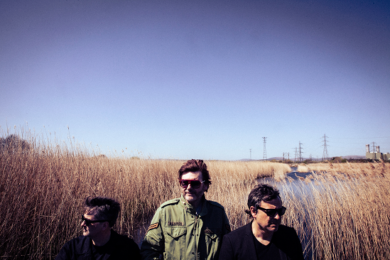

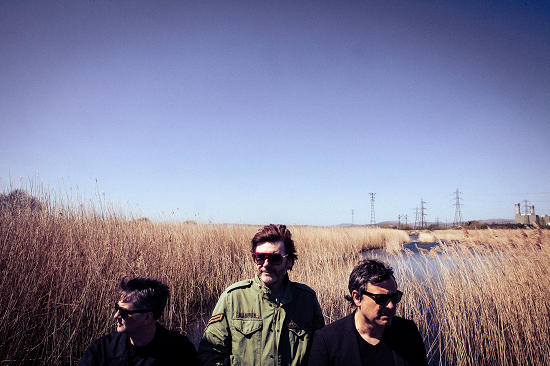
Photos by Alex Lake
One of the finest moments on Manic Street Preachers’ 2013 album Rewind The Film was the song ‘Running Out Of Fantasy’. On an LP concerned entirely with alienation and nostalgia in the face of a rapidly changing world, it was its most direct moment of recognition that keeping up might soon become completely impossible. “Has my fantasy run out of delusion? / Has my fantasy reached its logical conclusion?” wondered James Dean Bradfield over delicate acoustic arpeggios. Over the phone eight years on, Nicky Wire points to his lyrics on that track as the beginning of what he jokingly refers to as a “managed decline” for the band. “It feels like a key lyric,” he says. “Perhaps finally all the glamour has gone, your body and memory is degrading. Perhaps it’s time to put the feather boas away.”
2014’s more abstract celebration of Europe Futurology aside, a huge amount of what the Manic Street Preachers have recorded since ‘Running Out Of Fantasy’ has been defined by that same sense of self-doubt, a sloganeering band once assured of their strongly-held beliefs, now adrift in a world “where everything is overinterpreted,” as Wire puts it. “It was easier knowing less growing up, not caring about the endless backstory, including my own which is now… well, incredibly checkered.” (Last month, his wishing death from AIDS on REM’s Michael Stipe in 1993 resurfaced in an interview with Mojo, to whom Wire expressed his “deep regret”.) On their last record, 2018’s Resistance Is Futile, his lyrics were crammed more than ever before with references to beloved art and culture – Vivian Maier, Dylan Thomas, Yves Klein et al – familiar, ageless reference points with which he could arm himself against the blooming, buzzing confusion of the world outside. The album, by his own admission, “was a bit scattershot. There were really shining, brilliant moments, and places where it didn’t cut the mustard.”
Part of Resistance Is Futile’s patchiness can be attributed to a brutal period in Wire’s personal life. While the band were recording it, both of his parents were suffering from cancer, from which his mother died a few months after its release and his father the following summer. He was extremely close with both. “Having the parents that I had is probably the greatest thing that ever happened in my life,” he says. “I really liked them; I didn’t just love them. I liked talking to them, I’d speak to them every day. They were highly engaged, important, funny people.” He credits them with his best traits, “Rage from my dad, he was a mental and physical force. And from my mum, kindness and femininity, an appreciation of aesthetic and the bliss of just sitting down and watching TV together.” Even in his adolescence, their relationship was never strained. “I think my rebellion was against the outside world.” If the band had never happened or if I’d never got married, I think I’d still be living at home, and quite contently. Their illnesses, he says, “were the most important thing in my life for three years. I readily admit that that I did shut off from the outside world.” By the onset of the first lockdown, in all its sudden, supercharged introspection, seven months after his father’s death those losses were still keenly felt. “It wasn’t traumatic or anything, there’s no PTSD, but there’s a gaping hole of sadness that overtook my life.” Recently, he and his brother, the poet Patrick Jones, sold the house in which they had grown up. “It was an absolute heartbreaker, saying goodbye to the atoms that made us.”
The pandemic itself was wasn’t too hard to weather. “I have a great capacity for boredom,” he says, but when it came to writing, the downtime “allowed me to go deep into myself.” His loss “overhung the lyrics” he was writing. “[Lockdown] pushed me into facing my own horrors, rather than the horrors outside.” The songs that now emerge from those sessions, which make up new album The Ultra-Vivid Lament, “are internal galaxies, of exploration within myself. I think they’re the most personal lyrics I’ve ever written.” Wire quotes the elegant opening piano bars of ‘The Quest For Ancient Colour’. “I had a very bad dream, the main actor in it was me / My scream had lost its source like a reservoir in a summer drought.” As well as his parents’ deaths, he was clouded more than ever by the insecurity that first set in on ‘Running Out Of Fantasy’. “When you’ve been in a band for 30 odd years, it swamps you with a massive amount of history,” Wire says. “The amount of shit I must have talked, it can bog you down. If you have the ability to switch off then I would like to be you, but I don’t. ”

The Ultra-Vivid Lament is a very different album to its predecessor Resistance Is Futile, which leapt wildly from one bombastic pop song to another, its focus constantly shifting. “We weren’t particularly well-rehearsed for Resistance, but we were on the nail for this one,” says Wire. At points however, they return to older ideas, consolidating and expanding upon them. The malevolent forces of big tech, for example, have been a loose theme since 2010’s Postcards From A Young Man album track ‘Don’t Be Evil’, named for the sinister phrase used by higher-ups at Google in their code of conduct, but on ‘Orwellian’ they’re confronted in far greater depth. The track bears the influence of historian Jill Lepore’s If Then, which charts the history of data mining from The Simulmatics Corporation in the US in the 1950s, whose ‘People Machine’ drew on psychological warfare techniques in an effort to target and manipulate voters and consumers.
Wire describes the song as “A rejection of digital coercion,” the tech platforms that have driven the information overload and lack of capacity for nuance that have fostered so many of his insecurities. “Every time I put anything on, Peloton’s just fucking staring at me. Or fucking Park Run. What happened to the loneliness of the long-distance runner?” It raises a complex issue, and there are plenty of holes you could pick in Wire’s arguments, yet it still feels articulate and focussed, the words in perfect step with Bradfield’s pumping pop piano chords and bracing crescendo chorus.
Throughout the album, there’s an intense focus on marrying Wire’s lyrical ideas with the music Bradfield was writing. “I do think the time and space [of lockdown] had a lot to do with it, I think I needed to go to the final level in terms of making my words really singable while also, hopefully, pretty deep.” He entwined his writing tightly to the music James Dean-Bradfield was writing, primarily on the piano for the first time in the band’s career. “It had a more lyrical swing to it,” Wire continues of his writing. “The way Lana Del Rey can twist and turn on a phrase, I wanted to try and combine that with James.” The result is a record of considerable emotional depth, a consistent beautiful gloom from which little bursts of beauty constantly surface – a tender back and forth between Bradfield and Mark Lanegan on ‘Blank Diary Entry’, a thick and transfixing keyboard solo on the intensely melancholy ‘Diapause’, ‘The Secret He Had Missed’’s glorious tumbling piano chords.
It’s an album that constantly glistens, but through a sort of haze, like glitzy Top Of The Pops costumes viewed by a child on an analogue television screen. It’s a glamour drawn distinctly from the band’s youths, growing up together in Blackwood, South Wales. “The musical framework of the album is ‘Waterloo’ in 1974 to ‘Bring On The Dancing Horses’ in 1985,” Wire says. He looks back fondly on the long, “blissful” hours spent glued to his parent’s television set. “I learnt so much just sat there eating crisps. It’s what made me. Obviously, you had Top Of The Pops as your main portal, but you’d also see huge stars in really strange situations. Demis Russos on the Val Doonican show or something, Neil Diamond on Des O’Connor or Wogan.” It’s always been an influence on the Manics’ sound. “The run up in ‘Motorcycle Emptiness’ is totally nicked off ‘Dancing Queen’, James said it at the time.” The Manics’ innate melancholia can be traced to 70s pop hits too. “Whether it was Glen Campbell or ABBA or The Carpenters, so many of the world’s biggest pop songs were the saddest and most heartwrenching of all time.”

The Ultra-Vivid Lament tracks ‘The Secret He Had Missed’, a collaboration with Julia Cumming of New York band Sunflower Bean, and ‘Blank Diary Entry’ with Mark Lanegan, are the latest expressions of The Manics’ love for a good old-fashioned ‘Islands In The Stream’-style duet, from ‘Little Baby Nothing’ with Traci Lords in 1992, to 2007 comeback single ‘Your Love Alone Is Not Enough’ with Nina Persson, to collaborations with Cate Le Bon, Lucy Rose and Richard Hawley on Rewind The Film and with The Anchoress on Resistance Is Futile and more. It’s a tendency, Wire says, absolutely rooted in the old school. “Sometimes people ask, ‘what was it like to collaborate’ about someone, but it’s not really that.”
Still, the new music he’s most drawn to is that which prides aesthetics above all else. “Something like the last Arctic Monkeys album, or Lana Del Rey. “The lyrical flow when she first shared ‘Video Games’, the way it twists and turns… I must have played that 20 or 30 times in a row the first time I heard it.” Like Del Rey’s off-kilter California, and Alex Turner’s sleazy sci-fi self-parody on Tranquility Base Hotel And Casino, The Ultra-Vivid Lament is a record very much in its own world. “A futuristic fantasy album, but the classic ‘70s idea of the future that never really arrived,” as he puts it, on which all that glitz, artifice and melancholia always partly present in their work becomes the focal point. When coupled with the depth to which Wire plumbed his internal “horrors”, The Ultra-Vivid Lament manages to provide both style and substance.
The Manics have always been at their best when at their most cohesive – Richey Edwards’ dark, visionary genius on The Holy Bible, or ‘A Design For Life’’s anthemic capturing of the zeitgeist – and in its tight latticing of melancholia and glamour, The Ultra-Vivid Lament has cohesion in spades. On Resistance Is Futile Wire’s myriad uncertainties – from his parents to his personal insecurities about relevance – resulted in a sound that was itself uncertain, but on its follow-up they’ve mined the depths of that unease to produce something bold, coherent, and ultimately triumphant in its honesty. “We’re 52,” Wire says of himself and his bandmates. “Everything has been chipped away at, but ourselves and by outside factors. With this album we looked at each other and realised that the only thing we’ve got left, the essence of the band, is creativity. It’s the last thing that binds us together. We thought let’s make the most of that. Let’s cherish it.”
Manic Street Preachers’ new album The Ultra-Vivid Lament is released on September 10 via Columbia/Sony