
Ghost On The Stairs marks Lara Rix-Martin’s first full-length solo release, as well as her first as Meemo Comma. She’s half of Heterotic with Mike Paradinas, and has also released an EP (on her own label) as Lux E Tenebris. Her debut album sees Rix-Martin moves into more experimental territory.
“It’s always weird, isn’t it,” she says of releasing music, “I wasn’t sure how it was going to be accepted or received.” Ghost On The Stairs was written in an intuitive way, and is largely based on based on Rix-Martin’s experiences with audio processing disorder. Though she finds the album to be relaxing, she tells me that “the listener who hasn’t got APD might find it quite nauseating or annoying, as one reviewer has already said.” With a bit of wry humour, she plays with stretched, distorted vocals and occasional quasi-footwork drums, honing a sound that is her own.
How much of a difference has it made working solo as opposed with Mike Paradinas as Heterotic?
Lara Rix-Martin: It’s more lucid and more fluid, because it’s just me sitting there with the laptop. When we were making music as Heterotic, I’d hum a tune and say, “oh you know, something a bit like this,” and we’d always reference other songs. I think that’s why Heterotic always sounded a bit retro, because we were always referencing pop songs in our own little jokey way. Whereas this is really me, it’s my sound – that sounds really pretentious.
What do you think is influencing the album in a less explicit way?
LRM: Last year I went to the Deep Minimalism festival and I think it had a big impact on me. It was at the South Bank Centre, and it was actually mostly female artists, which was awesome. It was the day after Brexit happened, and it really felt like that was the music that really gets to me.
I’m quite into self-hypnosis which I guess is a bit like meditation, and I was thinking that deep minimalist music is a great way of getting into your inner self – but I actually hate saying stuff like that. I’m a really sciencey person. But it is true, that you can get deep into your subconscious with that sort of music, and dig right down into what you are in your core. I was trying to do that, but my songs aren’t 20 minutes long each, they’re more like two minutes long each – so maybe I get really deep down really quick [LAUGHS]. I’ve also been listening to footwork – I guess deep minimalism and footwork are the two main influences.
I can definitely hear that on the album.
LRM: I love footwork. Mike and I got together nine years ago this week, which was about when he started getting into it. It was new for me to hear as well. My parents are into music that’s quite standard sing-song, pop-rock stuff. Lyrics were a really important thing for them, but when you listen to footwork – sure it has lyrics, but the voice isn’t quite a voice – it’s more like an instrument. You’re using a different part of your brain to not think of it as language, but think of it as rhythm. I think that’s what I really love about footwork; it almost makes you retrain your brain. And of course it has amazing drums, which I could never do – I’m far too white.
Negative space was really important. I find with a lot of footwork, sure it’s about where the drum is, but it’s equally about where the drum isn’t; it’s not where you expect it to be. That kind of unsettles you, but also keeps you listening and keeps you interested. I love that.
And what about the album art? Where did that come from?
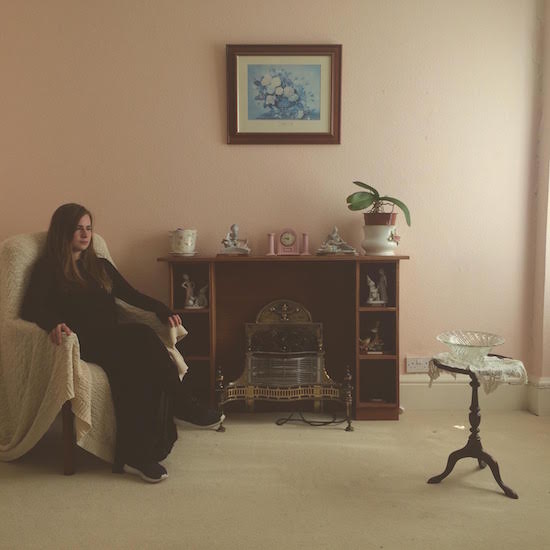
LRM: Well, I’m on the internet a lot, and I really love memes. I wanted to do a cursed image – they’re amazing. They’re pictures of people, like family photos, but with something really weird or wrong about them. Like, “Oh it’s Dad cooking, but he’s topless and has a mask on, or something,” – something that should be normal, but isn’t – it’s cursed.
So originally, it was going to be a cursed image, and Mike was going to be next to me, and I was going to be eating cold baked beans. We have those photos and they’re really funny, but the problem is that it looks like we’re still a band, so I had to get Mike out of the photo.
It was actually taken in my grandmother’s flat, who passed away a few weeks before the photo was taken, so it was a bit strange. I didn’t know what artwork would really suit it, but I quite liked the idea of it being sparse.
So what’s with the baked beans? I’ve noticed they’re a bit of a theme.
LRM: So I’m really obsessed with Twin Peaks, and in it creamed corn is kind of represented as pain and sorrow – it’s what the bad demons eat. So I thought, what’s a British version of creamed corn? (It’s quite big in America, isn’t it?) I thought it would be quite fun to ad some Garmonbozia in there, pain and sorrow, via baked beans.
I guess it’s just my own really bad humour. It’s like British pain and sorrow, which I feel bad about – because I love baked beans, and feel sad that I’ve called them pain and sorrow. They just fit the bill too well!
Moving to Objects Ltd. – what made you decide to start it and where you see it going?
LRM: I felt frustrated that women and non-binary artists weren’t being picked up in the way that they should be. I felt like there needed to be a record label that could not only reach out to these artists, but also talk to them and represent them on the level that was more about them and not as a sales pitch. I mean, now women are being signed more often and that’s awesome, but sometimes I do feel like a lot of labels will say stuff like, “Oh yeah if we do press photos, we want to make sure that you’re seen as a girl,” or whatever.
I want to protect my artists from that and want to make sure that they’re in control of how they present themselves. Next month we have an artist’s first release coming up, so I’ve been talking them through it kind of as a friend and not as a business.
I guess the music I’m into is often really male-dominated. There seem to be a lot more women who are doing things more proactively in scenes like techno, as opposed to in weirder scenes like IDM, which is where I’ve kind of come from. There’s so much sexism. It’s not even assumed that a girl could make music at all. There will be jokes like, “Oh the biggest killer to your synth collection is this,” with a picture of a [pregnant woman], or saying things like “Oh, you could have a girlfriend, or you could just be really cool and be into Aphex,” – fuck off! There’s all that sort of talk in that scene and I wanted to fight against it.
There are so many people now doing great things, like Discwoman – they’re amazing. Part of what I want to do is also not just showcase women and non-binary artists, but also find music that isn’t just coming from America or the UK. We just signed an artist that was originally from China – I’m also trying to find more artists who are people of colour. I tried to sign someone from Egypt, but they weren’t into it, which is fair enough. I think a lot of artists are a bit worried about being on an all female lineup or label – like they’ll only ever be looked at as “the female artist.” And yeah, that’s a point, but I hope that the music that we put out on the label shows that it’s not about that. It is actually about the music.
So then what are you looking for, musically? There’s quite a range in Objects’ releases so far.
I think it depends on what feels right. Like with Evelyn Privitera’s album coming out in October – their stage name is Vivienne. I listened to their music a lot and kept thinking, “I don’t know if I can put this out.” It’s kind of singer-songwriter-y, kind of acoustic. That’s not where my press contacts are. But I also feel passionate about this artist and their music, so I decided that I would make it work.
I guess that kind of Berlin scene, like with Ziúr, was one I was really interested in. But I also didn’t want to just be pigeon-holed with one genre or one sound. I’ve tried to find a few different people that I feel like really get in my head.
I read somewhere that when you first announced you were starting Objects Ltd., you tweeted that you were ready to receive hate for it – did you get a lot of flack?
LRM: No! That’s annoying, isn’t it [LAUGHS]. I have for my own music – I had someone say, “You shouldn’t make music,” well, that’s a nicer version of what they said, they used more swear words. That was a message through to my Bandcamp. I take the piss out of a lot of people who are really into Aphex Twin, so it was probably just a butthurt Aphex fan. I really can’t stand them. It’s probably just someone like that, I wouldn’t take it too personally. Well I did. I didn’t! But I did.
I know you come from a science background, so how have you found moving into the music industry? Are you still active on that front?
LRM: I’m mostly a full-time parent – we’ve got two kids who are two and four years old, so quite young. I have a science background – I used to be a horse breeder, and looked at horse sperm. I’ve been out of that role for a while now anyway, having kids pretty much forced me out of it. I was basically sick for my whole pregnancy with my first child, so lost my job. I couldn’t go back to that anyway.
Funnily enough, I’m looking for a part time job at the moment. I looked at my CV and I worked on a stud for a bit, it’s just talking about sperm – I have to delete that. I’m 27 now and I’ve spent a large time of my twenties just looking after kids.
In a way, I kind of hate the music industry – I hate the way people aren’t straightforward with each other. It’s not like that in the equine industry. I guess a lot of people would think they’re rude, but I don’t, they’ll just say what they want to say. I kind of hate the industry, but maybe that’s why I should be a part of it – because I’m trying to change things, but it’s hard.
But then again, I used to go out clubbing and I’d have the same kind of feeling after a night out. Come home after a night out and be like, “Oh there were creeps,” or “Oh someone was rude to me.” The industry’s definitely changing though, even within the last six years. There are so many more club nights now implementing safe space policies, and I definitely feel safer in clubs now. It could be because I’m older, but it’s hard to know when I haven’t been clubbing for so many years. Going out at 18, you’d feel hounded by men sometimes. Was it just because I was 18 or is it because things have changed?
I don’t really go out clubbing anymore, and to be honest, clubbing in Brighton has almost died. It’s terrible, there aren’t that many club nights here anymore.
Why do you think that is?
LRM: There are a lot of students here. Maybe people who are younger now, don’t have the same connection to music that older generations did? I don’t know. I still remember going to Virgin Records and getting a CD or something for the weekend – you just don’t do that anymore now. And I’m not even that much older, but it just happens so quickly.
People still talk about it online, but they’re downloading music, aren’t they? It’s not the same. I don’t see people going to specialist nights as much – young people, anyway.
So then what do you hope for in terms of how people might receive or engage with your music? And the stuff on Objects Ltd.?
LRM: I’d really like to reach out to more women, I’d hope that they can find something that they feel empowers and supports them. That would be awesome, but it’s hard. Most of our sales are to white men – interesting, isn’t it. I like trying to reach out and try to get women involved, but then again I wonder, should I be getting women involved in an industry where they don’t get paid much? Who’s actually benefitting from their involvement? It’s hard. I hope that people listen to the music and think that it’s pushing something forward – a scene, or a sound. Retrospectives are nice, but they’re just so stagnant. It’s nice to get some fresh sounds in there.
Ghost On The Stairs is out now on Objects Limited