

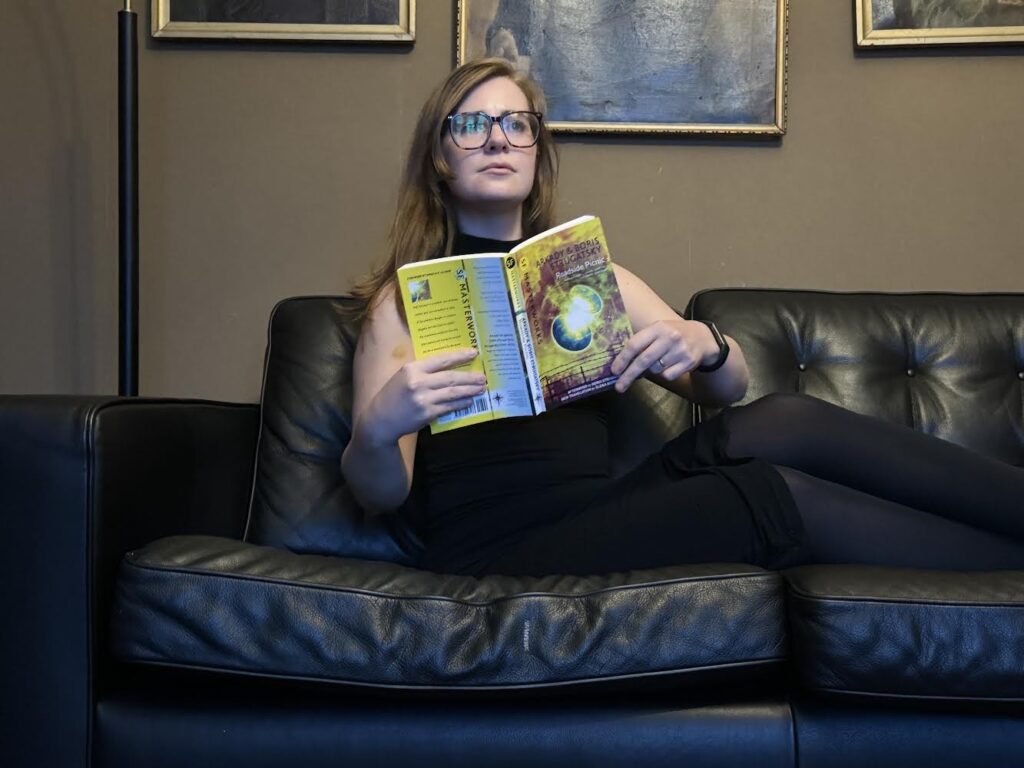
Stepping into the zone of fifth album Decimation Of I, Meemo Comma (aka Lara Rix-Martin) took as source material the toxic landscape and hostile environment of of Roadside Picnic, the Strugatsky brothers’ 1971 Soviet sci-fi that was itself the book on which Tarkovksy based his iconic film Stalker.
It’s not the first time Rix-Martin’s music has been rooted in science fiction, but it is perhaps the furthest back that it’s delved into the canon. Neon Genesis: Soul Into Matter² was inspired by the visuals of 90s anime epic Neon Genesis Evangelion other soundtracks such as Ghost In The Shell, bringing it together with Kabbalistic text and Jewish prayer.
Here, Rix-Martin talks about what she’s learned about the origins of the modern science fiction canon, the importance of subtle soundtracks, and why she now spends every birthday with a seven-hour adaptation of Tolstoy’s War And Peace.
The Blueprint: We
“I first read We by Yevgeny Zamyatin when I was around 17. Having already read Orwell’s 1984 at 16, someone suggested that if I enjoyed that, I should read We, the original inspiration. Written in the 1920s between various bouts of Zamyatin’s imprisonment, We wasn’t published until 1952. The writing feels more authentic than Orwell, like it was drawn from lived experience. Saying We set the blueprint is an understatement, 1984 is almost a replica, right down to the style of the names and the way the male character objectifies the female character’s name. In my mind, 1984 is simply the Western version of We, essentially, a rip-off. 1984 is held as a pinnacle for the ideas held in these stories, so much so it has entered our vocabulary as shorthand for surveillance, yet the concept wasn’t even Orwell’s own.”
Is Existentialism A Humanism?
“I have a deep love for classic sci-fi, writers of that era imagined the future in such brilliant, creative ways. The Bolshevik utopia was essentially a sci-fi utopia and ideas of both utopia and dystopia have long been prominent in Russia. When you mix this with Russia’s rich history of novel writing, you get the perfect combination for creating outstanding sci-fi. Much of Russian sci-fi was born out of living in political and civil unrest, imagination often stretches further when you’re already living in dystopia, much like the sci-fi we encounter today. In the 1990s, for instance, we had Star Trek, boldly going where no man has gone before. New worlds and peoples were met with compassion and curiosity as if we have conquered our own ineptitudes back on Earth. The sci-fi we have now, reflects the mood of the people, dark with real time crisis.
“During my 20s, I read a lot of existentialist philosophy, although I found the French existentialists could be overly verbose. Russian existentialism, however, is profoundly intense, sometimes uncomfortably so. It pushes you to question things more deeply and that’s precisely what existentialism should do. Personally, I’m drawn to darker themes, as someone who has struggled with mental health, I liken existentialism to a scab you know you shouldn’t pick, but you can’t help doing so. It’s that constant tension, don’t touch the void, yet you feel compelled to. Soviet sci-fi stares directly into that void.”
Dostoevsky Is Sci-Fi
“Dostoevsky’s The Double is existentialist at its core, but I also consider it to be sci-fi. The story presents an altered reality: you meet your doppelgänger, someone who is exactly you (in fact, better) they begin to take over your life, forcing you to question everything. Russian sci-fi delves deep into themes of identity and one’s place in society, which is what makes these stories so timeless. Today, we talk a lot about identity, but Russian authors explored these questions long before, while acknowledging that they didn’t have all the answers. You’re constantly waiting for resolution, but it never comes, leaving you profoundly unsettled.”
Roadside Picnic Two Ways
“I read Roadside Picnic a few years ago. The first part of the book feels almost like a documentary, with the film Stalker only really drawing from the final three chapters. While I appreciated the world building, it’s the unanswered questions that make the story feel so realistic. You’re thrust into this world and forced to accept it without explanation. In the book, Russia and the US are united as one country, but it’s never elaborated on. If this had been written in the UK or US, we would have packed it full of exposition.
“The city in the story is built around “the zone”and people are suffering from the environment, getting sick, yet they stay because there’s nowhere else for them to go, no other jobs. The unspoken meaning of this resonates with me. It’s about being trapped, unable to escape, doing whatever it takes to survive. This is a profound truth about human existence: if you’re not part of the ruling class, then you’re just surviving. Roadside Picnic depicts this struggle, set in an alien environment. Some interpret the story as a commentary on capitalism, with the underfed Soviet men wandering through the wastelands of capitalism, chasing a promised reward. They scavenge items from the zone and sell them. You can certainly read it on that level, but you can also appreciate it purely as an exercise in world-building. That’s what I love about these books—you can choose to see the political subtext, or simply enjoy the escapism. But ultimately, understanding these worlds helps you grasp the deeper political implications.
“The book was written during the Soviet regime, so much of its criticism had to be subtle, hidden between the lines. The Strugatsky brothers were communists, but they were dissatisfied with the way things were run. People often assume everyone in Russia hated communism, but many remained true to the ideology while disillusioned with its implementation. The regime stifled direct criticism, much like Zamyatin’s experience. Sci-fi provided a way to explore these ideas without making overt political statements. In Roadside Picnic, the characters change physically, but the real focus is on their mental state.”
Stalker As Meditation and Horror
“The film adaptation of Roadside Picnic, Tarkovsky’s Stalker, had to be reshot after the original film was lost. Tragically, many involved in the production died due to the toxic environment near the chemical plant where it was filmed. Tarkovsky’s wife, Larisa, who was the assistant director, developed cancer, along with several others. In light of this, the film’s dystopian atmosphere feels even more poignant. The zone becomes a metaphor for a carcinogenic wasteland, perhaps a former nuclear site, a place that alters you not just physically, but at a cellular level.
“One of my favourite characters in the film is the Stalker’s daughter, Monkey, who has a more significant role in the book. There’s a final scene in the film, where the viewer is intruding on Monkey, laying with her head on the table, no one else is there, then a glass is mysteriously pushed off the table. The film leaves you to interpret the meaning. In the book we know that this is a strange side effect of those born close to The Zone. Stalker is so meditative, inviting you to reflect and make sense of what’s happening.”
The Subtle Soundtracks Of Edouard Artemiev
“For me, the best soundtracks are the ones you barely notice. When a soundtrack draws too much attention to itself, it’s not doing its job. A great soundtrack blends seamlessly with the visuals and that’s what Edouard Artemiev achieved with Stalker. Much of it is experimental sound design, with long, quiet moments that amplify the film’s emotional impact. There’s a track called ‘Meditation’, which, by title I’ve incorporated into my own album. It encapsulates the essence of taking time to absorb what’s unfolding on screen, to feel the raw emotion.
“The soundtrack also features traditional music from Russia’s borders, such as the Azerbaijani tar and Armenian mugham, blurring the lines between music and natural sounds. I love that blending—it represents humanity fading away, which is central to Stalker.”
War And Peace As Part Of The Continuum
“Every year on my birthday, I watch all seven hours of the 1966 War and Peace adaptation. It’s essential for understanding Russia – it’s not a monoculture. War and Peace offers insights into Russia as it transitions into the 19th century, shedding kings and queens and grappling with issues of class. But at its heart, it’s about how people live. It reflects the national mood and serves as a barometer for understanding Russia.
“I love the 1966 films for its dreamy cinematography, although the use of live animals and ammunition during the battle scenes is grim. Despite that, the film remains groundbreaking—everyone should watch it. MOSFILMS, the studio behind it, has all their films available on YouTube. This film laid the groundwork for Tarkovsky’s cinematic vision.”
Meemo Comma’s new album Decimation Of I is released on 11 October via Planet Mu