
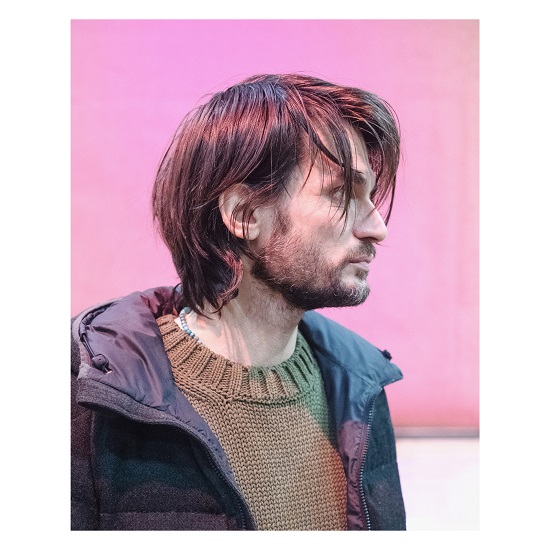
Jonny Greenwood is by now as accomplished in the realm of classical music as he is as a rock musician. Since 2003’s score for the documentary Bodysong, through hugely acclaimed music for There Will Be Blood, the first of many collaborations with director Paul Thomas Anderson, to the debut of his stunning composition for solo violin and 68 string instruments Horror Vacui at this year’s Proms, he’s done nothing but impress. He’s far from the only indie musician to branch out towards film scores and classical music – he’s not even the only member of Radiohead – but few hold quite as much love for it as Greenwood does. He’s more than an emerging figurehead in the world of contemporary classical music, he is one of its most passionate advocates.
Greenwood has spent much of the last few years putting on small concerts with The London Contemporary Orchestra, whose focus is on the development and promotion of young and innovative players and composers. It was they who inspired him to launch his new label dedicated to classical music, Octatonic. “Every time we’ve done a show, I’ve thought about what a shame it is that this stuff isn’t being recorded,” he says. “I’ve become friends with lots of players, and I wanted to document them playing this great music.”
The first two releases on Octatonic feel like something of a mission statement – “the two extremes of what we’re hoping to do,” as Greenwood puts it. One is Daniel Pioro, widely acclaimed as one of the best violinists of his generation, playing Bach’s Partita No. 2. “It’s this enormous piece of music that’s just done with a solo violin, something where it’s hard to believe that is just one person who wrote it and one person playing it.” The other leaps forwards 300 years, with Greenwood’s own ‘Water’ on one side, and contemporary composer Michael Gordon’s ‘Industry’, written for cello and guitar distortion pedal, on the other. “The distortion comes in so slowly that at first you think there’s something wrong with your speakers, and over the course of a few minutes it just overtakes.”
Together these two releases reflect a loose concept behind Octatonic, to essentially skip out the 19th century. “The original plan was this childish idea… I don’t know why, but I just have this aversion to 19th century music,” Greenwood explains. “Especially when anyone from a rock band is involved. Growing up, whenever there was any crossover between the two worlds it seemed that there was either a fascination with the really bombastic Rachmaninoff stuff, or the flowery romantic classical music played on synthesisers; the prog rock thing, I guess. And both of those styles just seemed gruesome to me. The idea of having distorted guitars playing these portentious classical music chords. Wow, it makes your stomach turn really. I guess there’s [Isao] Tomita doing his synth versions of popular classical music, some of those are pretty wild, but otherwise it’s a sorry history of prog rock.”
Octatonic’s expeditions into 20th century music make sense. Greenwood says the composers that hold the most influence over him are all from the last 100 years. He regards French composer Oliver Messiaen as the greatest of all time – “one of the few composers when you can hear just a few chords in isolation and know it’s him” – and his longstanding love of Polish composer Krzysztof Penderecki, whose ‘Threnody To The Victims Of Hiroshima’ directly inspired Greenwood’s award-winning ‘Popcorn Superhet Receiver’ (which subsequently formed part of his ‘There Will Be Blood’ score) in 2005, and with whom he would later collaborate with, is well known. The next Octatonic release is likely to be a recording of work by another hero, Steve Reich.
Modern classical music is an exciting world, but it is Greenwood’s approach to Bach and the baroque that is the more interesting half of Octatonic’s philosophy. “What’s amazing about lots of early baroque music is that it’s very strange and contemporary sounding to me. You know the Voyager Space Probe, how they put the golden record on and sent it out to space? Apparently one of the scientists said ‘maybe we shouldn’t put Bach on it, it’s just showing off’. It’s a twee comment and a bit skin-crawly, but I can see what they mean. Listening to Bach has the same feeling as when you’re listening to Kraftwerk and you think ‘electronic music doesn’t get better than this’.”
So is Bach the classical Kraftwerk? “I don’t think there’s anything pretentious or awkward about that statement, although I’m sweating now that I’ve said it,” he laughs. “Bach’s been dragged through jazz and easy listening and every genre of music really, and the music has still survived. But in a nice way what they’re saying is that Bach’s music is still chord signatures and melodies, the bassline dropping out for 16 bars and coming back in. These are all ideas that have been around since then and people are still doing the same thing because they work.
“I was talking to an equally pretentious friend about how the harpsichord in Baroque music is like a hi hat,” he continues. “It’s doing sixteens and it’s in the same kind of frequency. There are whole sections where literally the whole of the bottom end in the orchestration drops out, and you have the satisfying moment of it returning. There are lots of parallels if you want to look for them.”
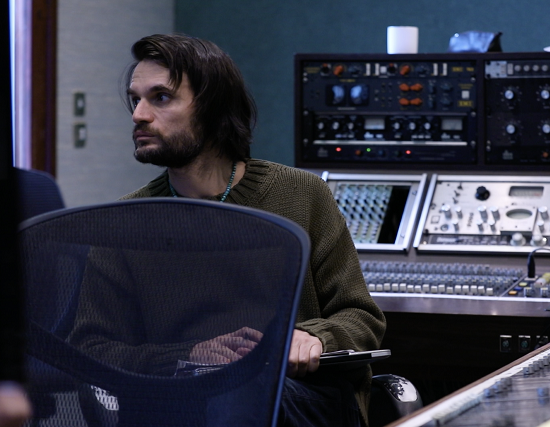
The old adage is that you get into classical music as you get older, but it’s always been a part of Greenwood’s musical upbringing. He spent his teenage years in County Youth Orchestras, “bluffing my way through at the back,” and was “a serious recorder player” until the age of 18. The influence of classical music has always “seemed normal,” he says. In fact, in an age where almost every piece of music is available to almost anyone, at almost any time, it’s probably now normal for most. “It’s true isn’t it, that you’re meant to hit middle age and suddenly ‘discover’ classical music, but I’m not sure that’s true anymore,” he says. “More and more people have it in their collection. One of the best things about staying in hotels is you get to spy on everyone else’s iTunes collections, most people are too lazy to put proper passwords in, so you can rifle through what people like and it’s always far more diverse than you think.”
He has been asked about how his classical work influences Radiohead and vice versa countless times, and is usually keen to draw a divide between the two. “[Composing] is more solitary, you’re alone in a room with a paper and piano for months without seeing another human,” he reaffirms. “Although it does make it difficult for [the rest of Radiohead] when I come back to them. I’m always over-keen and over-eager to do something social and communal.”
Nevertheless, it was with Radiohead that Greenwood first started composing – when the band hired a cellist and a violinist for one afternoon to add some texture to their 1994 LP The Bends – and he continues to use Radiohead as a vehicle for experimenting with the boundaries between classical and pop, to a greater and greater scale. On A Moon Shaped Pool, the band’s most recent album, the presence of Greenwood’s classical ear is more obvious than ever; the anxious staccato strings of ‘Burn The Witch’, for example. Take Thom Yorke’s voice away from the swooning, lavishly textured album track ‘Glass Eyes’, and you’re left with what is essentially a classical composition for piano and strings. “That album was the first time I’ve managed to get my hands on a Radiohead song when it was just a drum machine and a vocal line. Usually strings are just decoration, there’s not much room left for them, but it’s taken me these many albums to get the confidence to say ‘let’s just leave this song here and the strings can provide everything else.”
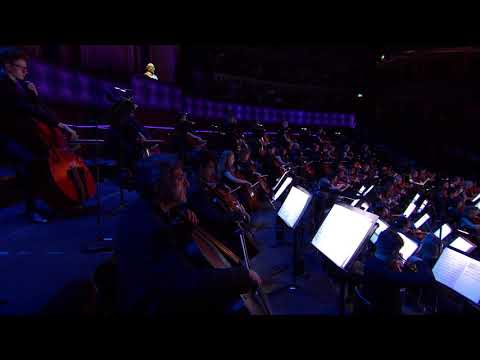
Greenwood’s composition for this year’s Proms, Horror Vacui, was inspired in part by techniques first explored by Radiohead. The music, composed for Daniel Pioro and a 68-piece string section, was said to attempt to ‘emulate’ electronic sound. “When we’re recording there’s always lots of options about how to make reverbs and echoes,” Greenwood explains. “Some of them are mechanical, there’s one that’s called a palm speaker. It’s a speaker inside a box with strings strung across it, and that resonates according to certain frequencies and sounds a bit like an echo. Horror Vacui was taking those sorts of ideas and moving them into an orchestra. It’s not meant to emulate it; it’s meant to try to be an interesting variation. Maybe even better if it works really well. I’m always a bit suspicious of classical music trying to copy electronics, so it’s trying to be better, to do it in a more interesting way than you can do with just a plug in.”
The performance of Horror Vacui was beautiful and terrifying, a sign that surely the time has come to regard Greenwood simply as a great classical composer, rather than as the Radiohead guitarist who often writes classical music. As he reflects on that Proms performance, however, weeks and weeks of work building up purely to the 36 minutes it takes to perform, the musician is not so sure. “I always get to the end of this stage, a crazy and intense process of months and months of preparation, then one concert then it’s all gone… I just feel the urge to instantly retreat back to the guitar and laptop.”
In a way, drawing lines and making links between Radiohead and Jonny Greenwood the composer is besides the point. “As long as I’m surrounded by instruments, I’m happy, whatever it is I’m doing,” he says pointedly. Throughout our interview he’s reluctant to talk too much about his own work. “I should start learning to edit myself…” he suddenly says while expanding on the parallels between Bach and Kraftwerk. But when it comes to Octatonic, and the goals he’s attached to it, he’s nothing but forthcoming. His passion for classical musicians, particularly those who are young and progressive, is infectious.
“When I stay in London, I’m sometimes near Abbey Road and I’ll often see jobbing string musicians on their way to sessions. Sometimes you’ll see one who’s in their early 20s, with a cello on their back, and I’m in awe of them really, I know how much of their life they’ve put into being able to play their instrument. I made a record in India a couple of years ago, and it was seeing those musicians that made me feel differently about Western classical musicians. I realised that they’re the same thing. I was all worked up into feeling amazed to hear how these Sarangi players had played since they were children and dedicated their lives to music, but I realised that that’s also true of a violinist. We’re taking it for granted, but what violists do in this country, it just floors me, really.”
Speaking to Greenwood, you sense that working with the London Contemporary Orchestra has been immensely rewarding, and the source of the boundless passion that underpins the Octatonic project. They taught him a lot, he says, not only about music but about the kind of people that share his love for it. They showed that classical music is no longer – if it ever actually was – the domain only of elitists and snobs, but a place in which young musicians of all stripes can push whatever boundaries they please. “There’s so much crossover now,” he says. “So many people who are into electronic music are into Steve Reich, and rock music is so old now that most classical composers were in rock bands at college, even the older guys in their 60s and 70s. There’s as much stuffiness and fuddy duddyness in jazz and rock music too,” he points out. “Go to Coachella and talk to the audience, it’s not that much different to the prissiest Prom!”
To find out more about Octatonic, and to pre-order limited vinyl editions of the first two releases, Daniel Pioro playing Bach’s ‘Partita No. 2’, and Michael Gordon’s ‘Industry’ backed with Greenwood’s ‘Water’, visit the label’s website here