


Ye Gods, photo by Yves Wilson
A whole year of New Weird Britain awaits us, and for the first such column of 2024 I have a good whack of acts appearing in it for the first time. But before them, there’s the most recently minted alias of Luke J Murray, perhaps his most archly chosen one yet: Liquid DnB-Like Ambient Grime 2, and an eponymous 12-inch on the Sneaker Social Club label. Past instances of Murray herein were collaborative, including with regular sparring partner Henry Rodrick (as Iceman Junglist Kru and 1-800-ICEMAN) and Astrud Steehouder and Alexander Tucker (as Nonexistent); this EP is a solo joint, and proves he can make music for the club as opposed to knowingly referencing it.
Essentially, it’s a love letter to a life spent buying records – I assume the pseudonym is intended to recall those punishingly atomised genre subsections you find in dance vinyl stores – but vibrant and lively, rather than dry and trainspotty like that might sound. Each of its four tracks are also titled ‘Liquid DnB-Like Ambient Grime 2’, but suffixed with a year and production style – which is where things become less self-evident.
We begin with the ‘02 Garage Mix’, named no doubt for its skippy syncopation and energetic hi-hats; the unheralded junglist breakbeat just over halfway through is a crafty feint, to say nothing of the broken-rig duvet of distortion Murray invariably comes with. ‘06 Dubstep’ drops and wobbles, after a fashion, but also has a breakcore plane crash in the middle, and resembles a Midwest noise take on Source Direct otherwise. ‘2011 Techno’ and ‘22 Grime’ are both unlikely year/genre matchups (I think I remember 2011 being a decent time for techno, just not a very innovative one) but each bring dark heat via backspins, vocal devilry, tooled-up loops and austere console bleeps. Cracking release that should have ample future legs – hopefully Murray agrees.
Here’s someone having arch fun of their own with the whole ‘physical format’ thing, releasing an album which can be purchased in the form of a memory card sealed in a baggie and buried in an earth-filled flowerpot. It might be quicker and cheaper to buy a download, source all the physical items and bury it yourself – except that would be ridiculous behaviour, of course. The album is Another Release by Excel DJ (Divine Glint), and through a veil of seriously inscrutable late-internet modernism this south London-based producer emits nine clattering pieces of seriously deconstructed club.
If I was the betting type, I’d wager Excel DJ likes a 4/4 beat and a nice clean synth melody on a night out sometimes, because you can pick ‘em out of Another Release like flies from soup: ‘Add A Chamber’ and ‘Chunk Raider, Warcraft Simple’, for two. It’s just that they’ve been microedited, shot to bits and hoofed into the flux capacitor, by which I mean turned into miniature symphonies of collagist postpostpostpostrave digijunk. The artist is (again, I’m betting) from the generation that turned The Caretaker into a meme, but I hear the spirit of James Kirby’s V/Vm in the album’s most malevolent moments; ‘A Ond A Rigner Version’ (no idea) cleaves closer to someone like Sote, though. The last track is titled ‘…And More K’, and no doubt some of you may treat that as a suggestion. Careful now.
This Bristolian teamup by Boofy & VMO$ is described by their own sales notes (its label, Sector 7 Sounds, is run by Boofy) as an LP despite coming in at under 20 minutes. I’m a punk rocker so I think this is fine, but for the sound being leaned into here – fragile soul laments intertwined with screwed-down breakbeats – it’s an audacious gambit, some tracks departing after as little as 80 seconds and running the risk of appearing eccentrically incomplete. Au contraire!
Whereas Boofy’s grime and dubstep-juggling solo production style is nothing if not robust, in cahoots with Amos ‘VMO$’ Childs, a calmer head prevails. Childs is also one third of Jabu, and if you not only checked their recent demo collection Boiling Wells but found it their most satisfying release, then Boofy & VMO$ is recommended tackle. Typically, two or three ambrosial voices will get looped, layered, pitched down, blinking out from the record static that’s deployed quasi-rhythmically and hip-hop drums that crashland into clouds of dust. ‘Here We Go Again’, the LP’s longest track at an epic three minutes, builds itself around a single-finger synth caress, a metronomic click akin to timestretched table tennis, and someone murmuring the title with sultry ennui. Think I’ll treat that title as a suggestion and give it another spin.
San Franciscan label Dark Entries have a knack for picking up UK-originated music that would have likely passed me by otherwise – often reissues of deeply obscure 80s gear, but in this case the vinyl debut for Ryan Ambridge’s Lust Pattern alias. Latterly Bristol-based, Ambridge is also the instrumental half of Linea Aspera, who minimal wave heads seem to go doe-eyed for: Stand, Scatter, a 12-inch EP, again puts his analogue synths to work but is less about the standardised song format and more about dancefloor journeys with no fixed time limits.
Stand, Scatter’s aesthetic, and the emotions it elicits, are paradoxically cold and euphoric. ‘Forming Lines’ has this curious slurpy bass, like Detroit techno with an ice cream fetish, that comes and goes with equivalent regularity to a dubbed-up keyboard melody which reminds me pleasantly of ‘Shack Up’ by A Certain Ratio. Five minutes in, some synthesised string swell recalls ‘Unfinished Sympathy’ – logically, it should be superfluous on the track, but is a choice serotonin boost in practise. Ambridge’s nous for folding in a sustained, ornate keyboard part enlivens the nine-minute ‘Choreography’, whose acid-adjacent beardo disco has a bit of the Lindstrøms about it, while ‘It’s Right There In Front Of You’ is in fact the EP at its least in-your-face but intrigues heftily with its stylish proto-dub-techno exoticism. Finally, ‘No Floor’ beefs up Lust Pattern’s drum sound for three minutes of fizzy electropunk that most closely resembles the Linea Aspera sound, albeit not that closely.
Bristolian by birth and in terms of his musical grounding, Anthony Goodfellow has lived in Connecticut since a little before 2021, when this column reviewed his horror-prog LP collab with old pals Anta. That was under one of his many pseudonyms, Antoni Maovvi, and here’s another, Ye Gods, which a previous release claimed was named on the advice of Jaz Coleman in a dream Goodfellow had. This latest, a tape titled No Albion (L.I.E.S.) stretches seven tracks over nearly an hour.
Though not allergic to the odd punchy rhythm, this album shrugs off much of the EBM/noise techno trappings of previous Ye Gods releases (including another tape dropped, pretty much simultaneously with this one, via seminal Dutch rave label Bunker) and burrows into an esoteric ambient labyrinth. Mostly instrumental, the relevance of the occult practises and lunar cycles cited as inspiration for No Albion thus hinge on how eager you are to be sworn in to this sect. Me? I’m inhaling the Drew Mulholland-type dark dronery of ‘Keseh’, ‘Three To Fourteen’s proto-techno traintrack chug and the slamming dungeon doors that punctuate sauntering goth-house on ‘Descent And Ascent’, and jonesing for a membership card.
Poppy H recently described his second album Grave Era (Cruel Nature) as being about conflict, capitalism and class politics, observing modern Britain as a working-class composer when such voices are increasingly shut out. Again, should you be requiring actual words to support this premise, they’re in short supply on this cassette, although its sound design includes a goodly portion of field recording, including from around London where the Suffolk-based Poppy works on and off.
The artist’s phone, by Poppy’s own account, is essentially his musical workstation, and explains the lo fi – not to be confused with badly produced – sound of Grave Era. (Food for thought concerning class dimensions: one can make music on a near-universally owned device, and share that with people who might want to release it without having to tell them much about oneself. What, then, disbars the working class from doing this? The main thing, I’d say, is an increasingly onerous employment culture that leaves precious little actual time or mental will to enter the creative headspace.) The results occasionally invert dance rhythms, as on the rock-tumbler beats of ‘Big Blue C Two’, and more often pit tearjerker piano or synth against captured domestic mundanity: ‘Flat & White’ and lengthy psych-folk centrepiece ‘We Feared The Worst, And It Was Worse’ feature, respectively, what sounds to me like a washing machine and a high end coffee maker. A varied palette emerges over 50 involving minutes brimming with smartly realised ideas.
Having spent most of the 2010s in Sheffield three-piece Blood Sport, who evolved into a pretty neat ‘what if rock band, but techno’ thing, and a shorter period in the more pointedly digital HYPERSTITION DUO, whose name and track titles you have to shout for some reason, Flora Ocean Parkin’s third act is as a solo artist. Debut EP Electric Dreams Golden Sea (Mutualism) introduces vocals to her repertoire, giving credence to the feeling that for Parkin this forms part of a personal rebirth.
Indeed ‘Loss’, which opens the cassette, is an a capella piece in which Parkin harmonises with themself for 158 pellucid seconds. Actual lyrics, and beats, are round the corner though: ‘Petals On My Chest’ is driven by UK funky-type drums, with the artist’s sharp intakes of breath performing a role akin to a synth stab, and ‘Electrify The Field Of Dreams’ speaks of “transmateriality”, “fleshy possibilities” and such over a track that takes a sort of Laurie Anderson approach to Chicago house. ‘Spectral Skin’ is something of a callback to the opening number, with Parkin this time reading poetry over a choral backing, and on ‘Hold Hands, Moment In Time’ she melts her voice into droning synth chords so it’s satisfyingly uncertain which element is which.
Referenced artists
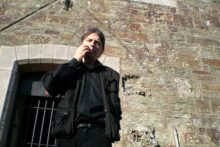
Nigel Ayers
No Commercial Value: Nigel Ayers Interviewed
Flora Ocean Parkin and Lauren de Sá Naylor have a few things in common, including the first Google result for their respective names being a warm, self-penned recollection of their time in further education. More relevantly, de Sá Naylor – trading as LDSN – uses her voice texturally, its tones and pitch enmeshed with sounds variously created and collected, as much as a vehicle for description or observation. On A Canção Da Casa, a two-track EP on Liquid Library, this is done in the company of Yakki Da, aka fellow Yorkshire resident Hilary Knott (LDSN lives in Todmorden, Knott in Leeds). Twenty-four minutes of DIY dissociation results, with arrhythmic percussion ranging from junky clatter to free jazz bells and either or both parties contributing half-awake singsong and reverbed murmur.
Another Knott project have a debut tape fresh out on Liquid Library, and it’s equally abstract if maybe a touch more mellifluous. Coin Juice – a word combo I’ve taken a visceral dislike to, no doubt pleasingly for whoever came up with it – is a duo with Geneva’s Gabriel Valtchev, usually found on the drums but playing them pretty sparingly on this occasion. I Wanted RnBee is led by its 22-minute title track, a blurred-vision journey of watery electronics and naif-like keyboard parts that’s like Cluster undergoing regression therapy hypnosis (if you use your imagination). ‘Big Try’ is more aurally jarring, in the vein of A Canção Da Casa as well as being of a feather with Knott’s peers like Territorial Gobbing and Shit Creek.
As Nocturnal Emissions, to note the most prominent of a few pseudonyms he’s used, Nigel Ayers picked up the recently-forged industrial music baton in early-1980s London and swiftly became a visible and important part of the scene, evolving his practise as quickly as the genre itself developed. (Spiritflesh, from 1988, is a particularly fine one to practise levitating to.) He’s lived in Cornwall for over three decades, making his present-day Facebook account a delight for your columnist as Ayers spends his pension years cutting about the villages and beaches of my childhood, but less fortunate souls unacquainted with Lanhydrock, Menabilly etc can dig his still-regular recorded output, such as new self-released album Excavations In Substation.
It’s a sequel of sorts to 2023’s The Pre-War Noise Encryption Standard, in that both are subtitled ‘Spoken Word And Electronic Sound’. As regards the first element, Ayers reads – his East Midlands accent treated to a little dub reverb – 12 pieces of short fiction which outline supernatural scenarios in marvellously lurid manner, free of tangible beginnings, ends or much linearity at all. On the musical side, the backing tracks range from bright ambient drone to inert keyboard minimalism to pieces that maintain Ayers’ longstanding interest for dance music (FAO any sufficiently bold post-techno DJs reading: ‘The Blinding Spray’ would make a great set opener) to leaden rumbling that kills in the old industrial style, perfected on ‘Most Days Like Today’. Strange and great things are happening beyond Cornish front doors!