More or less everything I’m writing about this month is a product of the space it was recorded in. That sounds like a truism, right? Same as how you can’t actually be apolitical, you can’t record or edit sound without the circumstances of doing so being somewhat relevant. There are several different spaces in play over these releases, though: commercial, leisure, educational, geographical, meat-, head- and -cloud.
Aniruddha Das’ practise strikes me as engaged with this, maybe historically (he’s been recording music since the mid-1980s) and certainly as Dhangsha, his solo alias. I bigged him up in a 2023 NWB column, as a contributor to the excellent Disruptive Frequencies compilation, and now he’s back on Brachliegen Tapes with Broadcast Signal Intrusion, 44 minutes of mutating industrial electronics split into two sides but essentially one continuous track. Previous Dhangsha music is by any measure full-on in its extreme readings of dub culture, but this cassette is his most forceful decoupling yet from ‘dance music’ as a functional product.
Formed of rattlingly deep bass tones, precise stabs of midrange distortion and a complex grid of beats, Broadcast Signal Intrusion is – in a surface-level aesthetic sense – as much a noise record as a jungle or techno one. It’s certainly not noise of the ‘wild abandon over technique’ type, rather something rich in musicianship and honed over decades of performance from DIY to big-league (notably, Das was the founding member of Asian Dub Foundation). Brachliegen’s blurb likens the results to Miles Davis’ epic live album Dark Magus, and you could wonder to yourself whether the big man would have agreed but I think that’d be missing the point. The exploratory jazz sensibility in Das’ ability to land on a pattern, or rhythmic figure, then de(con)struct it comprehensively, is inherent to this enervating suite.
Oli Heffernan releases a lot of music, most of it as Ivan The Tolerable or some variation on that. Vertigo is the first Ivan The Tolerable Quintet release, also Heffernan’s debut for the Riot Season label; they’re releasing a companion LP, Water Music, at the end of this month, which will be the seventh full album of 2024 to bear the ITT name. (Some of those are reissues and compilations, but even so.) Vertigo is the sound of a considered, near-horizontal performer, not a frantic recordaholic: Heffernan directs proceedings on bass, synth and myriad FX, with his bandmates bringing many of the jazz bona fides that makes this six-part instrumental opus some real swell expanding head music.
Drummer Christian Alderson and double bassist John Pope have played together in other combos, and lurch balletically in and out of one another when pushed to the front (cf ‘Salon Muzik’). Alderson, like the Middlesbrough-based Heffernan, arrived here via the fringes of northeastern England’s rock underground, and there’s an American ringer in the form of Kevin Nickles, from Philly psych stalwarts Ecstatic Vision. Nickles weighs in on sax, flute and ocarina (!), and you’d never suppose he was a dude steeped in riffs, on the basis of his feathery melodies and sustained, spiritually-attuned notes.
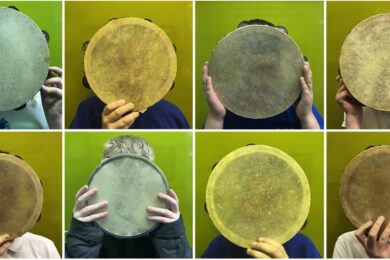
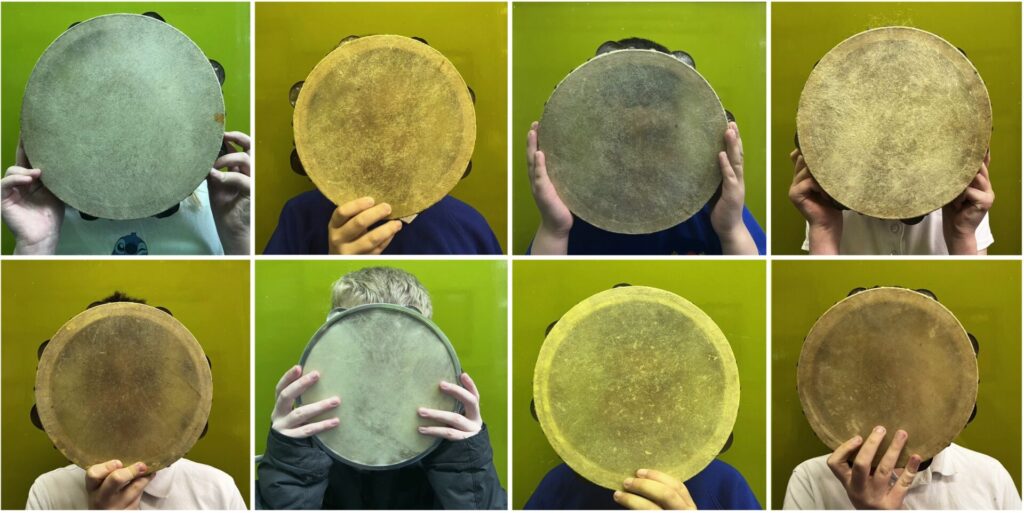
Mark Williamson was afforded coverage in the last but one NWB, as Spaceship, and now he’s back! Sort of. He founded and directs the Primitive Percussion Youth Orchestra, whose raison d‘etre is to give preteen kids an opportunity to play improvised music in an ensemble, and which changes its lineup regularly as a consequence. On their debut CDR We Demand… Everything Now! (Forged River), they comprise eight pupils from the Todmorden primary school where Williams teaches, and indeed recorded the album there, with interludes claiming to have captured a nearby PE lesson through an open window.
Alex, Alice, Kole, Kyle, Maddison, Rhys, Theo and Tommy may not be versed in the history of freeform protest music, but I’d fancy Williams is, enough to give a patina of righteousness to the PPYO’s massed chanting of the album title over flurries and knots of percussion. ‘London Calling’ is a live seven-minute drum instrumental, and like the scattergun bells and metallic percussion of ‘The Night’, grist to the mill of those who believe that true musical amateurs can produce worthy improv. Is that a pseud’s version of that old favourite, “my kid could have done this”? Maybe… how does the stock response to that one go? “Yeah but they didn’t, did they?” So here’s some who did!
Dean Rodney Jr has been releasing music for close on 15 years now, which ought to get anyone a gold watch in this dog eat dog world, and what’s more he’s done it as a leading light of London’s learning disabled music scene, facilitated by art charity Heart n Soul. His first band, The Fish Police, took their versatile funk workouts to the USA and several corners of the UK, and his current one, The Cowboys, have picked up the baton with strongly titled 2023 debut LP The Yeehaw Moment.
“During lockdown,” report Heart n Soul, “Dean wrote and recorded 54 albums, describing a fictional alternative version of the present day, Dean TV World.” You have to say that’s class. Belatedly, then, here’s a two-song single (which you can buy as a lathe cut 7-inch, released by Echoes In Time) whose subject matter is very much post-lockdown and conjures a setting sounding altogether too real to be fictional – something said about all manner of autofiction before, I’m sure. Pivoting, in smoove solo mode, to a kind of slow-rolling electrofunk, Dean goes out not once but twice and has his head turned by a woman in the club. The first, subject of ‘Dean TV Love Part 1’, accuses his hands of being cold; the other, as ‘Cowboy Hat’ makes clear, was wearing a cowboy hat. “On a Wednesday night! On 21st of December 2023!” A suitable tribute to such a bold move.
The first couple of times I test-drove this new tape by Taut & Tame, I zoned in on its stern, leather-clad basslines and metal-clashing hi-hats, and it sounded like a terribly European EBM record. A few listens later and it still did, but also all these smoked-glass Detroit techno melodies and early-80s boogie beatdowns came out the woodwork. And that was before ‘Nexus’, the last of four original tracks on Rosy Crucifixion (Clan Destine), started doing the braindance acid strut about two and a half minutes in.
Taut & Tame has used a few other aliases, including his government one of Matt Lewendon, and as well as expressing his love of party-smart hardware jamming by recording it himself also releases other people’s on his label Beat Concern. One of those people, L/F/D/M, supplies one of three remixes of Rosy Crucifixion originals, replanting the title track somewhere between bleep techno and breakbeat hardcore. Oh, and – thanks to Lewendon’s membership of stellar grungy death metal band Liquid Shit – this is now another in the ‘reviewed in both Straight Hedge and New Weird Britain’ file which not even I can be arsed to actually maintain.
Nearly five years have passed since the debut 12-inch by Daisy Moon and System Creak, its followup. If my (limited) insight into her duties is accurate, that long stretch isn’t attributable to the Bristol club maven slacking off, quite the opposite in fact. She plays out more weeks than not, for one, and keeps her hand in on various radio stations, and has also been instrumental in helming Mix Nights, DJ workshops for women. The importance of community – mates uplifting mates – feels inherent to Moon’s whole deal: this new four-tracker is released on Peach Discs, run by longterm pals Shanti Celeste and Gramrcy.
System Creak’s another one that can function ably on two levels, to my ears. Its A-side, especially, is a breathlessly pneumatic coming together of upfront, near-hard house and pop-techno: I wouldn’t call it lowbrow, but it could be a soundtrack to lowbrow activity (and the title track is a bit like a seriously pitched-up version of ‘Impact’ by Orbital, which is a distinct positive). Still, there’s layered subtlety even amidst Moon’s stoutly 4/4 drums and neon-bright synth stabs, with vocals (or vocal samples) micro-edited in elusive and interesting ways. ‘Pine Odyssey 1’ closes us out in a manner not wholly unlike late-90s tech-trance, topping off a very welcome reemergence of Daisy Moon the producer.
Henry Murray used to call himself DJ Boursin but is now FKA Boursin – I dig the linguistic paradox of using ‘FKA’ in your alias this way – and also shuffles around Bristolian spots with DJ booths. In fact both he and Daisy Moon had Noods Radio residencies on the go a couple of years ago. His productions are markedly more downtempo, however – first on 2022 debut Comatose and now this two-track, 20-minute snaker, You Just Give In, Giving It All To The Wind (Accidental Meetings).
The deepest of house is what’s on offer here: minor chords, soft pads and fragmentary soulman vox, wound down to the point where it borders ambient territory. Subtle ain’t the half of it, and so when Murray makes small tweaks to what’s developing, like the upward gear-shift on A-side track ‘All Kinds Of Shame (Circumcised Mix)’ it’s quietly exhilarating. ‘Decoupled’, its counterpart, is little but jazzy, live-sounding drums for stretches of its 11 minutes, but again, this really accentuates those delicate curls of flute and violin, or the night-owl synth twinkling.
Gorgeous stuff which, despite lacking lyrics as such, beckons you to Think. Comatose’s concept was Murray’s dismay at the general in-the-moment apoliticality of dancefloors (sounds like he’s on the same page as Dhangsha re: this, actually), and affixes this message to You Just Give In: “I encourage a decoupling from the family unit and giving up on any hope you had for improved relations.”
A sorta twofer review here, of a brace of tapes emanating from a mushrooming sound art scene based in London (though many members may not identify as British) and more specifically Hoxton’s Hundred Years Gallery (plus places like the more seasoned Cafe OTO). It’s largely a tale of tone, feedback and the sort of marginal, incremental aural progressions that demand impeccable concentration, likely headphones, or at least closing the window to block out the sound of rain on gravel outside.
Zheng Hao has been reviewed before as half of Oishi, with Ren Shang (who I believe has moved back to China); they had a tape released by the Bezirk label, as is Hao’s latest, Harmonium II. No harmoniums feature, and in fact what you hear on side A is made by putting headphones next to a handheld digital recorder, moving them about a bit, and sending the generative frequencies that result into a modular synth. Over 15 minutes we hear doom-drone rumble, mulchy grubbing, muffled robotspeak and demi-semi-percussive glitch-blips. Then on the other side we’ve got a reverb pedal going right into a mixer, and this is no kind of shoegaze hairshaker, I can tell you – it could be your trip all the same, mind, with an oppressive, blocky tone upended by a litany of machine-made trills, toots and sighs.
The other cassette – Two Movements, by a trio of Conal Blake, Regan Bowering and Li Song – uses its rooms more explicitly (whereas Hao makes a virtue of not doing so). Released on Blake’s label Feedback Moves, these live performances were recorded in, yes, Café Oto and the Hundred Years Gallery, and again instruments are mostly not played in the commonly understood sense of physical contact. Side A, ‘Swinging’, is so titled because the musicians hang three drums from the ceiling and have them create noise – aqueous, haunted, tense – with proximate contact mics and feedbacking mini-speakers. Perhaps improbably, this piece has a rock-adjacent sense of abandon to it, which is less the case for flip track ‘Oscillating’, though intrigue is inherent to these waves of sine (which occasionally coalesce into something foley effect-worthy) and their effect on taut vellum.
“Now I’m gonna tell you some English history! When Christmas come we eat turkey! 1944 we defeat Germany!” Forty years later, and General T is on the mic at the ‘84 Notting Hill Carnival, positively swelling with British pride as he rides the dubs atop the Jamdown Rockers soundsystem. And 40 years after that, London archive label Death Is Not The End have stuck it on a belter live tape with a self-explanatory title, Soundsystems At Notting Hill Carnival, 1984-1988.
Nearly an hour of decently preserved recordings of the decade’s premier UK sounds – also including Saxon, Java Nuclear Power and Volcano Express – it captures a fertile, transitional time in the culture where digital dancehall and hip-hop were exerting their influence on this music (and Notting Hill Carnival more broadly). Indeed, we hear a sizeable excerpt of Java Nuclear from 1986 which is basically a bunch of rappers with occasional recourse to toasting; on the other hand, they got Cutty Ranks as a special guest the following year, one of a new wave of hypeworthy deejays bubbling up.
Carnival and other such blowouts are good arenas to remind your audience of the real you, away from records with a little too much mid-80s polish: compare Tippa Irie’s vocal on this tape, as he piles through ‘Football Hooligan’, to the album version. It also doesn’t have the bit where he blames the Bradford City stadium fire of 1985 on soccer violence, so that’s a bonus.