


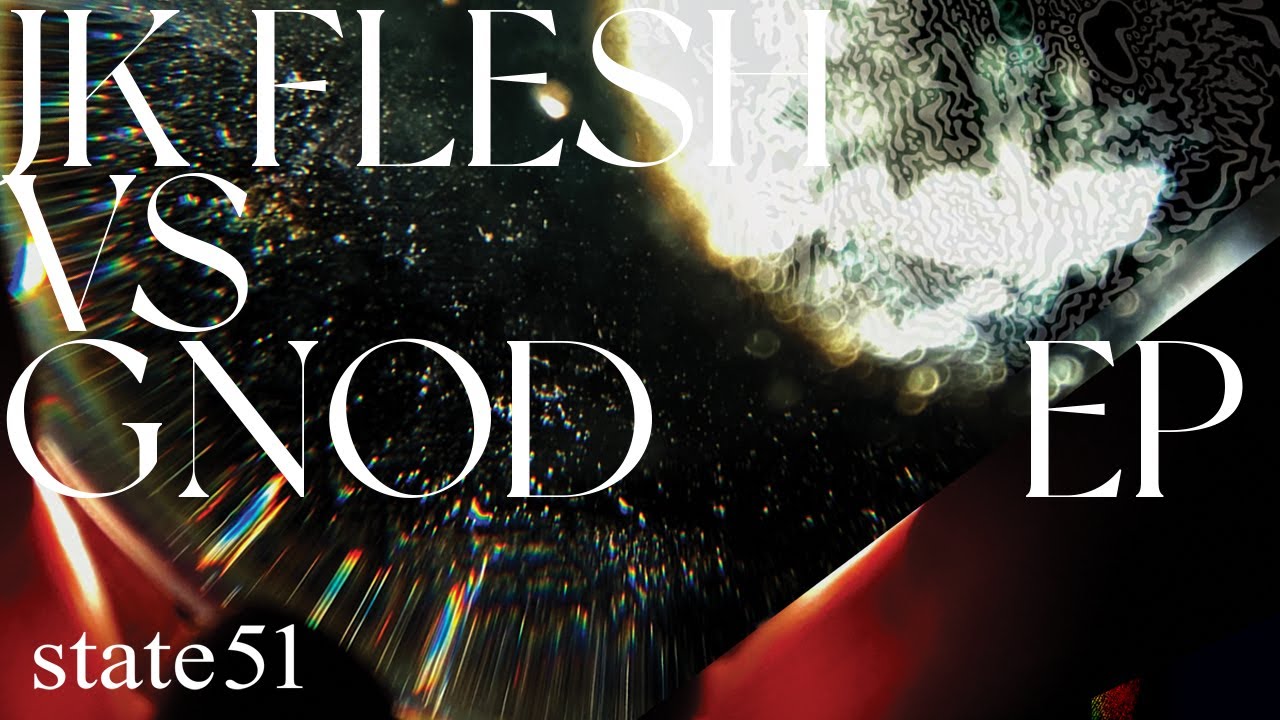
It’s kind of ridiculous that Justin Broadrick’s deep industrial techno alias JK Flesh has never been covered or even mentioned in these onward-til-infinity columns. Truth is, you could literally fill a book with the acts whose lack of coverage in New Weird so-called Britain is ridiculous – the fun of the big, messy sprawl has its tradeoffs. It is nice to nix erratum, though, and August provides that opportunity with the release of a ruff four-track EP pitting JK Flesh against Gnod, who have certainly been afforded their due.
JK Flesh Vs Gnod was actually released at the end of last year, exclusively for the Quietus’ top tier subscribers, so although no-one asked me to suggest that you become one of those, it would also look a bit off if I didn’t. Either way I think eight months is long enough to keep gear this good to yourself, and it’s being let into the wild by The state51 Conspiracy, including as a mad-scarce lathe cut 12-inch. (You can pre-order it here)
Each party remixes two of the other’s (previously unreleased, by the looks) tracks, and were evidently in a mood to melt down rigs. ‘Parasitic Systems (JK Flesh Remix)’ is dub techno enveloped by thunderclouds, with a capillary of pulsing, redlining distortion threaded throughout. Gnod are credited with the rerub of ‘Self Served’, which canters along at a fair pace while finding time for junglist bass rumbles and mystical-sounding vocal incantations: can well imagine this coming out on Downwards, as JK Flesh releases indeed have.
‘Not Listening’, again remixed by Gnod, has a bedrock of technoise fuzz but pops with a rainbow of cut-up vox and pitched-up melody, taking things into almost electro territory at points. Finally, Broadrick hunkers down with Gnod’s ‘The Fight’, and if the sword-slash panning and elephant bass of its first two minutes is expected, bouts of tricksy, vaguely exotic percussion add subtle layers.
The sometime Godflesh maestro also crops up on Too Long (Pessimist Productions), by Bristol’s Kristian Jabs as Stigma – only briefly, yet his screwface spirit seems to watch over much of this fine introductory LP. You might have encountered Jabs already, mind, other incarnations including dark, off-centre drum & bass as Pessimist; Stigma, while diversifying, maintains nocturnal paranoia and gunmetal-hard production. ‘Believe In Me’, whose murky vocalist is credited only as L, is a sultry lumber with a rhythmically hip hop heart; ‘Madureira’ and ‘Listening Now’ arrange taut, jazzy snares so as to add a strange cheer to their gloomscapes.
The Broadrick feature, ‘No Garden’, is the first of three such spots for likeminded producers on the LP’s second side, with Tropic Of Cancer’s Taylor Burch and previous Jabs collaborator Karim Maas the other two. Burch’s ‘Advertised’, where she sounds like someone unblinking but barely in the room over an EBM/techstep hybrid, is a standout gem, but they’re all minty. Can never quite discern where Jabs fits into the Bristol scene, marooned between its ripsnorter d&b legacy and the likes of Young Echo – a wealth of great music is both recalled and offered on Too Long, which should be your main concern.
As Appleblim, Laurie Osborne can take a decent slice of credit for the expanding horizons of Bristol dubstep in its mid-00s boom, cf his early glut of split 12-inches with Shackleton. Before that, he (along with Kavus Torabi) played in a 90s Cardiacscore band called The Monsoon Bassoon, which I cite as an inspirational journey through the underground while not suggesting it has much aural bearing on Infinite Hieroglyphics, the new Appleblim album. Released by Sneaker Social Club on too-limited tape and presumably limitless download, Osborne sounds in his pomp here, gliding through a wealth of club-and-beyond electronic influences on an expansive collection.
‘A Madman’s Nod’ opens with intoxicating carnival-gone-bad drums and graduates to lairy bass wobbles: it might be Appleblim’s most faithful harkback to his earlier productions. Later, his synth textures become widescreen, sweeping, with a kind of Model 500 quality on, say, ‘Fallen’ but sometimes what you might simply call electronica. The producer knows his onions far too well for this to ever become pallid indie-festival-dance-tent mulch, mind, teeming with knotty patterns and alien tones as well as some mighty satisfying drum sounds. That THWACK that leads into ‘Opal Moon’ – ooh matron!
Serving up this month’s second handcut scarcity, although all ten (ten!) dubplates pressed of this long flew the nest, The Re-Up EP (Parasol Culture) by Thoma Bulwer & Anna Wall is a weird one – in that I don’t think it comes from the Weird side of the tracks, if you follow. Both London-based club bods, Bulwer has a background in UKG and deep house while Wall has been a Fabric resident since 2019 (she’s also just launched a new age/ambient label, Dream Theory), but together they’ve stepped off grid with two tracks that rattle panes and roll their eyes when you seek to categorise. ‘The Re-Up’ jumps with ping-ponging FX pulled tighter than Francis Rossi’s ponytail, percussion that feels descended from UK funky’s boomtime and a bit of old skool breakbeat cheek. ‘Phrazing Faces’ judders ahead with dubstep wub and wonky techno machine riffage, faintly reminding me of the ‘UK bass’ scene that was fleetingly identified in the early 00s. I could imagine these tracks in a ton of wildly differing DJs’ sets, with little idea of where it actually fits in, and that’s refreshing.
Following several digital releases of EP length or less, Lifeforce, a 12-inch on Hot Fools, is the first physical object by Mighty Lord Deathman, aka Mat Colegate. A member of Teeth Of The Sea until 2017, at which point he debuted this solo moniker, Colegate has also written plenty for tQ over the years. Again, you have to mention this stuff even if your personal connection to the artist is pretty tenuous, because of the SNAKES out there in Readerland who will otherwise flag it up like they’ve uncovered some dirty backhander deal.
As it goes, Mighty Lord Deathman had mostly evaded my attention until now, but Lifeforce is a breezy doozy which professes to have been “recorded live onto Tascam DR-40” and accordingly has a driven proto-techno aesthetic. Opening cut ‘Gladius’ is my pick, sci-fi synthwork and clanking rhythms sounding like when the early industrial shitkickers – Chris & Cosey, Severed Heads – discovered how to dance. Much of its midsection is moodier, like a synth’s impersonation of a harmonium on ‘Mad For The Love Of The Mountain’, and although this is in effect an instrumental venture occasional vocal fragments serve to haunt and beguile. Not to thumb noses too much at technology’s advances, which after all is letting you and I listen to this on the world wide web, but Lifeforce makes great work of its four-track recording.
Dan Hayhurst is another graduate of a marginal late-90s out-rock scene, a member of motoriky cool cats Electric Sound Of Joy during that period. (This edition of NWB seems to be for those who’ve been round the block a few times. So it goes!) He’s been half of audiovisual duo Sculpture for a longer duration, and their spattery, granular digital meltdowns point more readily to the music on Counters (LTR), Hayhurst’s second solo album.
It begins with a gruelling midrange drone piece, ‘Dilapidate All Ends’, and fans outward from there with wilful inelegance. Plebs like me may slacken jaws while trying to peg the various sound sources, which seem to be acoustic at points: ‘Insecure Glueing’ sounds like a music box being pulled through a dimensional portal, the brief ‘Sunlit Dust’ features clusters of clanging chords ultimately not unlike Bill Orcutt. That track is though followed by ‘White Car On Europa’, whose linear central acid line is subverted by clashing rhythms that impress themselves on proceedings like so many boiling milkpans. A sidestep into properly noisy territory near the end – the Russell Haswell-worthy (g)rumble of ‘Burnin USB’ – and a general feeling that Hayhurst could wax on his concepts at length doesn’t snuff out the game playfulness across Counters’ albeit challenging whole.
I’ve briefly written before about experimental cellist Lucy Railton, sheepishly adding her 2018 LP Paradise 94 to that year’s “oops, missed this at the time” overview. Among its various guests was versatile jazzman Kit Downes, who played a little Bach on the organ; Subaerial (SN Variations) is a full-blown Railton/Downes collaborative album, justly billed as an exhibit of the pair’s musical rapport.
Its 40 minutes of stark improvisation was recorded over three hours in an Icelandic cathedral, Skálholt, boasting an apparently top-drawer organ for Downes. A performer clearly comfortable in more meditative mode, with two solo albums released by ECM in recent years, you’d be hard pressed to assuredly pinpoint a jazz sensibility on Subaerial – excepting perhaps the latter stage of eleven-minute prangout ‘Torch Duet’, where doomy, crashing grandiosity gives way to a ramped-up freeform squall. ‘Of Becoming And Dying’, the apt closing piece, is under four minutes but feels epic in scope, both parties attuned to the space’s acoustics and syncing into a delicately cavernous drone. Based on their respective CVs, with Railton having interpreted composers like Pauline Oliveros in the past, you might suppose this bears more of the cellist’s stamp, but both musicians are vital to a pretty stunning release.
Found this new 10-inch single by Lucy Duncombe when plunging my hand into the Bandcamp tombola. Struck by its coupling of choral swells and electronic ambience, as well as the typically good stencilled packaging from Glasgow label 12th Isle, I looked its creator up and realised she’d previously sung in Two Wings: a Scottish psych-folk ensemble who, amidst a glut of such fare a decade ago, I rated a bunch (although clearly not enough to have recalled the names of its members).
‘Brace’ finds Duncombe a vocal force, quavering yet steely, over keyboard washes with a little of The Orb and some 80s new age in the tank: it’s nine minutes long and seems to travel upwards as much as onwards. On the B-side, ‘Mend’ is a crawl-slow synth ballad that’s basically linear in its structure but wholly uncommercial-sounding. Cucina Povera, also blessed with a great voice, feels like someone of a comparable mindset, and also in Glasgow, although more ‘difficult listening’ than these two spectral sides. (The Rapture Of Cellular Accretion, an art edition tape Duncombe released earlier this year, is a bit more on that tip but also worth your while.)
As any such Bandcamp dive will tell you, there are a lot of tape labels out there right now, but Yorkshire’s Miracle Pond stand out with consistently plush packaging: colourful, screenprinted inlays and layouts that resemble old educational cassettes. The music’s peachy, too, ranging from the tall tale of Smaragdus (an anonymous 70s synth project found in a caravan), to rave don turned ambient geezer Luke Sanger, to a quasi-meditation tool narrated by Unofficial Britain author Gareth E Rees. Their latest release is by Carnivorous Plants, the solo-though-often-collaborative project of Bristol’s Owen Chambers. I guess you could view him as part of the next generation of no-audience-underground acts in the UK, with peers such as Robert Ridley-Shackleton, Zero Gravity Tea Ceremony, Territorial Gobbing etc.
Exquisite New Realms, spanning slightly over half an hour, is relatively welcoming, and sometimes closer to ‘structuredness’ than the names I just listed there. Built from guitar and what I assume to be loop pedals, Chambers rolls out pretty, low-key melodic figures before sabotaging them with overlaying impro-junk (‘Endless Fronds Of Undulating Kelp’) or blurs drone guitar until it’s like a reductio ad absurdum of shoegaze (‘Aria For The Rains’). Concluding Exquisite at nearly eleven minutes, ‘Leaky Moon’ is a seemingly incidental, actually detail-rich bed of errant plucks and mulchy tones which sounds dimly like Loren Connors but feels like a sonic dispatch from the forest floor.
Finally, another tireless worker in NWB’s supposed purview who really should have been covered already! Andrew Liles, an important post-millennial part of the Nurse With Wound/Current 93 ‘family’, releases music at a fairly breathtaking rate, yet It’s Only Pain is described by label Dirter as his first “general release” since 2018. Never mind the taxonomy, clock the concept: all the LP’s lyrics were written by Liles’ father in the 1970s, discovered after his death, and are interpreted – often translated from English – by multiple guest vocalists. Many are already in the musician’s collaborative orbit, some are more surprising. My recollections of Mared Lenny’s late-00s music (frankly pedestrian Welsh language indiepop under the name Swci Boscawen) did not mark her as someone with a future appearing on NWW solo projects, yet here she is on opening song ‘Skid-Row Schizoid’, narrating bilingually over a song that’s a bit like if Van Der Graaf Generator had been an influence on Fourth World music.
Liles’ taste for dramatic arrangements can border on kitsch but more often charms. Karin Park, synthpop soloist and Årabrot member, leans into her roles with terrific relish, initially reading over sawing strings and clanging piano on ‘A Thousand Minds’ before adopting an operatic register for ‘Beyond The Cosmos’ and ‘Humanist’. Faust’s Jean-Hervé Peron hams it up spiritedly over ‘Down The One Side’s stern gothic folk and ‘Bywyd Llonydd’ revels in its diverse guestlist: Matt Davies, owner of a Welsh record store and a fine ‘dramatic reading’ type voice; Maniac, ex of black metal originators Mayhem; and Awen Schiavone, author of a children’s book about a penguin named Pedro.