

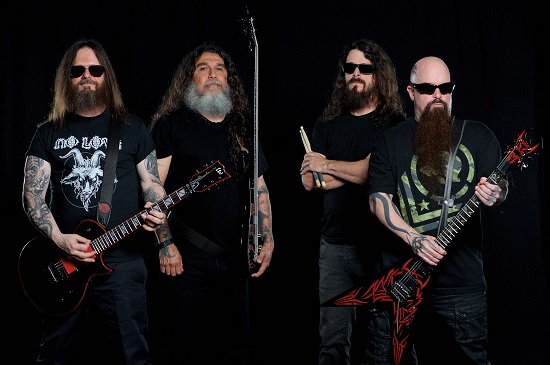
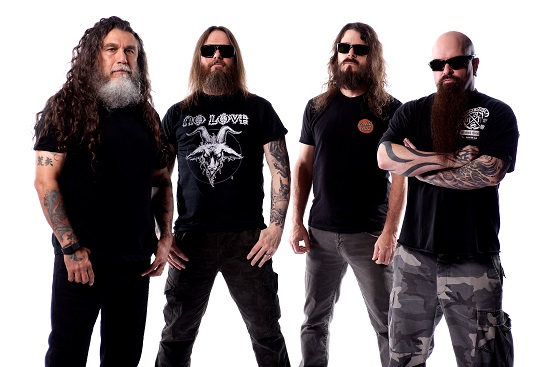
Slayer are a veritable institution in extremity. Part of the very fabric of global heavyosity for the past three decades, they’ve managed to push the boundaries while staying true to an original and deeply underground vision: intricate, speedy and deranged metal performed with palpable, life affirming glee and venomous intent.
Formed in 1981, Slayer initially set about fusing the aggression, political astuteness and adrenalised attack of punk rock with the more devilish imagery – not to mention seriously virtuoso physical chops – of the burgeoning thrash metal scene. First two albums Show No Mercy (1983) and Hell Awaits (1985) were raw exercises in brutality tempered by complex arrangements and the strange, off kilter soloing between Kerry King and Jeff Hanneman that was to become an often imitated, but never bettered, stylistic hallmark.
But while these records were well received – and led to the band being tagged as part of the mythical ‘Big Four’ of thrash, alongside Metallica, Anthrax and Megadeth – it was 1986’s Rick Rubin produced Reign In Blood that solidified the bands reputation. A stone cold classic – one of the finest metal albums of all time – Reign In Blood was a frenetic exercise in popping, foaming aggression; in forensic fat stripping. Inordinately influential on underground metal’s many sub genres, it remains a benchmark of total, chugging commitment – a frothing beast of vigour.
However, although Slayer have since consistently entertained perhaps the most committed fan base in metal with a maniacal live show and consistently solid records, the years have not been without their difficulties. Long time drummer Dave Lombardo was fired in acrimonious circumstances in 2013 while Jeff Hanneman tragically died of cirrhosis of the liver on May 2 2013.
Slayer, however, remains a mighty force. New LP Repentless was released last week and it is safe to say that Slayer have not exactly mellowed with age (check the fantastic video for the title track: prison, blood, knives, metal!)
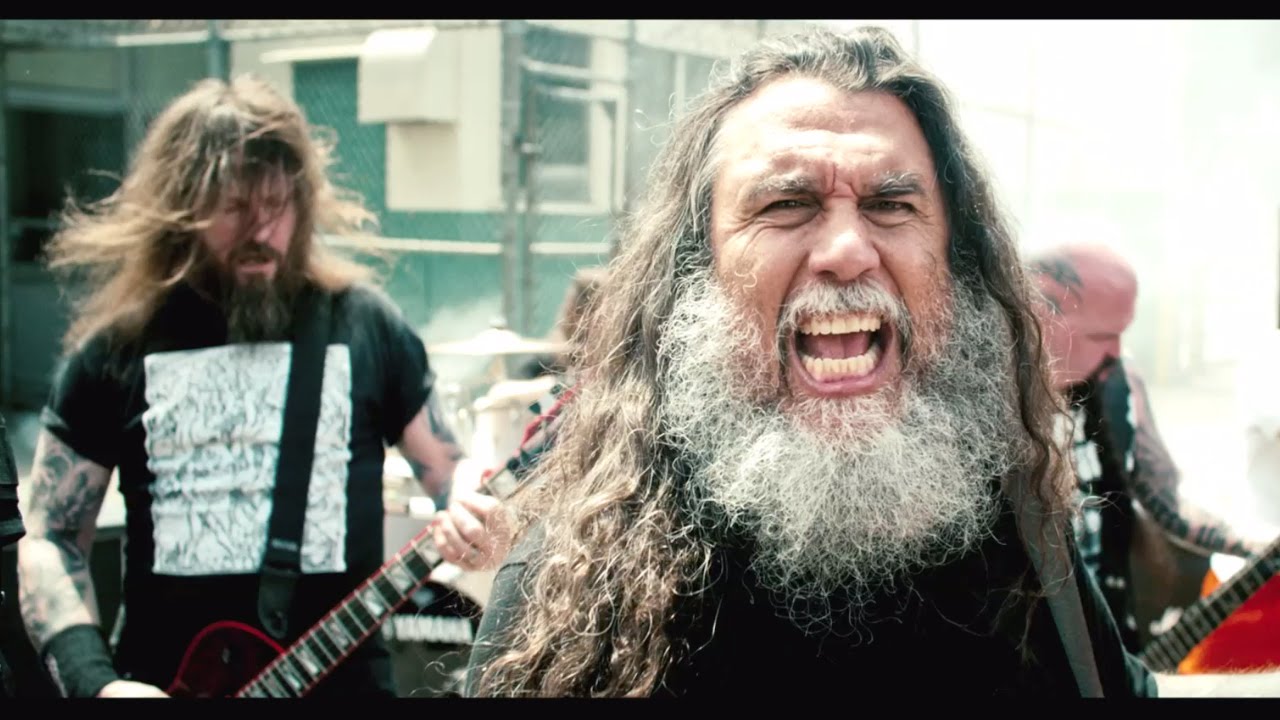
TQ caught up with vocalist/bassist Tom Araya – warm, self deprecating and possessed of an infectious booming laugh – to get the inside story of the LP, why Slayer and ‘plastic lawn chairs’ don’t mix, and the perils of planes, trains and automobiles.
You’ve just released Repentless. I’m conscious this was the first record you’ve made without Jeff, could you please tell us a little about the writing and recording process?
TA: The recording process for Slayer has never changed. We go in, start with basic tracks and then layer the stuff – but the biggest thing was that Jeff is no longer around. To me that was huge, but, y’know, you just have to do what you have to do. It’s the same process its just that Jeff wasn’t present. We worked with Terry Date, who actually never had the opportunity to work with Jeff.
Kerry wrote all of the music this time around and that is another huge difference, because Kerry has another style of writing; he has a different style of writing music compared to Jeff. A lot of folks may not notice, but I’m aware of the difference. So, I was very aware of that – one of the things that kind of concerned me was ‘is it going to be the same song ten times?’ [LAUGHS] We got close to finishing the album, and that was when I sat back and really listened to the songs. I listened back and thought, ‘This is good… this is Slayer… this is very Slayer’ [LAUGHS] We wanted to be able to make sure each song was it’s own entity and we did.
How about the writing? Slayer never really went down the fantasy route, lyrically, I’ve often felt you’ve been closer to punk rock or hardcore, the political edge. A song like ‘Repentless’ is a case in point…
TA: On this record, Kerry wrote the majority of the lyrics. He started the process of writing this album several years ago. Knowing the condition that Jeff was in with regards his ability to play, knowing that he was struggling with playing and performing – struggling with his ability play a guitar, period – Kerry took it upon himself to start to write a lot of songs, a lot of music, which is hard because he was kind of writing in anticipation that Jeff may not be able to contribute, so that was really sad.
He already had the lyrics but then I’ll try to make each song as individual as possible; I’ll change words, work on the phrasing.
How did you find working with Gary Holt of Exodus on the album? Because the interplay between Kerry and Jeff was such a stylistic hallmark of Slayer – that frenetic question and answer between the solos – how did Kerry adapt to that?
TA: What Kerry didn’t want to do on his own was what you just described – the interaction between the two guitar solos that go on in the song – because then it would be just one guitar player doing both parts. So Gary came in one day and Kerry told him to listen – ‘I want you to play leads on these songs’ – and Gary came in and listened to what Kerry had played solo wise and he played along to that; and that was something that Kerry and Jeff would do quite a lot, they’d sit and play leads together and then whoever could ‘answer’ it, would play it.
And that’s what Gary did – there were certain songs that Kerry wanted Gary to play ‘answer’ leads to and Gary did a great job doing that; he came in and he did it in one day, he just jammed them out in one fucking day, which was pretty intense! Terry Date would sit and listen; Gary would say ‘well, what do you think’ and Terry would say ‘sounds good to me’ (laughs) That was how that worked. He didn’t participate in the structure of the song but he came out and did the solos which worked out great because he is an incredible guitar player. Then we had Paul Bostoph coming back in too, which was great.
Paul has been in the band a number of times over the years. Am I right in thinking that the previous breaks with him were not in the least acrimonious?
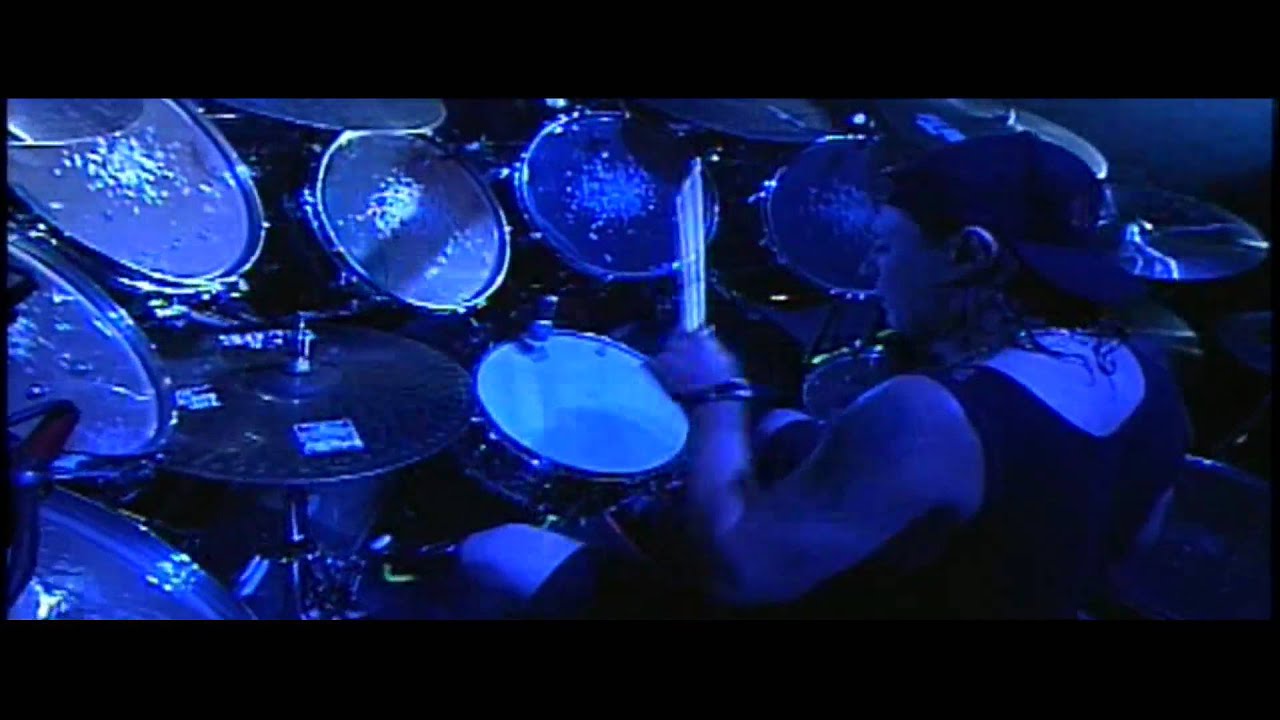
TA: Oh yeah, not at all. It’s great to have Paul coming back in. He played with us for twelve years before – he’s been in the band twice in the past. Kerry has said this a million times and I have to agree: he would have always have been in the band had he never left. He’s such an integral part of the band – his drumming style is incredible, he knows what the band is about and he does some great stuff. I mean, he came in and re-did some drum parts for a song that we’d finished on World Painted Blood, the song ‘Piano Wire’ – he re-did the drums on that song and changed a section of the song up completely with his rhythms.
Something I find interesting about Slayer is the groove. The music you make is extreme and aggressive but you have a groove that so often alludes bands you’ve influenced. Do you listen to much new music in the more extreme end of metal?
TA: As far as listening to new bands?
Yeah, new bands.
TA: Are there any particular bands you’d suggest? Honestly, because I’m not really aware of much. I like it when people suggest stuff because I don’t get to hear that much..
Ah, you should check out a band called Dragged into Sunlight. They come from Liverpool. The music they make is really interesting and quite terrifying. You might enjoy them.
TA: [Writes down name] Dragged into sunlight? Ok, cool, I’ll check them out! I’ll listen to it and let you know.
I guess that answers my question about contemporary metal. But what music do you enjoy? Do you still listen to the bands that informed you when Slayer started?
TA: Yeah, that’s where I’m at with my music. I listen to a lot of the music that I started out listening to. My high school years were in the seventies and my introduction to music was between 1966 and the 1970’s and the early 80’s was when we started Slayer. I don’t really listen to metal because I want to make sure that my ideas are fresh – and are truly mine. So I have a tough time listening to other metal bands because I don’t want to be influenced by them. Generally – unless someone says they’re a great band – I’m not going to listen to them.
I have a certain catalogue that I listen to and I like to think that is what influenced me to do what I do. Early Judas Priest; Led Zeppelin; Black Sabbath. All killer. Then off the wall stuff, too. I love country; I love Stevie Ray Vaughn; I love Hendrix. You know, any sixties bands – because that is what I grew up listening to when I was little. Growing up, my dad and my sisters were big fans of the Supremes, they loved them. So, that stuff. I’m assuming that some way listening to the variety of music that I listen to has inspired me and become part of the creativity that informs Slayer.
I’m interested in finding out where the extremity came from though. Let’s talk about Reign in Blood for a moment – because that record was a before and after moment, not just for Slayer but for music as a whole. There was metal before Reign In Blood… and metal afterwards. It changed everything – the sheer venom!
TA: You know, that record, the songs from that record evolved from the fact that we didn’t want to do a long album. We just wanted to write fast songs; we didn’t want to do slow songs anymore. Not that we ever did slow songs, they were still really fast, they were just fast… and long. [LAUGHS]
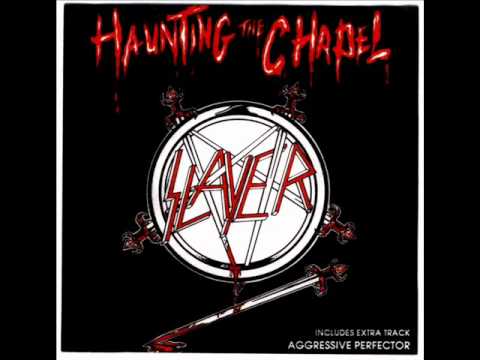
And that came from Jeff, he wrote the majority of the music on that record. Kerry wrote some of the songs, and then lyrically it was put together by Jeff and Kerry. I can take it back to the very first Metal Massacre compilation we appeared on for Metal Blade Records – Metal Massacre 3 in 1983. We had a song on that album called ‘Aggression Perfecter’. That song had the template to all that Slayer was to become. Prior to that, we had original songs that were kind of metal, kind of rock, but then we had the opportunity to put together a song for a compilation record and before we did that we thought ‘Ok, lets see what this Metal Massacre thing is all about – lets listen to the other releases that he’s done to see what we’re getting ourselves into.’
So, we went back and we listened to the first Metal Massacre compilation and Kerry and Jeff thought ‘we can come up with something heavier – something faster – than this stuff’ so we went and rehearsed the song and recorded it in the studio in one day and when we heard the finished product we were like, ‘Wow – we like this, we dig this, this is what we’re gonna do.’ We went back to the studio and trashed a load of the songs that we had done up until that point and started changing up our stuff. We started rewriting songs and that was how we came up with the songs that ended up on Show No Mercy.
After Show No Mercy, Brian Slagel came up and said he’d put it out. So, in the process of doing Show No Mercy, Jeff came up with newer songs. As soon as Slagel heard those songs he wanted to record them. We started it with that one song; we kept progressing to what Slayer is now. That song was the template and we just kept on at it.
I was always into heavy music – what I wasn’t really aware of was the speed in music. When I got together with the band, Kerry gave me a list of all the bands that they were into and were covering and I was aware of all of the bands on the list with the exception of Iron Maiden. I went out and bought the first album and was like ‘oh my god, this is fucking amazing’.
Something I find interesting about Slayer is the regard in which you’re held outside of metal. You were asked in 2012 to play ATP by Mogwai, for example. You’ve also done a few other festivals outside the confines of the metal world. I feel like people of all musical persuasions can get into the sheer ferocity of what Slayer do: what is it like playing to crowds outside of metal?
TA: You know, I guess we’re accustomed to playing to an audience that is not familiar with the band because we’ve done different shows in different locations. We can always tell [LAUGHS]. Because they’ll be standing there with their mouths open, agape. A few years ago, we did a gig up North in a farm – apparently it’s some big festival that they do every year – and they started incorporating metal into it, and we were playing to an audience that was sitting down in plastic lawn chairs…
I can’t imagine plastic lawn chairs at a Slayer show…
TA: There were 4000 seats and only a third of the seats were filled. We knew that the audience that were there were not really a Slayer audience. But then a good five hundred feet behind were some Slayer fans making loads of noise, but at the front it was plastic lawn chairs and they had their beers and they were Northern country folk; kind of looking up with their jaws open, nodding their heads to the rhythm of the music. [LAUGHS]
I wanted to ask about your fanbase. Slayer fans are notoriously devoted; I’m a huge Iron Maiden fan and it’s a similar thing with Maiden, but Slayer’s fans do have a pretty intense element, shall we say. Do they ever unnerve you?
TA: My view on Slayer fans? Pretty fucking crazy. Pretty out there. Incredible fans. There have been a lot of situations where people will say, ‘Tom, things are getting out of hand. You need to tell them to stop!’ But there is absolutely no point in doing that because, no matter what you say from the stage, all they’ll hear is, ‘Do it again.’ They don’t hear what you’re actually saying, they only hear what they wanna hear which is ‘DO IT MORE!’ [LAUGHS] ‘He likes what we’re doing! Let’s carry on doing it… but lets do it MORE!’
The best way to illustrate that would be when we did the Clash Of The Titans tour in the US a while ago, we were playing in Washington and Megadeth was headlining that night. On that particular tour, it was a revolving headline. We opened that night, Anthrax played after us and we were watching Anthrax and the crowd was throwing dirt – clumps of sod – at Anthrax.
Megadeth went on and it got worse, you could see it, it was at the amphitheatre in Chicago and they’d just laid out fresh sod – a whole new field of sod – and chunks of it were flying from the back to the front. People at the back seats would throw it to the front and it just got worse and worse. Megadeth went on and they were getting pelted. They walked off and Dave (Mustaine) was pissed and you could tell that he was going to say something but we were all thinking, ‘Oh, no, don’t do it Dave, please… bad mistake, bad mistake’ and he went out and got real mad at the audience and was yelling at them to stop what they were doing and they just started throwing more and more at him, y’know what I mean [LAUGHS]. That’s just an audience though; that’s how an audience reacts.
A Slayer audience in that situation would just go overboard; it would be like that scene in the Life of Brian – you know, at the stoning. ’Don’t start the stoning until I blow this whistle… even if he does say Jehovah.’ ‘He said it again, stone him!’ and they end up throwing that massive tombstone over him, dropping it right on him! That would be the Slayer audience reaction, right there. I would’ve drowned in the mud had I said anything [LAUGHS].
How do you find touring these days? You’ve been hardened road warriors for three decades. Does it still hold enjoyment?
TA: The best part of what we do is the stage time. That is the most enjoyable time of the day. Everything else that comes along with that sucks; the travelling wears you down. I mean, when we were younger -when we were young and life was grand [LAUGHS] – it didn’t matter, you could go on forever and nothing would slow you down, but that is something that a lot of people don’t understand, the constant planes, trains and automobiles wears you down. I’ve recently done a few articles recently where it sounds like I’m complaining – or people take it that I’m complaining about doing what I’m doing – but I’m not at all. We love playing music, but the other stuff…
I think anybody can understand the frustration that comes with three decades of constant airports. It reminds me of that great quote from Charlie Watts where he was asked, ‘What’s it like to have played with the Rolling Stones for 50 years?’ and he said, ‘What do you mean? I’ve played with the Rolling Stones for five years and spent 45 years waiting around in airports.’
TA: [LAUGHS] That’s exactly it. That’s it in a nutshell! I’ve only played five of those years, the rest of it is all fucking shit. It wears you down and when you tell people they say, ‘But you get to travel, you get to see all kinds of places.’ But you really don’t. You go from one hotel to the other.
How about the physical rigours of performing Slayer music night after night? It’s not exactly like playing Carpenters covers: what is the schedule like these days?
TA: It’s easy in the studio because I’m not singing every fucking night. In the studio I do a couple of songs, go back to the hotel. On the road though? Dude, I went from doing 15 shows in a row to doing five shows in a row. Now the longest stretch I can do, vocally, is three shows and then I need a day off. My voice doesn’t recover like it used to. It takes a whole week to recover after getting off touring. It’s lost the clarity that it used to have; it takes a while to get back to having a normal voice.
The only reason we rest is so I can rest my voice. The other guys, if they had their way, we’d be doing ten shows in a row, which is understandable because you build up momentum and if you rest for one day, it throws your body out of whack. And then it takes longer to get back into the groove when you finally come back to play. And two days is even worse, because that gives the lactic acid a chance to settle [LAUGHS]. I mean, Paul, when we have two days off he takes a little kit with him into his room so he can play the drums…
I bet he must be popular with hotel managers.
TA: It’s the same with playing guitar. If your hands stay idle for a day or two they get sore. The other thing that gets tougher is memory [LAUGHS]. We’re going to be playing songs from the current record. I’ve got to learn them again though; I’m going to have to relearn the songs and come up with my cheat sheets!
I’ve sung the songs in the studio a million times but usually I’ll put together a cheat sheet which will help me memorise the words – it becomes one word sentences, one word verses and then eventually I know the song. You have to use memory tricks; the biggest memory trick for me is playing and singing at the same time – if I just sing along it doesn’t stick, I gotta play and sing. Eventually I’ve memorised the song, but sometimes the learning process will be in front of all these people [LAUGHS]. I’m not shy or ashamed of it, sometimes one of my cheat sheets will fall off my monitor and I’ll see people looking up at me and I’m like, ‘I just gotta go get my cheat sheets… I don’t have a teleprompter… I have my cheat sheets’ [LAUGHS]