
Photos by Kuba Ryniewicz
“I might just grab something that seems pertinent,” says Richard Dawson before shuffling out of the screen on our Zoom call. He has been reading Ursula K. Le Guin’s Earthsea books, and feels that a passage from the author’s introduction to the fifth instalment of the series, in which she discusses the wider commodification of the fantasy genre, might be relevant to our conversation about his new album The Ruby Cord. He returns holding an e-reader. “For all our delight in the impermanent, the entrancing flicker of electronics, we also long for the unalterable, we cherish the old stories for their changelessness,” he reads aloud. “People turn to the realms of fantasy for stability, ancient truths, immutable simplicities… and the mills of capitalism provide them. Supply meets demand. Fantasy becomes a commodity, an industry.”
He continues reading: “Commodified fantasy takes no risks, it invents nothing but imitates and trivialises. It proceeds by depriving the old stories of their intellectual and ethical complexity, turning their action to violence, their actors to dolls, their truth-telling to sentimental platitude.” He skips ahead a bit. “What the commodifiers of fantasy count on and exploit is the imagination of the reader, child or adult, which gives even dead things a life of a sort […] Imagination can be co-opted and degraded but it survives commercial and didactic exploitation. The land outlasts the empires, the conquerors may leave desert where there was forest and meadow, but the rain will fall.”
He’s visibly enraptured by Le Guin’s words as he speaks, “I could keep going and going,” he says, before placing the e-reader down again with a newfound air of satisfaction. “Maybe I should just do all interviews like this,” he laughs. He read that passage because he believes it articulates some of the themes of his new record more eloquently than he can in conversation, a record that is concerned at least in part with the way in which commodified fantasy worlds are increasingly thrust upon us, and how they have blurred the boundaries between what is real and what isn’t. Le Guin may have been writing about fantasy fiction, her ideas are applicable to virtual reality too. The Ruby Cord is set some time in the near future at a point when VR has become so prevalent in human lives that the record’s protagonists regularly switch between two worlds.
Throughout The Ruby Cord it is unclear which scenes are from the ‘real’ world, which are ‘virtual’, and which are an augmented mixture of the two. It’s not clear whether the songs on the album build a picture of a single world, or are each snippets from alternate realities. Nor does it make explicit judgements on whether or not these technologies are good or evil. In his own life, Dawson says, experiences with virtual reality have revealed conflicting emotions. “It’s bold, it’s really exciting and interesting, but it’s also quite scary when you think about where it’s gonna go, and what effect it might have on us.” Lyrics hint at some kind of apocalyptic event – “At the end I didn’t really comprehend that I was saying goodbye for the last time to all my friends and family, my only thought was flight from the mines,” says the narrator of ‘Thicker Than Water’ as they wander beside a silent motorway in search of “mam and dad’s earthern vessels” – but the specifics are kept hidden, both on the record and in our interview. In the past, he says he’s “given away far too much” about the explicit meaning of his songs. “I’m trying to be careful, I don’t want to explain what anything’s about in terms of deliberate choices.”
It was when he was working on his second LP The Glass Trunk in 2012, in large part based around stories from a scrapbook of seventeenth century newspaper clippings, that he first “started to get a sense of time not functioning in a straight line, different moments being close to each other that aren’t necessarily in sequence.” Although in the earliest stages of writing The Ruby Cord he envisaged it as being set on a spaceship looking down upon the earth (an idea which remains in part on ‘Museum’, on which the human race is revisited in microcosm as a far-future exhibition “a dozen centuries” after their disappearance), it quickly became apparent that such an on-the-nose setting “wasn’t apt for the kinds of things I wanted to talk about. There’s a really fine line after which it just becomes The Matrix: The Musical.”
Instead, the fantasy is more diffuse. The album is draped a fogginess, difficult to grasp onto but irresistible to wander into. It is dominated by first song ‘The Hermit’. The first quarter of this 41 minute epic is devoted to expansive instrumental atmosphere building – arhythmic brushes of percussion and moody, winding riffs of guitar, the occasional fragmented flourish of stately harp or earthy violin. “I thought about that part as a video game on idle, just the most basic functions, the sun’s not up, the occasional animal skittering across,” Dawson explains. It comes accompanied with a film directed by James Hankins. It was the filmmaker’s citing of Thai director Apichatpong Weerasethakul as an influence, much of whose work has been defined by a blurring of myth, dreams and subconscious with the everyday, that convinced Dawson he was the right person to make a visual partner to one of his most ambitious tracks to date.
Hankins was largely left to his own devices, but managed to strike the same balance between vagueness and intrigue that defines the music. “It’s dangerous with videos because you can either just describe what’s happening in the song or else do something else that will distract. It’s about trying to find a ground that’s not going to hurt the song in any way, that doesn’t illustrate or explain but should still help deliver it,” Dawson says. A viewer hoping to seek concrete information about the world of The Ruby Cord – dates, lore, plot, etcetera – will be disappointed. Rather, the film reveals itself in snippets and expressions that are open to interpretation – consciousnesses that appear to transfer between characters, a glitching cricketer bowling against no batsman, vast bucolic landscapes entirely devoid of people, a mysterious recurrent goose figure.
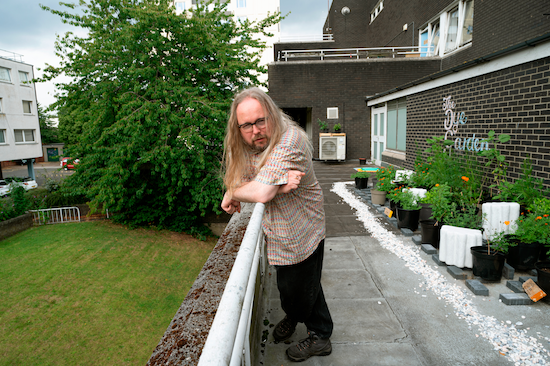
Dawson’s own interpretation of ‘The Hermit’ is that “what’s actually happening is very fixed. But the only way to describe it isn’t like a sentence, it’s more of a billowing out or a foaming. You couldn’t draw a straight line against it, there’s no hard edge,” he explains. “This is how I feel about a lot of things, and I think a lot of other people do too. From the outside it seems like others are having very crisp experiences and engaged with the world and staying on top of things, but really everything’s quite soft. In any moment there’s all these competing things, and just by virtue of being a human you’re in a number of different places at once, which we’re now adding to with phones, virtual reality, social media and so on.
“I wonder if it’s because it’s increasingly hard to keep track of what’s real, even what’s fact and what’s fiction.” he continues. “It seems like opinions have to fall one way or the other, and maybe other people really do have those sorts of opinions, but for me that binary way is not accurate, not enough for the different shades of what we’re all going through and the fact that multiple positions can exist simultaneously. You can have three or four contrasting opinions about the same thing and that doesn’t mean you’re a fence sitter, it just means you can see things from other people’s perspectives.”
When it comes to the scope of the record’s ambition, a complex unfurling across a large amount of physical and auditory space, Dawson took inspiration from the slow-yet-powerful approach of Japanese psychedelic folk duo Nagisa Ni Te, and writers like Thomas Pynchon, Michel Faber and Iris Murdoch. The latter’s The Sea, The Sea, about an ageing and embittered stage actor who retires to a remote coastal cottage, “is fascinating. It’s kind of dull, but the atmosphere is so cloying. I only started reading Pynchon midway through [making The Ruby Cord], but the scope of Mason And Dixon and Against The Day was inspiring, the bravery of the language… it doesn’t make any concessions.” Such writers, he says, gave him “courage” to be expansive. Dawson isn’t worried about what people might think about his inspirations, believing that “you have to put that to one side,” but as an artist “you do have options. You have this music which could be more suggestible if you were to take it in another [more concise] direction.” The Ruby Cord’s long running time “means it’s going to be a lot less suggestible and harder to engage with. You should never choose that route unless there’s a reason to.” The ambitious books and bands he turned to helped assure him that he had that reason, that “this is gonna be better if we take the harder route.” Long-time producer and collaborator Sam Grant, who runs Newcastle’s Blank Studios and performs in Pigs Pigs Pigs Pigs Pigs Pigs Pigs, was helpful too; the two repeatedly pushing one another further outwards. “’The Hermit’ was never gonna be 40 minutes long, but once we got into it I guess we just egged each other along.”
Grandiose as it is, it is possible to look at The Ruby Cord as part of an even grander creative work. Given that this album is set ostensibly in the future, the fact that its predecessor 2020 was a collection of songs concerning characters in the present (footballing children, dejected civil servants, UFO enthusiasts) and its predecessor Peasant was set in the pre-medieval North-Eastern kingdom of Bryneich, means that they might easily be grouped as a trilogy. On each of the three records there is a track called ‘No One’ that sticks out among the rest – each a cut of eerie and mangled static, perhaps the sound of the wormhole through which one travels between the timeframes of the three records.
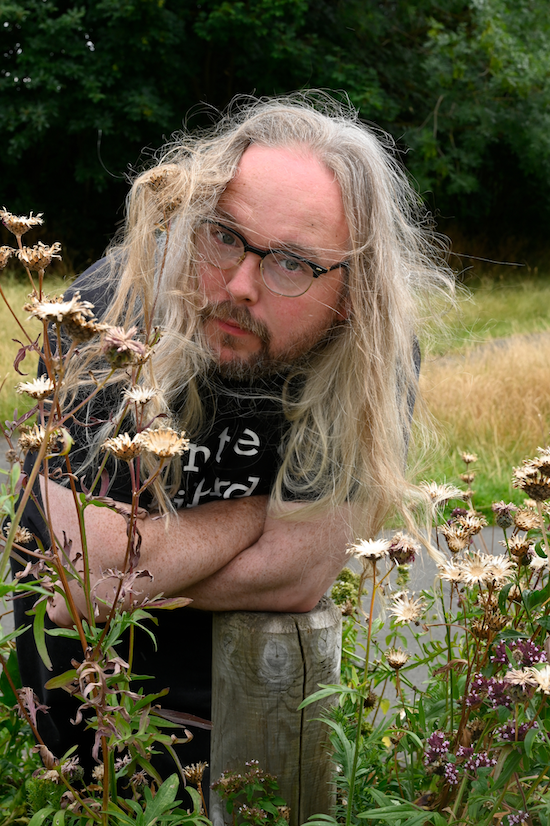
Again, Dawson won’t be drawn into a firm answer. Of ‘No One’ as the song that links the three records together, he says “I guess we’ll see if I do it on the next album as well.” He concedes at least, “it’s a possibility” that the three are a trilogy. “I see how they’re connected for sure. But they should stand alone as well. I’m not trying to be evasive or anything, it’s just not such a crisp answer.” The boundaries between ‘past’, ‘present’ and ‘future’ are not as immutable as you might think. On ‘Ogre’ at the beginning of Peasant, a character awakes terrified from overwhelming visions of what sounds like the future metropolis of 2020: “Blinding colours leap along bemirrored tower walls / Stretching as far as the eye can see.” On ‘The Hermit’, the narrator describes what appears to be a robot, but is in fact an ancient knight who has glitched into the ground like a malfunctioning video game character.
It is telling that the vernacular Dawson uses in his songwriting does not alter much between Peasant and The Ruby Cord, the virtual realities of the latter are talked about in anachronistic turns of phrase better suited to the former. On ‘The Hermit: “Vaporous shafts of a burgeoning sun / skewer the forest-floor onto a world fresh begun / all in the Name of the Harvest”. On ‘The Fool’: “I saw Ruth atop a dun Clydesdale in a pilgrim’s caravan.” Similarly, whether in dystopia or virtual reality (the distinction is never clear), there is a similar feel of the ancient and/or pastoral as there is on Peasant. The protagonists of ‘The Tip Of An Arrow’ reside in the ruins of a Roman villa, fashioning arrowheads from the skulls of the dead. Lovers on ‘The Fool’ meet in “midnight trysts” in “almhouse catacombs.” Another early idea for the record, Dawson says, “was that I wanted it to be a simple description of nature, the woods around where I live.” It is not that much of a stretch to imagine the world of Peasant as existing entirely as a conjuring of this kind of virtual reality, 2020 as an exhibit on ‘Museum’. The three albums could just as easily be an endless looping cycle as a trilogy.
In our hour and a half together on Zoom Dawson is attentive and thoughtful, but there is a sense that he is deliberately holding back from overt explanations about The Ruby Cord, a desire not to be drawn into strict definitions. Whether or not there’s any truth to my own ideas about how the project is not all that relevant – the ephemerality and openness to interpretation is the point. Yet from all the fog that blankets The Ruby Cord, one pillar of immutable truth emerges: the record caps off a period of extraordinary creative endeavour. The album might not necessarily be the end of that period – Le Guin’s Earthsea series was a trilogy that was later expanded into a quintet, he points out – “but it is a full stop.”
Richard Dawson’s new album The Ruby Cord is released November 18 via Domino