

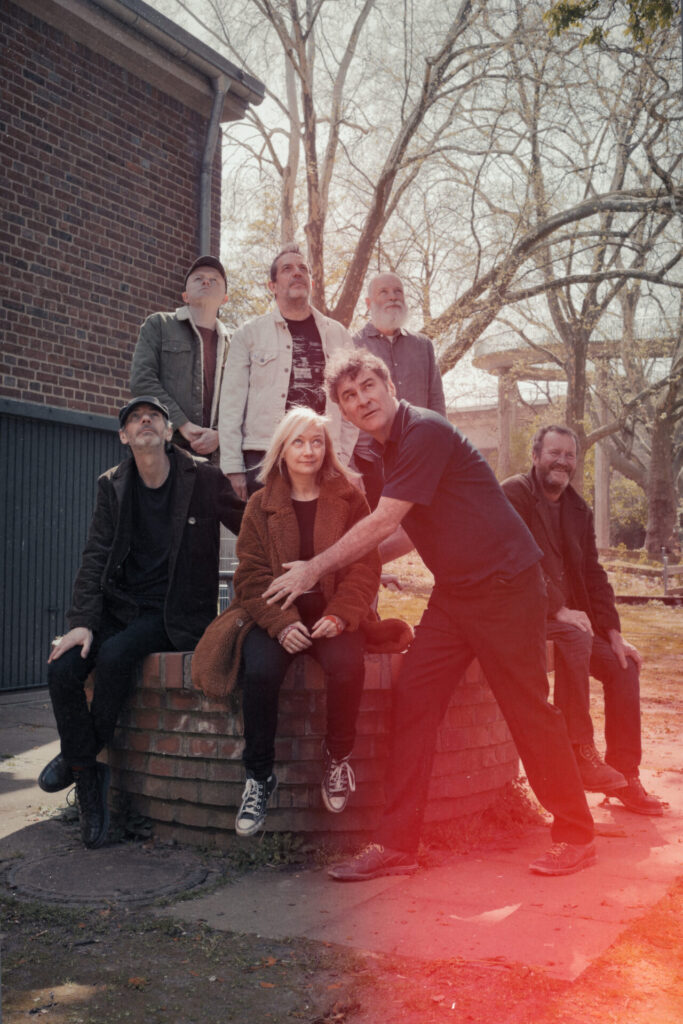
Three of the four members of Prolapse are sitting around a pub table in London, just like the old days, cracking jokes and gatecrashing each other’s sentences. This is a rare meet-up in person, but the energy crackles as it did back in the 1990s, because the play of language and the switchbacks of humour – what could be called banter, if it weren’t for the toxic connotations – is who they are, and how their music is made. “I don’t want to be famous. Never did,” says Linda Steelyard, one of the group’s two vocalists. “I’d like someone else to put my drum kit up,” retorts Tim Pattison.
Their new album marks the end of a 26 year studio hiatus, and comes a decade after they reformed for a gig in London in 2015. It’s called I Wonder When They’re Going To Destroy Your Face. It’s messy, and yet instantly recognisable as them. Mess is actually Prolapse’s core aesthetic – like The Fall or The Shadow Ring or Pere Ubu, new recordings simply present a fresh aspect of an ever-changing same.
In the 90s Prolapse were part of a clutch of British bands – Th’ Faith Healers, Movietone, Hood, Pram – whose playful approach to rock put them at odds with an emerging consensus on how indie music should be done. The rough edges of these groups made them hard to commodify in a decade of aspiration and ambition; they didn’t fit neatly into the movements and scenes being hyped by the media; and they pulled in influences and associations from European and American music that were often missed in UK-centric weeklies like Melody Maker and NME. Prolapse had two vocalists pulling in opposite directions, two or sometimes three guitarists with freedom to experiment, and were a democracy with no explicit leader at a time when British guitar music was valourising conventional stardom and lad culture codes. There’s a neat irony that Prolapse are back together at the moment that Britpop nostalgia, the antithesis of everything the band stood for, is being reheated again in the shape of Oasis, and just as fellow 90s outliers and Too Pure label mates Stereolab have also elected to return.
A conversation with Prolapse is multi-directional. The three band members here today have come from the North East, the Midlands and the Home Counties, and vocalist Mick Derrick adds his thoughts into the mix later on a call from Norway. They reflect on a stop-star career which occasionally gathered significant momentum, with the mature perspective that stardom was probably never for them anyway. “‘Autocade’ was playlisted on Radio 1,” recalls Pattison, referring to a single from 1997’s The Italian Flag. A glossy promo video was shot in New York for the track, one of several Prolapse songs embedding krautrock allusions or puns, “…and then Diana died. In a car crash”. “Perfectly terrible timing,” adds Steelyard. BBC radio playlists hurriedly switched into emergency mode after the fatal accident on 31 August 1997 – and the song’s promotional push stalled. “The curse of Prolapse,” says Pattison.
Of course, a group who cook up titles like I Wonder When They’re Going To Destroy Your Face could be accused of sabotaging their own career (one of Steelyard’s favourite lyrics is “I thrive on auto-destruction”, from 1995’s ‘Move To Limit Slabs’). But you can interpret a band name like Prolapse – which bassist Mick Harrison explains was dreamt up to be as depressing as possible when members of the group met at Leicester Polytechnic – as part of indie rock’s dirty protest against commercialisation via names like Butthole Surfers, Bongwater, Bogshed, etc. Prolapse like to take the piss, they have finely tuned bullshit detectors, and bodily fluids are a natural point of reference for a group who named themselves after a horrific medical condition. They’re the kind of band who found their van had been defaced with the slogan “Big Boy”, and decided to just leave it there for the rest of the tour.
The decision making within the group is and has always been shared, which feeds into Prolapse’s generally unpredictable and volatile dynamic. As Harrison puts it, “if one person didn’t want to do something, fine.” When it comes to the music, as Steelyard explains, “everyone does their own bit. I don’t know what Mick [Harrison] is going to do. Mick doesn’t know what Tim’s going to do. And that’s always been the case. So you couldn’t say to us, ‘make a three minute pop song’, as that’s not how we work.” A discussion about how labour is shared around the band breaks down into a lively back and forth about where the weird sounds actually come from: “Dave [Jeffreys, guitarist] is always coming from a more fucked-up direction,” ventures Harrison. “Was it Dave who could do the sound of rocks being cracked open?” asks Steelyard. “Crchh crchh crchh.”

Derrick, the group’s Glaswegian vocalist whose agitated ranting is stamped on Prolapse like a trademark, rarely listens back to their recordings, because he’s more interested in the alchemy of the moment. The new album was recorded in a few days at Foel Studio in Wales, where Young Marble Giants made Colossal Youth, and several tracks were laid down more or less spontaneously. “I love singers who can’t sing,” he enthuses. Pere Ubu’s David Thomas and Crass’ Steve Ignorant are vocalists who have stuck with him for the way their phrasing, presence and grain of voice run like fingerprints through their music.
Prolapse’s propensity for self-sabotage might have sidelined them during Britpop, but it helps make them a unique proposition. “A lot of the songs I would try and talk over the top of,” Derrick says of how their unique dual-layered songs took shape. “But then Linda would try to talk over the top of me, and it just became layers of voices everywhere coming in and out. It was actually a deliberate spoiling tactic, not just me, but Linda. This sword fencing thing where we’re trying to talk over each other.”
This argumentative energy makes the new album sound as fresh as they did the first time around. There’s the same attack of the voice and crunch in the guitars, and the feel of the air and the amps buzzing in the studio underlines this is music still created spontaneously.
The push and pull between Prolapse’s two vocalists was a major theme in the music press of the era. The song ‘Tina, This Is Matthew Stone’, which depicts two sides of an abusive relationship, became notorious at the time for the two vocalists staging a physical altercation on stage, with real cuts and bruises. Prolapse’s 1994 debut album Pointless Walks To Dismal Places (also the name of an extensive fan resource on the group, plus the title of a blog inspired by Prolapse which does exactly what it says on the tin) received positive reviews, but the band were viewed through an indie rock lens which played up their attitude.
While their reputation for chaos was celebrated, deeper echoes in their work were missed. There’s an echo of kindred spirits The Fall, whose most imaginative themes, from ghost stories to science fiction, were often ignored because Mark E Smith was such a loose cannon – as if that somehow excluded him from being a great writer too. So it’s natural to wonder whether Prolapse’s songs have messages that were missed the first time around. “I can’t recall many occasions when people were asking about the songs,” says Pattison of their interviews back in the day.
One theme that comes into sharp focus now is their empathy with the downtrodden, from drunks and gamblers to night owls and oddballs, whose faces didn’t fit the fashionable and upwardly mobile 90s. In retrospect, the group were ahead of the curve in considering society’s losers as victims of life’s rapacious rat race. “My stuff always seems to be downtrodden women or women who fight back in a murderous, dominant way,” notes Steelyard, who has also made a career as a news journalist up in Leicester. “I don’t know why, I didn’t set out to do that, but that’s always where my brain goes.” Her interest in lives lived hard has deepened since Prolapse’s first incarnation, as she’s delved into her family’s roots in the East End of London. “I’m Gen X,” she says. “I rebel against anything about housewifery, chauvinism. It finds an exit in lyrics.”
Derrick speaks admiringly of Shane MacGowan’s ability to find solidarity and romance with the drunks slumped in doorways in the songs of The Pogues. In the 90s, the band had to slum it, as they jumped from label to label, and they sided with those who plotted their own wayward path through life. “They were the ones we hung around with,” he says with an edge of defiance. “Because they were the ones that were most creative and most fun.” The new album is filled with memorable characters once again, from a man having a meltdown in front of a pavement ATM on opening track ‘The Fall Of Cashline, through to the end of the album, where someone becomes stuck in purgatory at Leicester Forest East services.
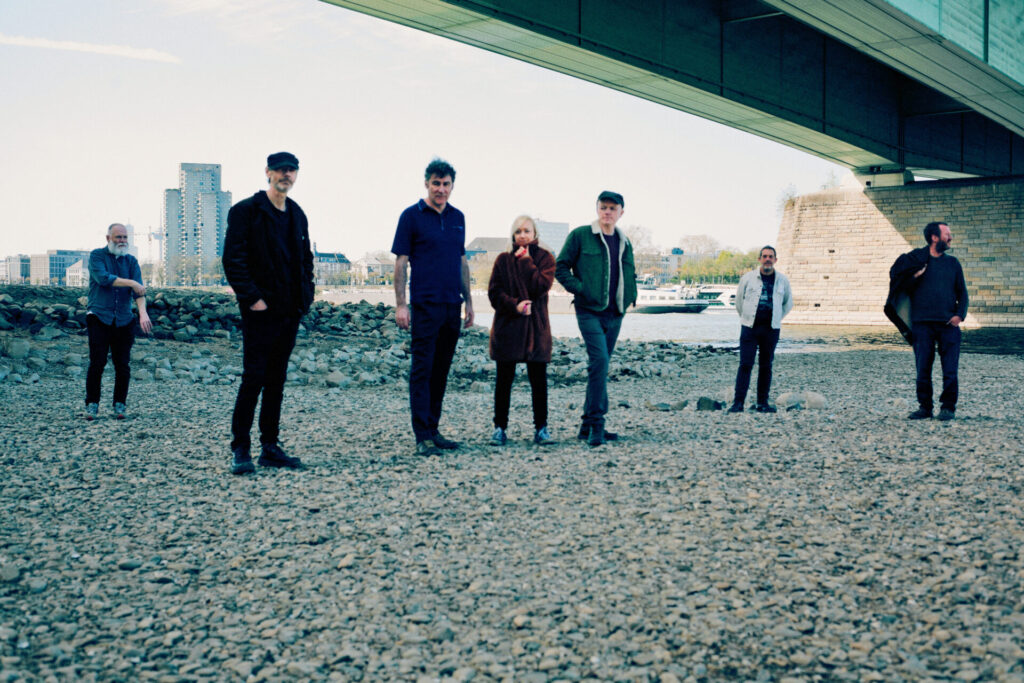
As is often the case when friends meet up after many years away, there’s a melancholy tinge to parts of the conversation today. The song title ‘Err On The Side Of Dead’ came about, as with many Prolapse song titles, from the ping pong of conversation. During a drive down to London, Steelyard used the phrase when talking about old acquaintances. “Your friends lose parents, and sometimes if it’s people you haven’t seen for a while, you can’t remember [if they are still alive]. So I said to Tim, ‘err on the side of dead.’ It’s quite bleak, but it’s life.”
One of the album’s most striking songs is ‘Ghost In The Chair’, which like many songs by Prolapse, and The Fall before them, juxtaposes the mundane with the spectral, via a supernatural visit in a domestic setting. “No really much of a conversationalist… Ghost in the chair, is this the same day?” Each member of the band has their own interpretations of it. “I always think it’s about an elderly guy, his wife’s died, he’s on the edge of dementia, and he’s imagining talking to his wife,” says Steelyard. Pattison and Harrison have had their own personal experiences of dementia in recent years. “When I heard that, it was instantly my mum,” says Pattison. “In the year she was living near us, she was hallucinating a lot. I would go round, and she would say, ‘you’re talking now, but you’ve been sat there all day’.”
There are invocations of mortality throughout the album, however much the band deny that their songwriting has matured. Derrick tells me about a recurring dream he has had for many years: “I’ve moved into a house by mistake, and I’ve paid the rent for a year, and there’s no roof on it. I’ve got a tiny bed in the corner, and there’s a ghost in the other room.” Our chat returns again to The Fall, whose own visions of transitory spaces crop up on songs like ‘Flat Of Angles’. I point out to Derrick that this dream crops up on ‘Err On The Side Of Dead’ – “Cookin’ in the dark in a hoose withoot a roof” – and he realises he has no recollection of singing it: “I didn’t even know that I had even put it into words”.
The more reflective perspective the band now has on its own work extends also to their most visceral song, ‘Tina, This Is Matthew Stone’. “I found it, watching, very uncomfortable,” says Pattison of the physical confrontation that used to be part of its live performance. “Mick and I used to be in a relationship,” adds Steelyard. “So it’s kind of fun to play into that stereotype. But the song is entirely about a really toxic relationship. And we don’t really do that anymore, because it feels a bit… inappropriate for 2025.” Derrick provides an alternative take: “When you see it in front of you, it’s quite uncomfortable, and I like the uncomfortableness. The audience isn’t just there to be entertained, you’ve got to feel something.”
Prolapse’s songs explore a zone in which it’s not always clear what’s real and what’s not. Confronting you with the uglier side of life, it forces the kind of reaction that healthcare or emergency service workers experience, where you find a way to laugh as a way to deal with trauma that might otherwise make you cry. “I do wish we were called something nicer, though,” ponders Steelyard. Pattison trots out an anecdote about one of the many awkward moments being in a band called Prolapse can cause. “I remember [guitarist] Pat [Marsen] saying to me, ‘are we still a joke band?’” The people at the table brighten up and crack a smile. “I think it’s a question that still needs answering.”
Prolapse’s new album I Wonder When They’re Going To Destroy Your Face is released on 29 August via Tapete