

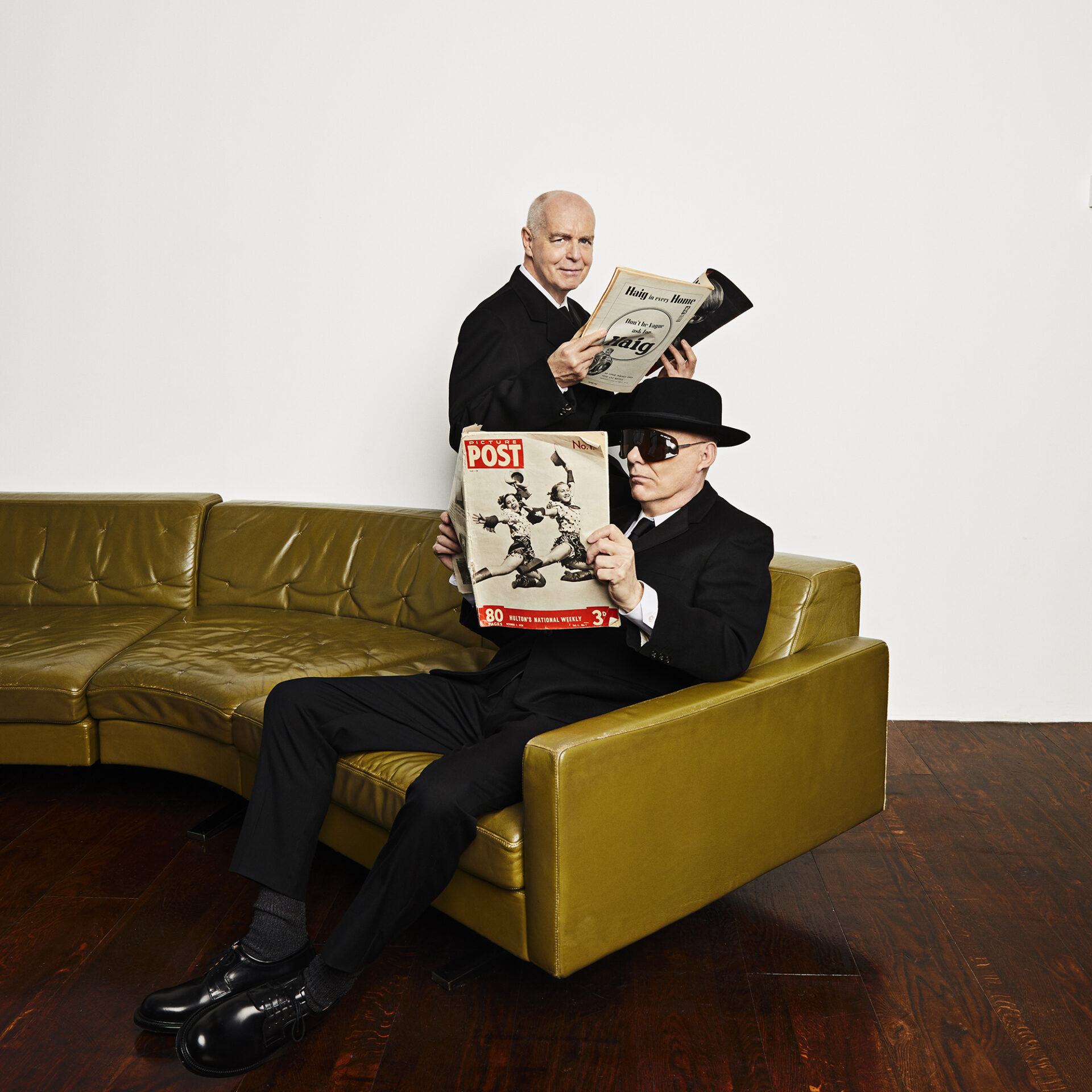
The Pet Shop Boys know what they’re doing. Whenever Neil Tennant and Chris Lowe sit down for an interview, you’re guaranteed a dynamic that’s gold dust for journalists: Tennant delivers thoughtful reflection and piquant quotes, Lowe jumps in to offer asides or take the mick – deadpan, down to earth. Take this exchange on the 18-year-old singer’s first meal in London when he arrived to study history at North London Poly: The wide-eyed boy from Newcastle found the plate of spaghetti Bolognese and chips rather exotic. “Spaghetti didn’t exist in those days,” Tennant reflects, pouring a glass of water in a meeting room in the Pet Shop Boys record label, Parlophone. “You didn’t have spaghetti on toast?!” Chris Lowe replies, incredulous; “What did you have for your tea?” He asks if you can still buy tinned spaghetti at the supermarket. “I might treat myself.”
This disarming interview style has long been part of the considered way that the Pet Shop Boys present themselves to the world. It’s suave, saying much while giving little intimate detail away, as much a performance as Chris Lowe’s onstage uniform of sunglasses, hat and persona based around standing very still. They’ve always been at it: that line from ‘Left To Your Own Devices’, “Che Guevara and Debussy to a disco beat”, is oft-quoted because as an artistic mission statement it has rarely been bettered in pop. A poacher turned gamekeeper, former music journalist Neil Tennant knows how to do a writer’s job for us, or at least, steer us into writing what he wants. Few artists have been quite so good at maintaining such a coherent aesthetic, a multimillion-selling knack of dissolving the boundaries between high and low art in an unrivalled four-decade catalogue of bangers and ballads, the latest addition to which is fifteenth album Nonetheless – as ever, a perfect one-word title into which you might jump for meaning. On the surface at least, they seem entirely at ease with the process of being a ludicrously successful pop band (they’re at Parlophone to sign thousands of limited edition records) and their return to a major label after three Stuart Price-produced albums on their own imprint, x2. “It’s like punk never happened,” Tennant says cheerily of the move, while Lowe adds, mouth full of chocolate biscuit, that they were wooed back by an improved royalty rate on streaming.
The last year or so has been a time of taking stock as the Pet Shop Boys hit a collection of auspicious dates. Tennant approaches his 70th birthday this July. Their debut single, the original version of ‘West End Girls’ recorded by Bobby O, came out 40 years ago in April. They released Smash, a 55-track singles compilation last year, and their Dreamland Greatest Hits tour is ongoing. They’ve become darlings of the BBC, all over Radio 2 and recently granted the honour of an episode of Imagine devoted to their career. Just last week, they released the Furthermore EP – four re-recorded versions of some of their classic singles, including ‘It’s A Sin’ and ‘Being Boring’. Given these are peerless within the English pop canon, is this an interesting experiment just because they fancied it, or a way of remodelling for relevance?
It’s arguably an unnecessary move given how artfully Nonetheless, and some of the B-sides released around it, revisit their career to understand where they’re at today. Fittingly for a record at such a significant anniversary and amidst all their Greatest Hits activity, there are all sorts of call-backs to earlier material. It features a piquant set of Pet Shop Boys signifiers – a Tennant rap, the recurring theme of London, songs about historical characters including Oscar Wilde and Rudolf Nureyev, geopolitics, niche artistic scenes. The music does recall their late 80s and early 90s self-styled “imperial phase” (another of Tennant’s gifts to music journalists) but aided and abetted by producer James Ellis Ford it never comes across as dated. Things were also freshened up by a new approach to songwriting enforced by the Covid-19 lockdowns. Lowe persuaded Tennant to start programming so they could work in separate locations. “I thought, I simply don’t do that,” says Tennant, archly. Lowe did his best to teach him how to use a 70-quid keyboard purchased online, but even he admits to being not entirely au fait with the technology which they’ve written so many hits. “We’ve actually managed to get far without being able to programme or do anything,” he says; “we’ve always used Pre-Set Number One”
Is this enthusiastic, if perhaps slightly put-on, amateurism a means of hanging on to a sense of playfulness to keep themselves motivated? “I think the word ‘playful’ is really important, because you have to keep, in your life as a creative person, a link with the playfulness of childhood,” Tennant agrees. “A lot of people cut that link – there’s that thing in the Bible isn’t there, ‘when I was a child I thought as a child’? Well actually, we still think like children, because that’s the source of our creativity. Playfulness, pretending, that’s a huge part of what we do, so it still feels fresh.”
Having eyes still set on the future gives the Pet Shop Boys the means of connecting with their past. It’s not quite back to childhood, but the key track on Nonetheless introduces the wet-behind-the-ears youth who had his culinary mind blown by a plate of spaghetti Bolognese in 1972. ‘New London Boy’ is Tennant’s self-admittedly nostalgic reflection on his earliest years in the British capital and sits perfectly alongside ‘Being Boring’, that poignant 1990 single about the friend who moved South with him, and later died during the AIDS pandemic. ‘New London Boy’ is also inspired by David Bowie, both via his underrated 1993 track ‘Buddha Of Suburbia’ (a Tennant favourite) and 1966 B-side ‘The London Boys’, about glam rock kids who’ve fled suburbia for mod, pills and “flashy clothes”. Tennant simply replaced Bowie’s mods with the glam rock world of less than a decade later. “It’s me looking back at my late teenage years, the idea that you’re growing up, wondering what’s the future going to be,” he says. With no family money to back him up and “nowhere to run to”, Tennant was by necessity a driven young man. His early jobs included working in the old British Library, wrists itching from bites from a species of mite that only lives in old leather book bindings, and hearing tales of sex among the book stacks. After a day in the fusty archives, he would go back to his Tottenham flat to eat a Fray Bentos tinned pie, drink Van Du Maroc (50p from the local offie), and head down the Victoria line to gay club Shagarama to cadge lagers (also 50p) from older men. “We used to use the word shjushy, everyone was wearing silk, wearing make-up, men with foundation, sjushing around,” he says, “it wasn’t butch at all.”
‘New London Boy’ lyric, “I know where I have to go to unlock the secrets of me” will resonate with anyone who has felt the allure of places like this in the big city, the opportunity they offer to escape the confines of where you grew up, especially in England – the quiet oppression of the creosoted fence, the homophobic jibe or the threat of violence of a Friday night. For Tennant in the early 70s, London was the solution, in all its complexity. “Me and my friend got thrown out of the Regents Palace Hotel because they thought we were rent boys – of course, we were thrilled to pieces by that,” he says, “We were wearing long coats and Biba scarves and were mincing about. It was all exciting, though I had girlfriends in those days and it took me a while to come around to the idea of being a homosexual.” He draws the word out, mid c20th style, emphasis on the “sexsua“, as if it’s an unpleasant sour taste.
The song is a return to what inspired them four decades ago. ‘West End Girls’ came from a long-vanished drinking establishment called The Dive Bar. “’West End Girls’ comes out of seediness, and the Dive Bar was very seedy,” Tennant say, “Seediness is firstly fertile, secondly it has a sort of glamour, doesn’t it? The man behind the bar would be playing a Barbra Streisand live album. There were creepy pictures, hand drawn, of her, Liza Minnelli and Shirley Bassey. It was what we used to call ‘tragic’. We loved it.”
Chris “We were never out of there!”
Neil: “We were connoisseurs of tragedy.”
Chris: “We really miss tragic bars like that”.
Neil: “Even in Berlin they’ve gone…”
Chris: “The sort of place where you could go, on your own, in the middle of the afternoon, and just feel completely tragic.”
It doesn’t exist anymore does it? I suppose Wetherspoons, but perhaps that’s just grim.
Neil: “No, there’s a difference, even though grimness itself can have an appeal. Those places were really seedy.” The first time the band played Top Of The Pops they went to a a club on Wardour Street where the clientele was made up of “ancient gay drunks who should really have been in Brighton, and a smattering of rent boys.” Nobody believed them when they told them what they’d just done, but the next time they went back the episode had been broadcast, “and our status changed”. Soho started to change with them. The seamy, sensual city they sang of on ‘West End Girls’, ‘Kings Cross’ and now ‘New London Boy’ has all but vanished under waves of gentrification. Tennant thinks they might have contributed to the cleaning up of the Dive Bar as, during their time as regulars revelling in its tragedy, it became fashionable. “We always suspected that the first version of ‘West End Girls’ had had some kind of weird effect on it,” he says. It’s interesting that a duo who spent a lot of their career dictating, or leading the commentary on, cultural change are now starting to sound a little uneasy with it, wondering where they fit in. If ‘New London Boy’ looks back to Tennant’s youth, then ‘A New Bohemia’ is a lament, not necessarily for sleazy bars, but the feeling of being part of a creative community. They miss the Groucho Club of the 1990s, for instance, where they hung around with the luminaries of the YBAs, Britpop musicians, “publishers and people who worked for Channel 4.” It’s all left them feeling one step removed. “We don’t seem to be part of a scene like we used to be, and life is somehow less Bohemian,” Tennant says; “social media and the digital revolution, whatever you want to call it, has made everything more professional. There are all these micro-decisions that endlessly have to be made. You can’t just flounce in and do your thing, or stumble down a flight of stairs and discover something. It makes life claustrophobic. I think we’d both like to find a new Bohemia”.
Chris: “I think it probably involves going out a bit late”.
You go to Berghain!
Chris: “We go at teatime!”
I’m not having that, you can’t say that’s the polite tea party time, Sunday afternoon at Berghain is when it’s getting the most interesting
Neil: “I was going to say, it is quite decadent to go there.”
Chris: When I lived in Clerkenwell, I’d see people park their cars on a Sunday and go to Trade, and that’s just cheating. You’ve got to put the hours in.”
Neil: You’ve got to turn up at midnight, haven’t you? We go for two hours, then we go for lunch. The days of going home and thinking, ‘Oh God it’s light’ are over. But [‘A New Bohemia’] isn’t about going to a club and getting twatted, it’s more the scene, and bumping into people.”
There’s certainly a sense throughout Nonetheless that, though this is a confident album, there’s an element of reflection of where they sit in the wider cultural, and especially pop cultural, firmament. The biggest mainstream impact Pet Shop Boys have had in recent weeks was an old-and-social-media storm when, during a live Q&A for The Guardian, Tennant suggested that Taylor Swift’s music was “disappointing” and critiqued contemporary pop’s reliance on relationship drama and the self alone for subject matter. “I complain that people’s song lyrics are like diaries,” he says. Just as when interviewed by my colleague John Doran, Tennant referred to Swift as “the Mrs Thatcher of pop music”, I’ve a strong suspicion that he drops the occasional Swift bomb fully aware that’ll it’ll reverberate around the internet for days. A calculate move, then? Perhaps, but not a desperate one. It’s a fair comment given Pet Shop Boys instinctual ability to use the personal reflectively, rather than to the ends of over-emoting. And of course, that’s not all there is. The former history student clearly remains fascinated by the subject, continuing to populate his songs with a glittering cast in which megastars meet the marginalised.
‘A New Bohemia’, for instance, refers to Les Petites Bon-Bons, a 1970s radical queer music-obsessed activist and performance collective from the US Midwest. Elsewhere, the teenage Neil Tennant is joined by characters in a state of oppression – gay ballet dancer Rudolf Nureyev’s defection from the USSR (‘Dancing Star’). Oscar Wilde watching boys cruising for trade on the sun-kissed promenade in Nice (‘Love Is The Law’), and the melancholy of visiting a loved one in prison (‘Feel’). The fantastic video for ‘Loneliness’ features a glory hole, one of those now-rare scraped and scratched openings in public lavatories that allow men (often those on the down-low) to find a sexual release quite literally out of a closet. Recent B-side ‘Party In The Blitz’ taps into Tennant’s fascination with “the intensity of the experience in the Second World War, the cheapness of life” and its effect on libido, the possibility of knee-tremblers in Soho with American GIs during in the privacy afforded by the blackout. There’s another call back to Pet Shop Boys past here too. The track is a “cousin”, as Tennant calls it, of the B-side to their debut single, ‘In The Night’, in which French bohemian dilettantes (known as les Zazous) faced the threat of a nocturnal “knock on the door” from the Gestapo or Resistance alike.
There’s an anxiety to these songs, people persecuted for their sexuality of their art, imprisoned or cornered by circumstance. It’s where the wider, historical characters connect with the Neil Tennant of ‘New London Boy’, ‘Kings Cross’ or ‘Being Boring’. “A friend of mine, who has known me since Newcastle, pointed out to me that I’m always writing about escaping, and I do have a fear of being trapped,” says Tennant.
Chris: “Try being on a plane with him when they close the door.”
Neil: “I’m fine! I’ve taken half a valium. It’s subconscious, but I definitely have a fear of being trapped, and also trapped in certain situations.” In the 70s, Tennant would reply to ‘talent wanted’ advertisements placed by music publishers in the NME and Melody Maker, playing his songs on guitar or piano at auditions. One executive told Tennant that he just needed to develop his craft a little more. “Well, they were absolutely right,” he says, “otherwise I would have been a failed, mid-70s singer-songwriter. There’s part of me that’s haunted by the thought of that. I’d still be in a bedsit in Acton, still trying to write pop songs.”

Tennant’s time working for Marvel Comics in the late 70s and as editor of Smash Hits at the start of the next decade is much discussed, but less well known is his tenure as production editor of The Dairy Book Of Home Management, a 364-page encyclopaedia published by the Milk Marketing Board in 1980 and sold for £1.99 on milk rounds. It gave tips on topics including gardening, cookery, legal matters and how to write a condolence letter. “Whenever something is going wrong and things are a grind and it’s tense, I always think, ‘Well, at least it’s not as bad as The Dairy Book of Home Management’,” he says. He had ten weeks to put the book together, a time he describes, in what might be said to verge on a hollow whisper, “a fucking nightmare”. When Tennant discusses this, or the other life in which he’s a failed singer songwriter in a bedsit somewhere that bit too far west, for a second or two he seems genuinely worried that he perhaps, still hasn’t quite made it. The Pet Shop Boys continuing spark comes not just from a desire to hold onto the playfulness of the inner child, but also a fear of that child never quite realising his full potential.
“Music, for both of us, has given us our lives, without having to rely on other people,” Tennant says. “The lives we’ve created comes out of using our wits. We’ve never ever been surrounded by ‘yes’ men or women, we always have to justify what we’re doing. But that’s good, because then you feel satisfied if it works and if it doesn’t you’ve got no-one else to blame.”
It’s an attitude of self-sufficiency that’s striking, even in the context of their return to the world of major labels, with millions of records sold, and their status as near-national treasures. Much as Tennant decries the “professionalism” of the social media age, that surely is what the Pet Shop Boys have always achieved. Whether the changing economics of music-making means this is a generational privilege is another argument, but there’s no doubt Tennant and Lowe have done everything on their own terms. Perhaps that long decade between Tennant’s move to London in the early 70s and the release of ‘West End Girls’, the frustrations of touting his musical wares, even the DIY skills learned from The Dairy Book Of Home Management, just gave them a greater hunger than most.
Back again to the beginning, when these two new London boys met one another at the Chelsea Record Centre, 203 King’s Road, in the summer of 1981, and the Pet Shop Boys were born. “We’re very much Northerners, with noses pressed to the plate glass windows feeling like outsiders – in a good way,” Tennant reflects. That “playfulness” that keeps the Pet Shop Boys inspired might come from retaining not just the easy creativity but also an enduring discomfort of youth. “When I was at school I used to think I’m not like other boys, and in late adult life I still have a sense that I don’t really fit in, I’m a bit strange,” Tennant says. It’s often struck me, and probably why the music of the Pet Shop Boys continues to resonate so strongly with me as I age, that for a lot of LGBT+ people the adolescent sense of difference endures far later in life than it does for heterosexuals. These no-longer-quite-so-new-London-boys are, for all the fame and record sales, curiously on the margins, still tapping into a sense of being slightly removed. Maybe they don’t need to find a new Bohemia, after all – they’ve just created their own.
So what are The Pet Shop Boys now, forty years in? The writer Michael Bracewell once told the duo that their work was like a “great dynastic novel, because you could look at our output as a social history”, with songs that over the past four decades have commented on privatisation (‘Shopping’), the AIDS crisis (‘Being Boring’), social media (‘On Social Media’), and so on. Tennant sees the Pet Shop Boys, from ‘West End Girls’ to ‘New London Boy’ as something even grander. “The Pet Shop Boys songwriting and record-making we set up to be specific to us, to create our own world,” says Tennant. The recurring themes, characters who wander in and out, from friends to historical figures, musical collaborations, literary references and lyric books, elaborate stage sets and choreography, soundtracks, a feature film, a ballet and so on are “all part of the same artwork; an artwork that keeps on growing…”
Chris: “Shall we commission a tapestry?”
Neil: “Like the Bayeux Tapestry?”
Chris: “Why not?”
But before the Pet Shop Boys start threading the needle as their artwork expands into its fifth decade, there’s a few thousand records to sign in a corporate record office in the middle of South Kensington, before going to dinner with their old friend, the broadcaster Janet Street Porter. One imagines that wherever they’re going, spaghetti hoops won’t be on the menu.
Nonetheless is out now via Parlophone. For more information on Dreamworld tour dates, including a run at the Royal Opera House in July and at London’s KOKO on Sunday, 26 May, visit the Pet Shop Boys website.