



On 6 October 2001, the England men’s football team were trailing Greece by two goals to one. If that scoreline held, it would end their hopes of qualifying for the following summer’s World Cup – a national disgrace. Deep into stoppage time, however, David Beckham stepped up to whip a now-iconic free kick into the top left corner, rescuing not only England’s campaign, but his reputation. The goal ended his pariah status bestowed after an ill-timed red card against Argentina three years earlier. In the aftermath, he had been spat at and verbally abused in the street. In one pub his effigy was strung up and hanged, and during a later club game his team bus was pelted with rocks. He would later reveal that the extremity of the backlash left him with clinical depression.
Watching as Beckham was liberated by the sound of the anarchic, frenzied celebrations that greeted that goal, a young boy named Nadeem Din-Gabisi (also a fan of the footballer’s all-conquering Manchester United) was enthralled. “I was screaming, cheering at the top of my lungs,” he recalls over coffee in King’s Cross 23 years later. “It was my team, the country I live in, the country I’m from. I really wanted to support England.” That was, he says, until they came up against Brazil in the World Cup quarter finals. Brazil were a different kind of side – diverse, fashionable and slick, their superstars forged in the heat of favela street games, their superior street smarts putting that England team to the sword. For Din-Gabisi, the son of Sierra Leonean immigrants, he became aware for the first time that, as he puts it, “I was seeing myself represented more by Brazil. I wanted to support them instead.” Ever since, he’s been left with “this weird juxtaposition between really wanting to support England, and also wanting to see them lose sometimes. At home, I’m often told by my mum that ‘you’re English, you’re born here, so support them,’ but then sometimes you want to rebel against that and support Sierra Leone, or any other nation that isn’t affiliated with the yoke of empire.”
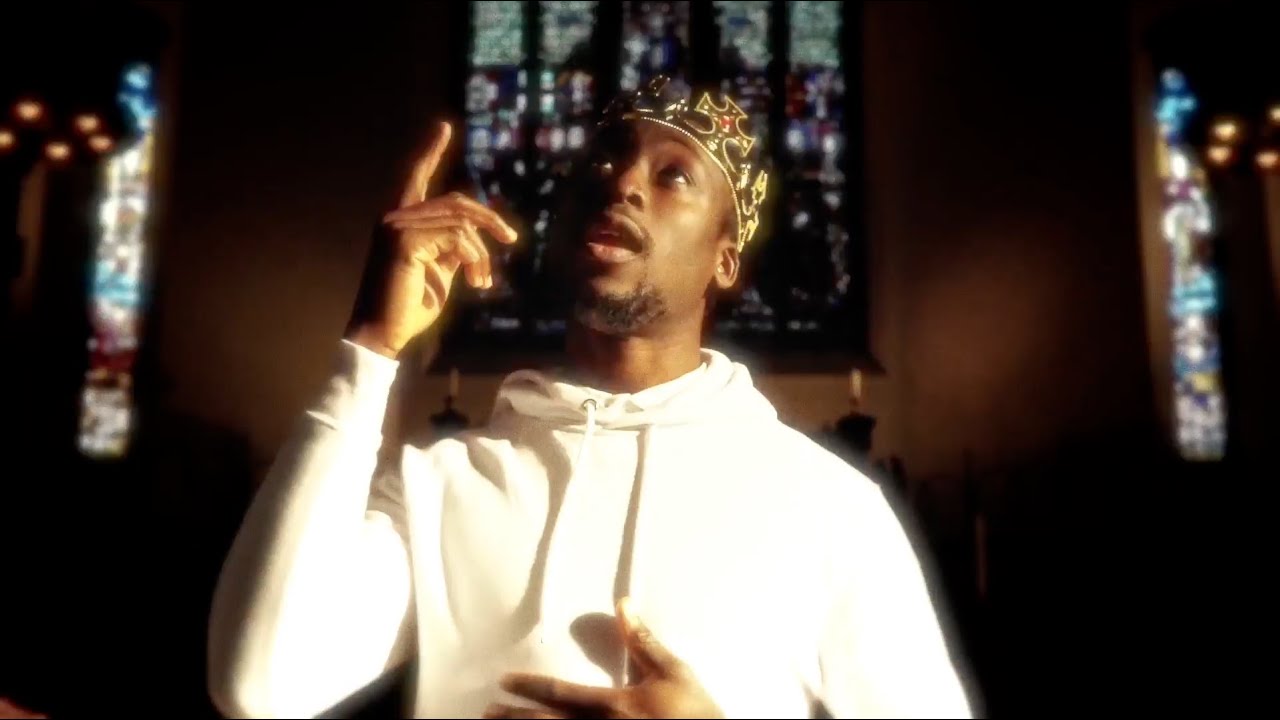
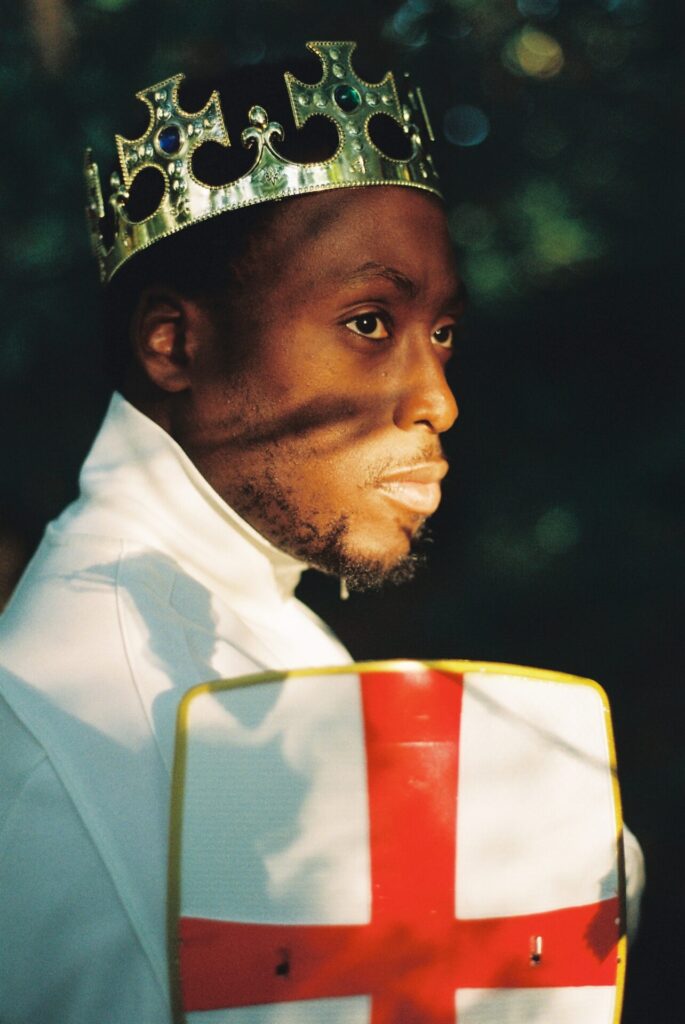
On a superb new album Offshore, Din-Gabisi takes that relationship with football as a foundation to explore broader complexities of identity, both English and diasporic. In order to not be too constrained only by his direct experience (though it is highly autobiographical), he has developed an alias for the project, ‘Jack Surname George in the Land of Hope and Glory’ in order to do so, a figure who garbs himself in sporting paraphernalia: red and white beanies, caps and tracksuits, adorned with the St. George’s cross. “Often the far right will use the flag and this iconography, or use football, as a means to alienate people and to make them feel scared. I wanted to be like, ‘No. This is a country I live in. It’s a country that my ancestors have paid a price to be in and to belong to,’” he says. “That’s why the sporting iconography is so significant. It’s like ‘If I can have an allegiance to this place, then let me wear it, let me play with it’.” What he does with that aesthetic can be read several ways – an affirmation of allegiance, an ironic statement, an act of confrontation, an act of reclamation, or something else entirely.
The point is that it can be – and is in fact – all of the above at once. Offshore is an album that provides no easy answers or final decisions. Reminders of colonial trauma are peppered throughout the record, in the face of which Jack presents a conflicted figure, embodying the mixed emotions that his creator shares as he wrestles with the question of whether England can be his. Or, under these circumstances, whether he even wants it to at all. Jack has an alternate moniker too: Jack Surname George in the Land of Ugliness and Despair. He flickers between those varying states of mind, offering routes forward on the slinky ‘Enter Claim’ (“‘Nuff man ain’t found peace […] so rip the whole ting up and start again / rip the whole ting up and make amends”), while also shifting into more confrontational mode over the moody groove of ‘Gratis’ (‘‘Burn the empire, watch it burn […] It’s not a question of retribution, it’s a pertinent solution to a society falling apart broken”) and outright rage on the shapeshifting ‘Chariots’ (“Why can’t we be free in the land of milk honey when we make dem man money?!”). On ‘New Wave’ the lyrics relay a dialogue between Jack and an inner demon manifested as ‘jealousy’. “Surely we’ll find a way / Learn from the past and what it has to say today,” offers Jack; “You’ll never reach the place you seek / so why waste precious moments seeking what’s not yours?” jealousy rebuffs.
The push and pull between the empire and the diaspora is also mirrored in the album’s frequent shift between vocals in English and Krio– the most spoken language in Sierra Leone. On ‘Enter Claim’ a Krio chorus reminds Jack that his life is short, that he should waste less time and start spreading light, while the verses find Jack still mired in his mental maze. On ‘Chariots’, the chorus repeats an order in Krio directed to a child: “Grap tinap pikin / see all man dey sing” – to stand up and see the adults singing, while the verses delves into what those adults are singing about: the everyday and existential struggles that they constantly face, and the deep reserves of resilience they draw on to combat them.
Krio identity itself holds lots of complexities, Din-Gabisi points out. The language descends from English and was shaped heavily by the resettlement of Black Loyalists – who had fought on the side of the British in the American Revolution – in Sierra Leone in the late 19th century, after an attempt to place them in Nova Scotia proved disastrous thanks to racial discrimination and harsh winters. Later, it was influenced further by Jamaican Maroons who were deployed by colonial forces to quell a revolt among those old loyalists, with many securing houses and farms of their own in the aftermath, and after that by thousands of formerly enslaved people from all over Africa who were delivered there following Britain’s abolition of the slave trade in 1807.
“A lot of Krio people are quite patriotic. A lot of my family are Masons, or they liked the Queen, they like the royal family. My grandma liked all that pageantry. So I wanted to reference that as well,” says Din-Gabisi. “Also the code switching that happens a lot. My grandma would speak Krio to me, then when she’d answer the phone, her voice would change completely and she’d speak the most perfect Queen’s English. It was fascinating to witness as a young child that you could hold these many persons inside of you.”
For all these complexities, however, Offshore is also an extremely accessible album, full of earworm hooks, spry beats and warm grooves, while Din-Gabisi’s delivery is consistently magnetic. “I think a lot about the idea of ‘Sugar Merecin’ [Krio for ‘Sugar Medicine’] which was a single by an artist in Sierra Leone called Emmerson,” he says. “That song’s not actually about that, but he’s got another called ‘Borbor Pain’. It’s about resilience and surviving, but it’s also one of the most danceable songs, played all the time at parties and weddings. It’s something I get a lot from African music. Fela Kuti’s a great example, where he’ll have a song that’s very upbeat but what it’s saying is very cutting. I think it’s an important thing to get right.”
African music of various stripes was a constant in Din-Gabisi’s childhood. He found out later in life that his uncle Akie Deen had been a producer in Sierra Leone in the 1960s and 70s, with Bunny Mack’s ‘Let Me Love You’ among his credits. But so too – unsurprising given Offshore’s blend of styles – were other influences. His grandmother was as interested in country artists like Hank Williams as she was in old Sierra Leonean stars like S.E. Rogie, he points out. His father handed down cassettes, “a lot of new jack swing,” while his mother would play everything from Buju Banton’s Voice Of Jamaica to Michael Jackson’s Dangerous in the car. On TV, Din-Gabisi lapped up music video channels, “everything from ‘Firestarter’ to Busta Rhymes. Even Westlife.” He got heavily into hip hop via The Notorious B.I.G.’s posthumous single ‘Dead Wrong’ and the soundtrack to the Will Smith vehicle Wild Wild West, both also gifted by his father. “It had an amazing song with Common and Jill Scott called ‘8 Minutes To Sunrise’. It was really inspirational to me because it shows you that you can tell stories [through music]. I was also reading a lot of R.L. Stine and horror books, and it showed me the link, that it was all storytelling, even if it’s abstract or non-linear.”
Also foundational was a role in the choir at an Anglo-Catholic church from the ages of eight to 13. “It was very ‘Ave Maria’ and a lot of English hymns. I really enjoyed being a part of the group and singing. I’m not religious anymore, but it was a warm and inspiring space to be.” He also took part as a junior Acolyte, ringing bells and carrying incense boats and candles, “always wearing different and specific things.” Here (as well as through childhood love of professional wrestling) he developed an interest in costume that carries through today. Beyond just the football connotations, for instance, he reads a lot into the colour symbolism of the St. George’s Flag, “white as purity and red as the blood that people have shed for it,” when put simply. “Also, the idea that we’re all connected through blood, that no one doesn’t bleed.” Similarly, among his costuming when performing live is a lion mask, a prop that doesn’t just hint at traditional English heraldry, but also that of Sierra Leone, “which is named after the Portuguese for Lion Mountain,” he points out. “I’m fascinated by hiding meaning and revealing meaning,” he continues, pivoting to the way the Yoruba deity of metal and work, Ogun, has been represented as St. George in some communities in Latin America, “where they syncretise African traditions that were brought over by slaves, where they would try to confuse the slave masters by saying ‘we’re worshipping St. George.”
Just as Offshore’s sound bears the fruit of this multi-faceted cultural upbringing, so too do its lyrics contain a plurality of meaning. A hypnotic refrain of “everything comes and goes” on the chorus of ‘I Land’ evokes the movement of people that has defined the relationship between England and West Africa for centuries, as well as Din-Gabisi’s own movement between languages, genres and styles. It also, he says, carries an explicit message that hardship and joy are ephemeral things, that storms – like those faced by immigrants trying to forge their path in a hostile land – can be weathered.
Then there is the smooth-flowing and introspective jam ‘B Happy’, where Jack declares that “England is mine and it owes me a living.” Echoes of the same lyric on The Smiths’ ‘Still Ill’ are entirely intentional. In its original context in 1984, Morrissey’s declaration might read as a sly, witty, petulant and sarcastic retort to the Thatcher government. Since the singer’s pivot to far-right politics in the decades since, it might be considered through an altogether different lens. “I was looking at what Morrissey has become, and I felt, ‘OK, we need to take this line from you and place it into a different context.’” Inserted onto a record like this, where they are delivered through the mouth of a second-generation African immigrant, the words take on a newfound confrontational charge.
“I feel that we don’t antagonise the far right enough,” Din-Gabisi says. “You can just wear the same things that they’re wearing, and then they’re confused because their sole identity is in their nationalism. What happens when we are the ones who want our nation to be better? I find that most socialist and left-wing people are incredibly nationalistic. They want their NHS to work. They want buses to work. They want things to be nationalised so that they can be run for the betterment of people in this country. A lot of people who consider themselves far right are not actually invested in the interests of their nation. They’re more interested in attacking low-hanging fruit.” Equally, he admits, the project’s aesthetics might also jar those on the left, “who rarely claim things like the England flag or the Union Jack as theirs, even though we live in this country. I wanted to challenge that notion that we can’t claim these things that no one person owns, or a sensibility.”
He springs from here to the topic of William Blake’s ‘Jerusalem’, and the fact that it has “a very socialist notion that’s always spoken to me,” despite the fact it’s so often placed in jingoistic contexts. “I always thought that what he’s saying is that we’re trying to build for all. A place where everyone can belong and see who they are and claim spaces as their own.” Then again, he concedes, it’d be too easy to lean entirely into such utopian visions. “I think in many ways it’s right for Jack to claim that as his, but the tricky thing is that we’re not all aligned on what it means to belong or to have our own space. For some people it means literally taking it, it’s a visceral, violent act. For others it’s just ‘this is my home, I’m gonna try to share and care and love and be considerate’. The hardest thing about life in general, I think, is how do we come to an agreement about what space is, what place is, how we can exist. I make art because these are unanswerable questions. I find a lot of joy in trying to figure them out.”
Offshore does not shy away from that unanswerableness. On an interlude, ‘Libation’, all the uptempo energy of the record is stripped away to leave just ambient piano and drifting strings, atop which Jack – his voice now a tender whisper – takes stock of it all, the “bodies we lost / Atlantic Ocean graveyard […] Slave ship / migrant ship / same cost,” before a moment of resolve: “Must strive / despite / in spite of / fuckery, injustice.” It is an interlude in the truest sense, a point where the record’s momentum starts to shift, not towards a clean conclusion, but to a point where Jack’s multiple points of view go from clashing with one another to co-existing in a multi-faceted, contradictory whole.

The final song, ‘Shade’, takes a bold conceptual shift, where Din-Gabisi finds inspiration from the troubled South African pianist Moses Molelekwa, who was found dead alongside his wife in 2001; whether it was murder, suicide, or murder-suicide remains unclear. “I was watching something with [the trumpeter] Hugh Masekela and he was talking about Moses Molelekwa and how much he wishes the community could have done something to help him. I thought that was indicative of how we can change these stories.” In Din-Gabisi’s telling, the narrator finds that will to keep going, “a fairy tale ending, almost.” He stresses, “I’ve experienced a lot of death, from quite a young age.” He lost his father when he was young, while his last album Pool was inspired heavily by the murder of his cousin, one of “too many people I know that died at very young ages. So, I’m always wanting to write songs that lift us as people, that change narratives. I feel like it’s almost my responsibility to do that. There’s no shying away from a lot of the things we face in this country, and many countries, that are really hard to deal with. And it’s understandable that sometimes people can’t cope. Those songs are almost like an offering, saying ‘yeah, it’s fucking terrible, but hold on.’”
He recalls a talk he encountered by the historian and political scientist Ilan Pappé, a few days prior to our conversation. “He was talking about how with what’s happening in Palestine we have to imagine better. Obviously, you also have to do everything else to stop it in the immediate, but there’s also that question of how do you build a better world? Capitalism wasn’t built by just bricks and mortar, it was built through people’s imagination. There’s often a despair that overcomes anybody that’s not in a position of immense power, but how do we imagine a better world? Sometimes you have to be fantastical, and a song can be a way to do that. It’s a way to say, OK, we can imagine that this could be better. It might take 50 years, 100 years to build, but we have to plant the seed somewhere. And that’s what I’m trying to do.”
Offshore by Nadeem Din-Gabisi is out now via Moshi Moshi