
There are plenty of lessons to be learned from an adult lifetime spent holding a tape recorder and an A4 sheet of questions. Prime among them should be how to become the perfect interviewee, without actually giving up much of the control you’ve grown used to wielding as an interviewer. Fully formed narrative arcs can be presented either covertly or in a helpfully overt manner; perfectly crafted sentences that scream for rendering as a 24-point-font-size pull quotes delivered as if dreamt up in the heat of the moment and emotionally resonant anecdotes seeded. A gift to the actual interviewer in some cases, a very well disguised curse in others.
I meet Mary Anne Hobbs, conductor of many notable interviews, on the steps of Tate Britain and some light steering is taking place. Not away from a particularly difficult line of questioning, I should point out – the precious few difficult questions I have, she preempts almost before I’ve hit record. That said, I’m being gently but physically steered into the art museum, implacably towards a conversation about a knackered old bus, even though I’m still a couple of hours away from understanding why this needs to happen. And while our conversation was ostensibly intended to discuss her new radio show on BBC 6 Music and her relatively new musical duo with Anna Phoebe and an upcoming performance at Manchester International Festival (MIF), I have to admit I adapt happily to treat our slow circular walk around this Thameside establishment as passage down a lazy river, rather than some notional battle upstream against the current. And yet this relative lack of resistance to the bigger details on my part leads us counterintuitively but directly to one of the most contested aspects of her on air persona; what she freely admits herself is the transmission of an “unwavering beam of positivity”, her discomfort with conflict and the grief this causes her online.
It is this determination to be a cynicism-free booster of relatively weird culture – to express directly how she feels about new music – to a large audience that both attracts and maintains a fiercely partisan fanbase, while repelling plenty of other casual listeners who simply don’t buy it. More cynical music fans, in my experience at least, don’t mistrust her advocacy for this music so much as the volume and texture of her passion for it; arguably a failure of their own imaginations. Who, when no longer in the first flush of youth, could love so much strange new culture, so passionately in such vivid, un-attenuated terms? Certainly not a man who only feels the icy intimations of his own mortality thaw temporarily due to ‘Sandstorm’ by Cast being played once every other hour on the wireless.
If hateful digital encounters and “character assassination” make up a significant part of her daily serving of slings and arrows, she is now sanguine after a perspective-rebooting encounter. During lockdown the designer Virgil Abloh was receiving a large amount of online abuse, leading the pair to talk about coping methods: “He said an incredible thing to me, ‘It’s a condition of the space.’ When I asked what he meant he said, ‘If you want to get from A to B on an aircraft you have to expect turbulence because it’s a condition of the space. And if you want to use the internet to transmit a message from A to B you also have to expect turbulence as it is a condition of the space. I thought the perspective that there will be people who attack you whatever you do or say, was amazing. Accepting that means I now have this tool which helps me remain hopeful and reject cynicism.”
Her passionate advocacy for culture is genuine, if likely dialled up by 15% to balance out the slightly deadening effect of regular broadcast and to combat the pull of other distractions vying for the attention of listeners. It feels like the only reasonable way to to have decades and decades’ worth of conversations with people who are ostensibly complete strangers that still feel intimate and heartfelt is to inhabit a hyperreal version of your authentic self, rather than to inhabit a personality that is completely fabricated. That much feels obvious. The thing that people perhaps should mention, as the yin to this passionate unfiltered yang, is the graft. Every new project she starts feels like it has been built steadfastly on the sturdy platform of previous projects, all leading to this point in time. It’s all about the work. What else is there? When I meet her at the front door of the Tate, I imagine, just for a second, she’s about to roll up her sleeves.
As we walk we’re discussing our favourite albums of the year so far. She reps for aya’s Hexed! on Hyperdub and Rainy Miller’s Joseph, What Have You Done? on Fixed Abode. Of the luxuriously gothic textures of the latter she says: “It’s a masterpiece. He and I actually grew up in the same area of Lancashire. Only the blink of an eye apart in distance but obviously some generations between us.”
Miller himself came up with one of the innovative new strands for her show, which airs for two hours every Sunday at 6pm, starting this weekend. The new slot is called the Director’s Cut, and it’s a simple but great idea, an elegant evolution rather than a mutation or rupture: “An artist will select one of their own tracks and I’ll give them an open-ended space to create a director’s cut. Rainy will be the first guest and he’ll go into the original stems of ‘Mud In My Mouth (Predetermined Definitions)’ from his latest album, in order to re-edit, remodel, extend and embellish it in any way that he wishes.”
Another “floating” feature will centre on a guest delivering spoken word that blurs the boundaries between essayistic lecture and prose poetry, with the first guest being Iggy Pop. Elsewhere, there will be the End Of Days: “It’s about building a library of music. I will invite artists that I love to select one piece of music that’s been really meaningful to them, that they would wish to preserve for future generations. My first guest will be Cosey Fanni Tutti.”
She moves to this Sunday tea time slot after six years occupying a relatively covetable mid-week, mid-morning slot on the same channel, where she performed what felt at times like a complex high wire act with numerous bravura manoeuvres pulled off adroitly; not the least of which was playing a specially commissioned live performance by Sunn O))) to a daytime audience. These events were novel, and they should be celebrated as weird events in broadcasting, but they were genuinely only id-scrambling or transgressive on paper, this music being far more approachable (and enjoyable) than naysayers might claim. (The Daily Mash skit from last year “Mid-morning experimental techno tests man’s commitment to being 6Music listener” – even speaking as a partisan fan of Hobbs’ work – seems unmoored from most actual user experience, although in its suggestion that the most conservative voices in the room might become those most closely heeded in the future, was perhaps unfortunately something of a bellwether.) She treads lightly round the subject, stressing that she sees herself as nothing more or less than the “guardian” of the space she has been given, and would sooner make people feel welcome than alienate them: “That’s the great challenge. It’s like understanding everything that I’ve learned and how to redeploy it in a new space and how to allow it to open out gradually like a flower would bloom, you know?”
She rhapsodizes the thrill of pirate radio, Cool FM and Rinse in particular, as an informative aesthetic, having to drive various points to Brixton to hear certain shows – radio that required work from both creators and users – and how this fed into her eventual role as a dubstep DJ. But more crucial was an attempt to distance herself from what she saw as negative aspects of being a member of the British music press. While still writing for the NME, she threw her lot in with the newly formed London local XFM in 1992, then an independent affair with restricted range and broadcasting hours: “Journalism was very confrontational… it was a case of, ‘Where’s the drama? Where’s the crisis?’ Radio was much more suited to me because I could just be a fan, you know?”
She credits XFM’s then controller, Sammy Jacob, with giving her the most profound broadcasting advice she ever received: “Right before my first show, he walked up to me and he pointed his finger at me and he said, ‘Don’t open your mouth until you’ve actually got something to say’ and then walked off. And I thought, ‘OK.’” This, combined with a formative conversation with Factory designer Peter Saville in which he advised distilling the creative process down to the most essential component parts and dispensing with everything else, became two fixed points on her horizon.
Radio is odd in that it was notionally superseded as a medium way before either of us were born and it has faced numerous widely trumpeted existential threats during the time she has been working. Not that she cares: “Listen to Iggy Pop on the radio and he’ll teach you more in one week than you’ll learn in a whole year if you refer solely to algorithms on streaming services online.”
When pressed about radio as an evergreen format she adds: “There’s something really magical about the present moment as an experience and the connection – the triangulation – between a live audience, a live radio show and the community of artists who you’re representing on air. And you can’t replicate that triangulation anywhere else. If you look across most media other than live streaming, everything offered is dead. It’s all something that’s happened in the past that’s now been uploaded. Radio can’t be replicated.”
The near-three-decade length of her association with the BBC – and in particular her work at 6 Music and her work guiding the game-changing Breezeblock show through 14 years at Radio 1 – tells its own story but an even clearer picture arises from the decisions she made during lockdown. She describes the period as a “very, very challenging time” but says it left her in a good position to observe “something about the nature of radio that became tangible in a very different way in people’s lives at that particular point in time”.
Having just moved back to London and living on her own, she made a deal with her bosses that she would be allowed to keep on broadcasting if she didn’t bubble with other people or ever use public transport. She agreed and this allowed her regular access to a Marie Celeste-like BBC studio: “I’d walk up through the park every day and there was a tree en route. I used to hug this tree on the way into work and it was the only [physical] connection that I had for that entire period. I still walk up to that tree and think, you know, I love you. But walking through Trafalgar Square, each day? It was desolate but you could hear birdsong in central London! There was this incredible blue sky… The clarity of the colour in the sky was the like of which I’ve never seen anywhere else.” And other payoffs? “It was absolutely overwhelming. It was clear a different sense of community was forming. It was a very, very beautiful experience.”
Community comes up a lot in a talk with Mary Anne Hobbs, but it’s not like she applies the term willy nilly. Yes, she found it in a putative form during lockdown, she found it among the biker gangs she hung out with as a teen and later with the people around the DMZ and FWD nights at Plastic People. Which brings us, in a roundabout manner, to the knackered old bus.
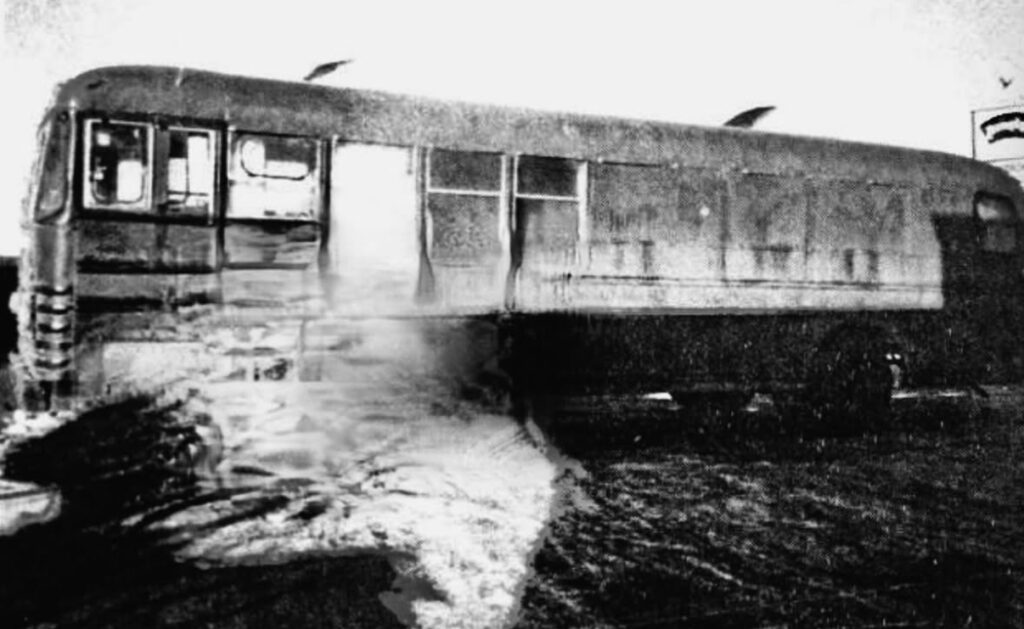
Growing up in a small working class village in Lancashire during the 1970s and having a difficult relationship with her father didn’t come with many advantages, outside of making Mary Anne Hobbs extremely aware of escape routes. After being thrown out of home aged 15, she ended up working in an egg packing plant, her focus, understandably, on finding the little exciting live music that was accessible to her locally. In the nearby market town of Garstang, equidistant between Preston and Lancaster, there was an irregular music event held in a working men’s club: “One day on the chalkboard, a notice went up saying, ‘Heretic from London’. And I thought, ‘That’s it, I’m getting a job with this band.’” After posing a post-gig question to the band – hard rockers with the kind of stages Thin Lizzy inhabited in their sights – what job do you need doing, they conceded that they needed a stage backdrop. After their departure, she got to work on the project, the raw material – old blackout curtains left over from the Blitz – now adorned with the band’s bird of prey logo: “I knew that this was my only chance and I had to take it because if that window of opportunity dropped, there would never be another. So I just thought, ‘I’ll figure it out.’”
She set off to join Heretic, an 18 year old lugging little more than a huge rolled up backdrop with her. When she arrived at the address she had been given, it turned out it was a car park near Hayes, Middlesex: “I hadn’t realised that they lived on a bus. But, my God, it was fucking freezing. We used to sleep with all our clothes on at the same time. We would collect cardboard boxes and flatten them and sleep under layers of it.”
Everyone who stayed on the bus worked day jobs – digging graves, tending bars, making dog dishes in a local factory – and money was pooled to keep the Heretic show on the road, fixing up the vehicle, amps and instruments. The lifestyle was harsh – she screws her face up remembering the 20 minute walk to a “disgusting” public toilet and the degradations to be endured within; food rations were often a bag of chips per day – but it was ameliorated somewhat by the skills she was learning, the connections she was making. Very soon she was the band’s booker, as well as one of their techs, and one of their bus mechanics, plus she was the lighting engineer, the in house artist and the stylist. And, in parallel, she started up her own fanzine. While the last of these roles clearly forms a literal bridge to her future career – it was a physical testament to her skills and drive, something to put in the post to the reviews editor at Sounds Eric Fuller, the thing that landed her first bits of paid writing work – it’s actually what she reveals about the other people who lived in the carpark at that time which is the most telling.
She speaks fondly of a pensioned off “high ranking” ex-military neighbour in a green van otherwise full of animals and hay known only as Dog Man, who was, to her, a sum of inspiring stoicism, uncommon graciousness, practical help with the purchase of chips and the provider of ritual engineering magic: “He was the only person who could get our bus started if it was icy. He would appear with these long iron rods and he would wrap strips of fabric around the ends of them, dip them in diesel, light them on fire and play rhythms with them on the engine of the bus. And as sure as shot, the engine would start.” Another neighbour once invited the homeless rockers round to his container truck for “afternoon tea”, an event that ended up more literal than they had initially imagined: “We were astounded when we walked up the steps into the back of this container. He had a front room laid out almost like Hilda Ogden’s in Coronation Street, with the ducks on the wall, sofas and a circular carpet in the centre. He brought out a cake stand with fondant fancies, some china cups and a pot of Earl Grey. And we sat in complete silence with him for half an hour taking afternoon tea. I think it was his way of just revealing himself to us; his way of saying, ‘I live here too’, you know?”
But after an eventful year it was done. Joyriders crashed a stolen car into the bus, writing it off, desperate attempts to repair it were both heartbreaking and instructive, in as much as they located the actual boundaries of what a DIY attitude was capable of achieving. The termination of their shared dream was formalised not long afterwards when the singer of Heretic was hospitalised with a serious illness due to the extremity of their fringe lifestyle. The band’s tour was cancelled but Hobbs, while devastated, was already starting to write for Sounds. But it was the breadline existence of living on the bus for a year that was her real proving ground. She says simply: “It gave me a different perspective. I very rarely worry about things going wrong in a conventional way. Nothing bothers me now.”

When finally we enter Room 8, Art For The Crowd, she says, “I found out about Tate Britain when I lived on the bus. It was somewhere warm that was free to enter and it was full of all of this extraordinary artwork. So it was interesting to come full circle in a way. To be invited back here to play by Maria Balshaw in 2023.”
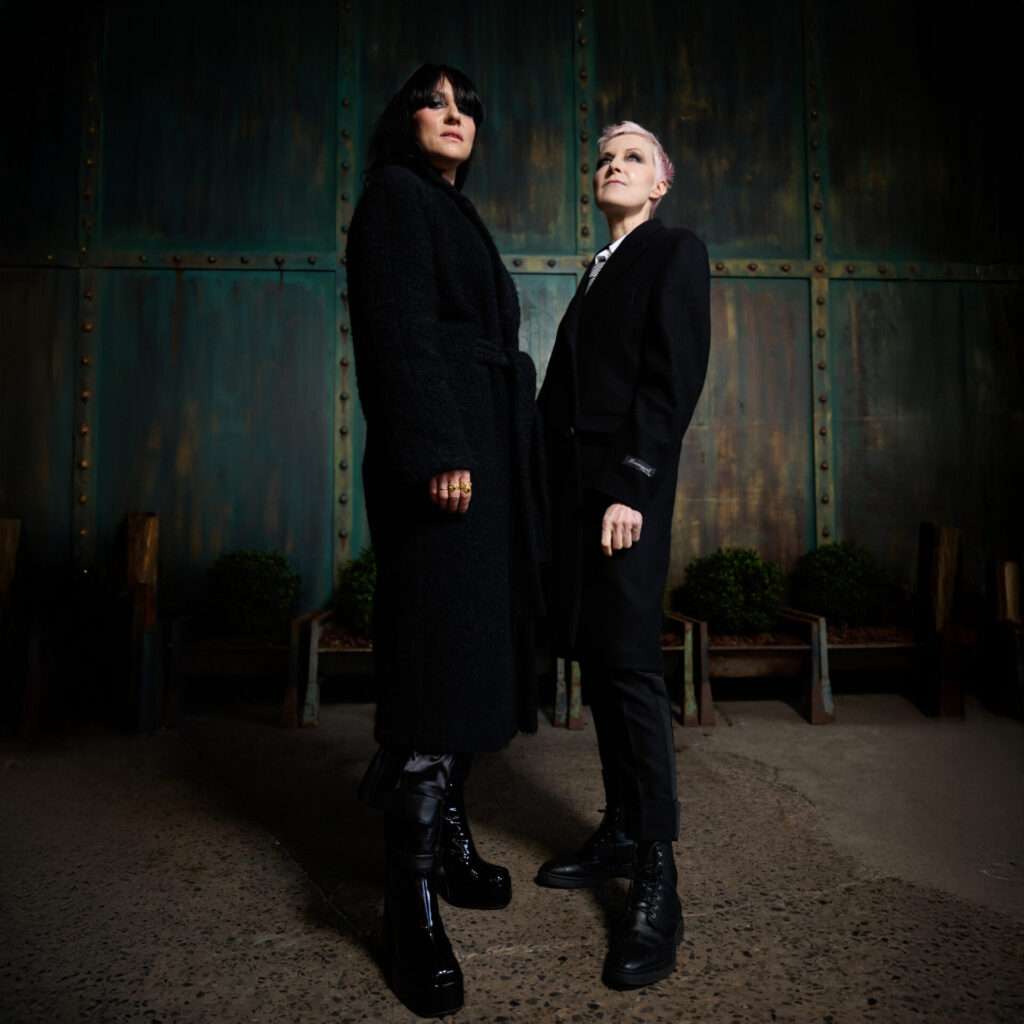
The “living artwork” that the director of Tate Britain commissioned was a debut improvised duet between Hobbs on CDJs and Anna Phoebe – who co-hosts Radio 4’s Add To Playlist – on violin, forging an instantaneous composition of audio in a zone somewhere between contemporary electronics and post classical, in order to celebrate the rehang of the art museum’s incredible collection. She points to where their performance took place: John Martin’s sublime and awe-filled ‘The Day Of His Great Wrath’ (1851-53) to stage right, in front of James Ward’s insanely overcooked but still profoundly moving ‘Gordale Scar’ (1812-14), under the watchful eye of ‘Unknown Man’ (c. 1830-40) and Henry Perronet Briggs’ ‘The First Interview between the Spaniards and the Peruvian’ (1827). Paintings that represented a considered assemblage of new juxtapositions, making the space zing with more contemporary ideas about British art concerning class, gender, race, colonialism and nationalism.
The pair had talked during lockdown, “She was making this beautiful music out by the shore near where she lives. As I came to know her she’d tell me she’d been doing the wildest things like playing [music] with nightingales which gathered in the forest at night time. I thought, ‘Maybe she’s my girl and we could try something.’ She is a free spirit; she has open energy and a huge enthusiasm which is luminous.” When I say this is all well and good but how do you describe what you do in your tech rider, she says: “Well, I’m DJing but not how you’d see me DJ at, say, Fabric; what I’m doing is creating an electronic foundation of sorts over which Anna can improvise on viola, violin and electronics. It’s completely in the moment.” The pair never rehearse in order to preserve as much uncertainty and connection as possible but ahead of the performance they share a map created by Hobbs which persists, in some occult way, as the echo of a visual or graphic score.
The pair went on to support The Smile and the L.C.O. at the Victoria Warehouse as part of the 6 Music festival last year and have two, admittedly high profile shows lined up for this year. After Glastonbury, the pair will present ‘WHAT DO YOU WANT?’ at Manchester International Festival, an event Hobbs has had a long creative relationship with. Just before the festival the titular question will be posed on a giant, otherwise empty, billboard in the city; and it seems this time, encountering the condition of the space might be a big part of the objective. She laughs: “I hope it just gets really, really messy. I hope it’s covered in graffiti and love notes and crazy 4am scrawl.” She reiterates a coolly enjoyed satisfaction, in Daoist terms, about a circular journey completed in her professional life, and drops me off at the front door of the gallery, exactly where we started two hours previously.
Mary Anne Hobbs’ new show is broadcast this Sunday 8 June at 6pm. What Do You Want? is a one-off performance held as part of MIF on 15 July