

Portrait by Ethan DeLorenzo
Over the course of four full-length albums, three collaborative records and numerous splits and experimental EPs, Faith Coloccia has spent the past decade exploring both the highs and lows of the human condition with her band Mamiffer, but her latest album The Brilliant Tabernacle feels like both her most personal and explicitly joyous release to date.
There’s always been a strong sense of family underpinning Mamiffer; though Faith has been the driving force behind the project since day one, her partner Aaron Turner (of Isis, Sumac, Old Man Gloom and numerous other post-metal titans) has been a big part of the band ever since their 2008 debut Hirror Enniffer. More than any other record in either’s discography however, The Brilliant Tabernacle feels like an explicit celebration of family and this special bond, a heartfelt hymn to the beauty of creation and struggles of maternity. It’s not surprising given that Faith and Aaron have recently welcomed their first child, three-year old Ashley Isadore Coloccia-Turner, into their lives.
“Oh, it had a huge impact!” agrees Faith, when asked whether parenthood influenced the album’s writing process. “It started before I became a parent, and then I think becoming a mother helped me to finish all the songs, and to flesh them out and create lyrics. The record kind of contains my whole journey from pregnancy, through the birth process and then becoming a new mother, and parenting with my partner too.”
Whilst Mamiffer’s core sound has always been based around Faith’s piano, earlier albums like 2011’s breakthrough hit Mare Decendrii augmented her twinkling keys with thick, distorted bass, ominous drones and pounding, portentous percussion, finding an interesting place somewhere between doom metal, minimalism and contemporary classical music. Faith’s output has gradually lightened and broadened out in scope – although, despite its sparser approach, even their last album (2016’s The World Unseen) was heavily informed by loss and despair. By contrast, The Brilliant Tabernacle feels like a complete inverse of that record; it’s a warm, bright and inviting experience inspired by the growth of a family unit, rather than the stark, cold sensation of losing a loved one.
“Yeah! I agree, it fit together perfectly for me,” Faith enthuses. “I think it could definitely be seen as a lighter record, it’s less based in loss and sadness than my other records.”
Faith’s voice is also much more of a focal presence this time around, with a lot of the bleak, imposing ambience of yore replaced by shimmering, folky song craft, something that Faith says was very intentional.
“I wanted my voice to be very present, and my breath to be very present. When I was mixing the record with Randall Dunn, he left all of my intakes of breaths in the tracks, which usually we edit out. I wanted the human voice to be very present. I feel like if you could look at my body of work, from the beginning of Mamiffer until now, I think that I’ve been trying to learn how to create just a simple song. Maybe I’m kind of going backwards in a way, than a normal trajectory for song creation? So I feel like I’ve finally learnt how to create a song, with a chorus and stuff like that, whereas before I feel like I was very rooted in abstractness and experimental composition instead of straight-forward song writing. I feel almost like the metaphor of a song structure and what it brings to mind in people, and how that structure can communicate, is what I wanted to utilise on this record.”
Despite this musical evolution, Faith’s original ethos for the project, that it should create “psychedelia without drugs and spirituality without the dogma of religion” is still at the forefront of her mind whilst composing.
“I definitely feel like that is still my motivation, and still inspires me, and even more so now – looking at the world through a child’s eyes is very psychedelic. Raising a tiny human and getting down to their level and the amount of energy it takes is very psychedelic,” she says with a good natured laugh, “and I feel like the only time I have to make music is when I’m already kind of in an altered state, having used all my energy to parent and clean and stuff, so yeah, I feel like it’s still very motivational – maybe even more so.”
As for the spiritual aspect however, The Brilliant Tabernacle is Faith’s most complex and nuanced attempt to reconcile her Lutheran upbringing with a non-dogmatic approach to divinity.
“When I was pregnant I had a dream that myself and some family and friends were sorting through the rubble of the world after the world had ended – or the world as we know it had ended – and there were burned down churches, and old cars and people’s houses, and we were just searching through the rubble. We were tasked with trying to recreate a religion for people and a community of belief. We found a map that said there was a pathway where we were supposed to take our old car to, and it was called the Brilliant Tabernacle. It was in North Carolina, and it was to be our church, so that’s what I decided to call the record as kind of a container for all of these ideas. I was specifically thinking, if I gave spirituality to my child, how would I contain the ideas for him? How would I help him or guide him to have a communion with the self?”
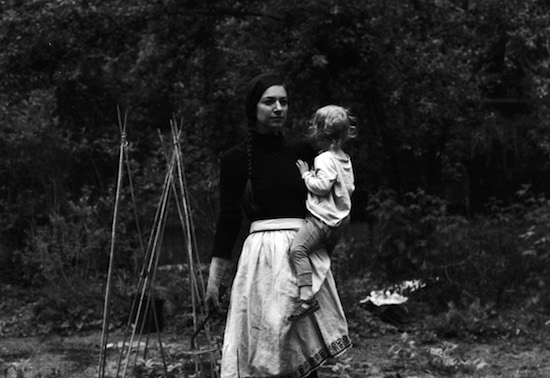
Mamiffer portrait by Paulo Gonzales
The gentle lullaby ‘Two Hands Together’ is one of the only songs in Faith’s oeuvre to directly make mention of “God” too, a much more direct approach than the largely wordless soundscapes of previous outings.
“The intention behind that was to have a parallel between the act of giving birth and the act of creating a religion. I was trying to trace the idea of God creating the world with a person creating a baby, and how it basically seems to be the same process. So when I say things in the song like, ‘Into father’s hands you are born’, I’m trying to mimic, for one, a child actually being born into their father’s hands and then also the act of baptism,” she explains.
“My parents were both Lutheran and my dad was raised Catholic, and so the presence of God and the Bible was very large in our household. Later on in life, my parents were not as based in religion and going to church, and so I wanted to kind of honour what they taught me. I’m no longer Lutheran, I believe in an idea of God and Goddess, but not in the way that I learned where there’s like a guy in the sky watching and judging,” she continues, chuckling at the idea. “So I wanted to honour what they gave me and take what was useful from that, and bring it into my parenting and especially into pregnancy and giving birth, where I felt like I needed to draw on as much support as I could from my foundations in order to do these things, and so that’s why I make a mention of God. I also mention Goddess, so I feel like both ideas are represented, the female and male aspect of what creation and the word to ‘be’ is.”
With parenthood understandably reconfiguring almost every aspect of an individual’s life, it’s interesting to consider the extent to which Faith and Aaron’s musical chemistry may have been altered by the presence of this new life in their household too.
“Oh yeah, I never thought about that,” Faith muses. “I think that we definitely have less time, but we also utilise our time better. I think there’s kind of a super power that happens if you’re creative and you become a parent where you can condense time and know what you want more – because you have less time you have to make better decisions and be more sure of what you need, so I think that the writing process with Aaron and creating music with him has become more fruitful, or more streamlined.”
This could also explain the album’s clear sense of focus – at just under 40 minutes, The Brilliant Tabernacle manages to express a lot of different ideas in a very cohesive, organic manner.
“Yeah, I feel like that definitely has happened for both of us because of becoming parents,” Faith nods, “where you’ve only got a certain amount of time so you have to make it work and make it matter. I guess becoming a parent brings clarity to some parts of life sometimes. I think that’s a major thing that happens to a lot of people.”
Given how explicitly personal the album is and Mamiffer’s penchant for collaboration (they have already worked with the likes of Chicago post-metallers Locrian, Finnish avant-garde legends Circle and multidisciplinary noise artist Daniel Menche), it’s almost surprising that three-year old Ashley doesn’t actually appear on the record itself.
“I want him to see us be creative and know that we have our own lives outside of him, and I want him to see us having a passion, but I haven’t thought about him creating with us yet,” says Faith thoughtfully, before pausing to add that “he’s on a record that me and Aaron did called Split Cranium, and I think that was just by accident – we didn’t have a baby sitter and he was still young enough that he couldn’t walk, so we just put him in the studio and recorded. The cassette label The Tapeworm did a record for Mamiffer and specifically asked for our son to do the artwork, so we had Ashley do finger painting for it.”
Ashley was also present during the mixing process for The Brilliant Tabernacle, but it’s unclear how much of it he will remember.
“There was one song that he would always fall asleep to, and we were kind of amazed because Randall mixes so loudly, it kind of just made our child pass out,” Faith laughs.
Any fears that parenthood might put the brakes on either Faith or Aaron’s release schedule should be put to rest too, as the pair’s creativity seems to be as driven as ever. Faith reveals she has another two collaborative records in the pipeline, with Menche and Circle’s Mika Rättö respectively, as well as an upcoming project with Monika Khot’s electronic outfit Nordra.
“I think it’s very beneficial for me as an artist, and hopefully the people I collaborate with,” she says of collaborating with new people. “I think it’s a really good process to respect someone else’s point of view and how they see the world and how that can affect what you make. Like with working with Monika, I go through my sound archive and I find things that I think she can manipulate in an amazing way, and so it’s kind of like a wonderful act of trust to bring sounds to someone and they manipulate it, and you kind of agree that it exists how it exists, if it’s an experimental collaboration. I really respect that process, for the experiment itself and for the times of feeling uncomfortable if you get pushed outside of your comfort zone, or if someone brings an idea that you would never think of.”