

Erasure’s new album is called Tomorrow’s World, which raises all kinds of questions: are we supposed to expect an album that’s looking forward or looking back or looking back to looking forward? Futurism, retro, or retro-futurism? Especially when it comes from Erasure, a band that’s been going for more than 25 years. Through that time, whatever they’ve done, in that moment, they’ve owned. Soul ballads, high energy dance, operatic heartbreak and gloom and hope – hell, even Burt Bacharach – through it all, Vince Clarke’s arsenal of synths launch Andy Bell’s wounded choirboy vocals so they soar, and whimsical little filigree-pixel synthbursts twinkle in the background.
This is, after all, the band that resurrected Abba from existence as a dated, kitschy (but secretly always loved) retro-pop punchline with 1992’s Abba-esque EP. They went on to experiment with even more, stranger covers on 2003’s Other People’s Songs, where an especially brilliant cover of the Buggles’ ‘Video Killed the Radio Star’ paired an overdose of autotune with a click track high in the mix that could have been swiped from the kind of Autechre mix that makes overcaffeinated programmers type faster.
It’s one thing to play with covers; that’s always an exercise in taking a song out of time and moulding it to an artist’s own aesthetic. Covering songs defines what the cover-er does. But what about originals? How much does production – and the choice of producer – have to do with giving a band’s new songs a signature that is both recognisable and experimental, current without being dated?
Tomorrow’s World is produced by Frankmusik, known for his work producing Ellie Goulding and Tinchy Strider, as well as remixing Mika, Lady Gaga, Pet Shop Boys, and Erasure themselves, and also for performing his own synthpop compositions. This record blends analogue flourishes into dubsteppy scuzz, and layers the odd bit of Melodyne skew on Bell’s voice when it’s at its soulful, belting peak.
Clarke and Bell talked to the Quietus about working with Frank, reality shows and their effect on the music industry, Tomorrow’s World and futures both failed and hoped for.
The new album sounds really contemporary: you’ve got a lot of autotune and more urban, dubsteppy beats, and you’ve been working with the producer Frankmusik. How did you choose this direction, and to work with him?
Andy Bell: We hadn’t met him before, but I’d heard he was a fan. I really liked the remix that he did [of ‘Phantom Bride’ from The Innocents]. He said that his mum was a huge fan of ours, and she couldn’t believe it when he said he was working with us. She was like, ‘Oh my God!’ you know. So it was really good fun working with him. He’s got loads of energy and he lives in LA now, so he’s quite crazy, which I think you need to be in the music business, especially now, because the pressure gets higher and higher…
Vince Clarke: It was really intense. Unfortunately his management company didn’t set us out enough time. It was all a bit full on.
AB: So it was frantic. But I think maybe that’s how it sounds, how it was recorded. He was working, how much?
VC: Five days.
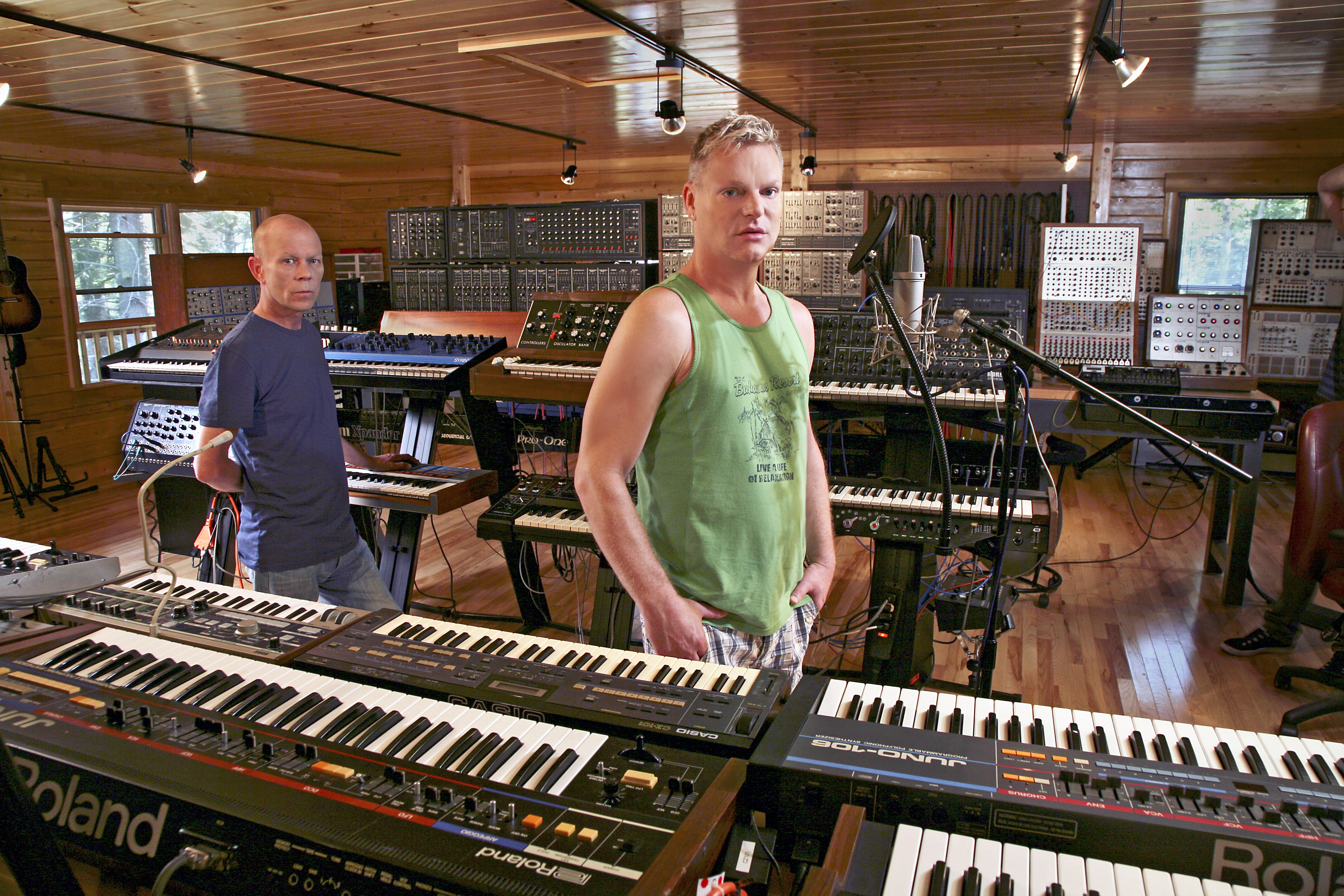
AB: He was with Vince for five days, I was with him for about ten days in the studio, and then we had another ten days doing the mixing. Everything all at once: he was literally working on the music as we were working on the vocals as well. I found it quite hard as well, the singing, because he uses so much compression on the mikes. You literally have to scream, to get your voice through the system. So it was great fun and I think the energy rubbed off. Vince was surprised at how many tracks Frank uses, because when we were doing our own music, we’ll use a minimal 16 or 24 tracks at the most and Frank uses 120…
VC: One hundred and forty two.
AB: One hundred and forty two? [laughs] So he just layers tracks one on top of the other to make it sound really huge. I really like… I loved working with him because he’s very anti-establishment. I think that’s why he’s moved away, because he hates it, he doesn’t seem to like it here. I think it’s really – not you guys, but the whole of the press, you know what it’s like, it’s completely changed. It’s always been a boys’ club, anyway, which we’ve never been part of, really. Moan moan moan!
There’s a German interview that you have up on your website. In it, besides the music press, you also talk about how the whole Pop Idol thing has influenced what kinds of music people are into. Do you think that’s part of the problem?
AB: I don’t know if it’s a huge problem, but it just seems that there’s kind of a vacuum that’s been created. I think a lot of young people, because they’re so influenced by television, and because that’s the only music programme that’s on the TV, they think that’s the only way that you can have a music career, by winning a gameshow, which is quite sad really. I’m sure there are loads of people that don’t think that, who are in bands, but lots of people do think that it’s an instant fix.
It seems that now a whole lot of electronic stars are producers who take whoever has the hit of the moment and remix that.
AB: Yeah, right… and that’s funny as well, because we’ve never been a part of that either, where you get hookups with A-listers or things like that, you know?
VC: I think one thing about that is because everybody’s chasing so few CD sales, you have to make records [into] an event… [The tape goes really quiet here, but Vince explains that spending time in the recording studio is a luxury that’s hard to reconcile with hard-sell, fast-turnaround PR cycles and a demand for constant new releases.] …and the reason is, they can’t make any money unless you’ve got that quantity of work.
AB: And also now you don’t get paid unless the person likes the mix. It’s the same thing everywhere, fashion’s the same, it’s the same for dancers…
On the subject of reality shows, how was Popstar to Operastar [Andy Bell was a contestant on the most recent series]? It looked like that was a lot of fun.
AB: Well, it was quite good fun, up to a point. The hardest thing was being nice to people, you know.
Some of those judges were a bit harsh.
AB: They’re very strange, because they’re really nice to you one minute but then the next… On that last show, the one before I got kicked out, I went down and I was like a rabbit in the headlights. They were all really nasty and it takes you by surprise. You’re just like, ‘God, where’s that coming out from?’ But it’s all for dramatic effect. I totally went into it with my eyes wide open, which… well, you think I would know by now… [Vince Clarke laughs] I honestly went in there with my eyes wide open, thinking I’m going to learn all this stuff about opera and about how the system works. I saw a few clips on YouTube of the show from the year before, just the performances and stuff, and I thought it was a bit cheesy but that if I got really into it, it might make it a bit more credible. But then towards the end I thought, well, no, actually, it’s not going to, it is what it is, and it’s just another one of those shows. It was fantastic having so much coaching in such a short period of time, and I think it is amazing what they do. But, within that environment, I found it really uncomfortable. I was out of my comfort zone.
That’s kind of awkward, since you were also touring at the same time.
AB: Yeah, it was really hard work, I didn’t realise the amount of stress there was going to be. Then once it was finished, and we were back on tour, it was like being on holiday. [both laugh]
Most of your recent setlists seem to be made up of classic songs. Since you’ve been putting out so many new records, and this new one is such a different sounding thing from so much of your back catalogue, how do you keep it fresh when you’re on tour?
AB: I think it’s quite hard. You have to mix them in. We probably did one of the new songs, in the hour-long sets, and the other ones, we had like ‘Heavenly Action’, ‘Push Me Shove Me’, ‘Fingers & Thumbs’, so we just put a few more in to keep it a bit interesting. I’m looking forward to doing the new stuff as well. For years we’ve been talking about doing either a B-sides tour, or taking our favourite remixes and doing those on a tour. For the next thing, I think a dance tour would be really good. Or perhaps we should do our own remixes for the tour. Because it’s hard; you know the songs exactly, inside and out – even though I forget the words and so on.
It’s a lot to remember. As far as the new album, you’ve called it Tomorrow’s World, and it is more contemporary in its sound and its production. But that title is also a cheeky sort of retro thing, because of the TV show, and an idea of the future from a time long ago that hasn’t happened yet. It’s kind of interesting because of the debate Simon Reynolds’ book Retromania. He has this idea that there is no more newness, no more idea of the future, everything is sort of retro, even if it’s retrofuturism. I’d like to know what your idea of the future is, and how you see this album as driving synthpop forward.
VC: The title really did come from the programme, all those computers, I thought it was amazing. But it’s funny, because you can see that in the 60s as well, we were supposed to have flying cars, and there’s no bloody flying cars! That’s part of the future as far as now is concerned; I don’t know, it’s somewhat disappointing. But the world moving on now, I think is a very positive place… all the amazing historical events that have happened, even in our lifetime, even though there are some terrible things happening right now. So I think that the future is… I don’t think we’ll have flying cars or we’ll be going into space any time soon, but we’ll just have one amazing smartphone that can do everything.
AB: I’ve been reading these things about Mayan prophecy, with 2012 coming up, and the whole business of the planets aligning. There’s supposed to be this enlightenment happening next year. I can’t really see how it’s all going to happen all at once, because there would need to be some kind of balance on the Earth anyway. There are wars and killings going on. The most horrible things that you can imagine are going on and have always been going on. Maybe there’s no such thing as the future. We spend all this time thinking about how it’s going to be [in the future], and how we’re going to do this and that, and… it never gets here, does it?
VC: [laughs] No.
Any ideas of how things will sound in the future, or where things are going? Because Reynolds’ whole thing is that everything has stalled, and he mentions something in his book that came from Jaron Lanier, this idea that if you can play somebody music from any decade before the turn of this century, you can say, ‘Right, identify that.’ And even if they can’t identify the year, they can name a decade or movement. but anything that’s after, say 2000…
AB: Yeah, you can’t, yeah.
…you can’t. do you agree with that?
AB: I do agree with that, yeah. I feel like being born in the 60s, as well, was a very fortunate period, because you had the whole of rock and pop history, already, that had come out of blues and stuff like that. Just having that whole reference, like a library, in your mind – kids now don’t have it, at all. They don’t know about Motown. I mean, Frank does, but most kids don’t, they don’t have a clue. I don’t know what it is, if it’s to do with video games or whatever, but I think it’s just to do with evolution, and it’s not necessarily a bad thing, when you talk about people’s attention spans getting shorter and shorter and shorter. I think that’s just a development. What was the question again?
That was pretty much it, you got the differences between this decade and the one before, and whether you can tell the difference, and what is the definitive music of the moment.
AB: I love the idea of all the histories being mixed up.
When you have a song like new single, ‘When I Start To (Break it All Down)’ you have the autotune on the voice that makes it it sheenier, you’ve got the powerful soul ballad, and you’ve got these great analogue details in all the layers. You combine about 20 different eras of music into that one song.
AB: We were thinking, before we started [this album], when we were just throwing names around, I said to Vince, what about Steampunk? And I quite think that’s kind of how it sounds, really. and I’d like to do a to a tour, it would take forever, on a steam engine, that would go around the country, and you’d have the synthesizers on the steam engine, and the steam would produce the sounds. And the record is printed on one of the cardboard sheets. And we’d have the whole show there!
VC: You could try.
AB: You probably wouldn’t get permissions from the highway.
VC: Nice idea; I’ll tweet that. Our next tour in a steam machine.
The new album, Tomorrow’s World, is out this week
TOMORROW’S WORLD UK TOUR DATES
OCTOBER
Wed 12 – Leicester De Monfort Hall
Thu 13 – Glasgow Academy
Sat 15 – Edinburgh Corn Exchange
Sun 16 – Newcastle Academy
Mon 17 – Grimsby Auditorium
Wed 19 – Nottingham Royal Concert Hall
Thu 20 – Manchester Apollo
Fri 21 – Preston Guildhall
Sun 23 – Wolverhampton Civic Hall
Tue 25 – London Roundhouse
Fri 28 – Southampton Guildhall
Sat 29 – Bristol Colston Hall
Sun 30 – Cardiff St Davids Hall
NOVEMBER
Tue 1 – Cambridge Corn Exchange
Thu 3 – Reading Hexagon
Fri 4 – Brighton Dome