
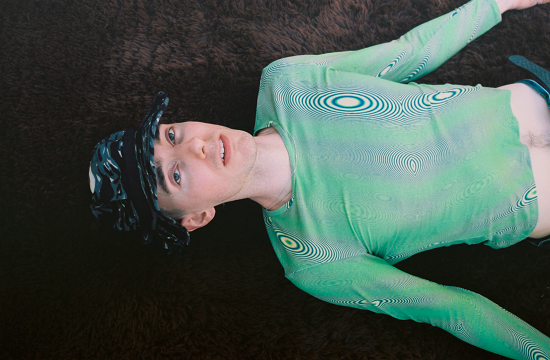
Photos by Gabriella Talassazan
In a number of sciences there is a mechanism known as the explore/exploit trade-off. Put simply, it applies to foraging, and the relative values of ‘exploring’ – pursuing new and unfamiliar routes for an unknown reward – and ‘exploiting’ – using the known route in favour of stability and predictability. It can be applied to the field of artificial intelligence: a scientist might weigh up whether it’s best to program a machine to learn by trying one new thing after another, to establish set parameters, or to strike a balance between the two. In human behavioural psychology, it’s of use considering the way children learn (via exploring) and the way adults operate (via exploiting). For the Los Angeles-based musician Dylan Moon, it could be applied to music, too.
As the title of his second album Option Explore implies, after taking explore/exploit as a guiding principle Moon decided to tip the balance firmly in the field of the former. It’s a record that is the result, above all else, of intensive studies into the possibilities of electronic music. During the first coronavirus lockdown the musician was furloughed, “and getting unemployment insurance which was more generous than normal,” he explains. “So I just started doing the album full time. I’d wake up really late and be up all night recording and mixing. I did that for months and months, for over a thousand hours.” He is still more or less nocturnal, speaking to tQ in a transatlantic Zoom call in the dead of the West Coast night.
The music he made in that time uses the ‘exploit’ side of the mechanism too, operating often within the familiarity of cold ‘80s and ‘90s synth music for which Moon has a genuine passion, but remains thrillingly unpredictable. Tracks will begin down one path, before Moon’s ‘explore’ instinct kicks in and he sends it instantly down another. It’s a product of “just trying to cram in so much stuff that it jumps around sometimes,” he says. “I’ll try a midi sequence through so many different synthesisers and sounds and then I’ll want to use all of them.” A discovery on an online forum of a folder containing “every single drum machine ever,” from which he samples all of Option Explore’s skittish and impulsive beats, proved particularly fruitful.
“When I’m listening to music,” he continues, “I’m thinking about it in terms of harmony and looking at it analytically. I’ll take songs that have an interesting chord progression and transcribe it and learn what’s going on. I really went in depth with some Scritti Politti songs, looking at how the synths were arranged and what was going on with different voicings.” Then, he’ll explore what possibilities open up when he starts tweaking with the song’s fundamental elements. “Sometimes you realise there’s something so particular about a chord progression that you just can’t do anything else with it, but then sometimes you just tweak it and it leads to something else.”
Moon is understated in conversation, but through his music he’s demonstrated an uncompromising progressive instinct. He developed his abilities to deconstruct songs when he studied sound design and electronic production as his major at university (“I just didn’t want to keep studying guitar and just be really good at jazz or whatever”) but embraces the possibilities of pushing directly against his training. “The stuff I was taught were fundamentals, learning all the rules. But I guess you’ve got to learn the rules before you break them,” he says. “I think people who haven’t studied music, who aren’t thinking about the theory, oftentimes make the most interesting and weird stuff. Sometimes if you’re really good at mixing and making things sound clean and punchy, you can get into a rut of doing everything that way and making commercially friendly sounded mixes.” With his own work, he operates somewhere inbetween, the exploratory instinct pushing against the exploitable rules he learnt at university. “All my songs still pretty much have verses and choruses, I don’t write anything that could be considered outsider art,” he points out.
Just as a song on Option Explore can shift its momentum dramatically halfway through, so too is the album itself a near complete departure from its predecessor, 2019’s Only The Blues. That record was essentially a psychedelic folk album, electronic production used as augmentation rather than the focal point. “I just wanted to do something different, I got tired of guitar music,” Moon says. Only The Blues remains significant, however. A five-song demo EP that he would eventually expand into the album was the first music he’d ever had proper confidence in. “I’d made some music in college [beforehand] and I think I could tell that it wasn’t very good, I guess it took me a while to develop my songwriting.”

He sent the EP out to a number of different labels with a simple message: “I’m hoping to get something released… don’t know how it all works.” The impact that had on Matt Werth, founder of the label RVNG Intl, would prove pivotal. “Once in a blue moon, a demo submission appears in my inbox that is so cryptic that my curiosity can’t help but engage,” Werth tells tQ. “To my ears, the music, while recorded humbly, went within and beyond its means of invention aesthetically. My immediate connection was Jürgen Gleue’s Phantom Payn, but then, Gleue would never dedicate a song to Jerry Garcia or to obscure Hanna-Barbera cartoon characters. There was more than a little levity in the ashen lucidity of the songs that Dylan submitted, and honestly, it was just an exciting prospect being able to work with an artist at such an early but promising point along their creative path.”
Moon and Werth went back and forth over email for about a year before the album was released in 2019, sprucing up the initial demos and expanding them into his well-received debut LP. “It was hugely validating, Matt’s still always someone who likes to hear what I’m working on. He’s a special person.” It wasn’t long after Only The Blues until he was exploring again, however. A follow-up EP, Oh No Oh No Oh No, arrived just a year later, on which its clear his ambitions have started to shift – the guitars stretched out and abstracted into fuzzy ambience, synths pushed more and more to the fore. A compilation EP of friends in the Los Angeles electronic music community, Moon’s Toons Vol. 1 followed in 2021, to which he contributes a blissful and lopsided pop collaboration with Ruth Kace that in retrospect feels like the precursor to Option Explore.
It is hard to imagine that Moon’s progressive instinct will leave him any time soon. His new album might be the product of a thousand hours’ travels through the possibilities of music, but Dylan Moon’s explorations are clearly only just beginning.
Dylan Moon’s new album Option Explore is released on June 17 via RVNG Intl