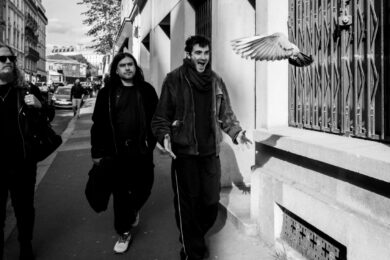

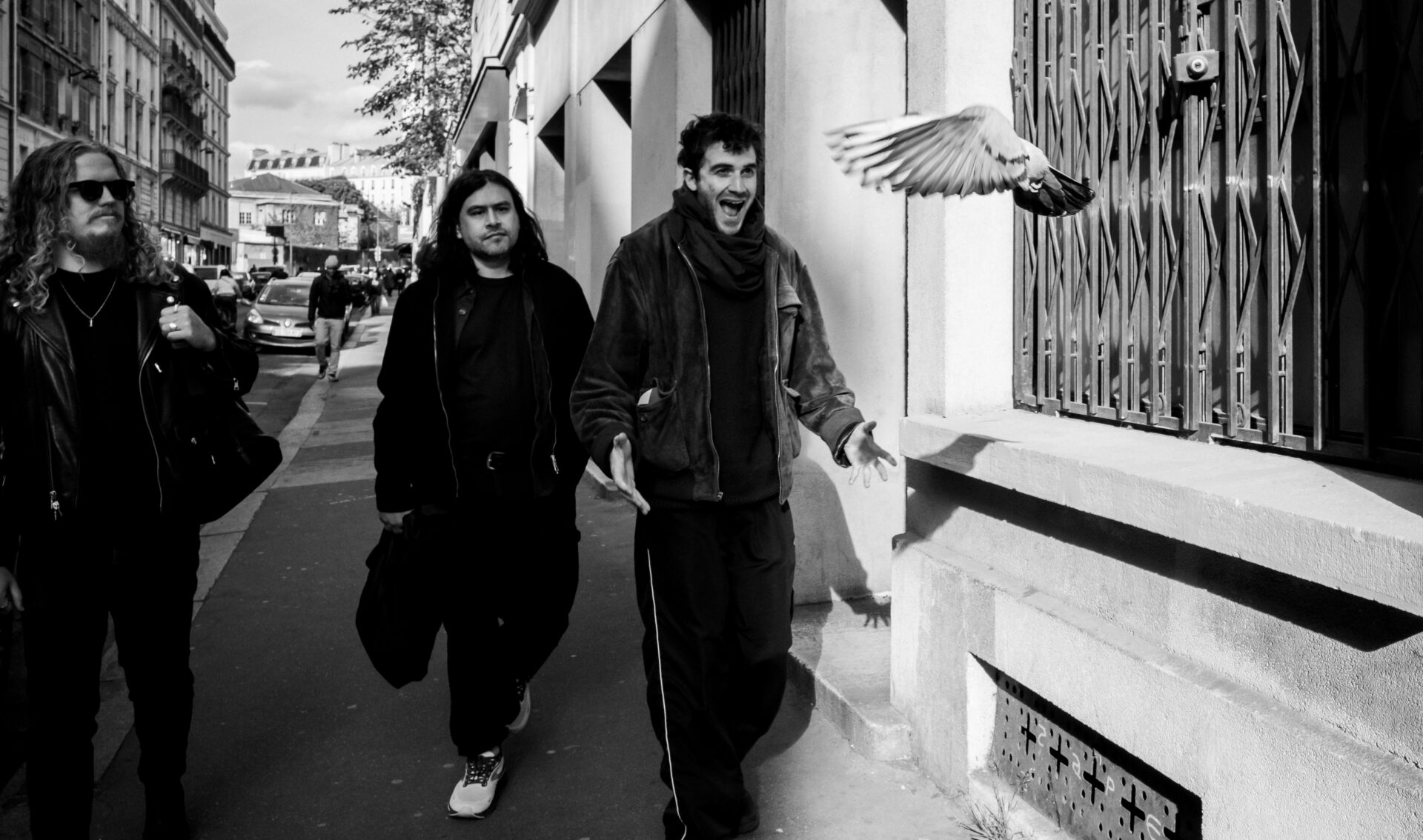
It wasn’t supposed to last this long. In 2011, in the middle of IDM wunderkind Nicolás Jaar’s European tour, he and bass player Dave Harrington were messing around with instruments in a Berlin hotel room when they accidentally formed a band. They released an EP and remixed the entire new Daft Punk album and then, in 2013, released their first record, Psychic. That album became an instant cult-classic; unabashed kosmische-music which cut a fog of glitchy electronics and swirling ambience through with taut blues guitar licks.
But Psychic was a one-of-a-kind record, especially to the band that made it. In August 2014 Jaar and Harrington played a valedictory show saying they were “coming to an end, for now”. Its two members were hailed, but in separate musical worlds and DARKSIDE seemed shelved. A hiatus began to look like something else when it stretched into six full years. Over time Psychic began to feel like a document of a specific cultural moment where the meshing of guitars with everything from house to avant-R&B threatened to take over. That era came, went, and seemingly took DARKSIDE with it.
Then, late in 2020, when they were all but forgotten, the band reconvened. Harrington and Jaar announced a new album, Spiral, and then a raft of live shows too. It was in those performances that it became clear that their intention was not to simply tread old ground. Up on big stages, DARKSIDE were transformed. The meticulousness of their studio production was gone, their songs re-made as noisy, propulsive epics. Wailing guitar smashed against pummelling dub techno, as if reflected in a giant, shattered mirror. It was the last thing you’d expect from two artists who often feel like scholars of their craft: pure, shameless theatre. “We’re prog, in a way” Jaar tells me, before turning to his bandmates with a smile, “forgive me if I’m saying an unholy thing”.
Perhaps some of this newfound scale is due to the fact the duo are no longer a duo at all. In 2022, when the pandemic was receding and Jaar and Harrington began to plan their first live shows in almost a decade, they were forced to consider the project’s future for the first time since its inception. “We had to have deep conversations about the future of the band”, Jaar says. “The first step after those conversations was to speak to our old friend Tlac and see if he was interested in completely altering our DNA”.
Tlacael Esparza, a pure mathematics major and drummer, had been orbiting their circle for years. Harrington had briefly known him during their school years, and Esparza joined him as part of Jaar’s touring ensemble in 2012. Before long though, Esparza shifted his focus away from performing to reimagine the possibilities of his instrument instead. While he and his bandmates were crossing Japan, Turkey and Germany by train, Esparza began to refine a groundbreaking hardware interface for drummers which he launched as a fully-fledged product in 2015. This innovative technology, named Sensory Percussion, allows drummers to trigger an extremely wide variety of samples via their own kit – along with generous options for shaping and modulating these sounds – without missing a beat.
Both Esparza and his invention became fundamental to the way DARKSIDE exploded their sound upon their return. After perfuming together live in LA, they began to wonder what their new arrangement could sound like in a studio setting. “On tour last year we had one day off too many”, Harrington says, in a story with echoes of the band’s beginnings. “We opted to take advantage of all three of us being in the same place at the same time, so we set up camp in a studio in Paris and started making things again.”
“Playing music with Tlac, a whole world opened up”, Jaar explains. “We spent the entire week in the studio, which was a dream because we got to make music all day long and experiment with weird techniques. We were there with [sound engineer] Pantxo Bertin, who’s a great friend of the band. The four of us together was very exciting and I can hear that excitement in the music we made. There’s something re-awakened in it, I hear.”
This idea is encapsulated in DARKSIDE’s third album, Nothing, which arrives 28 February; which, excitingly, seems to have cut the gap the band leave between making new albums by 50%. As a project, Nothing represents a melding of the eclectic musical pursuits of the three men who made it. It’s a record filled with sudden flips of genre and style, from the muggy dub of opener ‘Slau’ to the fried dance punk of ‘Graucha Max’, which breaks out into mayhem during its final moments. It turns up the energy from Spiral, while also expanding the band’s palette in many ways. Most startling is the arrival of pockets of stomping, twangy Americana – making it feel like the equivalent of Faust transmogrifying into the Flying Burrito Brothers before your very eyes.
Before you hear a note of the music, the most striking thing about the album is, of course, its name. Nothing is an anti-title, a black hole where a signpost should be. But it’s evocative regardless. The concept of nothingness is, after all, a contradiction; empty of content yet each nothing, unnervingly just the same as any other. Heidegger once called nothingness the origin of human dread, which I put to DARKSIDE…
It transpires that the word first began appearing during those studio sessions in France, when – with all that free time around them – the band developed an approach they nicknamed The Nothing Jam. How exactly does it work? “It’s a thought experiment for playing music”, Harrington says. “You’re not trying to make anything happen. In fact, you’re letting nothing happen at all”. Rather than Heidegger then, this method-less method seems to side with Descartes instead, and his interest in tabula rasa: the idea that we are born with a mind which is a clean slate, free of preconceived ideas or notions, in order to unlock worlds of unbound creative possibilities; a musical state that DARKSIDE were trying to find their way back to.
That DARKSIDE should set upon this extempore approach is unsurprising given the musicians involved. Harrington might currently look like the frontman of a sludge metal outfit, but he was raised as a jazz player, in a home filled with the music of Miles Davis and John Zorn. When he was a teenager, he snuck away from parties to go watch Steve Bernstein shows on the Lower East Side. He’s also a life-long devotee of rock musicians who jam, Jerry Garcia most of all. “I’m always playing Grateful Dead riffs” he says. “We actually to cut a piece off a live record because I’d subconsciously played too much of ‘China Cat Sunflower’ and our lawyers told us to cut it out”.
Nicolás Jaar has long pursued spontaneous art too. During his student days he staged performances with the gimmick that he would play only samples of records he’d picked up earlier the same day. When seeking a comparison to their current formation, Tlacael Esparza skips over all of their most famous projects and cites the Bladerunner Trio instead, a near-forgotten collective from the mid-2010s in which himself, Harrington and Jaar were players. Bladerunner performed solely improvisational music, the existence of which survives only in a few bootleg SoundCloud recordings. “I think the rehearsals for that involved us standing in a circle and talking”, he laughs.
Unsurprisingly then, to see DARKSIDE live in 2025 is to witness the same musical ritual as seeing Jerry Garcia taking a two minute rockabilly song and turning it into a mountainous epic. “When we’re touring we come across all of these nooks and crannies inside of songs”, Harrington says. “The songs are kind of loose scaffoldings, they’re like jazz songs for us. We unlock surprises which snowball over the course of a tour. A little thing which excites us becomes five minutes the next night, then it takes over the whole song until the original kernel is just a little thing.”
For the modern music obsessive, the thought of any song being lost forever is a chilling one. But when I ask Esparza, Jaar, and Harrington whether they’re naturally at peace with the impermanence of art, their head nods say it all. “I think part of the beauty of improvising” Harrington says, “or making a 35 minute song out a four minute one, is that you can see it on a particular day at a particular show, and then it’ll float downstream and nobody – including us – will ever see it again”.
Though they’re quick to point out that live improvisation is a different beast from studio spontaneity, as an album Nothing also chronicles the raw thrill of in-the-moment creation, only later given structure through meticulous editing – much like how Teo Macero and Miles Davis produced Bitches Brew. The opener, ‘Slau’, for example, began as a dub-heavy cover of Nina Simone’s ‘Baltimore’ until the band stripped away that song’s ambience to lay the foundation for their own.
The electric second single, ‘SNC’, was born in reverse. Harrington stumbled upon a playful, jaunty guitar lick and the rest of the song was built around it. “Later, I was in the studio messing with what we’d recorded and stumbled across this old song called ‘Rock ’n’ Roll Band’,” Jaar recalls. “The lyrics were so ridiculous – ‘I did it for the rush / I did it for the time of my life’ – but it felt oddly fitting because, for the first time, I felt like I was in a rock & roll band.” Jaar chopped up the sample, weaving it through Harrington’s guitar to create a vibrant fusion of jam band energy and jolting House music – landing somewhere between a Phish show and a speaker-rattling club set.
This patchwork approach explains the particular surrealness which pervades Nothing. Surrounded by swirling, ecclesiastical synths and the sudden jolt of Harrington’s licks, the words to a particularly cheesy slice of early 80s funk rock acquires a menacing, jeering quality.


Throughout the album, light is often met with dark in this way. ‘Hell Suite (Part II)’ is one of the most blissful, pieces of music the group have ever laid to tape but its lyrics – “Look out the window, it’s hell again” – are damning. Closing track ‘Sin El Sol Noy Hay Nada’ brings back the serenity until it explodes into the most blown-out moment in the band’s career. “That something which has been pushed harder with the three of us” Jaar agrees. “The effect that we have on each other is going to those extremes. That’s something which I’ve felt so happy about”.
The fact which seems most crucial to DARKSIDE is that it isn’t its members’ sole project. Jaar has spent the last three years penning short stories and touring the world teaching sound-editing and listening workshops in Chile, Germany and Palestine. Harrington released three jazz records in 2024 alone, and has formed his very own jam band, Taper’s Choice, with members of Real Estate and Vampire Weekend. DARKSIDE, like the songs themselves, is a loose scaffolding. It has become the world’s most active side-project.
“We live these other rich creative and intellectual lives when we’re away” Harrington says, “then we get to come back and see how they collide. My life changed a lot between Spiral and Nothing. I moved to a new city, we had a daughter. I was surprised I could bring all of that change into the band and it could absorb it.” Jaar says that this characteristic is true of their new album too: “You could keep throwing things at it and it could take it. There was a playfulness going on. We’d do something completely left-field and if it worked it really did work, and somehow it was more meaningful.” That’s the beauty and the discomfort of impermanence, after all: it can be anything, or it can be nothing.