

All portraits by Eugene Richards
The cover of Vince Clarke’s debut solo album feels like it’s making a statement. Monochrome, grainy, all ear, nose and throat, it’s a close-up of the face of an unlikely pop star, one who has sold roughly 30 million records over the last 42 years. He’s looking down, as we’re used to seeing him, staring at modules or machines as half of Erasure or Yazoo, as a founder member of Depeche Mode, or as a collaborator with Martin Gore (in the excellent VCMG), Eric Radcliffe (The Assembly), Martyn Ware (The Clarke and Ware Experiment). and Phil Hartnoll.
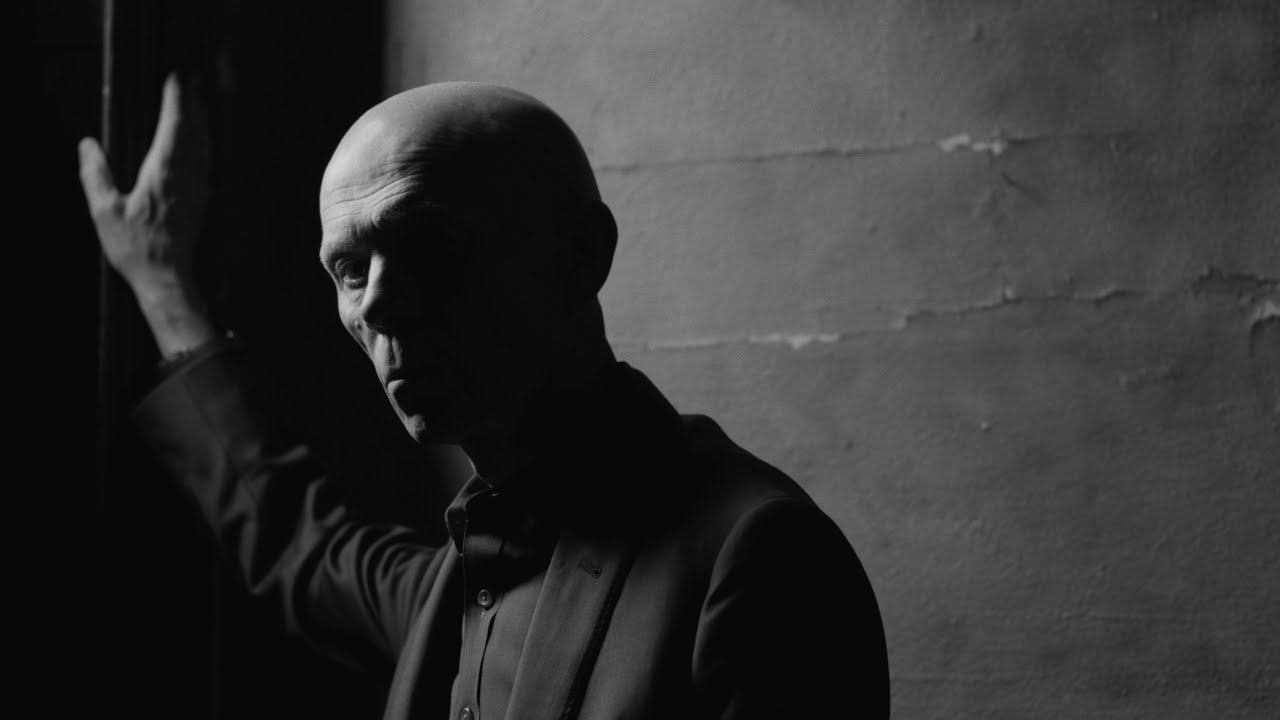
But here he’s alone, unsupported, oddly exposed. “Yeah,” says Clarke, his Essex accent still gloriously intact. Zooming from his new house in New York, the US having been his home now for twenty years, he’s looking like a fit and wiry ageing boxer in a round-necked close-fitting navy sweater. A lot of Erasure sleeves are quite whimsical and playful, he explains, as he discusses the sleeve – not that he’s against that. “But I thought, you know what, it’s about time I started showing my age. I wanted the cover to be serious and documentary, and I wanted it to be very real. Just show those creases and those lines and my eyes. Also, I thought it reflected better the mood of the record.”
Songs Of Silence is a record unlike any music he’s ever made. It’s still epic yet intensely human in mood – as his music has been often throughout his career – but here it’s ambient and purely instrumental. It’s full of drones that expand, gain colour, conjure sublime, often distant vistas, and twitching textures that suggest constant movement, energy, the replication of cells. “It was quite reflective of the way that I was feeling, and I am still a little bit.” It’s not clear if Clarke is searching for words or side-stepping them. “But with the tracks, I didn’t think, ‘Oh, I’m gonna make this song really sad.’ But that’s how they turned out.”
He says soon after that he has been living here for a fortnight. He’s had to pack up his studio of ten years in Brooklyn and put it into storage: “Having to say goodbye to it is kind of sad, but, you know, it’s a new chapter in my life”. I knew already that Songs Of Silence had been made during one of the toughest times in his life. In 2021, his American wife, Tracy Hurley Martin (her last name being her husband’s real surname), fell ill. They also have a son together, Oscar, who’s eighteen.
He expands: "Something like this does affect everything that you do, you know. It does affect your life. And I think it’s affected the way that I listen to, and look to, music.”
In what ways? “Doing this kind of music in particular is very therapeutic. It’s helped me to switch off all of the other stuff and just think about sounds.” During the past few years of COVID, it’s been well documented that people also turn to writing journals or poetry, or start painting to achieve similar things, but he would recommend this kind of music for anybody in a difficult situation, “Even though it’s not even me that is going through something directly,” he adds, pointedly. “You know, I’m just a carer.”
Ambient atmospheres are giving him new playgrounds as he gets older too. Even though Pink Floyd’s Dark Side Of The Moon remains one of his favourite albums, more “upbeat music”, he says, got him excited creatively when he was younger: “I didn’t listen to Tangerine Dream, or anything like that when I was a kid – at the time, I didn’t really appreciate it. But maybe what it is is you get older, and suddenly everything slows down.” He smiles. The music he’s that has helped him conjure up new visuals, which he enjoys. In this LP, you hear new possibilities, new spaces for someone’s head in his discombobulating new world.
Songs Of Silence began as a project at the end of Erasure’s Autumn 2021 tour of the UK. (The title nods towards The Sound Of Silence by Simon and Garfunkel, the first band that inspired Clarke to make music after watching The Graduate when he was a teenager: “I bought their songbook, there were the chords, I had an acoustic guitar, and suddenly music wasn’t completely otherworldly. It made me realise I could do this.”) Just after their last date in Brighton, most of the crew, including him and bandmate Andy Bell, came down with Covid; everyone else could isolate at home, but Clarke had to stay in his East London hotel for ten days. “The first thing I did was write bits of fifteen or twenty tracks for the next Erasure record, which I’m really excited about as well. And then I started experimenting, making this drone music.”
The Covid lockdowns had pushed him towards solo composition because he and Bell have never been able to compose remotely, he explains. “Our writing only works when we’re in the same room together. And I can’t sing. Thankfully for the world, I didn’t want to try either.” Creating on his own took a while though, because he couldn’t figure out how people made instrumental music and make it interesting. “You know, there are no choruses and verses, so the challenge was to create something interesting enough for four minutes without necessarily having to revert to a chorus, and still keep the listener engaged. And the listener in this case was me, you know, so I had to still keep me engaged.”
So he started disappearing into sounds. Lockdown drove Clarke to delve more deeply into the Eurorack modular synthesisers and processors he’d started buying because he suddenly had time. He found he enjoyed pausing and replaying YouTube tutorials, enjoying how “you can see someone do something and hear the result of what someone’s doing, rather than reading a manual – it’s really inspiring”. He became the kind person who can watch a 20-minute video on an oscillator. "I find it really appealing”, he laughs.
Clarke loves how democratic the modular world feels. “My modules aren’t by the same people, but different companies and it’s often these tiny garage guys doing this stuff, soldering it together and I love that, man. That’s how interesting ideas happen.” He also loves the unpredictability of the modular world, and how creative that feels. “You can plug anything into anything and you don’t know what’s going to happen. And you can modulate with anything – a voice, an instrument, any sound, it’s never-ending – and I love how if a sound doesn’t exist, you have to find it for yourself.”
What advice would he give to newcomers? “Keep things simple, because the possibilities are already so big.”
This spirit of possibility pulses and yearns within Songs Of Silence. The song titles came after the compositions, he explains (“I approached each, then thought, what does this sound like?”) but you sense immediately why he called the opening track ‘Cathedral’, a layering of tones into the approximation of a major chord suggesting a heavenly openness, a sublime sense of space. He’s not religious, he says, but there’s something moving about the size of those buildings, and the tones gave him visuals of their roofs; they also made him think of documentaries he’s watched in recent years about caves in South America: “[They are] full of stalactites and stone that had been there for centuries, and how a sense of magnitude isn’t even about the spirituality of the place, just the hugeness of it.”
The intriguingly named ‘White Rabbit’ follows, a track of frenetic but strangely gentle-sounding activity before it builds to a thunderous climax. It’s inspired by a frantic female friend: “No, I can’t tell you who it is.” It’s not about psychedelics? Is he microdosing? He smiles broadly. “No, I’m not microdosing. I’m not micro-ing anything, ho ho ho.”
Then there are the tracks into which opera and folk fascinatingly drift, ‘Passage’ was inspired by what he calls a “riff” from a Puccini aria, soprano Caroline Joy Clarke adding vocals that carry echoes of Hildegard De Bingen’s ‘O Euchari’, sampled in The Beloved’s ‘Sun Rising’ and later Orbital’s ‘Belfast’. Why a voice? “You know, vocal synthesizers are quite good and quite interesting and everything, I felt that I needed someone human to do that.” The word “human” crops up a lot in his descriptions, a sense that an electronic sound can summon up feelings that a person alone cannot express.

The most intriguing track is ‘Blackleg’, which uses a sample of an old male singer performing the 19th-century Northumbrian song, ‘Blackleg Miner’, invoking violence against strikebreakers. Clarke thinks Martyn Ware played him the song first when they were working together on sound installations for Sheffield’s now-defunct National Centre for Popular Music in the early 2000s. He tried to fit the a capella vocal around chords, but it didn’t work, and it now shudders over a long, thick drone, carrying shadows of Gavin Bryars’ ‘Jesus’ Blood Never Failed Me Yet’.
The thing that drew Clarke to the track also surprised him: “This is a terrible thing to say, but I liked the violence about it. It’s so violent. It’s a reminder of how much hate there was too at the time, on the part of both parties.” Hate that still exists in the present day? “Yes! I mean, live in America for a while. People don’t argue any more, they just shoot each other. Every day on the local news we’re told people are killed, like it’s just normal.”
There are tracks with sci-fi leanings too, like ‘Imminent’ and ‘Red Planet’, which come “from watching too many Netflix movies”, Clarke says with a laugh, but also his youthful love of sci-fi. Ray Bradbury’s ‘The Sound Of Thunder’ was the first story that convinced him that reading “was a good thing to do”. How old was he then? “Fifteen.” His love of sci-fi revolves not around fantasy, “but that sort of nostalgic 1950s thing, when people didn’t know what was on Venus, and just assumed people would be travelling in space crafts in the future.” Later, I think of his old futuristic house, Ammonite, in Chertsey, Surrey, custom-built to his specifications in the early 1990s, the sale of which circulated on the internet a few years ago. It’s like something from a film, his sister Carol telling the Independent how it was full of “toys for boys”, but how her brother loved cooking for his family in its kitchen, something you also see on his wife’s Instagram page.
Hans Zimmer and Benjamin Wallfisch’s filmic music for Blade Runner 2049 also inspired the album’s first single ‘The Lamentations Of Jeremiah’, Clarke adds, before a cello line played by Clarke’s friend, Reed Hays, transformed it. The pair co-host an occasional programme, The Synthesiser Show on Staten Island non-profit community radio station, Maker Park Radio, which they last did back in March: Clarke brings the upbeat stuff, while Hays is an obsessive of early electronic music. Hays isn’t a professional cellist either, Clarke points out, but he invented a part for Clarke’s soundbed on the instrument very quickly. “Then suddenly, the track became something much much sadder, rather than just another sci-fi soundtrack – it became something very human. And poignant.”
In the video for the single, Clarke is wearing a suit, shot in shadowy black and white like on the album cover, sitting in a chair in an empty house, by a fireplace, his head in his hands. He then looks at the camera, unblinking, strangely threatening, like a gnarly cousin of the Kray twins. More shots follow of him in a doorway, looking out of a window, raising and turning his hands – at one point we see his hands alone, moving like a dancer’s – then Clarke looking up to the light and closing his eyes. It feels like a short film with a dark, unsettling narrative to be unravelled by the viewer, but also a film showing a 63-year-old directly and vulnerably, allowing himself to be seen as he is, centre-stage.
The album ends with ‘Last Transmission’, its slow build, stutter and fade making Clarke think of an obscure, forgotten, disappearing radio signal. Its name also references the Joy Division track that’s in his all-time top 20 singles in its title. It’s a solemn end to an album, but these have been solemn years.
While making it in 2022, Andy Fletcher from Depeche Mode, whom he first met in his early teens at the St Paul’s Methodist Church, Basildon, at the Boys Brigade, died. Two weeks later, Clarke’s best friend (“you know, my real best friend, from back when I was ten, that real best friend cliche”) died too. Clarke didn’t go to Fletcher’s funeral, but he has maintained his friendship with Martin Gore, he says; a friendship not fostered in the early 1980s, but one that grew after they did the press together for the VCMG LP. They barely knew each other before that Clarke says, even though they’d just made an album together remotely. “It was quite funny actually, because we share a very similar sort of sense of humour.”
Gore helped Clarke out with his Eurorack starter module set-up (“I think he’s got the biggest system in the world”), and Clarke thinks Gore’s most recent solo work is “the best stuff he’s ever done”. They still regularly email each other questions about gear, although not so much in the last year.“ You know they’ve been on tour, and with Fletcher, that whole thing… I’m sure their lives are pretty strange and surreal right now.”

When I ask Clarke about the distant past, he’s not particularly interested. After the interview, I realised I know hardly anything about his pre-band teenage years and childhood: I know from older interviews that there wasn’t much music for him at home; that his parents were called Dennis and Rose, that he has two brothers, Rodney and Michael, as well as sister, Carol. The earliest experiences he enthuses about to me are his boys’ brigade years, seeing Generation X in a local pub, and falling in love with the early albums of The Cure. He didn’t see or hang out with many electronic bands from other places when he was first making music: he first saw OMD two years ago in Mexico, where he met and had a laugh with Andy McCluskey, he laughs. “People imagine we were in a scene all hanging out together, but we weren’t – we were just with people we’d known in our own lives.”
He has met two huge figures in that world, though, he admits. He can’t pin down the date, but he reckons was before the Computer World tour when he met and chatted to Ralf Hütter. Ralf Hütter?! His face lights up. “Yes!” He was on tour with Depeche Mode, and Kraftwerk were doing a few test club shows to try out their production, he explains; their tour manager knew Kraftwerk’s tour manager, and he made Clarke go backstage to thank the tour manager for the tickets. “And suddenly Ralf was there.”
Clarke laughs like a drain as he recounts their strange encounter. “I was speechless. Because he looks how he looks, you know? He really is that person. And I didn’t know what to say. I couldn’t say ‘I like your music’ could I?” It turns out Ralf spoke first. “And he said, which was funny [Clarke approximates a comedy German accent]: ‘So, vot is the best way to Liverpool? Is it the M64 or the M68?’ I’m not getting the numbers right, I know, but I went, ‘Mmm, probably, the M68, I reckon.’ So that was kind of surreal!”
Referenced artists

Kraftwerk
Reissue Of The Week: Kraftwerk’s Remixes
The other synth legend was Jean Michel Jarre, with whom he collaborated on Jarre’s 2015 album, Electronica 1: The Time Machine. “He came round my house! Me and my wife were all, this guy is so famous, what should we do? Get some French wine in? Some really good cheese? We had no idea.” He came and played Clarke the tracks he wanted them to work on. “And I’ve never met such a nice person in my life. He was so generous – very serious about his music – but what a lovely, lovely guy. You know, I was blown away.”
Even though Clarke is quiet, measured, intensely private, it’s clear that kindness, warmth and love are very important to him. When he talks about his son, Oscar, and how he’s taken him three times to see Taylor Swift’s Eras tour (“It was amazing. The stage, the lights, the projections, the choreography. I’ve never seen anything as good as that”), his affection is infectious. But when I gush about some of his most moving songs (including ‘Only You’ with Yazoo, ‘A Little Respect’, ‘Ship of Fools’ and many more with Erasure) and ask him how it feels that they have moved so many people, he is clearly uncomfortable, trying not to answer the question. “It’s always very flattering,” he says, at last. “But it’s always very weird what people get out of the lyrics because it’s never what you intended.”
Maybe it’s because something else happens when a song goes out into the world, I suggest, when a set of sounds move people for some mysterious reason, and we forge deeper connections with them. He nods. He clearly enjoys the magic of music much more when he’s not being made to reflect on it by fans like me, when he’s there with his collaborators, his tools, his fertile imagination, making music that has stood the test of time for over four decades already.
He never thinks about his legacy, he says, and never did – and that’s a product of his early days starting out. “You never really thought about the future. Especially when we started everything was about the next day. You get a phone call, and they say, bloody hell, you’re on Top Of The Pops! You go, ‘Fuck me, really?’ You cannot believe it, and then you do that, and then they’ll go, ‘Oh my God, you’ve just sold 1,000 tickets for your next concert!’ and you go, ‘What?’"
He switches from the present tense to the past. "Almost everything was like that. Everything was unbelievable all the time. And as you get older, you find the things that makes you feel at peace. And I can’t imagine myself not making music. It certainly won’t be for any reason other than because I found peace."