

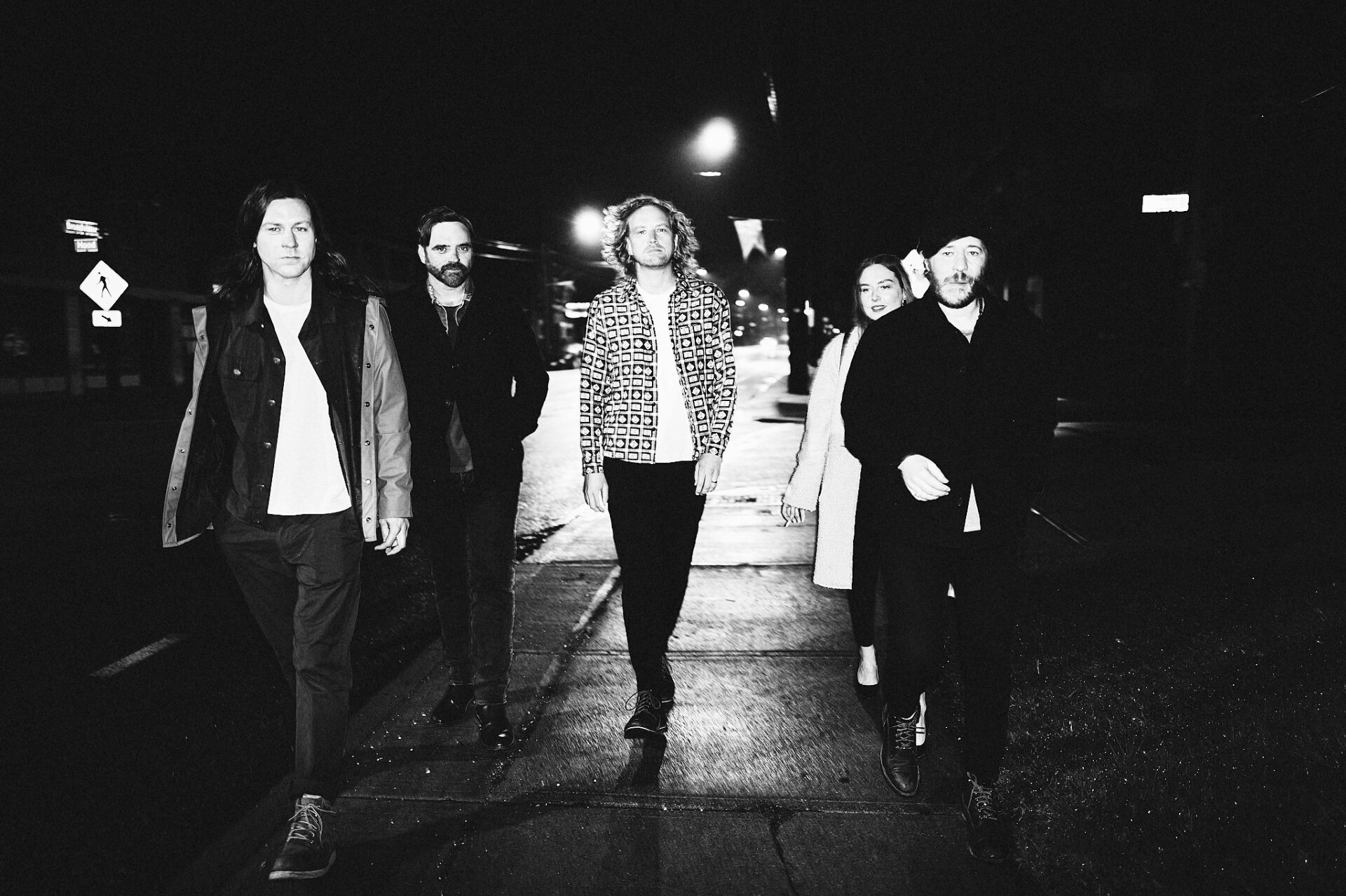
Just the name of their hometown is evocative. Even as Stillwater revives memories of Almost Famous’ protagonists – not to mention exemplary shoulder-length hair and musty suede jackets – it speaks to gullies and gulches, saloons and spittoons, true grit and tombstones. As shorthand, then, though the comparison is largely unfavourable, Stillwater is like Deadwood, at least to someone who is yet to visit. Stillwater, too, is an archetypal brand: Oklahoma’s tenth biggest city is a civic cowboy contrivance that shares a name with ten other American settlements. Think God and Country. Think God’s Own Country. Think The American Dream.
But not if you’re Jesse Tabish. Other Lives’ music may be as expansive as its Tornado Alley backdrop, but to him Stillwater has other, less rousing associations. Speaking from the temporary base of his mother’s Stillwater house, he laughs, “Growing up here…” – here being the home of Garth Brooks; a heartland of ‘Red Dirt music‘ – “I couldn’t wait to get out. It was very, you know… country music. It was very sports culture. It was a very stuffy place for somebody into classical music and an ardent socialist at the time. But I think I inverted that and created a mystical idea of what Stillwater could be. So, in my mind, I was always thinking about Europe as a teenager and in my early 20s.”
It’s understandable that Other Lives felt stifled in Stillwater’s conservative surroundings, pinned between Oklahoma City and Tulsa, some sixty miles south of the Kansas state border. It was here, pretty much in the middle of nowhere, that they recorded their first two albums, 2009’s eponymous debut and 2011’s Tamer Animals. Their ambitions to leave probably weren’t diminished after selection by Radiohead to open their 2012 North American tour, and not long afterwards they moved to Portland Oregon. There they worked on ever more elaborate ways to expand their reach. On 2015’s Rituals, produced by Joey Waronker (then drumming in Atoms For Peace), they experimented with electronica, and to make 2020’s For Their Love they decamped to a gorgeous A-frame wooden cabin in nearby countryside featured on the sleeve art.
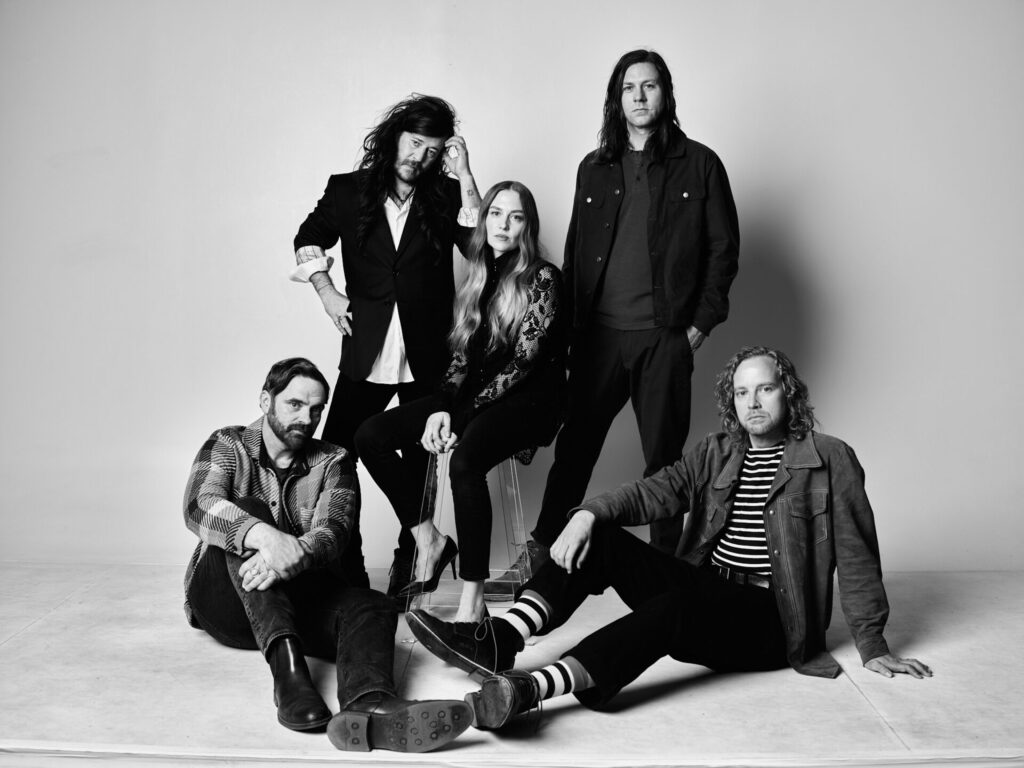
No one, then, can doubt their adventurous nature. As Other Lives, multi-instrumentalists Tabish and Jonathon Mooney, Josh Onstott (bass), Danny Reisch (percussion) and, recently recruited on vocals and flute, not to mention songwriting duties, Tabish’s wife, Kim (and hers and Jesse’s is a love story to relish) come from a lineage of what could be called the Great American Musical Mystics. Among their forebears are My Morning Jacket, Mercury Rev, Grandaddy and fellow Oklahomans The Flaming Lips, while those with longer memories may wish to cite Grant Lee Buffalo.
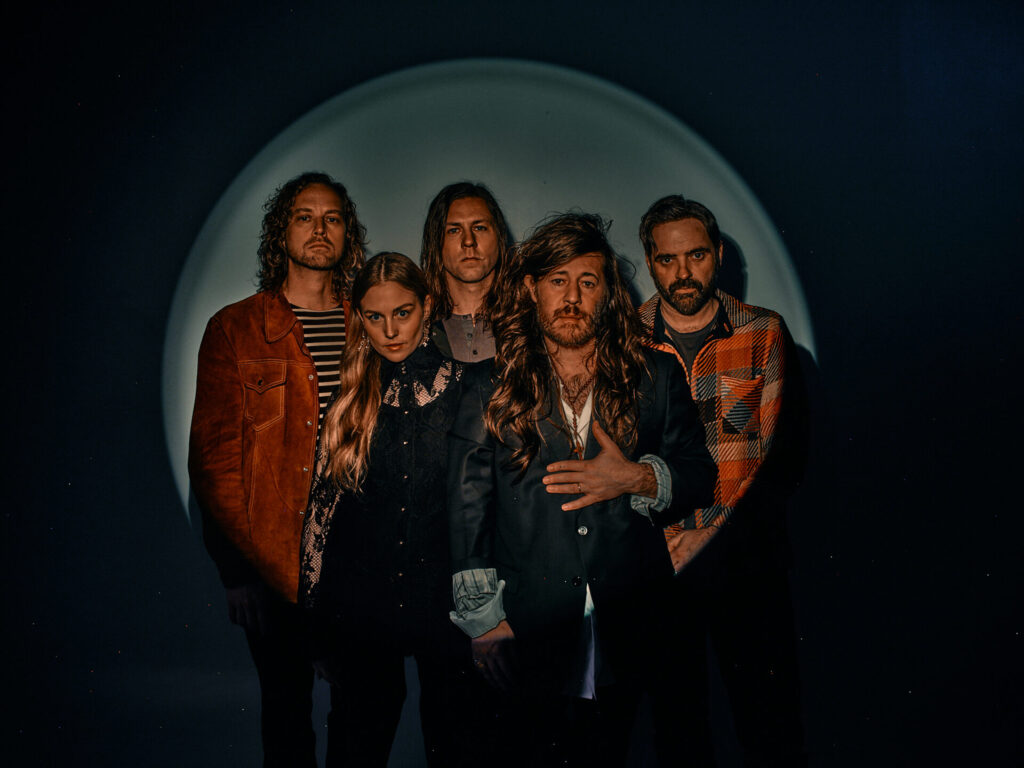
This is encapsulated at its most refined on their fifth album, Volume V, made after returning home to Stillwater, where their established, yearning Americana is wrapped in cinematic finery and given an erudite twist. With a hand on its heart and a starry inner eye fixed on a distant internal horizon, it’s the bewildering but stirring sound of cosmic epiphanies, both personal and universal.
They set out this stall boldly on its opener and first single, ‘Mystic’. Embellished by Patrick Conlon, a string player who co-wrote and recorded the album’s arrangements – his wife Christina Giacona was meanwhile responsible for woodwind – its sweeping romance boasts a cavernous elegance at which both Rufus Wainwright and Jim James might swoon. Such poise is evident as well in the towering ‘One For The Kids’, with Kim taking her first lead vocal on lyrics co-penned with her husband.
There’s also ‘Show Us Some Love’s weighty drama, which depicts a conversation – “Can you not reason why you’re in this mess? Ah, come on, show us some love every now and then…” – between mankind and the gods above. There’s no doubting the storm in the air, too, on ‘Cisa Cisa’, during which Tabish dispenses with legitimate words altogether, while ‘Heading West’ is a mournful, widescreen instrumental opening with brass, strings and kettle drums whose title betrays its increasingly spooky scenery.
Naturally, their frequent, sky-scraping glory remains inspired by a beauty even cynics would be hard pressed to deny. To Stillwater’s west lie the mesas and buttes of Gloss Mountain State Park and, to the north east, Great Salt Plains Lake. Indeed, this is a frontier version of what The Waterboys, in the run-up to This Is The Sea, once succinctly termed ‘The Big Music’. But it comes with desolation lurking surreptitiously in the darkness. There are “black clouds congregat(ing)” in ‘What’s It Gonna Take?’, written in the immediate wake of the invasion of Ukraine, and “kingdom(s) of dust” gusting around ‘One For The Kids’.
Even so, on the closing brace of songs, this threatening isolation brings virtuous independence. ‘Read My Mind’ may be a mournful, piano-led ballad but it offers solace in the grace of Jesse and Kim’s exchanges. It’s easy, too, hearing the closing ‘The Wake’, all strummed acoustics, ghostly harmonies and lonesome harmonica, to recall the jarring but blanketing warmth of some of Lee Hazlewood’s songs, like ‘Cold Hard Times’ or ‘The Night Before’, and Al De Lory’s Glen Campbell productions.
“’Wichita Lineman’…” Tabish sighs. “That is the song of that genre. That is, like, the ‘Hey Jude’.”
![Show Us Some Love [Official Visualizer]](https://stage1.thequietus.com/app/cache/flying-press/32491a79a8da717bd73f217a3d784700.jpg)
Moreover, for all their “Valhalla reverb”, as Tabish wryly calls it, one vital element makes Other Lives so notable. His dreams of Europe have helped them curate influences from well beyond their American homeland. Ranging from [Canadians] Godspeed You! Black Emperor and Sigur Rós, via The Beatles to John Barry and Ennio Morricone, these also encompass modernist classical icons like Satie, Stravinsky, Ravel, Debussy and Pärt. All the while, time works its mysterious magic, combining these potent ingredients.
Sometimes that time is considerable. As with For Their Love, whose release was sadly overshadowed by the pandemic’s opening months, it’s taken Other Lives five years to deliver Volume V (though Tabish slipped out a homemade solo album, Cowboy Ballads Part I, in 2022). Fortunately, it represents Other Lives’ peak, and if Stillwater’s elders are dismayed by their city’s fundamental role in this epic escapism, at least they can take comfort in what it is they’ve spurred on.
It’s thus strange to learn that, four albums in, Volume V was made the way it was. If Tamer Animals provoked The Guardian to describe Other Lives as “a band without limits” and Mojo to deem them “the next must-have pastoral American sensation”, they’ve yet to attain such giddy heights. The pressure, therefore, to make something defining and commercially successful must surely have been considerable. For many acts in their position, this would traditionally be the moment for an all-or-nothing gamble.
But not if you’re Other Lives. Though the Tabishes now live in Cleveland, Ohio, with the rest of the band scattered across the country, they chose collectively to make a grand yet unlikely, instinctive but counterintuitive gesture. Despite hightailing it from Stillwater more than a decade ago, they packed up their bags and set off for their venerable hometown.
This was intended as neither a return to their roots nor a grudging concession to heímweh. It wasn’t even about seeking inspiration in how the city had transformed in their absence. Tabish admits he only grasped this once back on Stillwater’s streets, but ultimately the decision provided a double-edged opportunity to examine how far they’d come since they left’d and how their absence had instead transformed them.
“We’d ended up realising that we were writing about Stillwater, we were writing about Oklahoma. This is our home. If you came here, you’d go, ‘Huh, OK.’ It’s like any other Midwest town. But it’s a place in my mind, more than anything”, he says.
Indeed, it was “sentimental feelings” that guided the band when, with few firm plans, they first arrived in town. Prompted by “these little memories that stick with you”, Tabish quickly identified his goal: to record in the Stillwater History Museum, located in the city’s Sheerar Cultural Heritage Center. “I remember going to this place with my grandma when I was 12, and we saw Beethoven’s late quartets, which for Stillwater folks… I’m sure it blew their brains out!”
To their delight, the band’s proposal was warmly welcomed. ”Stillwater people are so sweet,” Tabish stresses. “I walked in and said, ‘I’m from here. Is there any chance we could have a residency?’ And they just handed over the keys. No money, no nothing. Just, ‘Here you go.’ That’s something I love about Stillwater. It’s so genteel. There’s a kindness. Those things just… I keep on saying ‘seep in’. And it’s not haunting, but it is. There’s something extra about it. It’s not like we’re renting a spot in Brooklyn. There’s something very…” He laughs. “See, look? I’m getting all sentimental!”
This opportunity to immerse themselves in both theirs and the city’s history was certainly propitious, but it was the building’s former purpose that made it most appealing. Constructed in 1928, it was originally home to the local branch of the First Church of Christ, Scientist – the first of its kind west of the Mississippi. The chapel’s acoustics were to prove superlative, lending Other Lives’ songs a high-vaulted organic grandeur.
It seems compelling that this Christian movement’s central tenet is that prayer heals sickness and sin, and can even protect against death. Tabish insists that the thought had never crossed his mind, but there’s something appealing, in the era of Health Secretary Robert F. Kennedy Jr., about converting such a space to serve the power of rock & roll. Perhaps, though, this is just another element that can be said to have somehow ‘seeped in’. For all that musicians talk about their intentions with a record, these are often only reactions to circumstances.
Purpose, instead, is often assigned in hindsight, and while Tabish talks of Other Lives’ wish to mix reality and dreams, the primal and celestial, he can’t control how audiences respond to what emerges. Indeed, he confesses that, with Volume V’s release imminent, “I get sick to my stomach thinking about it.” He can, nonetheless, rest assured that, inadvertently or not, just as Sigur Rós evoke the otherworldy, breathtaking landscapes of their native Iceland, the portrait of their homeland that emerges from Other Lives’ efforts is muscular, noble, and indeed often sumptuous.
This time, however, it seems a little more riddled with regret than redemption. Although it fosters a familiarly vivid, even mythic impression of their country’s stature, it’s neither airbrushed nor one they’re afraid to cast in shadow. “This is the beauty of the subconscious,” Tabish says. “It takes all these things, these loves and hates, then it mixes it all up. And we’re definitely Eurocentric.”
In other words, their wider perspectives aren’t wasted. Unmistakably drenched in The American Dream, Volume V also acknowledges more than one side to that notion, not to mention the fact that there are realms both within and well beyond the country’s borders that subscribe to different beliefs. And what makes this complex ‘Stillwater Sound’ so timely is how it questions what it is that makes America great. It is, after all, a notoriously indistinct concept. What makes anywhere great? Its government? Its people? Its environment? And for whom must it be great?
Volume V ends on a devasting note with ‘The Wake’s final image of a nation in mourning, “counting every last single breath”. Asked if this represents how it feels to be American under the current administration, Tabish is quick to respond. “It hasn’t felt good for the last 16 years!” he chuckles, if morosely. “But I would say this: I don’t know what it feels like to feel good about being a citizen of any place. I’m not deflecting that question, because obviously this person that we’ve been living with is just…”
He trails off for a moment.
“I don’t look at it that way. I feel very lucky in the sense that I’m able to do my thing. The American Dream, it’s just a dream to me. It’s still something that’s mythical and I don’t think it will be obtained.”
If he seems unmoved, there are moments on their fifth album, not least on the rhapsodic, nostalgic ‘Mystic’, where a sense of loss, and its symptoms, are nonetheless hard to ignore: “No help from the mystics, they’re all asleep/ So you turn into a cynic, ah so easily.” This was written about the contemporary lack of inspirational voices after he’d stumbled upon footage of Glenn Gould making his television debut performing Bach with Leonard Bernstein and the New York Philharmonic on CBS in 1960. “I thought how quaint it was that this was on TV, that families were watching this. But that old world had just the same – and as many – problems as the new world.”
This should not be mistaken for complacency. Pressed further about the day’s headlines – Jimmy Kimmel was suspended overnight following his comments about Charlie Kirk’s murder – Tabish confirms greater fears.


“I can’t recall anything like that in my lifetime in America. It’s deeply troubling. But nothing’s going to change unless people find something within themselves that can wake up to this madness. Voting is one thing, but there has to be some sort of awareness. I don’t think there’s anything that [Trump] can do that will scare his followers off. I think they like this. That’s the most troubling thing. You’d think the Epstein thing would be enough for people to go, ‘This guy’s a crook,’ but it doesn’t seem to move the marker.”
Whether Volume V represents a conscious attempt to capture the American spirit in this grimly exceptional era, or it merely ‘seeped in’, Tabish says that there’s one thing more than any other which drives Other Lives forward with each album they make.
“It’s the idea of putting beauty above all,” he insists. “Essentially I don’t think human nature changes, and I don’t think we’ll stop doing the things that we do to each other. But there is a choice for individuals to make a decision to choose beauty and love. It’s a conversation I’m having with myself daily. It’s engaging with the darkness, but choosing to be hopeful. It’s a messy process, but you want some sort of joy to come out of this. I mean, that’s really it, isn’t it? To find some sort of cathartic release. Because everybody’s going through something. You just hope listeners find their own storyline.”
Ultimately, Tabish provides a more positive interpretation of both the land he seeks to depict as well as the manner in which Other Lives do so. “There’s this idea of America that you can ‘go out west’ and make your own own scene that doesn’t have any rules or regulations. There’s that individual spirit that says, ‘I’m going to make my own type of music. I’m going to make my own type of world. I’m going to make it up as I go.’ There’s an America there that I love.”
It’s a fantasy, of course, but it’s timeless and appealing, and the skill of Other Lives lies in reminding us of its existence at a time when it’s easy to forget. It’s true that to find the spotlight they deserve has demanded two decades of patience, but there are at least plenty of valuable precedents. Mercury Rev took four albums to break with Deserter’s Songs, R.E.M. and My Morning Jacket five for, respectively, Document and Evil Urges, and The Flaming Lips required six to deliver Transmissions From The Satellite Heart.
After aiming for the stars from the shadows for so long, there’s something romantic, even exhilarating, about an overdue masterpiece, and Volume V is unquestionably that. An illustrious, gratifying coming of age, it renders Stillwater, and all it evokes, in a far more honest and sophisticated fashion than mere shorthand can manage. Celebrating their homeland’s legendarily pioneering spirit while acknowledging and exploring what lies beyond its boundaries – in short, by accepting and championing other lives – it’s as earthy as it is worldly. These dignified songs, of what has been and what could be, are a true American dream.