


Gaika portraits by Wumni Onibudo
About an hour into my conversation with Gaika, we’re getting deep into a discussion of the Maroons. “I liked the idea of the Maroons escaping to the mountains”, he says, “whether it was in Jamaica or Brazil or wherever, and they would build these fortresses in the bush and no one could get them”. I’d been asking him about “Maroon technology”, an elusive concept that he’d mentioned as being one of the primary influences on his debut album, Basic Volume, which is released on Warp this week.
The image of a Maroon warrior as an archetype for Gaika’s creative output seems fitting. The Maroons were escapees, Africans who refused to submit to the violence of slavery and instead formed their own runaway communities in forested hinterlands throughout the Americas, including in Jamaica, Suriname, Brazil and Colombia. You can see why Gaika, as somewhat of an outlier in the British music landscape, is drawn to these figures. Rebellious, fiercely independent and characterised by a complete refusal to interact with the dominant culture on anything but his own terms, his work straddles multiple subcultures while not fully inhabiting any of them.
Though the LP teeters on the edge of pop sensibility, darkness and melancholy are never far from the surface. Like all of his work, it evades easy categorisation, taking in elements from various corners of UK bass music – like hints of hip hop and dancehall – but it’s all a bit too abstract to sit comfortably under any of these labels, and his production style betrays influences from the more experimental fringes of electronic music. As an artist, he’s hostile to being pigeonholed and refuses to be cajoled by the music industry in any particular direction for the sake of commercial expediency. As he puts it: “I just make art for art’s sake and I try to virulently resist anything that’s going to try and make me do shit for money.” At one point, he jokes that the whole record is about “crime and punishment and my sex life”. But as we delve deeper into its origins, a story unfolds of alchemists and outcasts, broken men, grief and loss.
Gaika’s had a busy few years. The South Londoner has been steadily building up a reputation for experimental, non-conformist beats, with self-released EPs like Machine (2015) and Spaghetto and Security the following year. Music wasn’t always on the cards for him. In fact, as far as his family was concerned, he was supposed to become “a doctor, or a scientist”. But after moving up to Manchester to study visual arts, he quickly found himself gravitating towards the local music scene, putting on raves and making music videos. Before long, he was invited into the studio and was given the chance to explore making his own tunes.
When we meet at a restaurant on the South Bank, Gaika is a little knackered. He’s just got back from performing at Belgium’s Dour festival. Keen to refuel, he orders a pint, a burger and a plate of buffalo wings. He then begins to tell me about his dad. In turns out that Basic Volume was the name of a company that started life “in a laboratory in an industrial estate in West Norwood” back in the late 80s. Charlton Tavares was “a materials scientist and he invented something before everyone else” Gaika says. “I grew up watching his business. It was destroyed. His best friend died, it was a bad time. And he never really recovered from it. He was a genius but he couldn’t really pick himself up. We had no money but we had a mass spectrometer underneath the coffee table.”
Charlton had moved to the UK from Jamaica in 1968, joined a sound system crew in Birmingham, and then "[gave] it all up and gone on to become a scientist”, becoming the inventor of “the first high-temperature super-conductor”. But despite this immense intellect, he found himself relegated to the fringes alongside “a ragtag bunch of black guys, like electrical engineers, science guys. People that had been left out of academia because of the racism at the time”. Charlton was unable to patent his new technology. He and his friends faced resistance and obstacles from all quarters, including incidents where unknown individuals “started to break into the business and smash it up. Who knows who it was? No one ever got convicted of anything, every court case that happened collapsed.”
Watching the ambitions of his father crumble in the face of ingrained prejudice while his family slipped into economic precarity clearly had a huge impact on Gaika’s childhood. “I lived in the middle of the hood and my dad had an exhibit in the Science Museum. It was kind of a mental existence”, he says. His dad’s idealism, and his belief that “if you did the right thing, then good things would happen to you”, was not borne out by reality. He was a man with a PhD who, after the collapse of his company, remained “underemployed for the rest of his life”.
The confines and restrictions of black masculinity were dominant themes shaping Basic Volume. ‘Crown And Key’, for instance, reflects “how it feels to be pressured by microaggressions that the perpetrators don’t even register. A comment here, someone barges you on the train. You get that rage inside you. It comes out sometimes in this hypermasculine art, in terms of rap music. I wanted to express that in a way that was layered.”
This layered approach plays out in interesting ways on the album, which constantly tugs between various binaries: hustler/academic, lover/fighter. Harder-edged tracks like the propulsive ‘Grip’ (in which Gaika growls “I salute every bloodclaat gang, bad youth with a pistol in his hand”) sit alongside songs expressing more vulnerable emotional states. On ‘Spectacular Anthem’ for instance, a haunting track full of lament for a lost relationship, the chorus is “it’s ok to love, it’s ok to trust”.

A fixation with the qualities of metals is another theme. “A lot of my references are to do with metals. I don’t know where this obsession with metal things comes from in my family but it’s there. [His paternal grandmother] was a steel worker for a bit, she used to weld things piece by piece in Birmingham in the 60s. Magnets and metal things always fascinated us”. This alchemical impulse to discover the hidden essences of things and to create new substances, whether these be in the form of music or matter, seems to be at the crux of the idea of “Maroon technology”.
Yet this idea is also steeped in contradictions and reveals the challenges of forming an identity in the shadow of empire.
References to gold, for example, (as in the track ‘Yard’, where he sings “It’s trouble non-stop when you hustle for the gold”) might allude to the pressure sometimes put on men of immigrant backgrounds to prove themselves through material means: “What drives men to feel less than their value in gold? What drives us, especially immigrants, to search for this value in material things or in achievement, rather than how we are with the people we love? Why can’t I just sit back and rest and be chill? Nah, I’ve got to work, I’ve got to make it. That to me is a mystery.”
This preoccupation with masculinity and the frustrations of observing the restricted opportunities available to many people of colour is expressed through overtly religious imagery. “I went to Church sometimes, but we were never forced to”, he tells me, when I ask about this. “I didn’t grow up with wooden crosses floating about in my house. I was taught to challenge that”. But his dad’s deteriorating health, and his eventual death two years ago meant that there were “all these people suddenly praying and chanting and talking in tongues in my house because they were around a sick man.” There was a tension in his family between the fervent Christianity of his dad’s extended family and the academic, scientific discipline that both his parents had raised him in. His dad was “a scientist who died with a cross in his hand.”
The desire “to make a work that was religious” partly stemmed from the fact that he was spending a lot of time “going to church, going to funeral parlours, so it just kind of seeped into what I was writing about.” But Christian iconography also had an appeal in and of itself: “The art that springs from religious fervour is fascinating to me” he says. “It makes for these magnificent things. I like the emotional magnifier that you find in the Catholic Church. But I also quite like to poke at the hypocrisy of it all.”
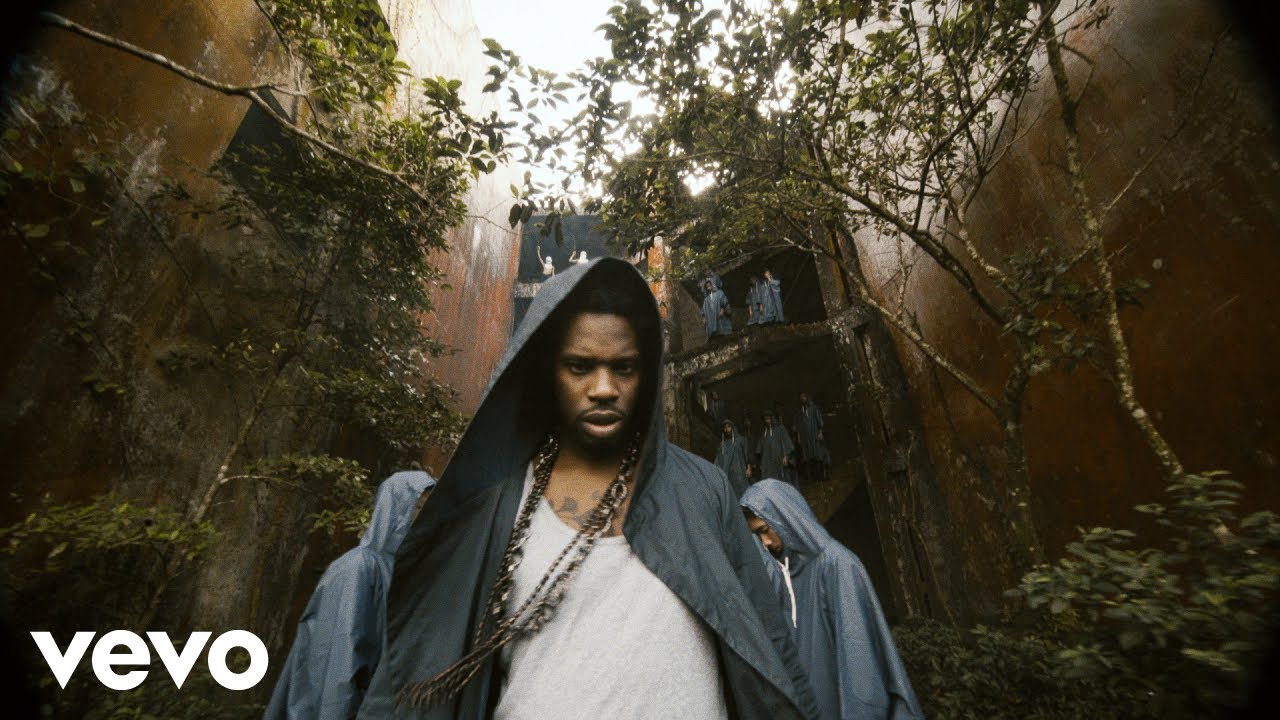
This foregrounding of Christian imagery is particularly noticeable on the video for ‘Crown And Key’. It was a collaboration with Filipino director Paco Raterta and was shot in a crumbling, skeletal building in Manila. In it, hooded figures with blurred faces, men wielding M16s and priests in the midst of smoky rituals meld in a hallucinatory vision, while Gaika sings, “Kill ‘em all.” He describes the track as a “an assault on power”, but the video is more of a dreamscape, full of crosses and blood-red pulpits, the haunted subconscious of someone processing death, identity and power.
I’d always thought of Gaika as an artist shaped by London. The sense of dread characteristic of so much music from the capital was very much present on his earlier work, such as Spaghetto and Security. But it turns out that most of Basic Volumewasn’t recorded there. “I couldn’t really be in England so I travelled a lot. It’s hard to place that record because I’m a hard to place person. Some of it was made in America, some of it in Mexico, some of it in the UK. It’s all over – hotel rooms, different studios with different people.” This was partly because he was seeking neutral spaces, free from the expectations of peers, record companies or the music press. “I remember thinking, I need to get out of London because if I make this in London it’s going be this angsty record. Having done Security which was so ‘London dystopia’, I wanted to do something different.”
Given that the album was made in a number of different locations, I ask Gaika where feels like home. “I’ve been really thinking about this”, he reflects. “I feel kind of dislocated, but I’m starting to enjoy the trippiness of it. What defines your locality? Your ability to get there and where the people you love are. So, if that isn’t limited by physical distance or your ability to communicate with them, then where do you live? I feel like I’m living at the edge of how a lot of us will live, where very fast travel and very fast communication means that we live in lots of different places at once.”
The trans-Atlantic nature of the album’s creation also meant that American, as well as British political concerns, influenced it. Gaika was in Los Angeles to witness the inauguration of Trump, a moment which solidified certain decisions about the direction the album would take: “When Trump won, I knew that it that was not going to be an easy-listening pop record, because there were too many things I wanted to say. It suddenly got a bit more real. I knew that some part of it would be a protest record, but I wanted it to be more nuanced than that. There’s not really any songs on there that are like ‘everybody dance and be happy’. That all seemed disingenuous.”
This refusal of the Twitter-ready, superficial nature of modern politics dates back to Gaika’s teenage years, when he first came across Guy Debord’s situationist classic The Society Of The Spectacle. “All my work is definitely connected to that book”, he says. “I think he’s right about late-stage capitalism. I’m a really IRL kind of person. You know everyone’s sitting there videoing themselves? It never seems not weird no me. We’re completely divorced from feeling anything that’s actually true. We put this barrier in place where everything is just a representation of itself. If it’s not on the screen then it doesn’t exist. It’s not cool, it’s not interesting until someone else tells you it’s interesting rather than you looking at it and making your mind up.”
I wonder whether this desire to be an “IRL kind of person”, is part of what drew Gaika to his other current project, his installation at Somerset House (where he also has his studio) entitled ‘SYSTEM’, made in partnership with Boiler Room. While ostensibly a celebration of history of sound system culture and Notting Hill carnival, he sees a deeper political significance to the work. “I think carnival is a demonstration of survival. It’s about immigration. It’s about space and holding it, so that you don’t die. My grandparents came here and got chased down the street by Teddy Boys with razor blades. You get marginalised, you come up against oppression of some kind, but they didn’t run away. They danced in the street.”
While a preoccupation with these themes pervades much of his work, there’s also a more playful side to Gaika’s creative output. He mentions that “when people listen to my records they think that I’m going to be one of these angsty people. But I’m not. I get all of that out of me in making the music. So I’m pretty chipper most of the time. I just like making stuff. I never want to be limited to just one thing.” When I ask what might emerge next out of this creative restlessness, he describes how his next album might go in a completely different direction to his previous work. “I want to make a record on a boat in the Caribbean. I don’t know what it will sound like, but I want to live on this boat for six months and make a load of sea shanties, like pirate songs.” I’m pretty certain that would be an album worth listening to.
Basic Volume is out now on Warp Records. Gaika’s installation SYSTEM runs from 2 – 26 August at Somerset House. He plays the Brighton Digital Festival a the Attenborough Centre for Creative Arts alongside Gazlle Twin on 11th October – for more information go here