
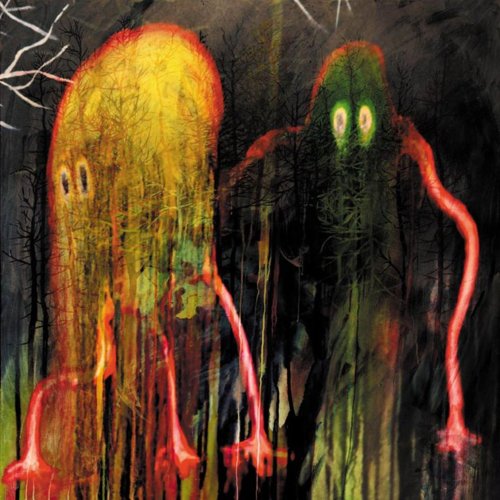
Here it is then: suddenly upon us, with a lack of promotional build-up that is, of course, the most effective fanfare in itself: the new Radiohead album, given a week’s notice and launched a day earlier than expected at that. It’s a media event, most certainly; and no doubt many column inches will be given over to discussing the marketing, the presentation, the notion of what being a rock band on a record label in 2011 actually means, and so on. But most importantly, King of Limbs is a collection of songs, and it’s the strength of those songs that must inevitably support the whole preposterous edifice. So without further sociological guff or preamble, here’s this writer’s raw response to the music itself.
‘Bloom’
A looped sample of a melancholy piano melody gives way to glitchy beats and an irritating high drone; this is Radiohead in definite Kid A territory, like it or not. And as a matter of fact, I do. Very much. “Open your mouth wide,” Yorke sings, as his opening gambit: his next line I can’t quite make out, as his vocals are quickly swathed in echo, looped and multi-tracked; something about the universe sighing, oceans and rocks? Appropriately elemental imagery anyway, before the lyrics give way to plaintive hums, moans and the repeated sound of his breath being caught; the voice as an instrument to be played and manipulated, and already we’re into one of the album’s abiding themes, an embrace of technological media at the same time as a yearning for the purity of unmediated nature. When a swirling, synthesised wash of sound swims in, it’s suggestive of the boldly modern (for the time) orchestral arrangements on Scott Walker’s ‘Plastic Palace People’, the highlight of 1968’s Scott 2, while the overall feel owes something to Walker’s more recent Drift album. The meditative, spiritual jazz of Alice Coltrane also comes to mind; not to suggest that there’s anything backward-looking about this song, or this album, but that it manages to combine the shock of the new with the feel of a timeless classic. And, you know, music that someone’s actually put some thought and feeling into.
‘Morning Mr Magpie’
Here’s one you can dance to: an insistent, two-note funk groove rides in on crackling hi-hats and muted, choppy guitar, as Yorke spits out, “You’ve got some nerve, coming here.” This is tense and threatening after the immersive opening number, Yorke calling out some thieving, possibly corporate, toerag: “you’ve stolen art, give it back.” Cue fevered journalistic speculation; for my part, I’ll merely note the contrast between the guilty magpie’s appropriation of art and magic, presumably for cynical or commercial reasons, and Yorke’s previously noted exhortation to just “open your mouth wide”. This can be taken as shorthand for the primal self-expression and un-tethered imaginative possibilities that remain the source of great art and music, and which exist in their purest form in the free jazz, folk idioms and experimentation for its own sake that Radiohead seem to be looking to for inspiration on this record.
‘Little by Little’
Mariachi-style guitar picking carries a romantic melody over what sounds like rattling cutlery, as Yorke croons about dark nights and complications. There’s a deliberate nursery-rhyme quality to the vocals- “little by little, by hook or by crook”- that suggests an incantation or charm, to warn off danger or just to quell panic and fear.
‘Feral’
Glitchy cut-ups and a busy, shuffling beat notwithstanding, this instrumental track has something of the feel of ‘Moments in Love,’ Art of Noise’s groundbreaking 1983 re-interpretation of Satie’s Gymnopedies. Yorke’s voice is sampled and rearranged in empty dark space, alongside lonely synth stabs, and the result is some strange meeting of progressive drum n’ bass with modern jazz and ambient choral music: too anxious and unsettling for chill-out muzak, it nevertheless harnesses an odd beauty.
‘Lotus Flower’
The loping jazz bass and the echo around Yorke’s plaintive falsetto here remind me of John Martyn’s 1973 classic, Solid Air. There’s a similar yearning for spiritual redemption through both music and love, as Yorke sings of the empty space within his heart, and the ideal of absolute freedom. And for me, this is the kind of setting where Yorke’s high, clear, yearning voice works best- against the wide velvet darkness of bass, synth and beats, rather than competing with dense layers of guitars. There’s hardly any conventional guitar sounds on this album, and this far in I think you’ve realised there aren’t going to be any ‘Paranoid Android’ style stadium rock anthems either, which is fine by me.
‘Codex’
A gorgeous, melancholy piano ballad, this relatively straightforward number is one of the album’s high points. You keep expecting it to explode into epic grandeur; it’s to its credit that it never does, remaining sparse and under-stated, with only a sorrowful, muted trumpet refrain coming in as counterpoint. Close cousin to Amnesiac’s ‘Pyramid Song,’ the imagery is once again elemental and nature-focussed, preoccupied with ideas of space and freedom, at the same time as suggesting the sacrifices required to achieve these goals.
‘Give Up The Ghost’
Driven by the pulse of a hand slapping against the body of a gently-plucked acoustic guitar, this beautiful atmospheric piece is another that evokes the late John Martyn. Yorke’s vocals are multi-layered, looped and echoing, fading and decaying, and making no discernable sense whatsoever; what they do communicate is an emotional resonance, a slipping away from reason and logic which is in keeping with the song’s title. It seems relevant that the track begins with a recording of birdsong, very obviously looped and sampled- nature in the raw as captured and framed by modern technology- and ends with what is either the repeated snipping of scissors or the stitching of a sewing machine- the cutting of cords or the joining together of separate parts into a new whole?
‘Separator’
Somewhere in this closing track is a blues, a modern-day spiritual worksong; Yorke’s singing is at its most soulful, while the musical setting is jazz-tinged and sparsely upbeat, with fretless bass weaving between skittering, trebly drums. A glassy, opaque guitar slides in as Yorke begins pleading for someone to wake him up, presumably from the somnambulistic state of modern life, in which man is cut off, separated from nature and true reality, although he could also be singing about the end of this drowsily hypnotic, dreamlike collection of songs.
Lasting just thirty-eight minutes, King of Limbs is a noticeably short album by contemporary standards, although back in the vinyl age it would be considered a perfectly respectable duration. But in this relatively brief span it sees Radiohead reaching out in many directions, joining hands at one extreme with the post-post-rock of Animal Collective and their ilk, and at the other with the experimental greats of bygone eras, like the aforementioned Alice Coltrane and John Martyn, who had the vision to step outside of genre and commercial considerations, swimming out into the ocean of all music, into Patti Smith’s limitless “sea of possibilities.”
It’s too early to say that this could be Radiohead’s best album to date, but I’m tempted. King of Limbs revisits the Kid A / Amnesiac period that alienated so many fans of OK Computer but does so with a greater maturity and weight of experience that enriches both the songs and the process. The members of Radiohead are growing into middle age now; it makes sense, perhaps, to increasingly align themselves with jazz and the experimental tradition rather than the youth and virility-obsessed conventions of rock n’ roll. King of Limbs is Radiohead moving further into leftfield, away from the mainstream they once courted, a mainstream that will no doubt damn this album as pretentious and self-indulgent, with all the confused venom of a lover spurned. And they will no doubt meet with equal brickbats from the other side, once again cursing them as an uppity pop band appropriating the innovations of the avant-garde for their own ends, like Bowie before them. I don’t really care. Speaking as someone who hasn’t always been a fan of Radiohead, who has at times found them pompous, over-rated and dull, King of Limbs is a thing of beauty, it has something to say, and it works. It’s OK by me.