
Photograph by MJ Kim/MPL
When the biography Many Years From Now was published in 1997, it was met with some incredulity, with critics suggesting it was a work of propaganda overseen by its manoeuvring subject. Was Paul McCartney, who spoke extensively with author Barry Miles over five years and thirty-five tapes (and was granted final copy approval), trying to change perceptions regarding who did what in the Fab Four? This sat uneasily with some, particularly as his partner in rhyme was no longer around to repudiate any such claims. And besides, most pop fans and fans of the Beatles in particular, probably couldn’t care less who wrote what line, or who was hanging out with Karlheinz Stockhausen and luminaries of the avant garde scene in London during the 1960s, or who for that matter embraced musique concrète or had the idea to incorporate experimental tape loops into the music in the first place. Most are just happy to sing along and luxuriate in the magic, regardless of authorship or origin.
If John Lennon was a charismatic, iconoclastic and sometimes demagogic figure in life, then his stature as demigod became even more mythical and hyperbolic after he was murdered in 1980, with the long shadow it cast leaving his erstwhile bandmates feeling like bit part players for a time. "When John got shot, aside from the pure horror of it, the lingering thing was, ‘OK, well, now John’s a martyr. A JFK,’" McCartney told Esquire in a 2015 interview. "I started to get frustrated because people started to say, ‘Well, he was The Beatles.’ And me, George and Ringo would go, ‘err, hang on. It’s only a year ago we were all equal-ish.’” This was certainly still on his mind in 2002 when he reversed the legendary Lennon and McCartney imprimatur on songs he’d exclusively written (‘Yesterday’, ‘Hey Jude’, ‘Blackbird’ etc), provoking a tsunami of ire, including some cross words from Lennon’s widow, Yoko Ono.
Given the canonical reverence afforded to the Beatles entire oeuvre and its likelihood of immortality, this does seem petty in the great scheme of things, and to cast McCartney as some kind of underdog would be ridiculous too. If his cross to bear is combating the forces of hagiography at its most spurious, then it’s the ultimate first world problem for an artist whose legacy is undoubtedly secure. Boo hoo for the mighty architect of modern pop, violins for the genius who wrote ‘Eleanor Rigby’. And yet, having said all that, it’s difficult not to feel a modicum of sympathy, even if there are far more pressing matters of imbalance and injustice to froth about. And besides, maybe those controversial seeds he sowed in ‘97 have taken root now, because along with the pisstakery about the thumbs aloft and the hip cat speak, he has started to get his dues in arcane places such as The Wire magazine.
McCartney claims to have given up fighting over who sits where at the top table anyway now, and perhaps he’s started to relax a little bit too. Certainly his acceptance of the importance of his own body of work is in full evidence tonight. The self-aggrandising nature of the whole evening would appear immodest from any lesser artisan. During the hour we wait for him to come on stage at the AccorHotels Arena, we’re treated to a megamix – The Beatles, Wings, duets and solo singles all leaking into each other – a nonstop nostalgia mixtape amalgamating ‘You Can’t Do That’ with ‘Tomorrow Never Knows’, ‘Say Say Say’ with ‘Listen To What The Man Said’, and so on. He’s preaching to the converted here in the chapel of McCartney, and the only support act he needs is the vast swathes of music he’s already created.
It’s a career so abundant that even the 36 songs over three hours played this evening, together with the extended Jive Bunny mashup of a pre-show, still can’t quite do justice to a back catalogue of such magnitude. There’s nobody left alive who can boast his kind of success as a writer and musician (Madonna, Elton, Led Zeppelin and Pink Floyd have each sold about half what the Beatles managed). It’s by definition phenomenal, and yet, having written so many of the 20th century’s greatest songs, the set is also uneven, with so much greatness punctuated sporadically with slapdash moments and the odd offering of doggerel.
The more recent ‘Save Us’ is sandwiched between ‘A Hard Day’s Night’ and ‘Can’t Buy Me Love’; ‘Four Five Seconds’ comes between ‘Lady Madonna’ and ‘Michelle’; ‘Letting Go’ and ‘Let Me Roll It’ are either side of the mighty ‘Temporary Secretary’, which McCartney introduces as a “chanson electronique”. There’s also time for an outing of ‘Ob-la-Di Ob-la-Da’, which divides opinion like few other Beatles’ “classics”. ‘Queenie Eye’ from NEW has a rambunctious ‘Hey Bulldog’ quality to it (and as a consequence is one of Macca’s finer 21st century moments), but it does leave you hankering for the actual ‘Hey Bulldog’.
‘Temporary Secretary’ stands out in a show that is essentially a band proving how much they can rock out; an ill-advised jam on Hendrix’s ‘Foxy Lady’ proves this to be so. McCartney, who has returned to vintage mullet, bestrides his Hofner bass with legs that seem impossibly long these days, and despite all the ageism chucked his way when he dares to dust off ‘Hey Jude’ for any civic event, he’s remarkably spritely for a man who’ll be 74 next month.
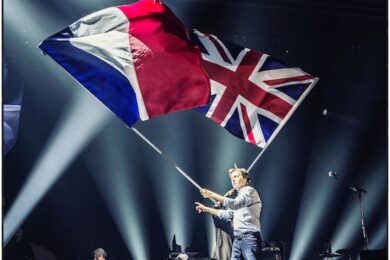
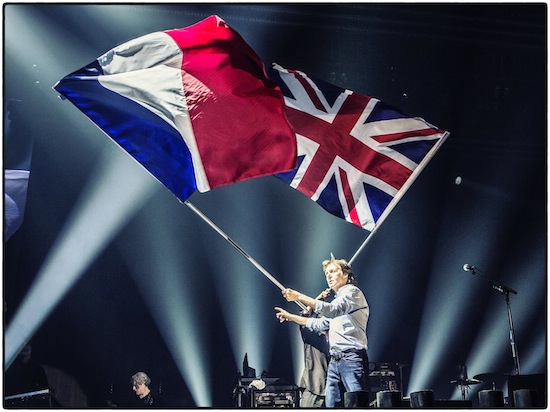
He reaffirms the fact he loves Paris, something he’s said often, with tonight being extra special – the city “deserves some good old rock & roll” he says, with the subtext being that it’s had to contend with too much bullshit lately. He even makes the effort, introducing some of the songs in French (with a little help from his cue cards). It’s just a pity there aren’t a few more oddities thrown in, or anything from Ram, his finest solo album. But in many ways these shows provide a service to the default memories of so many. His tours are now essentially roadshows for people’s recollections sprinkled with latter efforts that will never carry the same gravitas as those 60s and early 70s hits; it must feel like a losing battle, but McCartney’s a striver. Over familiarity with the old stuff is a curse that afflicts most living legends, though Lennon – cut down at just 40 years of age and having given up touring for many years before his assassination – will never know what it feels like. Swings and roundabouts.
The fact that McCartney does keep striving gives him many extra brownie points when that fatuous but all but inevitable “who was the best Beatle?” question rolls around. Aside from his magnificent, always tasteful bass playing, his preternatural sense of melody, his skilled arrangements, his mastery of every instrument and all the rest of it, it’s his keenness to keep abreast of contemporary musical mores that marks him out as by far and away the most innovative Beatle. It’s an instinct that has never left him, whether it’s recording with in demand young producers like Paul Epworth and Mark Ronson on 2013’s NEW, or working with Kanye West and Rihanna last year.
Obviously Lennon had all options cruelly taken away from him – a fact we’re reminded of when McCartney plays the kaleidoscopic and wonderfully off-kilter ‘Being For The Benefit Of Mr Kite’ and the poignant ‘Here Today’ – but Lennon’s solo career was a litany of compromise, an assumption of his rock & roll roots always looking backwards, and that’s only when he could be arsed. McCartney conversely pressed relentlessly forwards, erring and electrifying as he went. Take for instance Lennon’s Double Fantasy in 1980, his last album whilst he was still alive. It’s typical of his solo output: self-indulgent, self-referential, retrogressive; the only difference compared with other work under his own name is that at 48 minutes, there’s more of it to disappoint. In the same year, McCartney II was a revelation, a cavalcade of synths, electronic noises and studio experimentation, an influential milestone for electronica and even early hip hop. McCartney is by his very nature a fearless outlier forever attempting to subvert the mainstream, and while he fails now and again – sometimes embarrassingly so – he’s never dull. Lennon on the other hand peaked on the White Album (The Beatles), phoning in some of his finest ever songs while he retreated into opiated and loved up bliss in Montagu Square, striking gold again and again despite having lost interest in his own band (the workmanlike McCartney’s output on that album is more hit and miss).
There’s a theory that Lennon was McCartney’s quality control, and given Macca’s waywardness in the 70’s and ability to write entire albums of turd (Wings’ 1978 London Town LP springs to mind), there may be some truth in that. But when someone has given musical birth to – and can include – the delectable ‘Maybe I’m Amazed’ and the dreamy ‘Here There And Everywhere’, the anthemic ‘Let It Be’ and ‘Hey Jude’ – all played on an elevated grand – the emphatic ‘Band On The Run’, and the explosive ‘Live And Let Die’ (complete with dangerously loud pyrotechnics) all in the same set, then frankly they’ve earned the right to put whatever they like out, including singsongy nursery rhymes aimed at their own kids. As time wears on, Lennon’s contribution to modern culture – though enormous – increasingly shakes off the mythology and allows for more objectivity, while McCartney is at last being grudgingly given the plaudits he’s owed. History will be kind to them both, but one suspects the narrative of the last 35 years will swing in McCartney’s favour eventually, even if that’s many years from now.