
As the 21st century roared into view, so did Room40.
What started off as a pre-millennium zine cobbled together in Brisbane grew into a series of carefully curated shows promoting the type of artists very rarely seen in North East Australia, and has now evolved, a quarter of a century later, into a home for some of the most vital, compelling, and dream-like experimental records. Included on Room40’s discography are artists such as Kevin Richard Martin, Grouper, Tim Hecker, Alan Lamb, Celer, Kate Carr, Keiji Haino, Scanner and Rafael Toral, among others. The label has brought disparate people together from far corners of the planet, it has opened myriad doors, and it has started innumerable valuable artistic conversations.
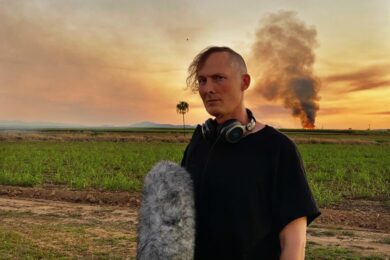
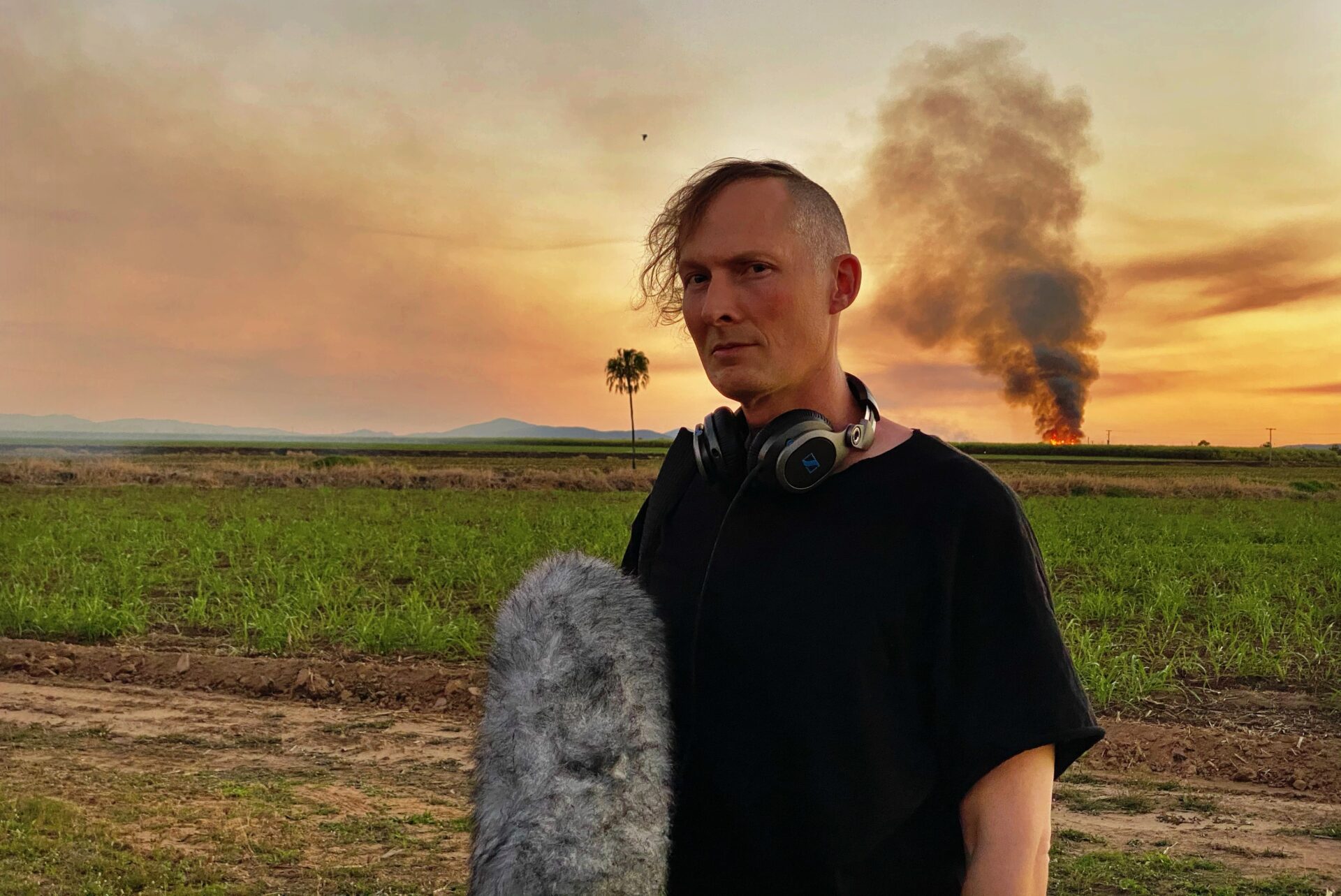
The man behind the label – Lawrence English – is celebrating this milestone by guiding us through a primer of the releases that have made the label what it is today. Speaking via video call, he remarks: “I’m pleasantly horrified that I’ve been able to maintain this life as long as I have. It’s quite sobering sometimes to recognise the passage of time.” He ruminates on subjects that range from the role of labels (“a kind of amplification device”) to colonial impacts on Australia, and the purpose of music criticism. (“There’s a huge gap in music criticism right now – talking about it within the broader context of a cultural landscape – it’s a huge issue that we need to address and probably soon because there is such a limited pool of people able to respond.”)
Mostly, however, we discuss the incredible music that Room40 has put out, leading to the revelation that I’ve been mispronouncing Ben Frost’s Steel Wound for over a decade (the title contains the past participle of the verb which means to repetitively turn a pliable substance around a pivot; it should make the listener imagine a metal cable, or guitar string rather than a knife injury). English has also recently released the fascinating and subtle, collaborative work Even The Horizon Knows Its Bounds as a loose audio guide to the Naala Badu building at the Art Gallery Of New South Wales. It’s a record that he describes as being “very much about making an atmosphere or environment that you can travel inside of… to try and create this space where everything was sort of falling into itself.”
Atmosphere. Travel. Space. These notions seem to align with the focus of the label, the artists on its roster, and with Lawrence’s own personal approach. There’s a thread of dedication throughout. Everyone involved is in this for the long haul. 25 years in and the bonds are only getting stronger.
Ben Frost – ‘You, Me, And The End Of Everything’ from Steel Wound (2003)
Lawrence English: “Ben Frost is a good example of one of these people I’ve had a relationship with for a very long time. Hearing where he started, in those very early recordings, to where the work is now, for me, it’s such a clear lineage. The depth of that practice, over that time, is incredibly admirable and it’s inspiring to see people be able to do that and to recognise that the work that we do as makers, as artists, is about deepening over time and being able to cultivate something that isn’t always necessarily new. It’s not a horizontal music. It’s a vertical music. You’re going deeper into the practice. You’re not just skating along trying to make the vista as wide as you can, you’re actually picking out one section of that vista and just diving into it as deep as you can. It’s like Hokusai’s Great Wave – he created a version when he was 33, he created a version when he was 40, then he created another when he was 50, and finally he made the image that everyone knows when he had turned 70. Sometimes you need a lifetime to unlock what it is that you’re doing.”
Tenniscoats – ‘Cacoy’ from Totemo Aimasho (2007)
LE: “I invited them up to play at a bar called Ric’s which fits maybe 80 people in it, with a tiny stage. We put on this show, and it was absolutely ram-packed. I played with Tenniscoats that night, I’m pretty sure. It was a kind of free-floating ensemble at that point and then they stuck around for another couple of days. It was the middle of summer, and we recorded in this abandoned office building in Fortitude Valley. It was about a thousand degrees inside this building, and we sat and recorded the guts of what would become Totemo Aimasho. What was amazing, and still to this day I cannot get over their capacity to do this, you could give them a fork, a glass bottle, a pencil and eraser and they could make you a beautiful song out of those things. I think there are different kinds of musicians. There are musicians who can take anything and make it into music. I am not one of those people so, when I meet someone like that, I’m fascinated by how they do it. It’s so second nature to them, I’m sure it’s not effortless but it looks completely effortless.”
Tujiko Noriko / Lawrence English / John Chantler – ‘The Sky And Us 2 Girls’ from U (2008)
LE: “I picked this record because it really speaks to the reason that I started the label which was this opportunity to make connections and to reach outward. During Covid, the thing that I realised that I really missed was actually seeing people and being inspired through those conversations over dinner, or whatever the case might be, that open up other ways of thinking about work or politics. Those inconsequential engagements and chance things that happen. Those are the things that fill you up. I realised very early on with Room40 that that side of things really does fill me up. That’s where I draw the satisfaction from in terms of what the label can do. What Room40 has done is make these doorways through which you can create these rooms on the other side. You don’t always go into them but Room40 gives you this great opportunity to make connections with people and sometimes those work like personal connections, like this one, that were about a musical exchange but other times it’s just about ideas or about being able to support people’s work in different ways. U was one of those projects that was really about bringing together all of these different threads that something like Room40 provides. And that’s the thing that I think I’m still so grateful for. This record was really born out of one of those early chance encounters.”
Mike Cooper – ‘Kokoke Nalu’ from Rayon Hula (2010)
LE: “It’s an incredible record and it’s an incredible record that’s about obsession, about deep interest and being able to translate that into something that’s really beautiful. He [Mike Cooper] is 100% committed to Oceania and all of the cultural manifestations that happen within Oceania. I think it’s also one of these records that began a relationship that has now lasted the better part of 20 something years and many, many editions on the label. He’s a prolific maker. He’s constantly seeking something new. I don’t mean that in terms of a different kind of stylistic newness, he’s interested in how you can find different exposures of the material. He’s always working with essentially the same tools but he’s able to get the gradation of the tools to operate in a way that I’m constantly in awe of, how he unlocks another sound. I can’t begin to imagine how it is that he does that.”
Norman Westberg – ‘Bunny Bill’ from 13 (2015)
LE: “I count myself fortunate to be able to champion people and Norman is a great example of that. I met him in 2012 when Swans came to play in Sydney, during The Seer. I remember being particularly struck by Norman’s playing because he had such an angular approach at that time on that record particularly. It was these plates of sound that he was able to create that sat and glued together a lot of what Swans was. I went back and listened to a lot of the early records that he’d been part of. I could hear this texture of guitar that I thought was quite different to how other people were approaching the instrument. There was this whole other language that he’d developed, which was about delay lines and these recurrent tonal pulses in the work, and I was completely fascinated by it. He’s someone that’s had a lot of recognition through one channel of his life but he has this whole other practice that sits a little bit in the shadows and, to be able to bring that into the light was, for me, an incredible pleasure. Something that I increasingly recognise as part of the pleasure that I derive from Room40 is being able to help folks realise projects and other ways of approaching what it is that they do. That kind of dialogue that comes with that, I really have come to recognise how much I derive a sense of satisfaction from what the work is.”
Merzbow – ‘StereoAkuma’ from StereoAkuma (2020)
LE: “In 1998 Faith No More were touring Australia. The story goes that as part of that agreement, Mike Patton said, ‘If we’re going to do an Australia Faith No More tour, I want to play with Merzbow on the off nights.’ They were doing this project called Maldoror which was a duet record, and they came to Brisbane where they played at a venue called Van Gogh’s Earlobe to a room of 500 people. Let’s say that 450 of those were Faith No More fans, they were all rammed into this room and I remember Merzbow and Mike Patton came out and they started this thing that was literally burn-your-face-off noise. It was amazing. Within three minutes of the show starting, I would say 400 people were outside the venue and there was this small group of people left inside. I just remembered being completely awestruck by this thing. There’s a bootleg video of the gig on Youtube somewhere and you can hear me call out “MERZBOW”. I made a Merzbow mixtape for this magazine a few years ago and the very beginning of it is me calling out from that video. A few years later he was in Sydney playing at the Room40 Open Frame festival. I remember at one point recognising that my lung was vibrating, and it was the most unnerving sensation, to have this internal vibration. This flutter of a part of your body. I remember being completely unsure how it was possible. I understand how sound systems work and I understand the physics of how a wave works on a body, but he found this frequency, it was only for six or seven seconds, it must have been some sort of filter sweep or oscillator sweep, and I just remember having this sensation that was unlike anything I’d ever felt. Partly the air was being evaporated out of my body but also this sense of having an interior self that was being activated. At the end of that show, we went to reset the PA and the subs had moved forward nearly a metre and a bit from where they had been set up. They’d literally vibrated across the room. With Merzbow that’s one of the things that I love, the terrain is never settled. There’s always another contour or another edge that you have to be wary of because it’s right there and, if you just tilt a certain way, this whole other vista in the Merzbow universe opens up. It’s like you’ve suddenly got a new Hubble telescope that’s just twisted and there’s a whole other nebula you didn’t even know was there.”
David Toop – ‘She Fell Asleep Somewhere Outside The World’ from Apparition Paintings (2020)
LE: “David is one of the first few people that I reached out to. I’m incredibly grateful to him in many, many ways. He came to Australia in 2003 and on that visit, he brought with him a series of compilation CDRs that he was making for himself but that he left with me. One of them was a sleep music, one of them was a kind of exotic music – that’s not how he described it but that, for me, was what it felt like at the time. It was a lot of Gagaku recordings and other things that the young version of me was not familiar with. From that initial meeting I stayed in touch with David, and he’s been a central figure in my life. He epitomises what I feel is important in music. It’s this idea of how music is situated in something that is much bigger than itself. Ocean Of Sound, Exotica, Haunted Weather, all of his books speak to this intermingling of things. The idea of music always being part of these much bigger narratives where, even the smallest little crevice that you can stick your nose into, there’s a whole other world that can open up. David is very good at finding those crevices and casting light where there is shadow and sometimes making shadow where there is light and suddenly that shift in perspective opens up some other space. Just when you think you have the language, he introduces a new word that completely surprises you.”
Annea Lockwood – ‘Breathing Machine’ from Glass World (2023)
LE: “I’ve been incredibly fortunate to have a number of people that have become part of this label family over the last decade; people who offer other means of practice and an accumulation of experience and ideas. I recognise more and more how important the ability to just be captivated is, and when I see that in someone else. If I can grow up to be like Annea Lockwood, I’ll be very happy. We met in a diner in New York. She caught the train down, sat down with me for a couple of hours, ate fries and then got back on the train and went home. We just talked about ideas and her work and from there a whole stream of things have come about. Nothing is fixed. There’s no static. Even if we perceive it to be static, it just holds for a moment and then it’s gone. That’s the beautiful thing about sound – the moment we recognise it, it’s gone and we’re just extracting this thing out of the shallow grave of memory. I think, for me, recognising the temporal condition of sound speaks to something much broader than just that experience and it becomes emblematic of something else. That’s really part of the opportunity that something like Room40 provides, it’s the chance to imagine and reimagine at the same time. From that comes so many opportunities to develop, and grow, and expand and reconsider the things that we think that we already know.”
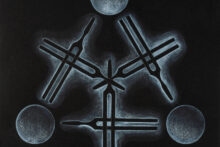

Beatriz Ferreyra – ‘Cercles Des Rondes’ from UFO Forest + (2023)
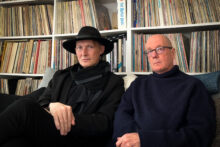
LE: “I met Beatriz Ferreyra at Semibreve Festival, and we all went to dinner together and, I don’t know why, but we sat together. At this point, I just knew her by name and a little bit by reputation. She’s kind of wild. I mean that in the best way possible. She’s just a wild energy. At one point she took my hat, and she was wearing it and I thought, ‘You’ve got some guts lady, I like your vibe’, and from then on we just hung out for a few days. I would say I was struck by the person of Beatriz Ferreyra. She caught me completely off guard and I was completely swept up in the person and then, when I knew the person, the music unlocked itself in a way that really surprised me. I am in awe of her as a composer but also as a person in the world. I speak to her probably every other month and she’s in her late 80s now and it is kind of like I’m talking to an auntie in another country, but it is this quite amazing relationship that I’ve had the great fortune to stumble across late. The last time that we saw each other was in Brazil and, if that is the last time that I get to see Beatriz, and I hope that it’s not, what I remember is her being this amazing force charging up a hill to go and look at toucans in the jungle. That kind of unstoppable energy, that effervescent lust for life is incredible, and I think, when you listen to UFO Forest, you sense that energy.”
Amby Downs – ‘Ngunmal’ from Ngunmal (2023)
LE: “Generally in Australia, over the last decade particularly, we’ve started a number of conversations around a whole range of historical and contemporary issues. What I think is really important about the work of someone like Amby Downs is that it speaks to these concerns and it asks questions in ways that are really very direct but also completely porous and open to multiple readings. If you’d said to me five years ago that there would be a generation of young, indigenous artists from Australia making experimental work, I wouldn’t have necessarily believed it. But, in the last two and a half years, there has been this string of artists making this incredible work, each absolutely in its own realm. I found it incredibly inspiring to see this generation of artists coming through and to be able to support some of that work is incredibly humbling and also incredibly important. That’s one of the few times where I feel like the label’s connection with Australia is particularly pronounced. Tahlia [Palmer AKA Amby Downs] makes work which is a really great example of this. The Ngunmal record has this sense of tension and a kind of recognition of trauma in it that is profoundly tangible to me.”