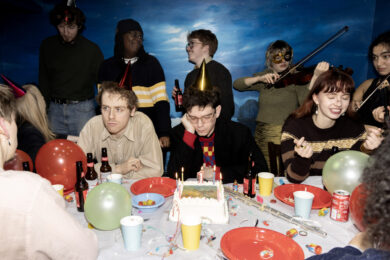


Hailing largely from rural Iowa, the members of Thinking Fellers Union Local 282 relocated to the Bay Area in 1986, from where they released seven unique studio albums between 1988 and 2001. A collision of divergent personalities and eclectic music tastes (classical music, big band jazz, easy listening, The Beatles, Ennio Morricone, Perez Prado, Zoviet France, Gastr del Sol, The Residents, to name but a few), with an ear for a great pop tune as well as a penchant for improvisation, a keen appreciation of the texture of recorded sound and a desire to experiment on every level, TFUL282’s idiosyncratic and wildly varied music attracted a small but intensely passionate group of fans. Their advocates include Pavement’s Stephen Malkmus, Elf Power, Ryley Walker and Animal Collective, who invited the band to reform for their 2011 ATP. Jonathan Franzen referred to them in his hit 2001 novel, The Corrections. Yves Tumor sampled ‘Cup Of Dreams’ for his 2023 track, ‘Meteora Blues’, whilst The National used the full lyrics to ‘Noble Experiment’ in their 2019 song ‘Not In Kansas.’ For this writer, TFUL282 remain the greatest weird American band of their time, directly comparable to no others, with only the likes of Butthole Surfers, early Mercury Rev, Amanita era Bardo Pond and Sun City Girls being near kindred spirits.
According to guitarist Hugh Swarts: “Back in the 90s, there was a brief period after we were off Matador and we were seeing if there was any major label interest. We talked to Ray Farrell who worked for Geffen. He told us: ‘A major label wouldn’t know how to market you.’ And I think that kind of nails it.” Yet, if their hard-to-pigeonhole sound made them a difficult sell back in the day, that same unclassifiable aspect is a welcome quality in the present. In May 2025, TFUL282 signed a publishing deal with Inverted UK, who said: “At a time when algorithmic music dominates, TFUL282 remain deeply human, chaotic and imaginative.” A series of recent reissues from Bulbous Monocle, an archival label overseen by Sublime Frequencies co-founder Hisham Mayet, has made their hard-to-find vinyl releases available again. If there was ever going to be an auspicious time for the band to find new fans, then this is it.
As Stephen Malkmus said in his 1997 Melody Maker Rebellious Jukebox feature: “When I see TFUL282 [live], I think: ‘It’s way personal and beautiful and that’s what I should be doing—making personal statements instead of grand public ones. That’s the best synthesis.” I asked Brian Hageman (guitar, viola, violin, mandolin, vocals) what qualities made Thinking Fellers so unique. Despite their time playing live being mostly behind them (the band played two shows in Portland in August 2024 and hope to do more), Hageman’s enthusiasm remains undimmed:
“We spent a lot of energy searching for serendipity. The main thing was the search for sound and atmosphere. More so than being proficient at the instrument […] That’s the whole idea. Instead of trying to find classically good sounds, you find things that work in their own unique way. When the first few of us that moved out here to the east Bay and played our first couple of shows in local places like Gilman Street, people were saying ‘obviously you are fans of Swell Maps and The Fall’, neither of which I had heard of. I couldn’t believe some Fall music when I heard it, how much kinship I felt with it. Their use of breaking up songs. Like that track [‘Paint Work’] where MES goes ‘spoiling all the paintwork.’ Putting your fingerprints on it. To me that was perfect.”
Regular practice and improvisation soon became a vital part of the band’s compositional process, with Hageman recording all of their sessions on tape. The obvious parallel is Can, with Hageman playing the role of Holger Czukay. Mark Davies (vocals, bass, guitar and banjo) recalls a fondness for the band but downplays their influence: “It was Greg Freeman, our producer, who turned me onto Can. We were already recording by that point.” Afterwards, some of those passages would be bolted together, Frankenstein-fashion to create songs, or included as they were as ambient/ noise pieces on albums. These pieces were sometimes referred to as ‘Feller Filler.’ Hugh Swarts recalls: “Some people liked it and some people hated it. We just put the stuff on because we liked the individual pieces for one reason or another.” Davies added: “We definitely appreciated different levels of fidelity and found that there’s something you can get out of all of it. I can enjoy something that’s super produced and slick, but I can also appreciate really gritty, muffled cheap speaker that has a sort of weird quality of its own.” Though this aspect of the band’s output may be off-putting to some, as with Sun Ra, the very unfathomability of some of the soundscapes they created is a key aspect of their music’s mystery and hence longevity.
‘Narlus Spectre’ from Wormed By Leonard (1988)
Mark Davies: “The lyrics came from a dream of this lonely young woman and her crazy grandma who was going out threatening people with a rifle.”
Brian Hageman: “That fits into my absolute fascination with Ennio Morricone and the spaghetti western. I was writing a lot of guitar parts back then with that sort of aesthetic in mind. It’s so early but it’s still one of my favourite guitar solos. There are songs which were super hard to get through that ended up succeeding, but there are other songs that were like four minutes, that’s the time it took to write it. And I really appreciate those.”
‘Change Your Mind’ from Tangle (1989)
MD: “I think the main riffs were Brian’s and it’s Brian who does the little vocal ejaculations in between.”
BH: “Whether or not we decided to play was always up to me on any given night, because I had to do an improvisational lyric part of it. Some nights it was really fun and I was trying to ride the character I was going to be when that part came up. I never knew what it was going to be but generally it was pretty abstract – somebody who was in a no man’s land of reality.”
‘Four O’Clocker 2’ from Lovelyville (1991)
MD: “There may have been some subconscious feeling of fucking with Matador by submitting an album with more ambient interludes and less songs, because we were now on an established label—an unconscious desire to put a spanner in the works.”
BH: “That song was really part of the improvisational sort of thing, and it had erhu on it too. It’s a little wooden drum with a snakeskin over it and a bridge and two strings and a neck and two tuning pegs. The bow goes in between the two strings, so you can pull up or push down or pinch between the two of them. That track always reminds me that I was bothering the people who lived above me so badly while I was trying to learn that instrument that they actually reached into my kitchen window from the parking lot and took it off my table and destroyed it!”
‘Tell Me’ from Mother Of All Saints (1992)
BH: “Mother of All Saints has way more of the banjo, mandolin and a lot more of the other instruments came in at that time. We were writing stuff on the road a lot and there was just so much, that’s how it ended up being a double record. We were loud and chaotic live – we wanted it to be overwhelming. The way Anne would deliver her vocal, and that banjo was freaking amazing sounding. It was so sharp. It had so much edge to it and Mark would play it sometimes with such ferocity. I remember playing a show in Austin Texas on a Sunday afternoon in some club, and when it ended I thought my head was going to explode, I absolutely loved it.”
‘Hurricane’ from Admonishing The Bishops EP (1993)
Hugh Swarts: “I think it’s one of our high points; maybe the best song we wrote. Perhaps because it was a completely collaborative effort and couldn’t have been written by any one of us alone. I remember vividly when I got a copy of the final mix on cassette tape, I did something I’d never done before and never did after. I listened to it over and over one night because I couldn’t believe it was us. It didn’t seem real or possible that we’d made this song. But there it was.”
BH: “We recorded at Steve Albini’s house and he was so generous. He spent a whole night with us, educating us about the history of CDs, which had just become de rigueur. While we were recording, Steve was on vacation but would take a break to make us pasta or frappes. He was also disassembling old ribbon style microphones and putting in new ribbons and reassembling them. Kind of off to the side of his brain. That’s the level of engineering he was at.”
‘Cup Of Dreams’, from Strangers From the Universe (1994)
MD: “This one has an Optigan on it. You could probably call it a sampler, though not in the way we would think of it today. It’s definitely one of the songs that I feel most proud of. The way we did lyrics was usually we would write the whole song musically, maybe even record it in the studio, before anybody ended up putting lyrics on it. So, this song was pretty well formed and you’re building upon the mood of the song by forming the lyrics.”
HS: “It’s funny you should say that’s a song you’d request at your funeral, because in the last couple of months somebody said to me that’s the song they want to hear on their death bed. For some reason it popped into my head today. I went out for a walk to get some fresh air and those lyrics came to mind. I think my take on it is kind of carpe diem, you know grab what you can while you can.”
BH: “I have this guitar part that comes in, like a B minor little climb of notes, that I try to rise up out of it with all this infinite reverb and I just start crying sometimes. Mark’s lyrics for that are really great. There’s a kind of sense of a beautiful giving up—like what are you gonna’ do? Let’s just enjoy this little bit.”
‘Elgin Miller’, from I Hope It Lands (1996)
MD: “We did most of the albums with Greg Freeman who had this studio called Lowdown, but this one was done at a place called Coast with Gibbs Chapman – a more of a high-end place.”
BH: “That song was a product of when we were trying to not work day jobs – a period of about a year when we were just trying to tour. For ‘Elgin Miller’ there’s probably a fifty-page notebook of versions and then I was just paring it down. Lyrically, that song means a tonne to me and it actually goes all the way back to my mom and dad. I’m the last of eight kids and my parents have both passed. But when I wrote that song my mom was still alive and it was all about that point in your life where she was seeing everybody around her die.”
‘You In A Movie’, from Bob Dinners And Larry Noodles Present Tubby Turdner’s Celebrity Avalanche (2001)
HS: “It was kind of like, ‘Well this is our final record, why not go whole hog and have a ridiculously long title.’”
Referenced artists
Pavement
To Chop And Change: Pavement’s Wowee Zowee 30 Years On
John Cage
Do You Have Plans For 4 Sept 2640? On Music Of Extreme Duration
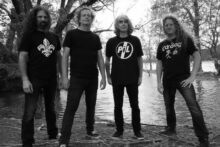
Steve Albini
Home And Away: Voivod Interviewed
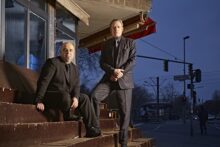
Ennio Morricone
A Black Atmosphere: Blixa Bargeld & Teho Teardo Interviewed
The Fall
Reissue of the Week: Fall Heads Roll by The Fall
MD: “That record was different in that it took five years to finish. We were able to experiment in different ways because we were more relaxed about it.”
BH: “I had an eight-track at my house and I came up with six tapes full of solos for that song. When we finally got into the studio, I just detuned two strings, without paying any attention to where they went and then played what I played on that record and thought, ‘that’s good, I like it!’ It took all this evacuation of crap and good stuff to get to the point where I was comfortable enough to just play what was in my heart.”
‘The Barker’, from Bob Dinners And Larry Noodles Present Tubby Turdner’s Celebrity Avalanche (2001)
MD: “We experimented a lot with different tunings. I think Brian came up with that tuning, the low E string is tuned up to a G, so it makes this little bit of different tension to it. It was my guitar that was tuned that way, usually it would have been Brian’s. That song had a completely different set of lyrics before what it ended up with. I had written a whole different set of lyrics and I just didn’t feel quite right about it.”
BH: “’The Barker’ is where I was headed. I jammed an outsized guitar slide on the underside of my strings at the bridge, for parts of it. And Mark’s choices about his lyrics and his singing [which is ludicrously high-pitched to mirror the hyperbole of the advertising world], and Greg Freeman’s choices about mixing were just perfect. We played it once at the Great American Music Hall in San Francisco and I just remember the sound of the audience came off to me as like ‘What!?’ – surprise and joy.’”
‘Entoloma’, from Hanging From The Devil’s Tree (2001)
BH: “Anne [Eickelberg] pitched in, Mark pitched in, but a lot of it was just me with this old computer software called Cool Edit Pro, looping sounds that I had found, and recording guitar parts and looping them. I really liked looping really messed up sounds. I had these little Radio Shack 9-volt battery powered speakers, that I habitually used with 9-volt batteries that had almost zero power left, so when you would play it through it, it would sound like it was dying. I’d finished all of the sound, the entire thing. I used to listen to John Cage a lot, and I woke up in the middle of the night, hearing [the composer talking about a case of a near mushroom poisoning, taken from Indeterminacy] fitting over the top of that music in my head. I swear, this is not an exaggeration. I realised that it would fit, got up that morning and just put it on top. I did not move anything anywhere, what you hear is the first attempt.”