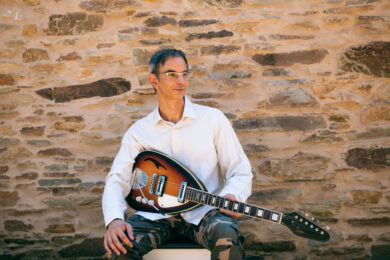

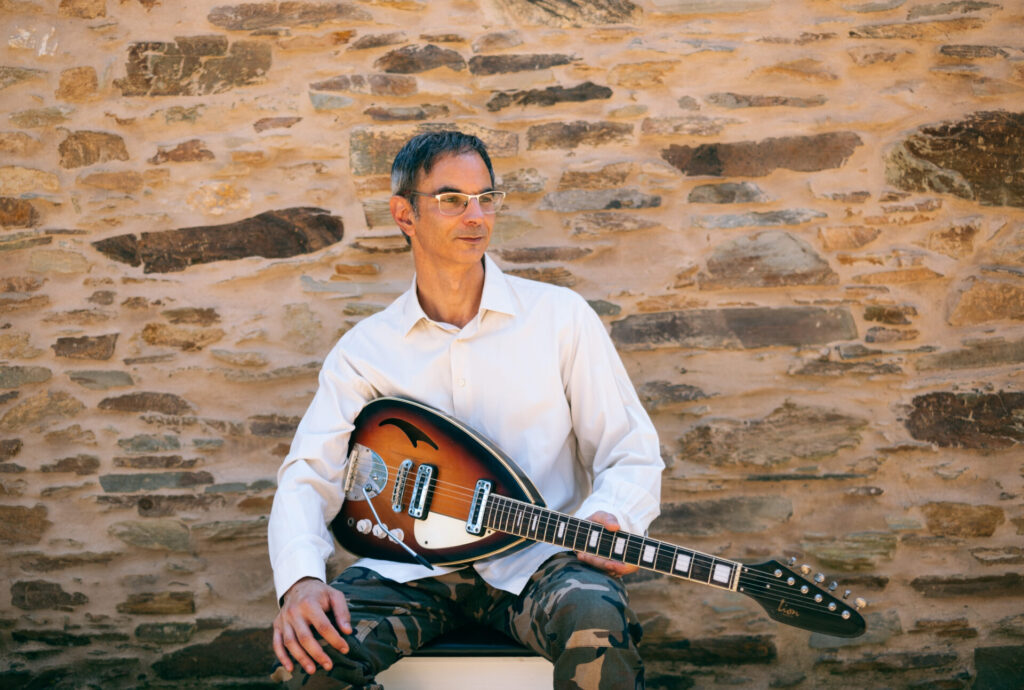
Rafael Toral’s records make invention and exploration audible in real time. 1995’s Wave Field originated after he saw the Buzzcocks in 1994. As the venue’s unsympathetic acoustics turned the British band into an ‘amorphous roar’, Toral imagined rock music liquefying, and that vision is what the album synthesises and explores. 1998’s Aeriola Frequency fixates on the resonances hiding in electrical circuits, turning them up and finding a world of spooky harmony. In 2004, Toral asked how volatile electronic instruments could play free jazz, and a series of records over the next decade plus, from 2006’s Space to 2017’s Moon Field, documented his research.
For all their questioning and exploration, Toral’s albums glow with peculiar life and colour. Synthetic chirps and warbles in the Portuguese artist’s music evoke extraterrestrial life, while his compositions are rooted in a deep exploration of terrestrial music traditions and sonic phenomena. Scientifically dissecting sound isn’t the end goal. He’s captivated by the resonances sound can have beyond itself. “I’m drawn to flux,” he explains over email. “When the instruments, the phrasing, the sound, acoustics and room energy are all perfectly aligned and magic happens.”
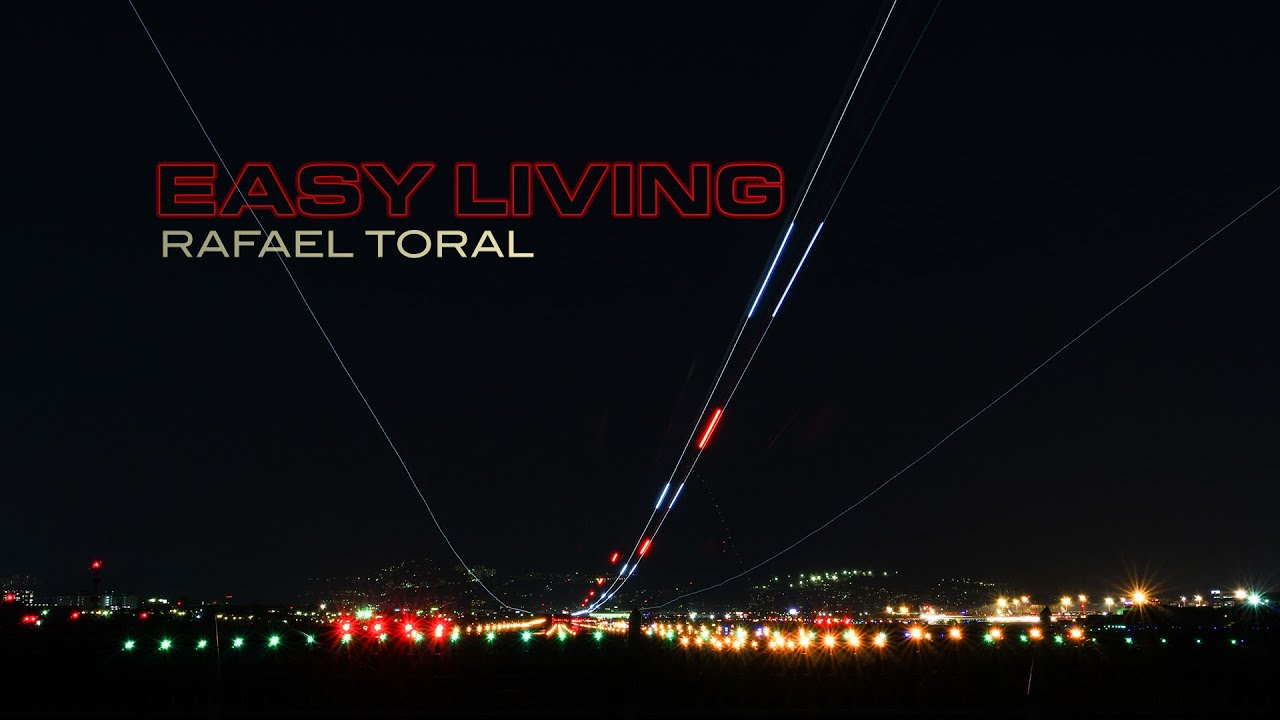
His forthcoming album, Traveling Light, opens with a chirrup of feedback before majestic chords sway like a cosmic speakeasy. The track, ‘Easy Living’, is based on the 1937 jazz standard by Ralph Rainger of the same name. Indeed, all six tracks on Traveling Light are interpretations of jazz standards from the 1930s and 1940s, rendered into swooning blasts of luminous tone.
Traveling Light, which Toral will be performing live at the 2025 edition of the Semibreve festival in Braga, Portugal with a small ensemble of clarinet, flugelhorn, flute and tenor saxophone players, was made “in parallel” with its predecessor, 2024’s Spectral Evolution. That record used chord progressions from standards by George Gershwin, and Duke Ellington and Billy Strayhorn, and has similar components to Traveling Light – Toral’s unusually haptic electronics and effects drenched guitar carrying the timbral complexity of an orchestra. But the standards’ presence is much less obvious in Spectral Evolution, where they act as jumping off points into fields of extraterrestrial sonics. Traveling Light stays much closer to the originals, seeing what happens when their harmonies and arrangements are allowed to bend and blur through long exposure.
“I’m aware of the tradition in jazz to deconstruct, reinvent or improvise over standards and I didn’t want to reinvent anything,” Toral explains. “But it’s also clear to me that Traveling Light is not a jazz record. It sidesteps traditional ways and expectations about how standards are to be approached. I didn’t treat them as songs but as sublime sound entities. I did my best to keep them intact even if the arrangements are sometimes unexpected.”
Upon release, Spectral Evolution seemed a sui generis intervention into how simultaneously gorgeous and bizarre ‘experimental music’ could be. In the history of Toral’s practice it’s less of an outlier. You can chart throughlines from his work over the last three decades, even if those throughlines are rife with intriguing diversions.
Toral grew up in Lisbon. At 12 he was learning to play songs by The Beatles on acoustic guitar. His older brother had an electric. “I was in total awe of how fascinating an object the electric guitar was. From listening to the bands I liked on the radio, I was drawn to the unconventional sounds it could make. It turned into an obsession.”
As a teenager he played in rock bands. “I remember imagining music that I was hearing in my head, but didn’t exist, and how I wanted to record it somehow so I could hear it,” Toral relates. “At some point I understood what I was envisioning was too specific. I had to pursue it alone.” He began experimenting with home recording and electric guitar from the late 1980s, the fruits of which can be heard on Early Works. By 1994, he’d completed his debut, Sound Mind Sound Body, an intricately woven guitar record where the instrument is varnished, refracted and extended through multiple signal chains. It includes ‘AER 7 E’, a track Toral has returned to and reinterpreted over the years. Wave Field and Violence Of Discovery And Calm Of Acceptance continued and expanded this line of guitar experimentation. Although slow moving, these records capture sound in dynamic motion rather than stasis, tones curling and changing hues like oil diffusing through water.
In 2004, Toral put the guitar down and began using a collection of electronic instruments which he built himself: devices where feedback and sinewaves could be controlled with joysticks and gloves, or synthesisers with theremin or light-based interfaces. These tools formed the basis of 2006’s Space (also featuring Sei Miguel on trumpet and Fala Mariam on trombone). Now, close to 20 years later, Space still startles. To describe its unfamiliar sonics pushes you into language usually associated with the vocalisations of organic life or science fiction sound effects. I ask if he’s conscious that these sounds often seem so curiously sentient.
“It’s not intentional, as most of my performing concerns are strictly musical. Those instruments were made in a way that they’re not 100 per cent controllable, so playing involves listening to what they do and deciding where to go next, every second. Some things I reject and some I accept. If it sounds like an ambulance I steer away. If it sounds like a strange entity, not any known animal, and still musical, I tend to accept it, as long as I don’t recognise it.”
These instruments directed Toral’s exploration of what he dubbed ‘post-free jazz electronic music’. Space heralded a sub-series of albums under the Space Program umbrella. Space Quartet records saw the instruments deployed in an acoustic free jazz ensemble. Two Space Solos albums collect extended solos on the instruments. Space Elements records brought in instrumentalists to accompany the electronics, each focusing ‘on a kind of instrumental behaviour’.
But it’s not a straight line from experimental guitar to self-built electronics and onto the peculiar verdancy of Traveling Light and Spectral Evolution. Constellation In Still Time stretched ‘AER 7’ out into a sparkling, record-length generative piece to be played by an ensemble of clavinet, harp, piano and vibraphone. Three albums in Toral’s Harmonic Series use computer generated sinewaves to magnify the raw components of music with spellbinding results. The collaboration with trumpet player Sei Miguel is two way, Toral appearing on the latter’s radical jazz records, most recently contributing to 2023’s The Original Drum. Elsewhere, Toral has recorded and performed with Jim O’Rourke, David Toop and Chris Corsano, and guests on a track on Sonic Youth’s NYC Ghosts & Flowers.
Four decades into his career, Toral’s techniques and compositions have developed, yet the curious teenager trying to perform the sounds imagined in his head can still be heard. It points to an eccentric invention and exploration behind Toral’s music that makes it so fascinating. His discography is bewildering, but the 10 records below help plot a way through.
Early Works (1987-1990, rel. 2001)
Rafael Toral: Most of these tracks were recorded at home, on a 4-track cassette recorder with my first guitar, a volume pedal and an early 8-bit delay. It was exciting to record tracks on cassette without having any idea about what they would be used for, except to experiment and listen to the results, to learn, to try realising some mental image of music. Now I’m aware of what I’m sending out and for whom. Back then, I didn’t even think about it. I was still in school and didn’t have a clue about many things in music, but my life pretty much revolved around it. Listening to Early Works now, I admire the intuition and vision I had, now I would not be able to access that spirit even if I wanted. They have some kind of spiritual elevation from me being 20 years old and passionately believing in something. They are direct predecessors to the tracks on Violence Of Discovery And Calm Of Acceptance.
Sound Mind Sound Body (1994)
RT: Back in 1987, I didn’t even dream I would ever make any albums. By 1992, however, I did envision an album from that material, after I recorded its centre piece ‘AER 7 E’. Sound Mind Sound Body was a collection of pieces from that period sequenced in a specific way. I was trying to find my way, experimenting with ideas, and I didn’t think it was very relevant at the time. The title came from a book that mentioned a ‘sound mind in a sound body’ and I immediately loved the word play with “sound”. When it was reissued on CD in 2001, I thought one of the pieces wasn’t aging well and I replaced it with a similar one. I realised I could swap pieces of a similar nature from the same period and they would have the same function in the album sequence [Sound Mind Sound Body has been reissued multiple times with different track listings]. I’ve always found improvements could be made, that’s why there are now four different versions of it, yet it’s still the same album. When the LP reissue was done in 2018 I went back to revise it and it was only then I understood why people loved it so much almost 30 years on.
Wave Field (1995)
RT: At the time I was very interested in contemporary music and graphic notation, studying analysis and composition techniques. There was a festival I used to attend where people like Luciano Berio, Iannis Xenakis and Karlheinz Stockhausen would perform. When I recorded Wave Field and tried to understand it in terms of notation, it hit me with shocking clarity that it simply couldn’t be transcribed. Doing so would miss 95 per cent of the actual musical information, which was embedded in the sound. So, I instantly dropped all that. I was in love with Alvin Lucier, Brian Eno and My Bloody Valentine in equal measure and I was inspired to bring everything together into this synthesis of liquid rock that I had envisioned. When I hear this record now I’m grateful that my younger self managed to pull it off. At the time I knew it was the right and only thing to do. But I had no idea how important it was to have done it.
Aeriola Frequency (1998)
RT: In 1994 I played a few improvised guitar solo concerts. At the end of one, I unplugged the guitar from the effects chain and instead plugged that cable into the effect chain’s output, to channel the signal back to its input. I found it interesting and it developed into Liveloop. It was complex and harsh. Later I was inspired to apply that idea to a much simpler circuit and a gentler sound. I was intrigued by how boosting some frequencies through a delay would have them gradually oscillating from nothing, a closed loop both “nourishing and digesting itself”. I was fascinated by the notion that electronic resonance often has the shape of a feedback loop and is everywhere, from radio to synthesisers and sound mixers. As the sweeping frequencies would hit harmonics, the piece acquired a strange but beautiful, hovering musicality and it reminded me of plants growing in a stop motion animation. In my mind it was a leap from Wave Field into pure electronic resonance. I had become acquainted with Alvin Lucier’s I Am Sitting In A Room a few years before, it remained a touchstone that inspired this album more than any other.
Violence Of Discovery And Calm Of Acceptance (2001)
RT: To me this is the masterpiece of the first phase, a distillation and refinement of everything I did previously. It’s made of short guitar tracks, crafted and collected over seven years. Each took many months of work. And the majority of the tracks were recorded after Jim O’Rourke turned me on to modular synths back in 1997, which sparked a new creative period. I used modulars for all kinds of “next level” guitar processing, quite different from pedals. The title came from a book on John Cage, where aspects of his work are described as ‘between the violence of discovery and the calm of acceptance…’ That phrase instantly struck me as an album title. When it was completed in 2000, I had the clear feeling I was done with the guitar. I couldn’t possibly move further without repeating myself. In hindsight, completing this album made way for the Space Program – even if I had no idea back then where to go next.
Space (2006)
RT: Space launched the Space Program, which entails a cut with previous work and a whole, radical rethinking of music with its own set of values and thought. I was interested in how freedom and discipline work together, and after exploring this idea for a long time, I decided I should learn these principles from jazz instrumental phrasing, with the understanding that silence is what sound emerges from and that has enormous implications in form, tension and meaning. Silence (which I also refer to as ‘space’) is an active part of the music, just as the whiteness of paper is what allows you to read words on it. Miles Davis was one of my main inspirations, he was a master of using silence. The guitar suddenly appeared as too complex to pursue a practice that called for simpler instruments, besides I wanted a clean slate and didn’t want guitar culture and music history baggage to get in the way. I’d have to invent new instruments, then, so they would be free from everything. Most of the instruments I used on Space were built from scratch, like the twin square wave oscillator controlled by two pairs of copper wires – a circuit I learnt from Nicolas Collins (who i met at STEIM in 1995, it blew my mind that you could make sounds out of capacitors and resistors) – or modular style modulation applied to a simplified, theremin controlled feedback circuit, or the stuttering effect on feedback with a weak battery on a portable amp.
Constellation In Still Time (2019)
RT: ‘AER 7’ [a track first recorded for Sound Mind Sound Body, which Constellation In Still Time extends and reinterprets over the course of the full album] is generative by nature, as there are four parts to be played simultaneously, and the duration of each note is bound between limits to be chosen by the performer. Nearly all of the composition techniques I used were borrowed from John Cage, who was hugely influential on me in the 1990s. Each musician has a different score, with repeating units of different lengths that overlap out of sync, with each repetition never being played the same way. So when you overlap these layers, you just can’t predict what the next note is going to be. But, given the harmonic structure of the piece, the outcome always generates a melody and its pace is always steady. It’s one of my best ambient pieces, and it’s interesting that it’s slow, meditative and full of space but those qualities are inherent to the experience of listening to it. I care a lot about that, what experience am I providing? The work towards achieving that, however, is often the opposite: tension, constant evaluation, technical thinking, precision. I have few chances of connecting with the experience I’m crafting. But if I do things right, I can trust it’s being sent out and the audience hopefully gets it.
The Space Quartet – Directions (2021)
RT: Directions was recorded in a small studio in Lisbon over two sessions, the last one right before Covid. The quartet [Hugo Antunes on double bass, Nuno Morão, drums and percussion, Nuno Torres alto saxophone and electronics, alongside Toral on acoustic and electronic feedback and direction] was built and directed around the electronics. It was a deliberate project to frame the electronics in their natural habitat, a context that was accessible and easy to understand. It became an extension of the Space Program, and I’d say perhaps its most advanced attainment. There was intense interplay between all the members and the abstract electronics could sound fluently in a jazzified context, fully applying the learnings from jazz culture. But it was more than that, there were plenty of alien ambientish passages, fire noise, and whatnot.
Spectral Evolution (2024)
RT: On Spectral Evolution I embraced the guitar again and the way I saw it changed dramatically. It was not as a return but a movement forward. I saw myself coming up with static forms at the end of the Space Program (for instance on Moon Field) and found that interesting to observe. Later I confirmed it would make sense to enter a field of music with more detachment and contemplation, and at the time I had the idea to work with jazz harmonies, using my guitar sound as a vehicle for them. It was then obvious that I had a whole previous background with the guitar and that approach to music. But that wasn’t enough, I couldn’t possibly move backwards. As I picked up the guitar, I knew I had to do something new with it, which turned out to be… to actually play it, in a way I had never been interested in before. Which meant to go through guitar culture and music theory, to actually engage with the instrument on its own terms, as it was originally built to play notes and chords. I’m not really drawn to guitar music, but to the sound, both the sound of the instrument and the sound of music. Guitar drones carrying chord changes was a powerful idea, but just on its own lacked a bit of agency and meaning. Gradually, I had the idea to bring in the whole Space Program sound world and connect it organically with the chords, a crazy idea because they were meant to be incompatible. The vision was of the electronic sounds appearing to grow out of the chords, as weeds grow from soil. That was the challenge, to bring two worlds together.
Traveling Light (2025)
RT: I started noticing the arrangements for some recordings of standards were really amazing, superbly crafted and performed. I wanted to be in touch with those harmonies from the 1930’s and that insight sparked both Traveling Light and Spectral Evolution, which were pretty much developed in parallel. But it became obvious that releasing an album of standards out of the blue would be shockingly unexpected, so I decided Spectral Evolution would open the space for it. Besides, Spectral Evolution has a different ambition and scope and releasing it first was the best thing to do. It was exciting and challenging just to bring myself up to the level of handling these standards at all, a skill you wouldn’t expect from a self-taught post-punk experimentalist… I chose these songs for how well their chord changes sound if slowed down, besides being gorgeous. These songs promised somehow they would work beautifully with this approach.
Rafael Toral will be performing Travelling Light at the 2025 edition of Semibreve, running from 23 to 26 October in Braga, Portugal, with an ensemble of clarinetist José Bruno Parrinha, saxophonist Rodrigo Amado, flügelhorn player Yaw Tembe, and flutist Clara Saleiro. The premiere of Traveling Light, with the same ensemble, takes place on the opening night of the Venice Biennale, 11 October. It’ll also be performed at the Culturgest Festival in Lisbon on 21 January 2026. For full tour dates visit the website. The album Traveling Light will be released by Drag City on 24 October