
"New York Jewish Blues" is how Alan Vega once described the music of Suicide. Evoking the maniacal, debauched, heat haze energy – and seedy damnation – of that city’s naked underbelly, the pair made music using a motley selection of cheap electronics when hardly anybody else was doing it, drawing on a seemingly inexhaustible supply of their own idiosyncratic chaos energy.
Death, sex, nihilism, fear and black leather – this was strange and incredibly powerful music. The peerless menace of their eponymous 1977 debut; the deranged pop maneuverers of The Second Album; the dense and foreboding patchwork of American Supreme… The Suicide discography is strewn with arresting work – disquieting, stark and bloody.
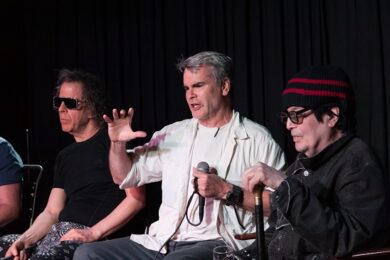
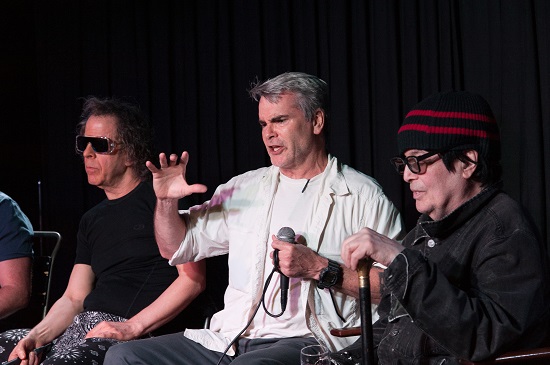
The band’s working relationship with Henry Rollins goes back some years. A long time friend of Alan Vega, Rollins released a number of Vega solo records in the mid 90s, a compilation of his lyrics and writing – Cripple Nation – and also a double Suicide compilation. The former Black Flag and Rollins Band vocalist – tireless powerhouse of myriad artistic endeavours (comedy, journalism, acting, music, travel, photography) – Henry is also something of a Suicide evangelist, having been listening to them intensely for nigh on 30 years and in advance of Suicide’s performance of A Punk Mass at the Barbican a few weeks back (of which Henry also played a part – see John Calvert’s live review here) tQ moderated a discussion with Rollins, Alan Vega and Martin Rev at Ace Hotel London. Also present was Alan Vega’s wife Elizabeth Lamere, who was on hand to help Alan with the mic (Alan suffered a stroke in 2012) and, occasionally, memories.
The evening was fascinating. We discussed the musical life of Suicide; New York as muse; dodging axes in Glasgow; the magic of ‘the moment’ and the perils of attempting to play Einsturzende Neubauten on the Black Flag tour bus. What follows is a transcript of our conversation:
When did you first encounter Suicide, Henry?
Henry Rollins: In 1979 when I grew up in DC we didn’t have access to many underground records; you couldn’t get punk rock records very easily. It was Fleetwood Mac and Black Sabbath and mainstream music. There was a record store which had cheap records though – for two dollars and 99 cents you could score a record. Ian MacKaye and I were at this record store at M Street in Georgetown one day and from the cut out bin, I pull out the Suicide record; with the iconic blood red cover, blood running down the front. From that alone it was like ‘I’m in’ [LAUGHS] and I flipped it over and see this weird inferno: they have sunglasses on and the credits just say ‘Alan Vega. Martin Rev…instrument’. That minimal thing; I had no idea.
Please understand, we hadn’t heard Can or Kraftwerk or anything like that. Led Zeppelin, Ted Nugent and punk rock was what we were used to. But I wanted to hear the kind of music that guys who looked like that actually made. So we took the record back to Ian’s bedroom and listened to it in stunned silence. Then we got to ‘Frankie Teardrop’ and the record came to an end. And we were so upset; without any idea of what had just been done to us we kind of had to make jokes to ease the record. For the rest of the evening we were going around shouting, ‘Frankie, FRANKIE!’ – not to make fun of it – but to ease the tension. It was the single most confrontational piece of music that I’d ever heard. It took me six weeks before I could even play it again. It was too punk rock. It drew a line between it and every record I owned and every record I had ever heard. I became fascinated by these guys: where it came from – why it came to be – the guts it must have taken and the vacuum they came out of to create it. So I got into Suicide because it looked cool – maybe that was a good way to do it, with no expectation whatsoever.
I’m interested in finding out where the music came from, Martin. I know The Stooges were hugely important to yourself and Alan but how did you get from rock & roll to deciding that you wanted to make electronic music?
Martin Rev: Necessity… it was synthesisers or whatever I could find to make sound. Anything I could possibly carry and throw into a store room – a small store room because we didn’t have the rehearsal space. It’s something very internal, I don’t know myself why I make the choices I make. It’s like a finger print. I’ve been given a sense of putting shapes and forms and colours in one position rather than another and it’s innate. It’s something you can’t really decide. You can decide, I want to use this instrument; what to follow it up with based on what I’m hearing.
Alan Vega: I remember when people used to stand up outside our window near 4th street and they used to really hate us. I used to say, ‘We piss yellow, we shit brown, we bleed red’ and that’s us; that’s Suicide.
Elizabeth Lamere: When did you first start doing sound though, as opposed to painting or doing sculpture?
AV: Well, when I met Marty we just jammed. Whatever came out came out and started the whole ball rolling – and who the fuck knew? Originally they hated us; I mean, really hated us. They used to call us ‘the band you love to hate… THE MOST’ [LAUGHS] and we were. 145 years later, we’re sitting here and now they’re all reverential. So go and figure it out. Because I can’t. But I remember it took us years and years and years; Maybe it’s 10 years? Maybe it’s 20 years; 40 years, however fucking long we’ve been doing this [LAUGHS].
You guys faced a huge amount of aggression and animosity on stage, as did you Henry. I’m interested in finding out what it does to you when you face that level of aggression every night… when you know it’s coming.
MR: What it does to you? It makes you play harder; makes you feel harder. Possibly feel more aggressive, because you just want to do what you want to do. And it’s a great sound, 15,000 people booing at you; screaming at you. 15,000 people people booing – like in specific breaks when we play the chorus, all at one time, in unison. It’s a composer’s dream; Beethoven’s dream. The symphony of the 15,000 – an incredible sound. You can work off of that and you do: you’re not going to let it stop you, and you don’t.
Henry, what kind of similar experiences have you had? As anyone who’s read Get In The Van will know, I think it’s fair to say that Henry has faced more than his fair share of animosity on stage…
HR: In Black Flag, we had a band leader – Greg Ginn – who would continually change the set and refuse to do old material. And unfortunately for us, our audience were quite enamoured with the old material [LAUGHS]. So, the leader of the band would write a whole new set of music and we would bravely go out with a whole new set of songs.
The audience wants to hear what was but Greg Ginn wants to play you what is and what will be! And then the audience would want to take it out on the singer because I was the cute one. And so people would be angry because they weren’t getting what they wanted and we were hell bent on giving them what we wanted. They would take it out on me with everything they had. Projectiles of all description; fists with rings; boots; lit cigarettes plunged into my leg. I’ve got well over 30 stitches from the chin up, just from people hitting me. Some of the worst abuse we suffered was in beautiful England (laughs)- nothing personal, you’re wonderful and I have a great love affair with England – but this was in the middle of Reagan, Thatcher era. A lot of things were in the mix and our attitude was not exactly ‘crowd-pleasing’.
One of the things I learned was that you have to stand your ground. I learnt a lot about that from Suicide. I remember walking through the Lower East Side with Thurston Moore of Sonic Youth and I say to him, ‘You ever see Suicide?’ because they were his favourite band. He was like, ‘80 times.’ He had these amazing stories. He told me about watching Alan and Martin onstage at CB’s. Alan’s wearing a platinum wig and looking terrifying; they had lashed themselves to Martin’s synthesiser and they’re hurling abuse at the audience – who are gleefully hurling it back. Somebody throws something through the air which opens Alan up; he’s bleeding; something smashes on the keyboard but Martin keeps playing. They’re both dipped in blood and they don’t stop playing and the audience says, ‘You know what, you can have it; it’s yours.’ It was like an arm wrestling act and Suicide won; two men, bloodied, chained to a keyboard versus an entire audience.
And I like those odds. You stand them down. The first five years of music for me was 20% of the au-dience going ‘YAYY!’ and 80% of them going ‘Not so much yay.’ The courage it takes to do your music – and the idea that courage is required to do your music – is a beautiful thing. When people hated us, I didn’t necessarily think that we were onto something… but damn does it make you play really hard.
Alan, why do you think the music that you and Marty made inspired such visceral reactions?
AV: Well, this is the way we used to start: [QUIET VOICE, TAPS MIC] ‘I can’t hear you.’ [LOUDER] ‘I can’t hear you.’ [SHOUTING] ‘I CAN’T HEAR YOU!’ And you know, it was crazy, it started something that built up and I used to love it, I used to love the crowd, used to love the noise, used to love the things we inspired. I got people locked in the… I forget the name of the place…
EL: Max’s?
AV: No, near the air conditioning company… The Mercer Arts Centre! The Doors played there: everybody played there. The Mercer Arts Centre. So, I got 1,000 people in there and I jumped in front of the door that led to the outside and I locked it and I said, ‘Make a move!’
And they stood there, all ready to leave and I said, ‘Fuck you! FUCK YOU’ and I made them all wait [LAUGHS]. After a while they got crazy and then half an hour later I said, ‘Ok… go!’ Those were things that we used to do very often. We created confrontation with what we had. And I loved it… and Marty too [LAUGHS]. Marty’s music got crazier, I got crazier; beautiful people used to dance around us… it was fun.
One of the most notorious tours you undertook was supporting The Clash. Martin, could tell us a little bit about that?
MR: The Clash was a riot every single night and that was straight after supporting Elvis Costello, which was also a riot every single night on the continent. But The Clash was a UK tour, the climax of which was Glasgow. And, as probably many of you know – or know from your parents – at that point Glasgow was one of the poorest cities in the world, if not the poorest. They said, ‘If you can survive Glasgow, you can survive anything’ and they were right. It was a riot. Hatchets were thrown.
AV: It’s true!
MR: We found it embedded in a bass drum; an actual hatchet. A fucking axe head.
AV: They threw an axe at me! They threw an axe at me!
EL: And nobody believed you… [LAUGHS]
MR: The money that was thrown could be lethal, too. For the guys who cleaned up afterwards it was pretty good though…
AV: See, we started with The Specials. Two bands opened on that Clash tour. I liked them by the way… they were all fucked up [LAUGHS]. They were great, really great. So they got The Specials and then out comes Suicide and it was ‘BOOOO!!! BOOOOO!!!’ We got booed to shit and had to work our way up from there… upwards, or sideways or downwards. I don’t even know. And The Clash were great and always on the drum riser before the show. I loved them.
MR: But you have to remember that The Clash got the same thing. It was the height of punk, so to show your affection you used to spit and throw things. The Clash went on and if you were watching the band – and that was the band that everybody had paid to see – you saw all kinds of shit. And Glasgow was hardcore. Very serious.
AV: But at the front was a bunch of fucking Nazis. Every kind of available filth in the world. And at the back were the poor guys who liked rock & roll and they were exquisite. Go to the back!
MR: And they were fighting each other. The punks, the nazis and the skinheads. They all had their own personal thing. The only unifying factor was that they all hated us.

Henry, I remember a quote from you describing touring with Black Flag as like ‘getting America in the teeth every night’.
AV: We had…
EL: He’s talking to Henry…
AV: Well, I’ll talk instead. Marty and I were on stage in some big club playing disco music and they had some big ball.
EL: Disco ball?
AV: Disco Ball! And Marty and I said, ‘Uh oh – watch out. Watch out…’ And it turned out that the guys were all black and they were dancing to our music. And this was Edinburgh. And I remember thinking, ‘Holy shit! What do I do now?! People are dancing to Suicide’ And they were really beautiful and exquisite and I thought, ‘I’m finished! My life is over with’ [LAUGHS]. But then I said, ‘Marty, Marty, it’s alright, it’s alright, it’s four o’clock in the morning, it’s ok.’
Then – in the early eighties – loads of people started liking electronic music; Soft Cell, all of that. They suddenly loved us and the dressing room was jammed and we were pressed to the wall. And that was the beginning of the end as we saw it, we didn’t know what to do.
It’s interesting to hear you talk about Soft Cell. Because your second album pre-dated synth pop. I’m interested in why that record never took off, commercially? It was a far less abrasive record than the first album. The tunes were there and the production was there, yet it was Soft Cell and Depeche Mode who received that mass attention.
MR: You can never predict those things but, to me, there was something that was just a little too disturbing in our sound. Certainly for America. It was never going to be embraced. It’s different for every artist. As we all know, Van Gogh didn’t sell one painting in his lifetime, not one. And yet today he is seen as this big commercial artist, one of his tiny sunflowers going for 100 million dollars…
HR: I think it’s pretty interesting, Suicide have been doing their thing and as you say Depeche Mode and Soft Cell were gravitating in the orbit of Suicide, citing Suicide’s music as an influence. Certainly the first album and definitely the second album and for you guys – watching your music become appreciated, and watching a safe version become popular when you’d been there all along, what was that like? Did it do anything to your creative process?
MR: Not a thing. Honestly, it all sounded kind of wooden; kind of watered down. Not that I didn’t like what I heard. Maybe there always has to be an interpreter. Elvis was – despite all the individual talent that he had – an interpreter of rhythm and blues, what was called ‘race music’ at the time. It was stuff that white people were not supposed to be hearing; they couldn’t get it on the radio. So Elvis was the messenger, he took rhythm and blues, he took songs from people who were making 25 cents a record. You always need that, someone who will take it and interpret it and present it to the majority who won’t take it from the original source. It might be too real; too political; too raw.
Before synth pop there was disco and you were in the middle of New York. Did you feel any affinity towards that?
MR: For me, personally, I really dug disco. A lot of my friends were like, ‘Oh, it’s too commercial and it’s party music’ and yes, it is. But it was also the first instance of the broad based use of electronics in the commercial world. It was a dance music that could be catchy, I’m not talking about every track – in any genre there is mediocrity – but it was coming out of the streets; it was coming out of the neighbourhoods; it was coming out of the ghettos. You could feel New York; you could feel Philly. It was the rhythm and blues of that period and when Donna Summer came out with ‘I Feel Love’ I could sense Giorgio Moroder back there with the rhythm machine in Berlin.
I want to discuss the idea of New York as a muse for Suicide. Because Henry and I were talking before we started and he said something interesting: the city is like a third member of the band. What was the atmosphere like in the early seventies; and how have you seen the city change, because it has changed a huge amount over the past 20 years.
AV: You’ve gotta go further, you gotta keep going. I was just talking to Liz about it. We started the thing doing blues music but then there is a whole new thing about it. We changed it by our music; it’s something new, Marty does what he does; I do what I do; we all do what we can do to broaden our experience.
But in terms of that specific early 70s atmosphere that fostered Suicide. If you read your rock & roll history books, it’s always termed as being a place of borderline anarchy.
MR: Borderline economic anarchy for sure, the city was defaulting. But I don’t see it as much different now. It’s still a cool place to live in many respects. A lot more opportunity and intelligence than most of the rest of the country. It’s closer to being a European city and always has been. But it’s also vapid and it’s been that way since the late 70s. It’s not inspirational in that way at all – it is a tourist oriented, business oriented town and in that way it has not really improved at all.
Henry, what effect did New York have on your musical world? Because you come from Washington DC.
HR: If you had never been to the Lower East Side in the late 70s/early 80s and wanted to go cheaply I would advise that you listened to the first Suicide record. It was like that. We were from Washington DC which is a few hours south and – at that time – DC was considered a sleepy town. So, me and my friends would drive down to New York and park our cars in some war zone at 2nd and A. It would be like, ‘Is my car going to be alright’? Because there is a man rubbing my car! There is a man eating the antennae of my VW fastback. ‘Put that down! Don’t do that to my car!’ As soon as you got out of the car somebody would be touching you, feeling you up to see if you had money. [SHOUTS] ‘DON’T TOUCH ME!’
Or you’d go see a show and it was thrilling because you had to deal with New Yorkers; and then you’d see the show and you’d somehow have to get back out, get back to the car, back to DC. But the East Village in New York was kind of terrifying. We’d dare each other, ‘You wanna go down one more avenue… Let’s go to B!Let’s go to C! No, not this time; we’re not ready, we’re not ready.’
This is late 70s. We’d be going to Max’s to see The Cramps or The Bad Brains and we’d drive back feeling like we’d been delivered from something: ‘Wow – we survived the East Village.’ But those streets now? You can’t afford them. Three wheeled baby carriages being driven by au pairs and you can’t afford a blade of grass. Up until the mid 90s there’d be crack vials everywhere. ‘Is that guy dead or just sleeping?’
But Suicide played New York. It was an instrument that gave you texture; it was a canvas for you as visual artists. You guys epitomised my memories of New York. When I walk East Village now, I feel old and weird and I can’t afford it.
MR: You’ve got to remember we were both born in New York. You can’t separate us from our immediate environment. The trains, the subway trains. Some of the stations have never really been renovated to a great extent and when I’m down there – which is often – I get such a thrill and excitement because that’s the way they were back then.
HR: You guys are playing indigenous music.
MR: Exactly. It’s a theatre. If we had been born somewhere else, we’d probably have still made music: but you can’t separate it, you can’t put your finger on it. The sounds; the rhythm; the structure; the architecture of the streets. The stations; the people; the rhythm.
Rhythmically, how important was the jazz influence – both on Suicide and also for you Henry, with Black Flag and Rollins Band. I wonder if we could talk about that?
MR: Rock & roll was what I was weaned on but later on – as an instrumentalist – I heard the strength and the truth that was not only coming out of rock & roll but also jazz. Coltrane; Davis; they were pioneers. When I’ve been moved by something I’ve always wanted to understand it and play it. Jazz isn’t something you learn over night – and neither is rock & roll really. It’s a culture all of its own. This earth that rock comes out of – Mississippi mud.
Jazz is a discipline of its own and you could study it for many life times. Modern jazz is an incredibly sophisticated musical form. It’s easy for John Lennon to say when he was 16 ‘I fucking hate jazz’ – and I know what he was saying and know what he was feeling – but he was blocking it out and there is so much there.
Henry, what kind of influence did it have on you. I’m thinking specifically about Black Flag records like Family Man.
HR: We had very little money. For us, music was making cassettes at other peoples houses. We didn’t have many records back then so I’d camp out at peoples houses and make tapes. People like Mike Watt of the Minutemen; that whole band was wildly eclectic, and in 1983 we toured Europe together. Mike would commandeer the tape deck in the van and it was all Soft Machine and Sun Ra, just perfect music. I was raised on my mother’s traditional sense of jazz: Kind Of Blue by Miles, some Coltrane – but when Miles went electric my mom dropped off. She used to go see him play and I used to ask, ‘Hey mom, how come you don’t have Bitches Brew?’ And she said, ‘That’s when I stopped understanding Miles.’ [LAUGHS] So when Mike Watt played me Sun Ra it made me see that other things were possible.
But any avant or jazz structure you see in Black Flag’s music, that comes from Greg Ginn, 100%. Because it was his band and he wrote most of the songs. As to what was influencing him? He liked Ornette Coleman but we didn’t have those records around. We had Sabbath, Stooges, Velvet Underground, MC5 and whatever we could glean from here and there. I was the one making Einsturzende Neubauten tapes and bringing them in to have them hated and rejected and vilified by the other band members on the bus [LAUGHS]. It was like, ‘Out of the window.’ I think Greg got dissatisfied and felt restricted by normal rock formats. He went in his own way and did some really incredible structures. I don’t know what the influences were – it’s not like he was putting on a Coltrane record and going, ‘That’s it – we need horns.’ [LAUGHS]
It’s interesting listening to you talking about the avant garde – it feeds very much into you putting out solo music and writing by Alan in 1994/95.
HR: Here’s what happened; the short version. Rollins Band were on an endless tour of Europe because in Europe people actually fed us and turned up so we were like, ‘We’re never going back, we’re here forever.’
I was in Germany and I read this review of Alan Vega’s Deuce Avenue and eventually found the record in Munich. It was one of the best records I’d ever heard. I became wowed by Alan all over again. So I was back in America on this big tour called Lollapalooza and I had a day off, called my agent and said, ‘I’m in New York can you get me a phone number for Alan Vega?’ He gets me his number and I cold call him like some lunatic. He said, ‘I know who you are. You’re the Black Flag guy; I know who you are, kid.’
I said, ‘Great. A couple of things. 1) You’re the man 2) Deuce Avenue is great and I’d like to talk to you about all that writing that you have in your apartment. Is it ok if I come over to shake your hand and go through your notebooks?’ He says, ‘Ok, ok, stop talking, stop talking. Come over.’ So I go over to his place, the door opens half an inch and this eye appears in the crack. He says, ‘You like coffee?’ I say, ‘Every day.’ And he says, ‘Well, I’m warning you now kid. I drink mud.’ We became fast friends in about an hour and spent the rest of the day wearing each other out on various topics.
There is just so much logic in Alan Vega’s lyrics. ‘She’s deadly! She’s from Mars!’ I’m like, ‘I’ve met her!’ [LAUGHS] Liz, Alan and I collated the material that eventually became the book Cripple Nation and then Liz sent me the next Alan Vega solo record which did not have any distribution or play or manufacture in America because, you know, us Americans can be very pig-headed when it comes to music which is actually artistic. I remember saying to Liz, ‘You have officially made me mad. These records should not just come out in France.’ So I took it upon myself to make a record label and put these damn things out and I worked very hard with Alan and Liz for years. We put out five or six records. Alan kept saying, ‘What are you doing?! This isn’t going to work.’ And I kept saying, ‘Shut Up! We’re doing this!’ So we put out all these records and to this day I get emails saying, ‘Henry, you turned me onto Alan Vega and Suicide. Thanks.’ I sunk a ton of money and effort into it – voluntarily, I should add, Alan was always trying to talk me out of it – but I felt it had to be done. I felt that strongly about it. That whole time was so exciting to me.
I’m always amazed when I pick up a history of punk and Suicide only get a cursory mention.
HR: That’s changing.
It is now – but in the 90s it was uncommon for them to be covered in any kind of detail. Did you ever feel overlooked?
MR: You can’t let that stuff bug you and you can’t let the good stuff bug you either. Sometimes somebody writes a great article about you and it can be cool. It can be like poetry when they are really creative, but otherwise they are kind of telling you what you’re doing and of course you don’t really want to know what you’re doing. It goes in one ear, out the other ear; in one eye, out the other eye. I don’t want to know what I’m doing.
You’ve avoided the nostalgia trip completely. Suicide are in a constant state of invention. You never play the same song the same way twice. What is your philosophy behind playing live?
MR: None at all! None at all and there never will be one. Music is something that goes through the ears; painting is something that goes through the eyes – and in time I’m hopefully going to continue to hear better and more deeply.
Playing live is hearing what comes out of me and listening to what that tells me to do next. Not to have anything too concrete. Sure, you might have an outline or a sketch but that’s it. Fill it in with all of the stuff you’ve have been thinking about and it all comes out in that unpredictably. You always learn something that you could never learn in any other place but the show. And that one little gift you get at the show is priceless. You only get it by playing live.

You’re often touted as minimalists but a lot of the work you’ve done is very dense. I’m thinking specifically of American Supreme. Alan, I wonder if you could tell us a little bit about recording that record, because it was a very different record for you.
AV: American Supreme?
EL: The record you and Marty made right after 9/11.
AV: What is that?
EL: The last Suicide album that came out; after September 11. What do you remember about it, lyrically?
AV: I remember nothing about it. And that’s the way it should be.
EL: That’s true, after you finish with something you never revisit it.
AV: I remember it as being the end of a life.
EL: What life?
AV: The end of American life. The end of life in America
EL: And what had happened just before that?
AV: Wherever we were going had changed forever and that’s all I can remember.
EL: Marty, when did that album come out
MR: 2002, I guess.
EL: Alan wrote the lyrics right after September 11. And just before that he was doing these crazy linear sculptures, that were kind of dropping out of the celling; and then right after 9/11, people started putting these memorial pieces on the walls outside ground zero. And so many of these memorials looked just like the sculptures that Alan was doing; it was very prescient of what was happening there. Before that, Alan had been working on what was to become the solo album, 2007 – a very dark Alan Vega solo record. Alan was doing it on his own – it was the first time that we hadn’t worked together on a solo record – and it was really, really dark. He was having visions and nightmares and was telling me ‘something really intense is going to happen in America.’ That is what 2007 was about.
HR: You and I were in contact a lot back then. I really got an insight into the way that Alan works, you know? The lyrics are completely different every take! [LAUGHS] He works so spontaneously; he writes a new set of lyrics every 20 minutes. No single song is ever the same. It is such a brave way of working. I was talking to Alan’s engineer Perkin years ago and said: ‘What’s it like working with Vega?’ And he said, ‘Man, you just hang on and put a mic on it.’ [LAUGHS]
There is a really interesting thing you were talking about Marty – ‘the moment’. Where does that bravery come from? Because it makes rock & roll look so studied. I come from rock & roll – verse, chorus, verse – ‘Ha ha – you blew a note! you got it wrong!’ But for you guys there is no wrong; you’re in the moment.
MR: That’s right. It is everything we’ve lived and felt and seen.
HR: Up to that second?
MR: Right. Between the last gig and the gig that will take you to the next place. If you don’t do anything related to what you love and what you feel you’re gong to get less coming back. It’s a blank canvas every day. I remember taking to students of Martha Graham after some big dance performance; the next day at 6am, they’re back at the wooden bar, in the dance studio. Next day, they’re back doing minimal stretches – starting again from nothing. A blank canvas so that they can go beyond the night before. It’s not the performance; it’s everything that you do in between. Once you get to the performance you’re already so close to what you do, but there is that unknown fact that is going to come out that you can never predict.
AV: The next day is always something new. Those dancers were working on something new and you don’t know where it comes from and it’s always the next day that has a little bit of extra… god knows what.
And that’s life – we start the next day and we go ‘holy shit – where does this come from’. And you never know.
Originally published July 2015