

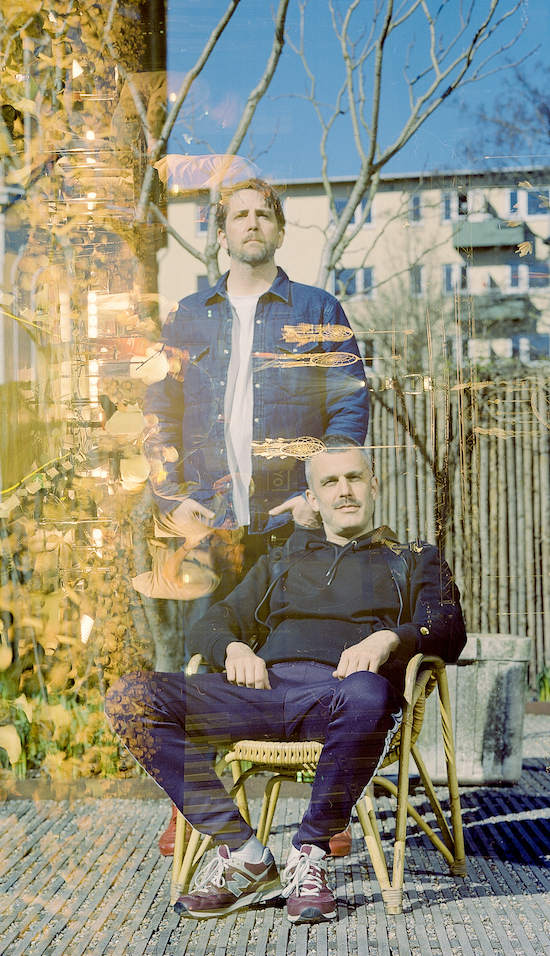
Owen Pallett and Joel Gibb, by Søren Lynggaard Andersen
Music writers. Who needs ’em? We recently had the opportunity to get touring partners Joel Gibb of Hidden Cameras and Owen Pallett, fka Final Fantasy, in front of a tape recorder. We left them together to have a conversation about both their practice and world view, without any interference from us.
Joel Gibb founded The Hidden Cameras in Canada, 22 years ago, as the primary outlet for his song writing skills. After the (solo) debut Ecco Homo, his second album, recorded with a band, The Smell Of Our Own was released on Rough Trade two decades ago this month. This album with its mix of symphonic indie on a shoestring and celestial churchical vibes, not to mention its celebratory, relatively unabashed bordering on transgressive lyrical depictions of gay sex made the group a cult success.
Hidden Camera’s last full album Home On Native Land, a meditation on Gibb’s roots in Canada, was released in 2016 and featured Rufus Wainwright, Feist, Ron Sexsmith, Neil Tennant, Bahamas and Mary Margaret O’Hara. Owen Pallett is a composer and multi-instrumentalist who has worked closely with Arcade Fire as well as arranging for Robbie Williams, Pet Shop Boys and Taylor Swift. Their debut album Has A Good Home was released under the artist name Final Fantasy in 2005, and its follow up, He Poos Clouds, won the Polaris prize a year later. Their last full LP was Island in 2020 but he also contributed to the Arcade Fire OST to Her last year.
Owen Pallett and Joel Gibb are currently touring together in celebration of a reissue of The Smell Of Our Own, while Domino have also reissued Pallett’s He Poos Clouds, Has A Good Home and a compilation of his Spectrum, 14th Century and Plays to Please EPs.
Owen Pallett: Joel, how are you enjoying the tour so far?
Joel Gibb: It’s going great. We’re getting better with each show, getting into the zone. The sleep deprivation seems to not hinder our performance, so far.
OP: I would argue that it’s improving it.
JG: [Laughs] As mature adults, touring is somehow more enjoyable. Since we’ve done it for so long, we kind of know how to do it. Less alcohol, more self-care, you just do it.
OP: I’ve always said that what we call “wisdom” is actually just learning “what not to do”. Like, learning when to say “no”.
JG: Experience creates the voice of reason. Do you remember our first show in Dublin? On tour supporting The Sleepy Jackson? We had that tour manager, Gaz? We partied hard, we missed the ferry, and we missed the second show. It was in Edinburgh, it was heartbreaking for me because I’m Scottish, I really wanted to play that show. We asked The Sleepy Jackson if we could swap spots and play after them, just so we could perform, and they said no. And NME were there to review it… it was devastating! You almost should take it more seriously when it’s your first tour.
OP: Well, I was 23 at the time? You were 25?
JG: Really! We were that old?
OP: I think we were behaving with an appropriate amount of maturity, considering! What else do you think you have learned in the past twenty years of touring and recording?
JG: Always thinking about backing stuff up, keeping stems, being more organised. Valuing my own material, I guess. What about you?
OP: I think most of what I learned was stuff that couldn’t be taught, stuff that just had to be experienced. I remember turning 30 and being taken aback, my albums and shows had gotten so good but I was confronted with a shrinking audience, like I’d aged out of people being interested in me. I can’t really call it “ageism” because I don’t think that’s it, it’s more like, people genuinely getting excited about the thrill of an artist when they’re new. I like to call it “potential energy”, when nobody knows what a new artist is fully capable of, that can be very exciting. You lose that as you become more established and people start to understand you.
JG: Yeah, there’s something about the potential of a young artist that resonates. I think I subconsciously knew that, and that’s why I really wanted my fourth, fifth albums to be very different. I had conceived that all at the beginning, like with ‘Gay Goth Scene’. I knew I wanted to make a “minor key” album, using the signs and signifiers that I learned from goth and industrial – same with folk and country, with my sixth album – so I couldn’t be pigeonholed by what my early albums sounded like, being defined to that “second album sound”. Mississauga Goddam was definitely an extension of The Smell Of Our Own, it could’ve been a double album, in a way.
OP: All the songs on Mississauga Goddam were from that first batch.
JG: We had been performing all those songs already! ‘Music Is My Boyfriend’…
OP: ’I Believe In The Good Of Life’…
JG: I’m trying to think of which songs were new.
OP: ’B-Boy’, ‘Doot Doot Plot’, ‘That’s When The Ceremony Starts’, those were newer.
JG: But a lot of those songs were written before I’d even started the band. ‘High Upon The Church Grounds’ was written in Vienna, by a church. ‘A Miracle’ was written as soon as I sat down on a train from Paris to Rennes. ‘Boys Of Melody’ was written even before, like in university times, before I went to Europe. I think I wrote ‘Breathe On It’ the same evening, during university days. The lyric: “My flight is flown over water black and cold”, from ‘Worms Cannot Swim’, that was written about my first-ever overseas flight, going to Europe with a broken heart at age 23.
OP: Tell me about your more recent songs. I’ve heard some of them, ‘Brontosaurus Law’, ‘Undertow’, ‘How Do You Love’ and ‘Don’t Tell Me That You Love Me’. The new songs are a departure for you, they seem much more explicit in their subject matter, somehow more personal.
JG: The album’s not out yet, I feel weird talking about them. And ‘Don’t Tell Me’ was written ten years ago, so it’s not new to me!
OP: You seem to stockpile certain songs, write them and then hold on to them for a certain project. I remember being in the band back in 2004 and working on ‘Gay Goth Scene’, which didn’t end up coming out until the Age LP from 2013, nine years later!
JG: You’re right, I do stockpile songs. The amount of time it takes to record, mix, master, release, tour and put out a song, it’s a long time! But writing a song is comparatively very quick. I have a whole album of unreleased songs from 2002 that could be a whole thing on their own, that basically nobody has heard except you. They’re kind of songs that I just didn’t get to. What about you? I noticed that you have a lot of titles lying around. That is totally interesting!
OP: I don’t have any spare songs. None. I have some that are bad, that I don’t end up recording, but I don’t have any secret weapons lying around. When I’m getting ready to make an album, I think of the title, and the concept, and I write down what I want the song titles to be. I simultaneously start brainstorming lyrics, which are usually just the “hooks”, but I actually just think of them as “jokes”, like things that I think would be funny to sing.
JG: So you don’t walk down the street and think of a hook, think of a phrase?
OP: Generally, no. Sometimes somebody will suggest a title and I’ll remember it. Nico Muhly once said ‘The Great White Noise’ to me, I don’t remember what context it occurred, but it stuck with me as being a really good proxy reference to the god Owen, like ‘Our Almighty Father’ in that world. I used it a few times in my lyrics. Sometimes I’ll get a musical phrase in my head and I’ll voice memo it, but usually that only happens when I’m actively in album-making mode. When I score a film, for example, I’ll watch the scene, then sit at the piano and improvise three to ten ideas and record them on voice memo, and then flesh them out immediately in Logic or Sibelius, and send on whichever ones work best. I am constantly hearing something that I’ve written and thinking, “Oh this is nice” without recognising it as being my own music, because for me, the process happens so quickly. When I apply myself. Which is… sometimes.
JG: Have you ever thought of trying to do your songs without a loop pedal? Like, if you had to choose one song from Island, say, just acoustic, which one would it be? You have this whole new thing with disappearing loops now, it’s a whole art form! But are there songs you can play without the looping apparatus?
OP: To be honest, after Heartland, I’ve been very permissive about writing songs that have absolutely no forethought as to how it might turn into a looped performance. Most of Island can’t be looped, that’s why I play with a guitar now. I don’t really loop any of those songs because they’re not written with that in mind. One of the prettiest songs on Island, ‘Paragon Of Order’, was written at the piano, and I turned it into a loop song, but it never really worked out with much success, it kind of felt like a failed graft. But yeah, I could sit at a piano and play for 90 minutes straight, songs that I can’t play with a looping device.
JG: So you never write down a song spontaneously? You never scribble down a song? Like, sometimes I am supposed to leave the house and I am late because I have a moment of inspiration and have to write it down.
OP: Nope, I write music “to order”.
JG: What about your new cello? Did you immediately write a new song when you held it for the first time? That happened to me, when I bought a Gretsch, I wrote a song immediately. Or when you learn a new chord, I write a song immediately. I’ve even been rocking out chords I like at soundcheck, every day I feel like I’m drawn to something new.
OP: No, I don’t. When I got my cello, I immediately started playing Bach very badly on it, and then I spent the next few months practising scales. Literally! I bought books of cello studies and learned them.
JG: Have you tried looping with the cello?
OP: Not yet. I have played with it live, with Kelly McMichael at the Polaris awards, and I’ve used it in the studio. I have it set up for amplification. I’ve attempted to play this song or that on it, just casually, but I feel like I’m still learning to play it and I need to get better before I actually make any inroads into using it for professional live performance. Usually the moments of inspiration that hit me, they’re larger and more abstract. Like, I conceived a few months ago of exactly how I want my new album to begin, but it’s a very abstract notion, more like a blueprint for an orchestration idea.
JG: Let’s talk about gayness.
OP: All right.

JG: How do we talk about gayness in a cool way?
OP: That is a question I’ve never been able to answer with any success. Personally I’m most attracted to the non-sexual aspects of gayness – the rejection of nuclear models, the implicit anti-establishment qualities of it. I’m interested in the ugliness of it, the terrifying second half of a gay life when we all just get old and lonely and get sick and die. I’m interested – in the way that one is “interested” in car accidents and disaster reports – of the racism and misogyny of its culture, historically, and body fascism and stuff like that. It’s not cool, I don’t view gayness as being particularly cool.
JG: When I started the band, I wanted to make the band “super gay”, but the more I wrote about it, the more I hated gay culture, and the album is meant to be criticising it. Because I didn’t like the music that the gays were listening to! I liked… whatever. And I didn’t see gay subject matter in any music, hardly at all.
OP: That is why ‘Smells Like Happiness’ remains my favourite of your lyrics. I remember when you presented the song to us, and I asked you about that line, “the neck of a boy who wears eau de toilette/ and shaves every day and behaves well in department stores”. I wasn’t sure what response that lyric hoped to elicit, at first, and you told me, “It’s meant to be sad.” That’s what I’m talking about! Gay is sad! I actually had an interesting thing to talk to you about, and I wanted to know if you’d had similar experiences. Something I started to become interested in, in my 30s, was developing a personal model for ‘how to age gracefully and gayly’. Like, what is a gay man supposed to be? Especially, what is a gay man supposed to be once the stereotypical “gay” things become less accessible and/or relevant? For a while, I was having conversations with “gay elders”, like trying to find some older role models, and most of the men I talked to had nothing for me in this regard, they were sex-reminiscing horn-dogs, ha!
JG: I think I know what you mean, and when I was young, I thought I would never wear a baseball cap, and I would never turn it backward, and sure enough, in my 40s, I wear a baseball cap, and I do turn it backwards. Disgusting! And I haven’t even lost my hair yet!
OP: Hahaha!
JG: Are you excited for these last shows?
OP: It feels bittersweet. I kind of wish I could go home for a week and then go back on tour right away. I wish touring happened in shorter bursts and with time at home in between. I miss my boyfriend and I miss my dog. I messaged my boyfriend yesterday saying that it was all fine and cute for him to be sending me photos of the dog all the time but that I missed him just as much if not more and couldn’t he send me some selfies once in a while.
JG: I agree. In the olden days, we’d do two six-week back-to-back tours, and that wasn’t tenable. But three weeks with one week in between, that was perfect. You’re still in the zone, but you’re refreshed. I guess you have to ask? When bookers wanna book, they book a long tour. To do North America is six weeks, right? If you’re driving?
OP: I wouldn’t know. I don’t like touring USA.
JG: Me neither. I like Europe. But even that little stop in my apartment in Berlin was perfect. Like, to do a load of laundry and sleep in your own bed. I do prefer a nice vehicle and short drives. That’s what Europe is built about. In Canada the drives are so long. Eight hours between cities?
OP: I’ve enjoyed nightliners tours of the States.
JG: When I’m not paying for it, sure.
OP: I only did nightliners when I was playing support for a larger band and they let me ride with them. One thing I miss about touring the USA is I love playing smaller cities. Salt Lake City, Iowa City, Oklahoma City, Birmingham, these are all my fondest show memories.
JG: I played Birmingham but that was not fun.
OP: Along with Whelan’s in Dublin, Birmingham Alabama had my favourite ever venue, the Bottletree. I think it’s closed now. One of the guys from Man, Or Astroman? had a trailer behind the bar for bands to sleep in, he decorated it so kitsch and so cool, it was one of my favourite ever shows. Is there any song of yours that you feel kind of transcends your entire oeuvre and takes on some massive, universal meaning? That you get emotional while singing it, every time?
JG: Definitely. I think I have a few. ‘A Miracle’, for example. Or ‘Boys Of Melody’.
OP: For me, it’s a new song, ‘Don’t Tell Me That You Love Me’. There are some lyrics in there that make me hallucinate. They are so profoundly affecting.
JG: I gotta put that record out!
OP: Tell me where you want your body of work to be ten years from now. A handful more albums, or something else?
JG: In the next ten years I want to put out the record I’ve already made, and make another guitar-pop album, maybe even a “gay folk church music” record, possibly based on all the unfinished songs from that early era, but trying to have the freshness and naivety of those early songs that are still in my notebook. Maybe I could include some of the signifiers of the first record, which I still think is a really good genre!
OP: If you could start again, what would you do differently?
JG: Maybe try not to please other people as much. Hard to say, really. I could’ve been more calculating rather than so open to everything and everyone.
OP: Is there a song that you wish you’d written, and why?
JG: Not really. There’s always the song that I wish I would want to write, myself. I don’t really think like that. I more congratulate those people for writing their songs, not wishing that I’d written their songs.
OP: God, there are so many songs I wish I’d written!
JG: Like what?
OP: ‘God Is Alive, Magic Is Afoot’. Any number of Gordon Lightfoot songs.
JG: Yeah but you can just write a song. I don’t think like that.
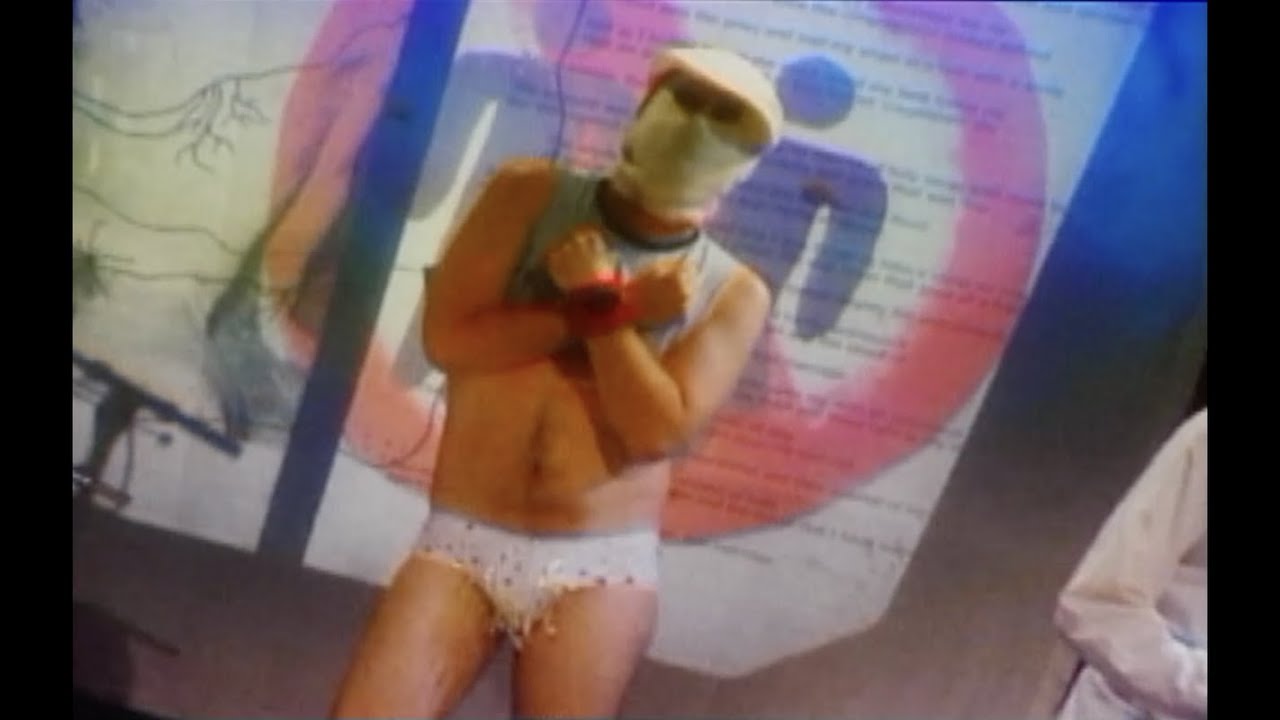
OP: Here’s my last question for you. We just watched the Robert Kennedy documentary Music Is My Boyfriend, which documents The Hidden Cameras during the period of “The Smell Of Our Own and Mississauga Goddam. What are your feelings about that era of the band, and what emotions does that documentary elicit in you?
JG: Oh I think it brings up a lot of different emotions. Twenty years later, mostly just pride. It’s a little awkward getting a documentary made about you when you’re in your early 20s. But some of the footage, the 16mm live footage, I’m just really proud of it. I want it to be screened and celebrated because it wasn’t screened and celebrated when it was made. My biggest feeling about that era is that I want that stuff to be shown and seen. OK, my turn to ask you a question. What is the most important element of an Owen Pallett song?
OP: I really want the lyrics to be airtight. I’m sensitive to certain things in lyrics. I don’t like intensifiers like “really” and “quite” and stuff like that. I don’t like describing an emotion or feeling with a plain adjective. And I feel a lot of songwriters will try to cast a spell and the spell fails because of one or two errant lines that ruin it. I spend a lot of time debugging.
JG: What’s your earliest musical memory?
OP: Pachebel, if you can believe it. I was three and had Pachebel on record, and I would put it on and go to my mom and scream, “LISTEN! LISTEN!” because I thought it was so beautiful.
JG: What’s the next instrument you want to buy?
OP: I have scaled down my instrument collection to the bare essentials, and I basically only own a few excellent instruments that I play all the time. I would like an octave mandolin so I could improve my picking.
JG: What band would you kick somebody out of bed if they liked?
OP: Owen Pallett. I’m serious. I don’t date anybody who has even a passing familiarity with my music. I actually have an auditing process in place, now. My boyfriend doesn’t even like my music. He thinks I sound like “Kate Bush, but not as good”. We’d been dating over two years before he saw me play live.
JG: What would you be doing if you weren’t doing music?
OP: I make no secret about my ambivalence toward a professional music career, and advising people to “stay amateur” if they want to continue loving music-making. I’ve always wanted to stop and do something else, but it feels daunting to just re-emerge in another field, I guess. I thought for a long time about going to medical school but then I got too old to consider it. I thought about going to law school. I thought about training to become a therapist or a psychology researcher. I thought about learning how to make cheese. I’d basically do anything! Offer me a job, somebody!
The reissue of The Hidden Cameras’ The Smell Of Our Own is out tomorrow via Rough Trade.
Joel and Owen play a special gig tomorrow (14 April) at Third Man Records, tickets just £7. Owen Pallett has just released remastered reissues on Domino including Has A Good Home, He Poos Clouds and The Two EPs