

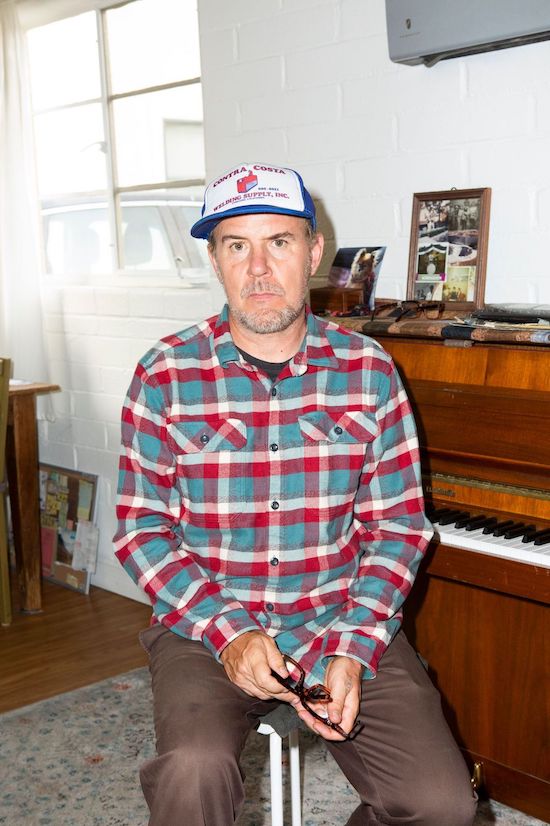
Jason Lytle portrait by Aaron Farley
Alienation is fickle. There’s a moment on Pavement’s 1997 song ‘Shady Lane’ where frontman Stephen Malkmus sings, “You’ve been chosen as an extra in the movie adaptation of the sequel to your life”.
For some, this is the nadir of a certain strand of 90s collegiate indie rock, as much in love with the idea of sounding clever as it is clever. If it had come out in our digital era, it would have been a line whose shelf life was counted out in retweets.
Love it or hate it, it’s also a sentiment that dangles a certain kind of alienation out in public. The sort of thing that a certain type of young person in the US in 1997, one who lacks access to the infinite river of content we have now, would hear and think, “Hey, I know that feeling. I feel disconnected and disassociated like that." That recognition creates relatability. Relatability creates community. And suddenly feeling isolated and alone is something communal.
In the taxonomy of alienation, this is classed as alienation with a big “A”, the kind that creates connection through a shared experience of disconnection. Bar the odd one liner, Pavement in reality were not a big “A” band. 1990s Radiohead on the other hand were full of big “A” energy. For a period, they were the grand bards of what proved to be a commercially friendly emotive alienation.
As an 18 year old living in Wisconsin in 1998, I can’t stress enough how many first year Uni students would want to quietly discuss their deep love of OK Computer. It went far beyond your typical trench-coat wearing indie music fan. At its core, Radiohead’s big "A" alienation comes from a place rooted in a sense of opposition and reaction. By raising itself above the parapet and shouting, the implied binary it created had a tendency to lure people to it. It worked well for Radiohead in the late 90s and other bands, like early Coldplay, used the tone, if not the actual ideas of this kind of alienation to produce big, sing-a-long communal hits of the era.
British critics were quick to call Grandaddy’s The Sophtware Slump the US answer to Radiohead’s OK Computer when it was released in 2000. On first impression, band mastermind Jason Lytle’s slightly nasal choir boy voice, a love of ELO-inspired melody and the band’s melancholy guitar tones mixed with charity shop Vangelis synths read like the perfect formula for success in a post Brit Pop, post Y2K new millennium.
Except Grandaddy are not full of big "A" energy. The world depicted on The Sophtware Slump is alienation with a small "a". It’s a kind of alienation that while quieter and less noticeable on the surface, it creates a constant background noise that fills the gaps of everything around you. It’s an alienation that intuitively doesn’t even consider the possibility of communal anything because that would imply there’s some kind of way out. That doesn’t mean total nihilism, it’s just something that’s more individual, more observant and often more darkly absurdist. Grandaddy had more of these traits than many of the bands they were compared with at the time and it means The Sophtware Slump comes from a mental and physical place that doesn’t fit as easily into the ready-made narratives of the millennium.
As a record, it wanders the borders where technology and nature meet. Two themes that in the hands of others could have been filled with big "A" energy. It could have been written like a scream into the void or at least a commentary on a shared flaw or crisis that we should be paying attention to. But that’s not what Lytle does. His small "a" energy isn’t looking for connection. It’s full of longing and observation but delivered from a space residing solely in his head that doesn’t feel like it’s trying to commune with others who feel the same. It’s gentle. It’s sad. It’s sometimes funny. It’s also razor-sharp and hints at a state of mind that has only really started to widely make sense in the 20 years since The Sophtware Slump was released.
“I’m not really the type of person that feels the need to just stand up and yell the loudest. I know my place and a lot of it is just [being] the observer” says Lytle while on the edge of the desert outside of Las Vegas. It’s near the end of a long solo road trip on his way home and he’s sat on a lawn chair having finally found a spot with decent enough mobile signal for this interview so we can discuss The Sophtware Slump and its reissue 20 years on.
Dealing with fiddly technology while surrounded by vast expanses is perhaps the most Grandaddy of situations imaginable but it’s also one that has defined Lytle’s life far beyond the band. Hailing from Modesto, CA, it’s the sort of place that when you look at it on a map, it seems well-situated for the type of California lifestyle that outsiders assume can be found everywhere within its borders.
“People look at Modesto and think, ‘Hey, there’s all kinds of stuff going on there’," explains Lytle. “I mean, it looks like San Francisco isn’t too far. It looks like Yosemite National Park isn’t too far. And it looks like there’s a lot [going on], you know. It just looks like there’s a lot happening. But oddly enough, there’s really not that much happening. It ended up getting ravaged most of the time that I lived there by drugs and crime, and [eventually] it became like a big commuter town. A lot of people are making that trek from Modesto where they live to the Silicon Valley or working in the Bay Area. And because of that it just started losing its sense of community”
Modesto is “the kind of place that people are going through to get somewhere else whenever they end up travelling through California” he adds. Just a bit too far from the lure of the city and just a bit too removed from the grand pleasures of the wild. It’s a story that repeats itself in thousands of towns across America where the end points of technology and commercialism play out in box stores and decaying sprawl set against backdrops on the edges of nature. If you want to understand what America really is, it’s this. Not the thrills and innovations of the big coastal cities but the places that are often just a stop on the way to somewhere else. They’re places where the arrival of a national fast food restaurant chain in town can feel like big news. They’re places awash in the products and goods that everyone is told to keep buying while surrounded by large expanses of nature you have to cross just to get to the next town over. This is actual America for so many. This is modern Americana in its most honest form. This is what defines Grandaddy and The Sophtware Slump.
If you’re a young person who finds yourself in such a town – the sort of young person who want to explore something beyond it – then sometimes your only option is to escape inwards to your bedroom, your head or a field with your dog. “My parents divorced when I was five, and then I lived out in the country when I was in my very formative years,” he explains. “We lived way out in the country, no neighbours. I spent most of my time just wandering through fields and orchards with my dog just like in my own head, playing music, listening on headphones, and drawing, I was left to my own devices. It was, undoubtedly, the most influential, creative part of my life. All that stuff was forming, you know, because I still feel like to this day I could go anywhere. And I mean, my goal at this point is to recreate that feeling I had about the newness and the wonder of music and production that I experienced when I was eight years old. All I’m really trying to do is, like, to get to that point.”
This drive to return to something pure and solitary dominates The Sophtware Slump. It’s a pattern that influences the album as much as it influences how Lytle works. Grandaddy live are a full touring band, but their albums have always been made by Lytle on his own in a home studio. “Grandaddy was like this other entity when we played live”, he says. “I felt like it was two completely separate entities: the live thing and the recorded thing. It was good for me to have them separate because if I started thinking that the live thing had to be too close to what the recorded thing was, I think it would just be a bummer. Those tours would drag on and on and on. And, you know, it’s that whole concept of having to recreate on a nightly basis some shitty sketch of a beautiful painting that you’ve already made.”
Discussing this with Lytle and listening again to The Sophtware Slump today, it’s clear that this duality extends beyond his working preferences. On songs like the eight-minute album opener ‘He’s Simple, He’s Dumb, He’s The Pilot’, he explores the overlap of nature and technology. It’s a landscape filled not so much with the utopian shine of silicon-valley but instead littered with the debris of discarded technology. A technology abandoned not out of wilful waste but instead just victims of the everyday indifference that is the by-product of our constant urge for novelty.
It’s a scenario best played out on ‘Jed The Humanoid’. It tells the story of an android who, after being slowly neglected by his creators when they become more interested in newer inventions, takes to drinking and eventually dies from it. It’s a sad, tragic tale. Jed makes an appearance again later on the album with ‘Jed’s Other Poem’, where it’s discovered the deceased android wrote poetry no one cared about and the narrator decides to share an example of his work. The verse turns out to be a tragi-comic narrative concerning Jed’s walk of shame through town after a night of heavy drinking. The two songs are like watching a minor-key version of Data from Star Trek the Next Generation finally achieve his goals of being human, simply by indulging in our worst habits and tendencies.
This may all sound like a treatise on man & technology versus nature but Lytle never feels like he’s shouting at humanity for the damage it does. Instead, he simple wanders through terrain filled with crystal lakes and broken appliances, observing what he sees and simply acknowledging the reality of what’s there. And while concept album is a label that could hover very near to The Sophtware Slump, Lytle is quick to point out that was never the intent. “I’m a big fan of production and just having fun in the studio and that looks a lot better when you have more expansive themes. But I definitely wasn’t trying to make a paranoid album about the end of the millennium. It’s like people really latched on to the nature versus technology thing. Which, I mean, if anything, it’s more concerning nature combined with technology. The one thing that it was honing in on was that we were definitely going through this awkward period, the internet age, and what we were deciding to do about it. There’s an album by ELO called Time that I remember was very influential to me because it was speaking about the future, but it was always talking about the good old days, while entering this brave new world. And it was just toggling back and forth. I was really looking forward to paying homage to that album.”
Leaping between the past and the future is an idea that Lytle repeats throughout The Sophtware Slump. The combination of the two creates a space in his hands that avoids the kind of rose-tinted nostalgia that often creates blind spots in people’s worldviews, while simultaneously adding an emotional heft and weariness to what may lie ahead. The result is something that serves as a reminder that no matter how much we’re hurtling towards our techno future, our emotions and human quirks will always be there to complicate things.
Yet as much as Lytle looks to past and future simultaneously, he has said in previous interviews he’s no fan of nostalgia. Which raises the question as to why he decided to re-record The Sophtware Slump… on a wooden piano. This new version is being released alongside a remaster of the original album this week to celebrate its 2020 anniversary. “I was a little worried about that. But once I started working on it, I took a crack at a couple of songs and I realised there was something different happening. It helps this much time has gone by. But also it felt like I was just hanging out with old friends again. And the way time goes by and old friends change. And then one song after another started getting recorded. I realised it was turning into its own thing. So I started welcoming the idea a little more. So it wasn’t so much a case of, ‘Oh, God, here we go again.’ More just like standing around a circle talking about the good old days, and it started moving away from that. And I was pretty relieved that that was the case.”
Shifting back to the idea of technology, while the album is not a klaxon call about its dangers, Lytle also doesn’t deny that his work comes from a place of frustration too: "A lot of the time, it’s just like sitting back and watching the shit show and then trying to learn from it. I’m all about treading lightly and I’m all about trying to be respectful to other people in the environment, but I’m so outnumbered. It’s so pathetic and sad that the only way to voice that frustration is just to write about it and even then not go dark with it, but just put a humorous slant on things. Usually, it amounts to a word of caution and laughing about the ridiculousness of the situation, while also keeping in mind that this too shall pass. I’m okay with that. I’m okay with being the person that’s going to be talking about that stuff.”
The album’s themes have grown in relevance since its original release 20 years ago. But its greatest legacy is also an unplanned one. At its core, it’s a bedroom album. One made by a self-confessed introvert completely on his own who in the process inadvertently foreshadowed the arrival of a very 21st century bedroom mindset. While this wasn’t an entirely novel approach by 2000, the role of the bedroom in people’s lives has only grown in the intervening years. This may seem stupidly evident in a pandemic where we’re all trapped in our houses but for millions of young people under a certain age, these internet connected personal spaces have become the key backdrops to their exploration of music, culture and the world in recent years.
They’re as isolated as they are connected. Hyper aware, hyper-sensitive and hyper-observant of the tragedies and absurdities of a chaotic world where climate change, lack of economic possibilities and the negative impact of technology feel like the only constant. It’s a state that’s given rise to the creating and sharing of darkly absurdist and often hilariously nihilistic memes among young people who are often labelled Gen Z. Their bedroom mindset intuitively understands that when everything is crumbling around you, sometimes the greatest form of protest is to simply point at the absurdity of it all. None of it feels far off from making songs about sad drunk androids writing poetry that no one pays any attention to.
Lytle is naturally understanding of people who find themselves living so heavily in their personal and mental spaces but he also doesn’t deny the challenges it can bring. “It’s still a struggle for me. I still spend so much time in my own head. I use that as an out. I’ve had a pretty terrible track record with relationships. And it’s usually just because it deals with having to communicate and express my feelings and my thoughts. Not having to say anything and pouring it into music, it has come back to bite me in the ass. You may think that’s noble. And you may think that’s heroic, but when you’re in a relationship, you know, [the other] person doesn’t really give a shit about that. You can’t get away with murder and just be a self-centred asshole and be self-centred, while saying, ‘Oh, I’ll make a song about it later, and everything will be fine.’ So yeah, I would definitely encourage people to not to forget that it’s important to be good at hanging out with people.”
It would be wrong to label Lytle some indie prophet from Modesto who correctly predicted how so many of us would end up living in our heads dealing with the downside of technology. He’s not a mapmaker trying to show us there’s an alternative route to all this mess if only we look hard enough. He’s just someone who through the random lottery of personal circumstances showcased a particular mindset on The Sophtware Slump that since its release has become a much more common reality for so many of us. It’s perhaps fitting that Lytle closes the album with ‘So You’ll Aim Toward The Sky’. Filled with sad yet uplifting cries of flying away to somewhere far from pain, it feels like music for watching the world end while sat alone on a space station whose orbit is slowly deteriorating. That may sound terribly bleak today but it’s also a reminder that you can find genuine beauty in observation and, as Lytle says, just remembering that even this too will pass.