


Gary Numan’s career presents one of the most interesting volte-faces in the history of popular electronic music. Emerging amongst its most visible pioneers in 1979, his game-changing early albums (Replicas, The Pleasure Principle, Telekon, Dance) crucially shaped the next decade of British pop. This was a decade he would paradoxically spend struggling to live up to his initial artistic and commercial achievements, following a sold-out run of 1981 Wembley Arena shows intended as his retirement from live performance.
In 1994’s Sacrifice, Numan set out upon a startling new course with a dark, gritty line in industrial metal. Now an eminent force in the genre, Numan’s latest albums have returned him to the peak of his powers: his highest chart position (No.2) since 1980 with 2017’s Savage (Songs From A Broken World), his scheduled return to Wembley Arena, and – in his new album Intruder – his best work in the genre to date.
Driving this success is Numan’s 15-year partnership with his lieutenant Ade Fenton. A historically spiky relationship, in which the producer has also acted as manager, bandmate and best-friend, their collaborations since Jagged (2006) have yielded Numan’s most vital work since the early 1980s.
Movingly portrayed in Numan’s recent autobiography (R)Evolution, their partnership brings to mind those of Nick Cave and Warren Ellis, or (devoted Numan fans) Trent Reznor and Atticus Ross. Sitting together for their first ever joint-interview, they also exhibit a very ordinary kind of friendship. Whilst discussing the principally-remote process of writing Intruder, necessitated by both the pandemic and Numan’s residence in Los Angeles, a constant stream of barbs and knowing smiles flows between them.
“We Facetime all the time” Numan says, grinning at Fenton. “I’ll have the music up in the background and say, ‘What happened to the bass end of that?’” Registering this as a reference to the creation of the track ‘I Am Screaming’, Fenton’s eyebrows hit the roof.
“So what actually happened, is he’s going, ‘It’s fucking shit! It’s fucking shit! I’m so fucking angry! It’s fucking shit!’” Fenton says. “I go, ‘It’s alright mate, we’ll just put some more bass in it!’” While the pair laugh, Fenton acknowledges this as the real secret of their success. “He made the song better by having that hissy-fit. Our relationship is good, so it doesn’t matter."
“When you can talk freely and get grumpy, you make progress really quickly,” Numan agrees. “You get straight into the problem, you can talk about it, and there’s no ego involved."
Intruder is the duo’s fifth album together, and in some ways a thematic companion to Savage. While Savage depicted humanity in the aftermath of ecological apocalypse, Intruder explores global warming from the perspective of the planet itself: cast as a conflicted, heartbroken protagonist, compelled to destroy the human race to ensure its own survival. “I shamelessly stole the idea of it from my 12-year-old” Numan says, having read a poem by his daughter which depicted the Earth speaking with other planets about mankind’s harmfulness.
“The idea of Intruder is to add more noise to that conversation. To try to persuade people and make them think about it – it is real, and it is urgent,” he says. “The most you can hope for is that we get enough people in power who are able to do enough to slow it down enough that the next generation that comes in will actually be able to do something to stop it." While Numan downplays his ecological credentials, Intruder’s convictions about the environmental crisis are clearly deeply felt. “If the Earth could speak, that’s exactly what I think it would be saying.”
Album highlight ‘The Gift’ imagines coronavirus as a weapon, deployed by the Earth to wipe out the human race. “The idea of the Earth fighting back was already part of the ideas within Intruder. When Covid came along it fitted seamlessly, in a very tragic way,” Numan explains. “Nature as a system is inherently cruel, but it works – there’s a brutal harmony to the whole thing, until you put people in it. I think we are one of those rare mistakes that nature makes: it made us too curious, too intelligent, too greedy.” Numan’s conflicted feelings – balancing hope for ecological progress with pessimism about humanity’s role in the natural world – manifest themselves in Intruder’s double-ending. ‘Now And Forever’ presents the possibility of mankind’s future existence, before its destruction in ‘The End Of Dragons’. “If you look at it from the planet’s point of view, the best thing that could happen is that we go,” he resolves.
The task of giving sonic expression to “the planet’s point of view” has resulted in a thrilling, emotionally resonant body of work. Numan is a famous early-adopter of musical technology, and his partnership with Fenton has helped keep his sound on the cutting-edge. “Ade is the one that’s really on top of technology – he laughs at me” Numan says. “I’ve sort of abandoned trying to stay on top of things. Having said that, the studio is pretty state-of-the-art.”
“It is since I sorted it out!” Fenton interjects.
“It’s one great big touch screen and a MIDI controller keyboard,” Numan says. “There’s no synths, no outboard gear, no cables and wires… but in that system is probably the most capable and powerful studio I’ve ever had. You just don’t need all the stuff producers like to show you because it makes them look clever.”
“That’s true actually” Fenton laughs. “How much can you develop a synthesiser really?” While Intruder features screaming analogue sounds from Fenton’s semi-modular gear, he lauds the software tools that are now available. “What’s great is how far you can push sounds now, and that’s the bit that I enjoy,” he says. “As a songwriter, I’m sure the technology and the amazing sounds that are capable through instruments like Spectrasonics Omnisphere also help Gary push songs in a certain direction.”
Intruder features notable contributions from Gazelle Twin and Görkhem Sen: the creator of a bizarre, one-of-a-kind string instrument named the Yaybahar. A lover of Middle Eastern music, Numan stumbled across online videos of Sen performing and invited him to remotely record parts for the album. “The first time I heard what he did on ‘The Gift’, I remember sitting in the studio like a weirdo with my arms out – it was just incredible,” Numan says. Shortly before the deadline to finish the Yaybhar recordings, the duo received a call from Sen’s wife in an ambulance. Sen’s appendix had burst and he was being rushed to hospital, but he was determined to finish recording regardless. “He got out of hospital, got home, and recorded it with hours to spare."

“The moment Gary had with the Yaybahar, I had when Gazelle Twin sent the vocals back to us for the piano version of ‘The End Of Dragons’,” Fenton says, referencing a bonus track from Intruder. “I was screaming at the top of my voice, on my own in the studio”.
Meeting through mutual friends, Numan and Fenton did not initially see eye-to-eye. “He mistook my quietness for arrogance,” Fenton says diplomatically, but by 2005 a friendship blossomed. “Musically we were miles apart. I’d forged a career as a techno DJ and producer and had a couple of labels… but pictures of him were on my wall in 1979, and no-one else,” Fenton says. “I’d started working on some more industrial stuff, and I forced him to listen to it at a party.” Impressed by Fenton’s work, and unhappy with his then-producers, Numan gave Fenton three tracks to work on. Excited by the results, Numan then invited Fenton to work on Jagged – their first album together.
This would soon become “the best and the most productive” of all his creative partnerships, Numan claims. “Going into it as friends really helped. We’re very similar in nature – we both laugh at the same terrible things”. Their broad process is simple: after writing a song’s basic melodies and structure, Numan sends it to Fenton “to make better” before the pair develop the fleshed-out track together. “When we first started working on stuff together, I was a bit of a control freak about it,” Numan says. “I now have absolute faith in him”.
Following the creation of Jagged, their relationship deepened dramatically. Fenton was drafted into Numan’s band as a keyboardist, invited Numan to work on his own album Artificial Perfect, and became one of his closest confidantes. A major falling-out between Numan and his parents led Numan’s father to end a 30-year term as his manager: an intense role that would now also be partially held by Fenton. “At 11’oclock at night my heart would be beating, and all I’d be thinking is, ‘How am I going to start producing the album in the morning?’” Fenton says of the strain he found himself under. “It was pretty hardcore… but I loved it.” While he misses certain elements of these additional roles as Numan’s bandmate and manager, Fenton claims their current partnership is the healthiest fit. “I miss being in the band massively, but I don’t miss the travelling side of it.”
“He can’t sit sideways in a bus! How can you tour if you can’t sit sideways in a bus?” Numan quips. Having now managed himself since 2015, Numan can sympathise with Fenton’s experience. “When you’re managing, doing the music, touring and you’ve got family, that’s a huge amount of work.” However, Numan enjoys it increasingly. “It’s much like becoming famous to begin with – you learn how to navigate it, to avoid the bad and enjoy the good."
Around making their second album together Dead Son Rising, Numan experienced severe depression and panic attacks. Meeting Fenton’s efforts largely with lethargy and ambivalence, it would take five years to follow up Jagged. When I ask about the strain this must have put on their partnership, Fenton corrects me. “It strengthened it, actually. The only thing that put a strain on our relationship was that I was worried about my best mate having depression,” he says. “What came out of it was something we’re still really proud of – it just took a long time to get there.”
Their relationship declined in 2014 after the completion of their next album Splinter (Songs For A Broken Mind, amidst managerial pressures and Numan’s move to Los Angeles. Numan cut Fenton out of his life entirely, and the pair would not speak for two years. “There were outside influences that were helping to force a wedge between us” Fenton explains. After learning Numan’s mother had passed away, Fenton decided to make contact again. “We had a four-hour chat of thrashing it out without hitting one another, and then at the end of it he went, ‘Should we start working on another record?’” he laughs. “I’d say that our working relationship is stronger than it was before that happened. Savage was such a brilliant rollercoaster. Not even a rollercoaster – it was all up.”
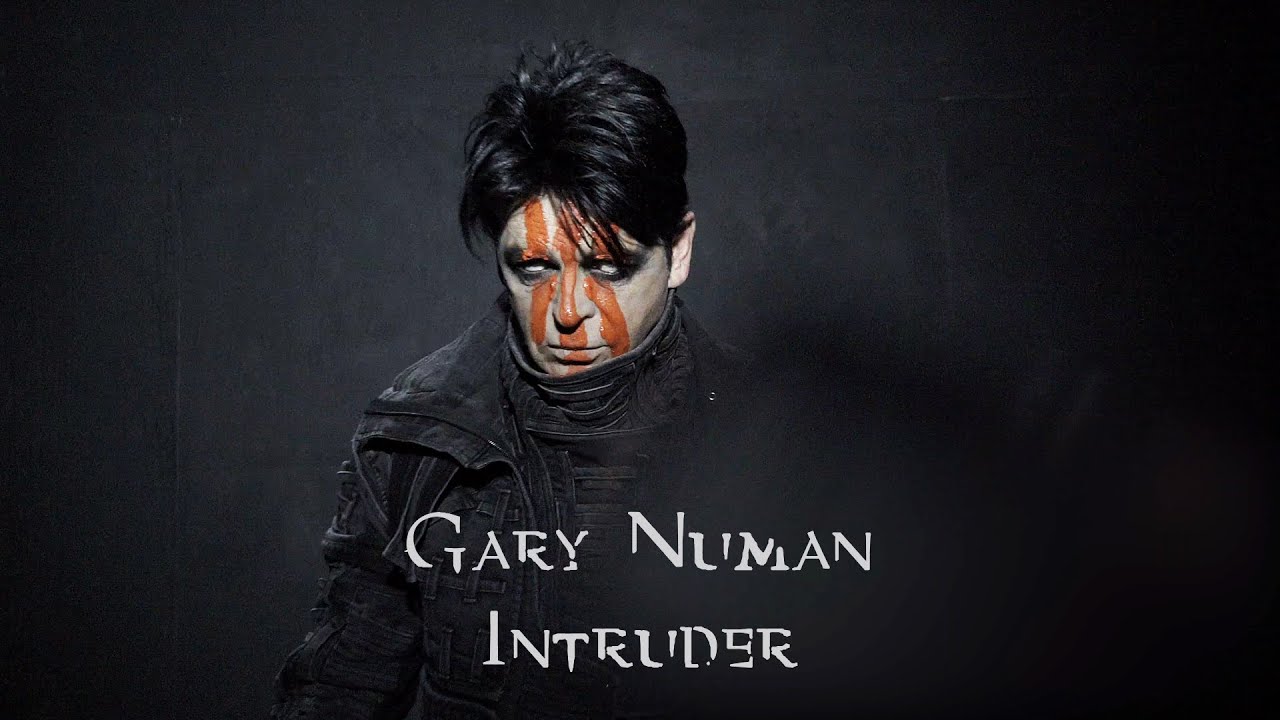
This partnership’s good health is evidenced by the brilliance of Intruder. Expanding the volcanic landscape of Numan’s ‘mature work’, it builds on the sonic and emotional scope of recent albums whilst making full use of his most enduring gifts: not least his keen melodic instinct and hauntingly peculiar voice. ‘The Gift’ highlights the Numan-Fenton era’s latest triumphs, with its howling synthetic textures, skirling Yaybahar and dramatic backing vocals (courtesy of Gazelle Twin). The soaring chorus on title-track ‘Intruder’, meanwhile, reasserts the duo’s established skill in presenting tantalising glimpses of Numan’s earliest creations, through a refined vision of his crushing post-Sacrifice sound.
Numan’s journey to rebuild his early success now approaches symbolic completion, as he announces his return to The SSE Arena, Wembley on 7 May next year. In 1981 Numan temporarily retired from live performance with three sold-out ‘farewell shows’ at Wembley Arena, after intense struggles with his immediate stardom. These extraordinary productions, including a moving set larger than any previously seen on a UK stage, marked the peak of Numan’s early fame. “We did Wembley, then I retired and my career dive-bombed. There’s been this 40-year attempt to get back to where I was before, and it’s been really difficult” he says. “That day when I get back to Wembley will probably be the best day of my life”.
Amidst the world’s transformations since 1981, Numan’s career invites consideration of how popular art’s attitudes towards the future have also changed. While the fantastical, science-fiction imaginings of Numan’s early work were hardly free of dystopian themes, Intruder signals how music exploring humanity’s future feels increasingly bound by certain morbid certainties. However, Numan claims his “fascination with what’s coming" has hardly changed. “Replicas looked at Artificial Intelligence and how that would deal with the problems of humanity,” he says. “The first thing the machine realises, is that the only problem is people. Here we are again for a very different reason – now the Earth is deciding this. It’s always people that are the problem!”.
Despite his musings on humanity as an erroneous ‘intruder’ in the natural world, it is Numan’s fascination with the human spirit that most significantly bridges his earliest and latest works. “We are ultimately self-destructive – and yet amazing. We’re this constant contradiction, fighting against ourselves all the time to become better,” he says. “My interest in science-fiction isn’t anything to do with spaceships and aliens – it’s us and what we’re going to become. The weird thing is that we might be at the end of it,” he says seriously, before flashing another grin at Fenton. “What an amazing time to be alive!”