
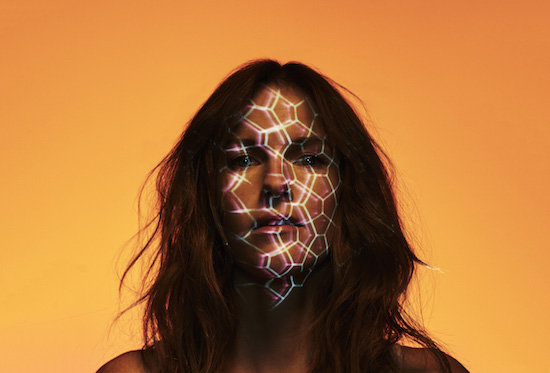
Photo courtesy of Tim Saccenti
It was in his lectures and writings that philosopher Alan Watts would frequently offer his thoughts on spiritualism, identity and the various stages of life, drawing on and studying different belief systems from Zen Buddhism to Hinduism to Christianity, and other religions in between, to feed into his work.
“I really like how his talks were always so playful,” Kaitlyn Aurelia Smith tells me over Skype from her Slovenia hotel room. “I always feel like he’s semi-laughing when he’s having his conversations and giving his talks, and I really appreciate that demeanour.” Watts’ appraisals of the different stages of life are a heavy influence on Aurelia Smith’s sixth full-length record, The Kid, which follows on from last year’s Sunergy, on which she collaborated with Buchla synth pioneer Suzanne Ciani. The Kid sees Aurelia Smith explore her own interpretation of the four stages of life that each person transitions through as they move closer to old age. It’s a narrative arc that she’s keen to share having put a great deal of energy into its development over the process of writing and recording the album. “It all came from my dad because he has been reading up on this idea a lot, and feels like he’s entering into the final stage of his life,” she tells me.
The idea soon became a focal point of discussions between Aurelia Smith and her father, coinciding with her own growing fascination with Watts’ lectures on the matter – she first discovered his work at college aged 17. “The first stage at the start of the album involves the process of going from pre-creation into creation. Birth is a very heavy thing so I was intentionally trying to make the start of the album sound heavier to reflect that.” This manifests itself in ‘An Intention’. An early high point on the record, a heartbeat-like drum pattern provides a bed for starry synths, courtesy of the Buchla synthesiser that has formed the focal point for her output, that unfurl around her majestic vocals, as she proclaims, overwhelmed, “I feel everything at the same time.”
The second stage, she explains, involves finding yourself in the world, and learning as much from your surroundings as possible. Childlike naivety runs through much of the record’s first half with its wide-eyed, twinkling melodies, while track titles such as ‘In the World but Not of the World’ further hint at the ongoing learning process through the earlier parts of Aurelia Smith’s self-identified four stages. At the third stage, we begin to develop self-awareness and an understanding of the needs of other people, while the fourth, she concludes, is centred around the point at which we are simply able to exist – “going back to where you came from depending on what your belief is; I’m not even sure what mine is yet.” Later tracks such as ‘I Am Curious, I Care’ and ‘I Will Make Room For You’ are lent a brighter, more enlightened tone, hinting at a life well lived.
Talking through her Baker’s Dozen, Aurelia Smith admits that she finds it more difficult to express exactly what it is that she connects with in the music of others than she does to talk about her intentions with her own work. Her picks place a distinct focus on music of a calming nature, ranging from new age favourites by Laraaji and Midori Takada to influential works by Steve Reich and Laurie Spiegel. Much of the list is made up of discoveries from her final years in college and at her childhood home of Washington’s Orcas Island before she relocated to California’s Berkeley University to study and later to Los Angeles where she now resides. “That was the period when I was most spongey,” she says referring to her final year of college. “I didn’t really know what I wanted my music to sound like yet, so I was just trying everything on.”
Kaitlyn Aurelia Smith’s The Kid is out on October 6. She plays London’s Scala on November 21. You can get tickets <a href="https://www.residentadvisor.net/events/990649" target=“out">here
To begin reading her Baker’s Dozen, click the image below.