
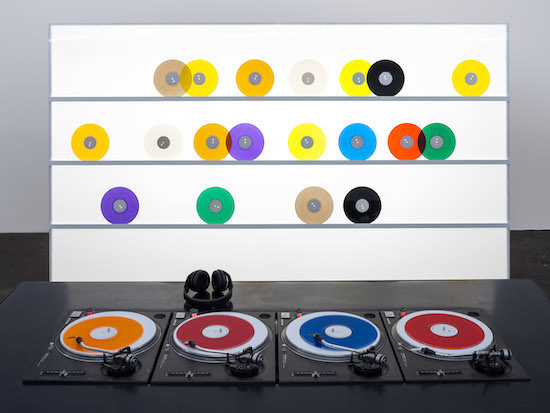
Carsten Nicolai, bausatz noto ∞, 1998/2015, exhibition view "Broken Music Vol. 2", Hamburger Bahnhof – Nationalgalerie der Gegenwart, 17.12.2022-14.5.2023 © Nationalgalerie – Staatliche Museen zu Berlin / Thomas Bruns
Vinyl is here to stay; this we now know. Sales are soaring and record shops think nothing of asking (gulp) £30 a pop for an album. But it wasn’t always this way. West Berliner Ursula Block was prescient in knowing the threat to vinyl from other technologies. From 1981 to 2014 she ran a record shop and gallery called gelbe MUSIK, (‘Yellow Music’) in sleepy, bourgeois Wilmersdorf, far from the techno hipsters in Mitte and the punky anarchists of Kreuzberg.
In the teeth of the expansion in CD sales, 1989, Block set up a highly successful travelling exhibition called ‘Broken Music. Artists’ Recordworks’. This featured record covers made by artists as original works; sound producing objects; books and publications that contained a record, and records made by visual artists themselves. Over thirty years later she now gives us an expanded Volume 2, a survey of around 700 art-related records arranged in ten sections. If that’s not enough of a thrill there’s also sound works from the National Gallery’s own excellent collection.
The works here fill a lengthy extension of the gallery space; it feels like a full mile of rooms. We begin with a work that was specifically designed for the gallery back in 1998: gelbe MUSIK by Hans Peter Kuhn. Block’s shop’s name comes from a Wassily Kandinsky quote. The artist, like Messiaen and Scriabin, was fascinated by synaesthesia: a state where one sensory pathway (e.g. colour vision) leads to involuntary experiences in another, such as sound. There’s a large photograph of the shop/gallery space at night, an inviting sight with its windows lit up an evocative bright yellow. We hear intriguing sounds like those made by the clunking sling puck games you get in amusement arcades.
On the walls of this first space we also see album covers from Eno’s Discreet series: Bryars, Nyman, Toop/Eastley, and the rest. Fittingly the series is mounted with obsessive precision, like a minimalist installation by Donald Judd. In angry contrast to such calm there’s a cover on the adjoining wall showing a mean William Burroughs; he’s wearing a Stetson and he’s armed with a rifle. He stands with John Giorno. And here’s Giorno again on another cover, this time with Glenn Branca, glaring out at us on a disc entitled Who Are You Staring At?
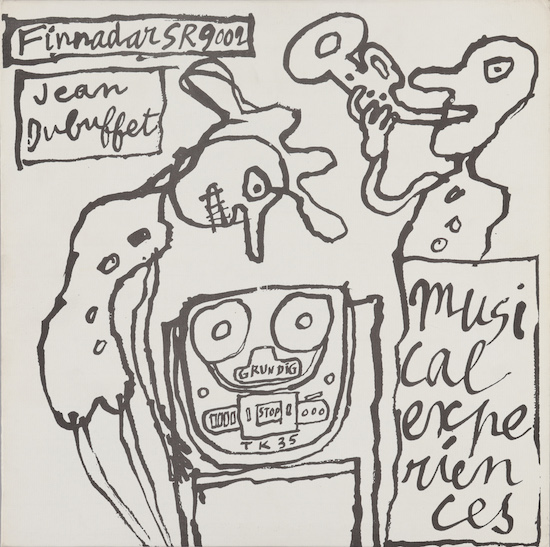
Jean Dubuffet, Musical Experiences, 1973© VG Bild-Kunst, Bonn 2022© Staatliche Museen zu Berlin, Nationalgalerie / id3d-berlin
The second room features albums and covers by canonical artists such as Miró and Picasso: check the latter’s economical line portrait of Satie on a piano recording by Aldo Ciccolini. Here too we find Kurt Schwitters’ Ursonate as performed by Jaap Blonk. Elsewhere Piotr Nathan has cut up vinyl records into little snippets to form Snowflakes (1988–89), a ten by ten piece grid of plastic slivers that looks from a distance like Japanese calligraphy framed by the pristine white walls.
At this point on the tour you’re given a set of headphones and an iPhone. Easy instructions help you to point the camera at codes beside the helpful wall texts and then listen in to a selection of many of the albums. I tune in to Emeka Ogboh and, unseen, jig away like a prat. There’s an installation work here, too: Nam June Paik’s TV-DG (1993) which has a sculpture of Nipper, the HMV canine, staring at his own image on a small TV screen as he’s filmed by a tiny camera sitting alongside.
The soundtrack now switches to Yoko Ono screeching away as she performs ‘Don’t Worry Kyoko (Mummy’s Only Looking for a Hand in the Snow)’ from 1971 only to settle, click, with the next work along: a tranquil sequence from Hanne Darboven’s album Der Mond ist Aufgegangen called ‘Vierjahreszeiten 1981/82. Opus 7’. In a nearby wall cabinet there’s some unadorned vinyl to look at. Here’s Christian Marclay’s Untitled (Record Without a Groove) (1987) that is precisely what it says it is. Next door to this is a black frisbee made to appear like a vinyl record, a typically amusing work by David Shrigley called simply: I collect records, I am obsessed with them (2012).
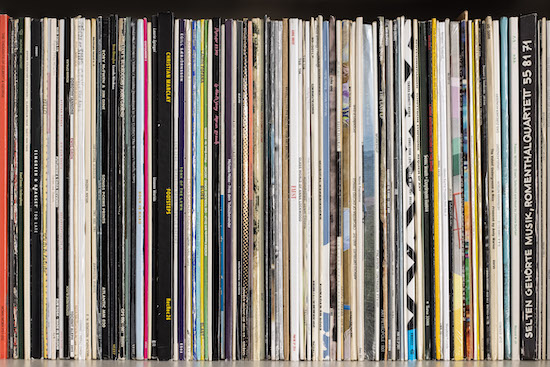
Schallplattensammlung des Hamburger Bahnhof — Nationalgalerie der Gegenwart, 2019 Ankauf der Sammlung Broken Music von Ursula Block, erworben mit Hilfe der Ernst von Siemens#) Musikstiftung und der Ernst von Siemens Kunststiftung sowie 2022 erworben durch die Freunde|der Nationalgalerie, © Staatliche Museen zu Berlin, Nationalgalerie / Thomas Bruns
The next room features field recordings, sound collages from rural and urban sources, and so we get Emeka Ogboh again. Berlin loves Ogboh; he’s even got a sculptural work on the roof of the newly restored palace in the centre of the city. There are also examples in this space of maximal and minimal music’s going from the aforementioned Glenn Branca and his ‘Lesson No. 1’ then settling down to the more serene Steve Reich. Here too are sound sculptures, collages as with Ferdinand Kriwet’s Hörtexte – Radiotexts (2007) that post-dates Holger Czukay’s innovations but pre-dates Jan Jelinek’s experiments with radio and TV transmissions. Nearby are examples of OpArt on covers: Bridget Riley, of course, and Victor Vasarely’s work for Xenakis’ LP sleeves. The headphones now blare Kriwet’s voices in a cacophony of chatter.
Peace returns again with a beautiful wall-mounted installation by Christina Kubisch called The True and the False (1992) that looks, from the end of the room, like an art deco flower arrangement. Close to that we see that the ‘flowers’ are in fact twelve grinding discs, their surfaces covered with fluorescent blue pigment; the cables to these are the stems. Each disc makes a quietly soothing metallic sound. Bliss.
Better-known imagery arrives next up with a sequence of famous covers by Raymond Pettibon for bands like Black Flag and Sonic Youth. The latter also have four of their classics mounted with designs taken from work by Gerhard Richter (Daydream Nation), Mike Kelley (Dirty), William Burroughs again (NYC Ghosts and Flowers) and Richard Prince (Sonic Nurse).
No doubt you’ll find some of your own personal favourite covers somewhere here. For me these included Cosima von Bonin’s designs for the Moritz von Oswald Trio, a sequence that includes a rainbow-coloured rolling pin, a femur patterned with the Irish tricolour, and an orange and white toy V2 rocket. Then there’s Warhol’s brilliant Kodachrome sequence for John Cale’s The Academy in Peril album from 1972 and Hipgnosis’ superbly droll cover text that parodies record company manipulation and capitalist mores for XTC’s Go 2.
Unsurprisingly German pop music features in yet another room with Chicks on Speed, To Rococo Rot, Roman Flügel, and Alva Noto all present and correct. Albums made by the Vinyl Factory are inventoried, including artworks by the likes of Thomas Demand. A section of covers from the more immediate past also feature in the next to last room as ‘Broken Music Now’: this includes Martin Creed’s gurning mug along with other works by Jeremy Deller, Mark Leckey, Anne Imhof, and the wonderful Michaela Melián from Monika Enterprises. Seeing Rodney Graham posing as a singer-songwriter reminds us of the sadness of his recent death. Nearby there’s another type of shocker altogether as Joseph Beuys performs Sonne statt Reagan (1982) on a TV pop show with what appears to be the German Bananarama.
Two Scottish artists based here in Berlin have installations: Susan Philipsz and Douglas Gordon. The latter’s Douglas Gordon Sings the Best of Lou Reed and the Velvet Underground (For Bas Jan Ader) (1993) sees the artist visualised on a TV set. He’s lying on the floor listening to songs from Transformer through his headphones. You can listen in to him with another pair of headphones as he gamely covers ‘Perfect Day’. The show finishes powerfully with Philipsz’s poignant War Damaged Musical Instruments (Shellac) (2015) which features the Last Post as played by the actual bugle that sounded the Charge of the Light Brigade along with a tuba, a flute, a clarinet, a trumpet, and a saxophone that all survived war.
Broken Music Vol. 2 is both hugely entertaining and highly instructive, an introduction to many other worlds of differing music’s, different visions. Take a trip over!
Broken Music Vol. 2. 70 Years of Records and Sound Works by Artists is on at the Hamburger Bahnhof, Berlin until 14 May 2023