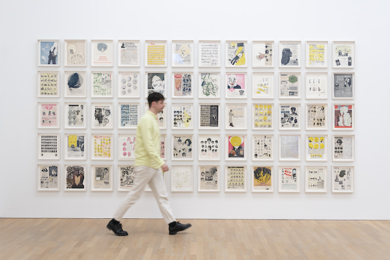

Deep Horizons at MIMA in partnership with the Roberts Institute of Art. Photography: Jason Hynes
From C.P. Snow’s assertion that art and science are divergent cultures through to the work of crossover individuals from the past such as Leonardo da Vinci or today’s Olafur Eliasson there’s been a long and fruitful dialogue about the boundaries and interactions between the two disciplines. This is difficult and complex territory ever threatened by charlatanry and it’s a brave museum that tries to illustrate the points of contact.
So here we are at Middlesbrough Institute of Modern Art, where seven curatorial collaborators are involved in an ambitious exhibition focused on the art and science of excavation and all that word implies. Botanist Dr. Greg Kenicer and the astroparticle physicist Professor Chamkaur Ghag represent Science. The collaborative nature of the project means there’s a combination of artworks from the MIMA collection along with a selection from the Roberts Institute of Art.
This is a mental pinball of a show where the mind pings pleasantly, informatively, from one work to another. The art/science dialogue is entirely appropriate to the location given Middlesbrough’s industrial history, its connections to coal and iron mining, and the art purchasing that came as a result of the profits…
In keeping with the industrial aesthetic, your attention is drawn first to a sequence of loudly rhythmic noises – a tick-tocking in various speeds ranging from the rapid Geiger clicks of Kraftwerk’s ‘Radioactivity’ down to the slowed propulsions that recall the pump-thump sounds that begin OMD’s ‘Stanlow’. This is Martin Creed’s Work No 180 Largo, larghetto, adagio, andante, moderato, allegro, presto e prestissimo (1995–2004), a line of metronomes beating in different time, their pyramidal shapes reminiscent of the many mine lifts that once dotted the landscape hereabouts.
In turn this calls Bernd and Hilla Becher to mind and their documentation of coal tipples, bunkers, blast furnaces and the like. Across the room there’s some of their Water Towers (1972-1992) here in all their retro-futurist glory: enormous concrete egg cups and Brobdingnagian golf tees. Then too there’s the local imagery of mining. Photographer Robin Dale is from Teeside and shows a sequence of pit images, abandoned iron mines and stacks as with Kilns Chimney from the early 1970s.

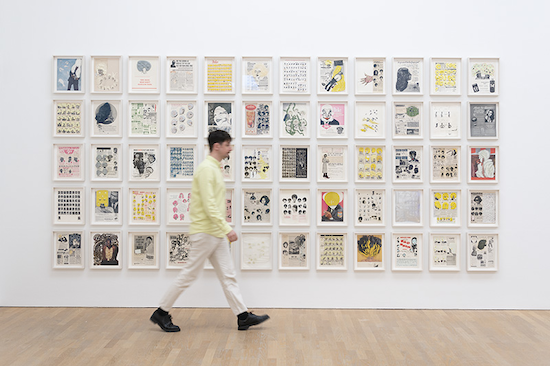
Deep Horizons at MIMA in partnership with the Roberts Institute of Art. Photography: Jason Hynes
What we’ve casually dismissed or merely missed seeing is excavated from memory as with the Boyle Family’s constructions – these part-sculptural reliefs representing actual slices of horizontal ground features are presented vertically, flatly on the wall like a painting. I always associate the Boyle Family’s work with the cover for one of Tom Verlaine’s solo albums called, appropriately enough, Cover (1984), partly because I first saw the Boyle Family’s constructions around the time of its release. There’s an aerial shot of Tom standing on a traffic island in what looks like the UK from the street markings, the yellow parking lines. The Boyle Family took the concept of photorealism and made sculptures, rather than oil paintings, of random samples of street surfaces. Demolition Site Study with Broken Red Bricks and Rusty Metal (1990–91) is just that but somehow its very quotidian nature, its overlooked everydayness, quietly fascinates. Theirs is a true Updikean poetry of the sidewalk with its random craquelure-like ruptures of dried mud, its fragments of burnt wood. Kenicer suggests the work becomes ‘a representative, a proxy, for the wider landscape…this piece is both map and ground-truth in one.’
Conrad Atkinson’s Iron Ore (1977) is a sequence of collages that should anger you; this is agit-prop at its starkest. We see documents that outline illness related to an iron excavator who was refused compensation and how legislation was only paid to coal miners. We read letters from a GP saying the situation ‘is deplorable’ and that they intend to pursue this ‘with the Government’. We see death certificates and letters with details of inadequate respirators: fifty years after these events it’s hard to escape the mounting animosity towards this current government when we remember the recent PPE debacle for healthcare workers during COVID and those who died.
Onya McCausland’s 54˚ 34 07.37 N 0˚ 57 42.87 W/Saltburn no 3 (2019) takes waste material –recycled ironstone mine residue from the site in the title – and turns it into pigment. Ghag thinks that ‘at some level, waste doesn’t exist – there’s no such thing…if we think in terms of cosmic accounting, everything is valuable.’ McCausland’s painting has overlapping parallelograms of ochre and sienna – a geological take on Josef Albers if you like.
Theaster Gates would agree there’s no such thing as waste: he’s known for his urban renewal projects funded by the sales of his works like the sardonically titled In the Event of a Race Riot (2011), loops of decommissioned fire hose coiled behind glass. A variant in the series is here called From Every Mountainside (2013) that looks – from a distance – like a giant crimped Ab-Ex canvas or a dumpster take on Robert Irwin’s neon lights.
Hannah Rullmann and Faiza Ahmad Kahn’s Habitat 2190 (2019) is a video taken of the new nature reserve near Calais, previously the site of the refugee camp nicknamed, insensitively, the ‘Jungle’. This was cleared in 2016 and is now the site of growth by new orchids. As with Cal Flyn’s 2020 book Islands of Abandonment this work stresses the resilience of Mother Earth, the planet’s phenomenal regenerative capacity.
Elsewhere, far away from Earth, we’re reminded of deep space by the intense darkness, the deep blacks, by Rashid Johnson’s Cosmic Slop ‘I Got Your Back’ (2012) – a 3D wall work made from an amalgam of black soap and microchrystaline wax. You think about coal again and dark matter reminded that not far from here is Boulby mine – 1,400m below the North Sea – the second deepest mine in Europe and the site of an underground lab that studies astrobiology, organisms that survive in extreme environments. Dark matter experiments are conducted here too and look for WIMPs – weakly interacting massive particles. Pleasingly we learn they use something called a WIMP detector.
Boulby is the only place on earth where the fertilizer polyhalite is mined. We’re with Ghag again and his idea that there is no such thing as waste. It takes seven minutes to get to the bottom of Boulby by lift. People still get hurt down there and only last year Cleveland Potash were fined £3.6 million after breaches in health and safety regulations between 2016 and 2019. Atkinson’s concerns about occupational health are as relevant as ever.
Like those metronomes this show keeps beating away incessantly at your brain; it’s one to visit a few times and tunnel into its depths again and again.