


Installation view of Mike Nelson, The Deliverance and The Patience, interior, 2001. Various materials. Various materials. Photo_ Liam Harrison. Courtesy the artist and the Hayward Gallery
If, today, you were to knock on a particular door on an ordinary-looking street in Bermondsey, you would be welcomed into a strange and ever-so-slightly disturbing alternative universe. It sounds like something generated by Twitter’s Magic Realism Bot: Behind a red door in South London, there is a room that holds the whole world.
The room is small, only about three metres cubed, and feels cramped, with much of its floorspace taken up by a rather spartan-looking metal cot. There are no other doors leading to further rooms, the rest of a house; just a single window, its frame cracked and peeling, leading onto another wall a few centimetres beyond. The door to the street is the only visible means of access. But as frugal as the place might seem, the shelves which line every available inch of wall space are stuffed. From corner to corner: nothing but travel books.
There are Michelin Green Guides and Lonely Planets and National Geographic Travellers and AA Pocket Guides, each one promising a whistle-stop tour around Italy, Spain, New York, Jamaica, Mexico, Peru, Thailand, Australia. The books are neatly stacked, arranged into sections by country and continent (with notably few guides to African cities and countries – a couple of half-bare shelves bearing treatises on Kenya, Egypt, Tunisia, three books on “East Africa”, one on “North Africa”, compared to nearly thirty on California and even more just to New York City).
These are not new books. They have lived, been places. A Benn Blue Guide to Northern Spain dates to 1930. Others go back to the 80s and 90s, their spines cracked and pages dog-eared with desirable recommendations. A Rough Guide to the USA holds a post-it in its flyleaf itemising entry requirements. Improvised bookmarks and scribbled annotations abound. “They’re incredibly charged, these objects,” explains the work’s creator, Mike Nelson. “They’ve been to this place at this time. Especially now that there’s this circular relation of the destruction of a place through tourism. It somehow destroys the things it describes.”
“I’ve been kind of obsessed with travel guides since I was travelling a lot back in the 80s and 90s,” he continues. “And now the fact that they’ve become obsolete! They’ve turned into these strange sort of things that mark places at a certain point in time. Then they get updated. So you can time travel, in a way, from year to year: ’79 to ‘84 to ‘96 to 2000…” The work is called The Book of Spells (a speculative fiction). It has a fantastical aura, like Clive Barker’s universe trapped inside a rug in the novel Weaveworld. We might have stepped into a conjuration, or some strange ritual from which the participants have just recently fled.
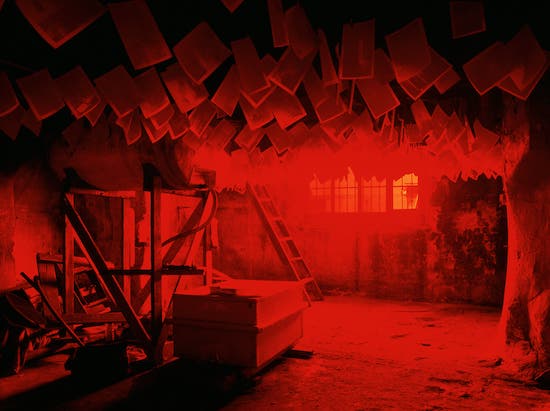
Installation view of Mike Nelson, I, IMPOSTOR (the darkroom), 2011. Various materials. Photo_ Matt Greenwood. Courtesy the artist and the Hayward Gallery
Rooms like this were once Nelson’s signature dish. Vast, warehouse-spanning works like The Deliverance and the Patience (2001) for the Venice Biennale or The Coral Reef (2000) at Tate Britain, comprised mesh-like labyrinths of uncanny chambers, each one an exquisitely dirtied-down stage set for some unspeakable, unnameable horror. Every object within – from stubbed out fag ends to soiled sheets – bearing the mark of some absent user. “You’re annexing the histories of all these people that these things have come from,” Nelson explains. “But of course, you’re then tapping into the histories of the people that visit and their own histories in relation to them. So you have this huge myriad entanglement of histories going on. It’s kind of heady.”
Nelson used to trawl the world’s flea markets and car boot sales, searching for items with just the right patina, the right texture, to open up an “understanding of something on another level from purely what it says.” But it had been over a decade since his last room. “I stopped building the rooms after the pavilion in Venice years ago,” he tells me. “I felt it had been slightly killed by a strange commercialisation. When I set out making this stuff, a lot of the intent was to bypass the commercial system or the consumption of it in a certain way. But, of course, capitalism is like water. It gets everywhere in the end. I think, with the rise of immersive cinema and cafes and theatres and cinemas and even shop aesthetics, I started to realise that actually it was being diluted, the experience of works like this.” Then came the show at Matt’s Gallery, and hot on its heels, a vast survey show spanning the whole of London’s Hayward Gallery – including a recreation of The Deliverance and the Patience, the massive work that once filled a former brewery on the Venetian Giudecca.

Installation view of Mike Nelson, Triple Bluff Canyon (the woodshed), 2004. Various materials. M25, 2023. Found tyres. Photo_ Matt Greenwood. Courtesy the artist and the Hayward Gallery
Nelson seems exhausted when we meet, about a fortnight after the Hayward show opened. His right eye has developed a slight twitch. He’s always taken a very hands-on approach to the construction of his installations. Back in the early 90s as a recent graduate from Reading’s Fine Art department, he helped his former tutor, the artist Richard Wilson, build his house off Southwark Park Road, just round the corner from where The Book of Spells sits on Webster Road. Since then, his work has consistently borne the traces of his own labour, hammering and plastering with a small, trusted team who have worked with him on-and-off for years, on different projects here and there. “I often joke that I’ve built myself this opportunity to escape from the livelihoods that my forebears had, in factories or in trades in the Midlands, and yet what I’ve done is created a situation where I’m just working: mixing concrete, cutting timbers, painting rooms. But in my mind I’m doing something else. So my mind is free.” This time it seems to have taken it out of him more than usual. Just four weeks to build twelve works, some of them enormous. “I’ve never felt so knackered in my life,” he says.
We’re sitting in his studio in another part of South London, a building bookended by junk shops and secondhand stores. With its odd assortment of stuff filling up every available surface, Nelson’s studio could almost be one of his works. There are old wooden doors piled up against a wall, old radios and an ancient volume by Lenin (in Russian), the stray, disembodied hand of a shop window mannequin. “I’m trying to deal with storage problems,” he tells me. Before long, the Hayward show will close and multiply those issues ad infinitum. “When that stuff comes back, it’s going to be a disaster…” The imminent disappearance of the work has always been a key part of Nelson’s work, the fact that it would exist for the course of a show, and then, as he says, “it’s gone.”
“When [Hayward Gallery director] Ralph [Rugoff] asked me eight years ago, what would a Mike Nelson retrospective look like? I said, don’t go there.” But ultimately he felt, in turning such an opportunity down “I would have been avoiding something in the work that perhaps should be addressed, in terms of that temporality. The challenge of trying to make a survey of this type of work, I think, is interesting. I did change it from being called a retrospective to being called a survey. I think a survey is far better because it suggests some sort of constant movement – a movement forward as well as a looking back, which is hopefully more where I’m at at this delicate age of 55. And ultimately I think it’s still just as ephemeral as it was twenty years ago, because in the end it’s going to just be a big pile of stuff again, to do whatever with, in the future – or not. Or to be disseminated wherever.”
Mike Nelson, The Book of Spells (A Speculative Fiction) is at Matt’s Gallery, Bermondsey, until 23 April 2023. Nelson’s survey, Extinction Beckons, is at the Hayward Gallery until 7 May