


Granada Television, Offices, 1960, photograph by H. Milligan, Courtesy of Manchester Libraries, Information and Archives
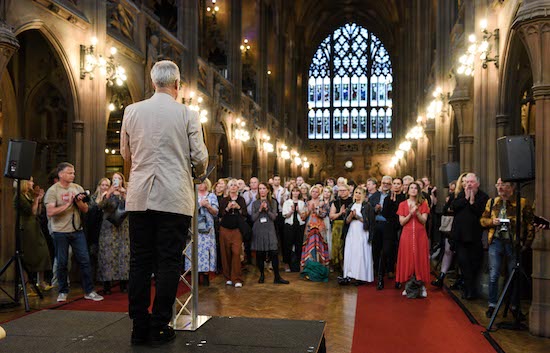
Rob Gretton, the manager of Joy Division while they were becoming New Order, quietly kept a record of Manchester’s evolving pop history. Hannah Barker, John Rylands’ director, said that “He kept everything. The archive is enormous, it took up an entire cellar.” At Manchester’s new British Pop Archive – opening with an exhibition titled Collection (very Factory) – we got a brief look-in to Gretton’s vast trove of the Northern city’s pop culture memorabilia. From Factory, to Granada Television, to The Haçienda, the debut was curated by Jon Savage, Hannah Barker and Mat Bancroft. But this is the first of many pop cultural exhibitions to be held at the British Pop Archive.
After the initial opening reception, I found Maxine Peake and Johnny Marr (who were invited alongside Peter Saville, Colin Newman, Gillian Gilbert and other names) roaming around the exhibition floor. Despite being known as the British Pop Archive, Marr was keen to tell me that Manchester’s history isn’t at all insular: “The North West has got a hell of a lot to archive. It goes back an awfully long way, you can even trace it back to the Industrial Revolution, and immigration, different entertainments that immigrants brought with them … You can’t divorce it from the Jewish community, the Eastern European, the Irish and West Indian communities.”
What you get to currently view at the British Pop Archive, then, feels like it could be just an initial scraping of the surface. It sets its sights on the whole of the UK, seeking to document youth culture, particularly pop culture with a certain seriousness that hasn’t been attempted before. Maxine Peake explains to me that there’s generally less tribalism in Manchester now: “you might have a band from Manchester, but they might have an American member … You have people coming from all over the world…” Quite reassuring, then, for someone who just moved to Manchester about five months ago.
This linking of Manchester’s recent history with its distant past also comes through in Paul Morley’s recent biography of Tony Wilson, From Manchester With Love: The Life and Opinions of Tony Wilson. which provides some context for Wilson’s life in the form of a potted history of Manchester in its introduction. Like the British Pop Archive, Morley’s biography seems to me like one of many grand efforts to tie Manchester and Salford pop cultural history into some elaborate web, as though it’s part of a conspiracy that goes back decades or even centuries. It’s exciting (and undoubtedly romantic) to frame it this way. The graphic style of both Factory and The Haçienda also feel part of the Northern sci-fi lineage that Alex Niven discusses in his Tribune article The Northern Roots of Modernist Sci-Fi, highlighting how Anthony Burgess’ A Clockwork Orange “was also, as well as being embedded in its post-war context, very much influenced by Burgess’s chaotic upbringing in interwar south Manchester.”
British Pop Archive Launch Manchester
At Collection, Manchester’s recent cultural history takes the centre stage. You’ve got press passes, Johnny Marr’s Gretsch, fan letters to The Smiths and Joy Division, Ian Curtis’ handwritten lyrics, Granada TV paraphernalia, posters from The Haçienda next to whole zine collections and a copy of the Situationist magazine the moving times. Much of what is shown here has not been seen by the public in years; it’s thrilling to see these objects regardless of which scene you’re personally invested in. But there’s no clear guidance through a start, middle or ending like in some exhibitions about youth or pop culture. The works are presented together without a strong sense of their time period. There’s just enough explanatory text to roughly guide you through.
This might also be to do with Manchester’s social history as an oral tradition. The more you talk to people about it, the more densely connected it all seems; everyone has a friend-of-a-friend-of-a-friend who is linked to one part of its history or another. You could argue this is more of a small city phenomenon, than a strictly Mancunian one. But the mundane and the glamorous rub shoulders in a way that feels less startling than in London (Grenfell Tower being a ten minute walking distance of Portobello Road Market). In South Manchester, I’ve walked past Broadway – an inconspicuous row of Arts and Crafts houses – where Tony Wilson and his wife lived for years, only being told of its significance more recently.
With Manchester’s past still a strong collective memory, it’s easy to overlook its present if you’re not careful – particularly the present found in “The Other City”, Salford. In the last year, post-pandemic restrictions, Salford’s The White Hotel has blossomed, attracting more punters than ever before, with its new crop of artists like aya, Iceboy Violet and Blackhaine. These White Hotel-associated artists draw attention to their lyrics; lines that are suffocatingly verbose, gothic, hallucinatory, and as compelling as the music itself. The sexual politics of Ludus spool out of this as much as Mark E Smith’s paranoic imagery. And more Smith via grime and dubstep than Curtis, aya’s lyrics contain abstract references to Northern landscapes; blasts of neon through dense clouds. On ‘Emley lights us Moor’ she whispers: “Lost indoor / As she burns out Mancunian Way / She sends west rays / Gamma”. The past is caked into their words like dust; obscuring but also revealing imprints and trails. On the soil of Salford’s warehouse grid, The White Hotel becomes a Situationist collision of unexpected trajectories (Manchester’s nostalgia industry and Manchester’s current radical outlook). Peake, who has DJed at The White Hotel herself, explained that: “[it] reminds [her] very much of back in the day, nights like Club Suicide – Manchester’s always had that. There also used to be The Bunker… There’s a continuity there but it’s very much its own thing.”

Rob Gretton’s acetate of Unknown Pleasures by Joy Division, 1979, Courtesy of The University of Manchester
Ex-Smiths, Electronic and The The guitarist Johnny Marr sees the idea of Manchester revisiting its pop culture heritage at the Archive as not a touristy cash-in, but a means to remind people of creative possibilities: “You’ve got to have some kind of cultural counterbalance to crass commercialism and capitalism,” he tells me in the John Rylands’ already loud and busy Archive, “the more that a city owns that and exhibits that, thank fuck. Because otherwise eventually, all the cities are going to become generic, and forget the amazing cultural stylistic greatness. Glasgow’s got it, Bristol’s got it. It’s human beings that did it, not faceless capitalist structures.”
It’s easy to get jaded about this, after all, the iconography of Manchester’s past celebrity has been a huge selling point to big business, particularly those looking to cash in on its relatively still-low (compared to the South) housing prices. Owen Hatherley (who has frequently written on Manchester and Salford regeneration) describes in The Meteor how: “The centres of Manchester and Salford had, it was clear, been completely reconceptualised as hubs for property development and consumption, with ‘culture’ a distant third.” A regenerated city loses its creativity – and Tony Wilson certainly helped sell Manchester to the rest of the world. But from the fringes, there’s much more recognising and remembrance of Manchester and Salford literary-musical scenes as linked with the city’s radical traditions. Mark Fisher in particular is a recurring name drop in White Hotel or Peste event listings and the manifesto of new south Manchester bookshop Alphaville. A limited example – for many reasons – but an encouraging one nonetheless.
Alongside this, it’s important not to forget that Manchester’s radical past also contains Anthony Burgess, Emily Pankhurst, and of course Chetham’s Library being where Marx and Engels began research for The Communist Manifesto. Having said that, there’s no discussion of Manchester’s post-capitalist future via past pop cultural possibilities at Collection. Showing links between its artistic and radical roots feels important to appreciating where and how this work originated. This was mentioned in brief during some of the British Pop Archive’s opening speeches, but it doesn’t feel central to its current presentation.
There are hints to this sometimes through Collection’s explanatory text, particularly on The Haçienda: “Designed by architect Ben Kelly its industrial aesthetic, open spaces, Situationist references and chevron accents provided the people of Manchester with a mash-up of pop culture interior design clues.” This is no doubt a reference to how The Haçienda was rumoured to have been based around a quote in the Situationist-published, “free play” endorsing text Formulary for a New Urbanism by Ivan Chtcheglov, “the Hacienda must be built”. The extent of the anti-modernist Situationism’s influence on Wilson has been long debated – how deep it goes or how superficial it was. Since it was hinted at in the British Pop Archive, I’d have loved to see The Haçienda’s origins here contextualised a bit more.

‘From Manchester With Love’ poster, designer unknown, 1986, Courtesy of The University of Manchester
A particularly strong point for the British Pop Archive is how it doesn’t just tell the artist’s story, but the fan story as well. As Jon Savage says about this: “It’s very easy to look at artefacts from 400 years ago and say that’s really important. What we are saying is this is important now. Maybe if more people had kept material from Shakespeare’s time it wouldn’t just be Shakespeare that we’re talking about.” This is done via tables filled with badges (of bands not just from the Manchester scene but other UK groups), fan letters presented on a level with Haçienda posters. Fandom and youth culture archiving is part of a new wave of thought in archive and museum culture – that the social history of fandom and fan collecting is just as crucial to understanding the history of pop culture and music scenes as the work of the artists themselves. For instance, The Museum of Youth Culture and Flashback’s collection of oral histories surrounding Blackburn’s raves, which used social media as a means to gain access to new audiences and personal collections. It’s a move away from the idea that everything is just about “the music”, rather than the fans, the fashion, the graphic design. In other words, the visual and social world the music lived in.
The British Pop Archive somewhat sells itself via the idea of placing Ian Curtis’ lyrics alongside Shakespeare and the Gutenberg Bible. But really, they’re just housed in the same building rather than side by side – which I think works. This is possibly a nod to Manchester’s long and serious tradition of autodidacticism. Although this is an interesting idea, the Archive doesn’t provide quite the obsessive depth that the Factory exhibition Use Hearing Protection at the Science and Industry Museum had (yet), with its correspondences between Wilson and the rest of Factory, synth and stage designs all carefully drawn out by hand. But it certainly echoes its approach, and if there are future exhibitions that engage seriously with the context around these bands in this way it’s surely an important debut that fills a void in the current world of museum curation.
I’m sure in the future much of Manchester’s (and of course Salford’s) present via The White Hotel, radical bookshop/bar/cafe Peste and the soon-to-be Alphaville bookshop in Withington – with their emphasis on graphic design and all the ambiguity of old rave flyers – will be documented in some form. There’s probably a modern day equivalent of Rob Gretton, squirrelling away this stuff for future generations. But in the meantime, perhaps it’s better to live through this, collecting memories here and there, rather than sealing it away in a glass cabinet just yet.