

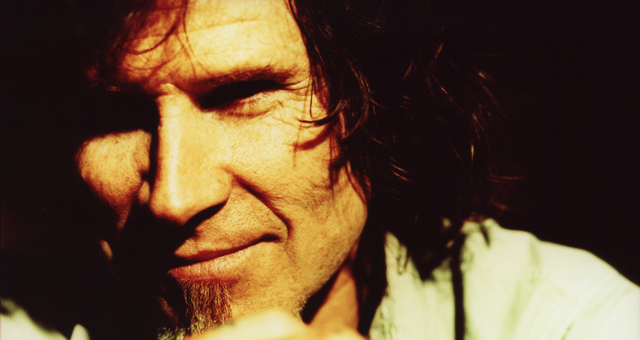
“I’ve done it a lot of different ways,” Mark Lanegan once offered. “I been insane and raised hell every single day for years, or I’ve put myself on a schedule of writing every day and got records written.” He’s certainly a man whose reputation goes before him. Born in a Washington suburb in 1964, jail time and heroin addiction arrived before Lanegan was out of his ‘teens, after which he co-founded the spectacularly dysfunctional Screaming Trees in 1985. Their decade-plus career, with Lanegan as broodily hirsute frontman, was marked by on-stage drunkenness, in-fighting, more drugs and some of the most gloriously dishevelled rock of the grunge era. Yet, unlike his good friend and fellow Seattle dweller Kurt Cobain, the Trees enjoyed neither fame nor fortune.
The confessional folk-blues stylings of Lanegan’s solo work, starting with 1990’s The Winding Sheet, suggested a soul still in varying degrees of torment. While his frequent spells in rehab only served to deepen his public perception as mad, sometimes bad and probably dangerous to know. Notoriously press-shy, Lanegan often came across as a surly bugger, fixing interviewers with a mirthless stare and offering so little by way of conversation that he made Robert Mitchum seem like a blabbermouth. “I’m not a human interest story, man," he once snapped at an inquisitor. "I’m just a musician trying to make some small records and be happy, be peaceful."
But it was clear he held the deep respect of his peers. In 2000 he guested on Rated R, the second LP from his buddy Josh Homme’s band, Queens Of The Stone Age. Lanegan joined the band as full-time member the following year, before hooking up with another close friend, Afghan Whigs’ Greg Dulli, as The Gutter Twins. He’s since collaborated, largely to stirring effect, with a whole raft of talent: The Eagles Of Death Metal, Mike Watt, Soulsavers, The Breeders, UNKLE, My Jerusalem, The Walkabouts and more. Though perhaps his most riveting endeavour of recent years was a three-album spurt with Isobel Campbell, playing fast and louche as latterday Lee Hazlewood to her less fevered Nancy Sinatra.
Lanegan may have cleaned up his lifestyle some time ago, but his solo albums still carry the same narcotic air of wounded defeat. And then of course there’s that distinctive singing voice. An expressive burr so deep, rich and full of portent that it could have been summoned from the pages of the Book of Revelations.
New album Blues Funeral, his first since 2004’s wonderful Bubblegum, is another high watermark and already seems set to take its place among the year-end best-ofs come December. Regular buddies Dulli and Homme make cameo appearances, though it is, for the most part, classic Lanegan.
He may be a reformed man these days, but he’s still someone you approach with more than a little trepidation. Today though he’s in fine form, holding court in a West London hotel, looking relaxed and as heroically dressed-down – baseball cap, lumberjack shirt and scuffed jeans – as any reluctant rock star is entitled to be. Far from coming across as the gnomic old grouch that common wisdom would have you believe, Lanegan’s in chatty mood. And laughing a fair bit too. The signs are good, so I leap in…
It’s been eight years since your last solo album, Bubblegum. Had you been planning Blues Funeral for a while?
Mark Lanegan: Not at all, it’s something I didn’t actually mean to do. I was happy doing my other stuff then I got asked to do a song for the Rage video game. I wasn’t even going to do that either, because I was on tour with Isobel Campbell in the States and told them I just couldn’t do it. Then when I had a few days off I flew into Washington State and went to visit my family. I was in a store with my teenage nephews, who were looking at all the games and going: “Mark, do you play games?” And I said: “No, but somebody just asked me to do a song for some game, though I’m not doing it”. When I told them it was something called Rage, they couldn’t believe it: “You’re kidding! You have to do that”. So that led to me meeting up again with Alain Johannes, who I hadn’t really worked with since Bubblegum. But I realised how much I loved working with him, how easy it was and what a great working relationship we have together. This was about a year-and-a-half ago and I didn’t have anything lined up, apart from a couple of tours. So we decided to make a new record. It was the easiest one I’ve ever made.
Some of the new songs – like ‘Ode To Sad Disco’, with its full-fat dance beat – aren’t exactly what you’d call typical Lanegan fare.
ML: That song actually comes from a trilogy of Danish movies called the Pusher trilogy. The director’s a guy called Nicolas Winding Refn [also responsible for recent Hollywood success Drive, starring Ryan Gosling] and I love those movies. The second one in particular, Pusher II, has got a great soundtrack, all various Danish artists who he’d specifically commissioned to write it. And one of the pieces is called ‘Sad Disco’, which plays over one of the best scenes in the movie. So I lifted it and used it as the basis for ‘Ode To Sad Disco’.
The lyrics of ‘Phantasmagoria Blues’ – “Now if you found a razorblade / And took it to your wrist / Then I’d be here in my electric chair / Because of this” – suggest that the path of true love never runs smooth.
ML: You’re probably right, though it’s difficult for me to talk about songs and what they mean. Usually I’m just doing whatever the music is telling me to do. I’m not questioning it too much outside of whether to rhyme cat with hat or whatever [laughing]. I called it that because around that time I started listening again to Phantasmagoria by The Damned. That’s a favourite record of mine.
The blues seems to have been a guiding force in your music ever since you began. Why does it resonate so deeply with you?
ML: When I was a kid my Dad was a schoolteacher and at some point he was clearing out some old school and found a box of records. There was some Lightnin’ Hopkins and John Lee Hooker in there, so that was my first exposure to the blues. It’s certainly been a huge influence. I love a lot of the blues and the way it makes me feel. The personal nature of it just feels natural to me, so I remember thinking how I’d like to do something like that, but not in a traditional blues setting. I didn’t want to do any of that 12-bar stuff, but I saw that I could use the blues in one way but do something different lyrically.
Considering you have one of the most distinctive voices of the modern era, it’s amazing to think that you never wanted to be a singer. When you began in Screaming Trees you were the drummer. Was that a lack-of-confidence thing?
ML: The truth of the matter is that I was such a bad drummer, I just could not play. The guy that did sing – Mark Pickerel – had a good voice but he also turned out to be a great drummer. So that’s why I ended up being the singer, which didn’t really feel like a natural thing for me. Did it take me a while to adjust to being the singer? Oh, only about 25 years!
1992’s Sweet Oblivion, the band’s sixth album, seemed to mark the point where you were suddenly given a fair degree of creative control over the Screaming Trees’ music.
ML: Yeah. At several different points during the lifetime of that band, leading up to and after that, I really didn’t want to do it anymore. After our first major label record [1991’s Uncle Anesthesia] I was probably at my most disenchanted, which is saying a lot. Sometimes I wasn’t into doing it, for whatever reasons. But the guys had gotten a new drummer and were encouraged by that, and also by the advance they’d gotten for the next record on a major. They asked me to do it and I said: “No, I’m done.” Then they asked me again. By that time I’d made a solo record [1990’s The Winding Sheet] and had written the songs, so I said: “OK I’ll do it, but I have to do it my way. I have to be 100% on all these songs. I don’t mean I have to be the one writing them, but I have to be OK with them all." Because even at that point it’d always been four guys in a democratic situation, but it’d been an uneasy one. The Conner brothers fought all the time and me and Gary Lee, who was the guitar player and the main creative force, had a difficult relationship. It was very unhappy for a long time. Anyhow, after saying I wouldn’t do it, I ended up coming into my own, creatively, with Sweet Oblivion. [Laughing] So I was right!
Were you eyeing up a full-time solo career at that stage?
ML: No, I was thinking about quitting altogether. We’d spent several years of playing for $100 a night or not much money at all, all over the United States, five guys sharing a room in a motel. And it wasn’t easy living like that, especially with the dynamic in that band. It was really dysfunctional and I just knew that I didn’t want to do that anymore.
What was it like being signed to the SST label?
ML: It was such a coup for us, because we loved all the records on that label. It was the most prestigious, hippest underground label in the States. We were all huge Black Flag fans and of course it was owned by Greg Ginn. When he called up I thought he was bullshitting us. It was amazing in that we had free rein to put out as many records as we wanted as long as they didn’t cost more than $800! That meant we could make a lot of crappy records with ridiculous covers, handling everything ourselves. Then towards the end the label started to have problems. I don’t want to disparage those people but we haven’t been paid for years and years. Nor are those records in print. Not that I’m really interested in whether they are or not, but the label itself became a very paranoid place and eventually shut down. But signing on SST was probably the most excited the Trees ever were, collectively. Just before that we were very close to signing to an offshoot of Enigma Records – a label called Pink Dust. But their slant was that we were psychedelic, which grated on me because I was never into psychedelia. That was also some of the cause of the creative struggle between me and Gary Lee Connor, because he was really into all that. So when we heard that SST were interested in us it was like being saved by the coolest guys in town.
When it comes to your solo career, 1998’s Scraps At Midnight seemed to be an important album for you. Did it arrive at a critical time in your life and career?
ML: Well, it was the first one I’d done clean. And it was also an exercise in letting go, y’know what I mean? It was the same kind of feeling I had with this new record, but the difference is that Scraps At Midnight is not a good record! [much laughter] For years I’d say it was one of the most positive experiences I’d ever had, but that and the first one [1990’s The Winding Sheet] are the two records I like the least. If I heard it today I’d totally cringe, though there are a couple of songs on there, one of which I still play acoustically – ‘Because Of This’ – that I think are really good. There’s a guy in the States right now who’s doing an anthology of mine and I told him: “OK, I’ll go along with it, as long as there’s nothing on there from The Winding Sheet or Scraps Of Midnight! The rest of it’s all OK.” But in the end I relented so there’s a couple of songs on there from those records. It’s not like the anthology is a really creative thing that I’m heavily invested in, but I get to have the final say.
You co-wrote ‘Kimiko’s Dream House’, from 2001’s Field Songs, with your great friend Jeffrey Lee Pierce. What he was like to be around?
ML: He was really personable, not like the usual perception of him at all. Before I met him I remember hearing about what a nightmare he’d been in the early days and later he actually showed me some video tapes of him on stage that were less than flattering. He’d be breaking a bottle over somebody’s head from about one foot away, watching this and going: “Aw, I can’t believe I did that!” I first met him at a fIREHOSE show at the Whiskey in LA, when he was staying at his mom’s down the street. Halfway through the show Steve, fIREHOSE’s sound man, noticed that he’d turned up so I went over and introduced myself. I did that whole thing: “It embarrasses me to say this, but I hope I’m not bothering you. Your music’s everything to me." He said: “Are you ever in London? Here’s my phone number, man. Let’s meet up and go get something to eat." So I came over a month later and was staying in Shepherd’s Bush, literally five minutes from his house. I called him and he said: “Hey man, how are you? Look, I’m going out for a run, but when I’m done I’ll drop by." And sure enough, there he was in his sweats, which isn’t an image people usually associate with him. I got to know him for several years after that, and saw him go through hard times, but he was one of the all-time greats in my opinion. He’s one of those songwriters and singers that everybody [should] know about. His music probably touched me more deeply than anything I’ve ever listened to.
He’s one of many close music industry friendships you’ve made over the years, alongside Greg Dulli and Josh Homme. Josh once said that he thinks you’re “an outsider on purpose” and “the meanest nice guy” he’s ever known. Do you understand what he means?
ML: [Grinning softly] I do, yeah. I do.
And of course Josh played guitar in Screaming Trees for a while…
ML: He made it tolerable for me, for four years or however long he played with the Trees. I always knew he was being highly under-utilised, which of course he knew also. But I just wanted him around me because I just totally loved being around him. And I still do.
Any plans to make another Gutter Twins album with Greg?
ML: At some point, yeah. Right now we’re both wrapped up in other stuff. But hopefully it’ll happen again before we’re 60!
You’re often portrayed as a lone wolf, but your recorded work suggests the opposite. You’re actually a serial collaborator. Are you always inundated with offers?
ML: No, there’ll be periods of time when I’m asked to do things a lot and periods when I’m not asked to do anything. It’s funny, because I recently said: “Y’know, I’m done doing stuff with other people." I think it’s because somebody had asked me to do something, then come back and asked me to do something extra on top of it. So I said that’s it. I was working in Josh’s studio with a songwriter called Duke Garwood. I was totally psyched about the record we were making together, so it wasn’t in regards to that that I said it. But it was while we were doing that I stopped and did a couple of things for other people, so I told the studio guy I wasn’t going to do anything else. Then two days later Josh phones up – “Hey man, I’ve got this thing…” – and I ended up working with him again. The trouble is I can’t really say no to people!
So what do you look for in a collaborator?
ML: The thing I always look for is: is it something I can do? Is it so far out the box that it’s ridiculous or do I just like it? Usually the criteria is: am I going to enjoy this? Do I like what they’re doing? Do they want me to be involved? And almost always it’s, “Yeah, I can do that”. There are times when I logistically can’t do stuff because maybe I’m on the road or doing something else, but almost always I say yes. I really don’t like turning people down!
Will there be another record with Isobel Campbell?
ML: I don’t think so. You’ll have to ask her, but I think we’re done. We’ve done so many in such a short period of time, which was way more fruitful than I ever thought.
And you got better with each album…
ML: I agree. I mean, I really love the first and second ones, but when I first heard the songs for Hawk [2010] I thought, ‘These are really good.’ And that’s a testament to her talent and songwriting ability. She really knows what she wants. I loved the experience of playing with Isobel and I love her to death, but I can’t really envision us making another record together.
How do you go about inhabiting someone else’s songs?
ML: Well, that’s my goal really – how to turn something you see on paper into something real. There was this Tim Buckley tribute record several years ago and I was hell bent on doing ‘Moulin Rouge’. You know that song? [Laughter] It’s one of the most out-there songs ever. But of course I couldn’t do it because I was out of town, but that’s the kind of thing I look for.
What records would you save from a burning house?
ML: Son House’s records are important. He’s still the best singer I’ve ever seen. I have a video tape of him sitting on a chair and singing, from some TV show, which is incredible in its power. And I’d save all of my Gun Club records and definitely my John Cale collection. He’s probably my favourite singer. I just love the way his voice sounds, it’s so expressive and full of melancholy. He does an amazing version of Nico’s ‘Frozen Warnings’ that’ll give you the chills. And of course his own solo stuff is all the shit. I actually attempted to get John Cale to produce Bubblegum, but it didn’t work out. Now there’s another collaboration I’d still like to happen.
Blues Funeral is out now on 4AD