

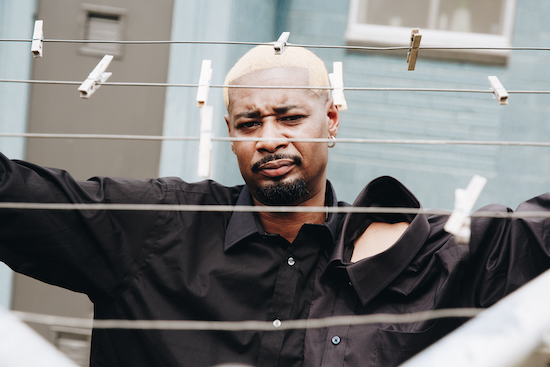
That chasm of time an artist finds themselves in after soundcheck and before show is what many consider to be their only real free moment during a tour. Time to grab a bite, settle their nerves, check out a few local spots or smoke a few blunts before the circus tent opens. On this particular wet and windy night in Shoreditch, fans have already started queuing up to see their favourite rapper from Detroit hours before the show begins at Village Underground.
In the green room, Danny Brown and his DJ, Skywlkr, are sat down. As far as green rooms go, Village Underground’s is arguably one of the most welcoming that doesn’t feel like you’re stepping into the abyss or the kind of atmosphere Mike Skinner illuminates on ‘Blinded By The Lights’. Brown cites A Grand Don’t Come For Free, The Streets second album, as one of his favourite British albums of that time and one he was able to get his hands on at Tower Records during his visits to New York City.
Perhaps one of the more striking and illuminating facts about the Detroit rapper is that grime isn’t something he got into in the past decade but a scene he’s witnessed grow from afar since its beginning. “They had a UK section there and I’d catch a bus to the city, that’s how I got The Streets, Kano and Dizzee. I couldn’t find any of that in Detroit,” Brown explains. He’s also lived the lonely, off-your-face moment Skinner raps about on the album’s fourth track. Maybe just one too many.
On this occasion, he’s not very talkative, he’s sat at the round table in the green room with a bottle of water. There was a feeling that a couple of hours before the show, Brown wasn’t all that keen on a writer asking him a bunch of questions about his life, particularly one that’s undergone so much upheaval and reckoning post-pandemic. Another conversation was scheduled for a time when he’d likely be a bit more loquacious. The next time would be a phone call while he was at home in Austin, Texas.
That Monday night in December wasn’t the first night I’d crossed paths with Danny Brown. A few days earlier on a Saturday afternoon in N5, the rapper was invited onto Arsenal’s Breakdown talk show, a livestream featuring fans such as myself giving our thoughts on the game in which Arsenal went onto win 2-1 against Wolverhampton Wanderers. When the presenters announced that a special guest rapper was appearing, it was assumed it would be 21 Savage as he was at the stadium earlier in that week for a Champions League game. Instead, it was Brown. His love for the Gunners cemented after the club became his team of choice on Fifa games; plus Thierry Henry. It would become apparent a few days later that Brown’s London connection runs deep and it’s only an ocean, and some thousands of miles of land on the other side, that separates him from the capital’s cultural fabric. That game wasn’t a cold, windy Monday night in Stoke but looking across several seats in the Clock End’s box seats, his first taste of a Premier League game did everything but disappoint. Unlike that post-Wenger, pre-Arteta neverland.
D Double E even passed through, and Danny Brown met another emcee he’s been a fan of years. So for them to cross paths was a measure of mutual respect and admiration. It also shows that the two artists’ tastes are more expansive than the music they both respectively make. Perhaps, more surreptitiously, it highlights an often unheralded and undersung relationship that London and Detroit shares. Grime is something that he’s always experimented with but he admits that not being from London meant there was some distance in being intimate with the cultural aspects of the scene. “Even though I worked with Paul White grime is definitely something I always wanted to do. I still do,” he says. Maybe in another life.
Let’s take it back to the beginning though, to the early moments that led to where he is now. Like most young people of a certain age, rap was just a casual sport and pastime among friends. Being from Detroit, one might assume that a young Danny Brown was rapping over Dilla beats attempting to mimic Slum Village, Royce da 5 ‘9” but that wasn’t quite the case. "I didn’t even know Dilla was from Detroit but he was talking that language”, Brown says, “I remember hearing Slum [Village] for the first time, I didn’t really grasp that, my ears wasn’t really mature enough, I had to get older to appreciate Dilla.”
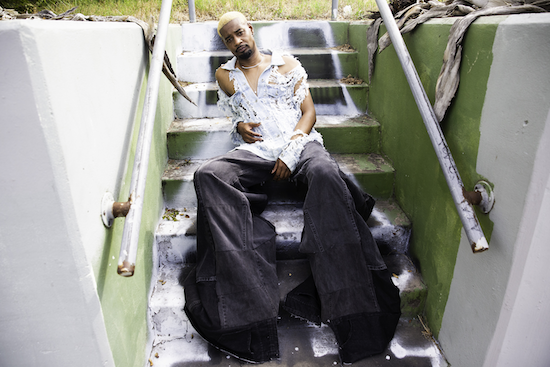
Brown doesn’t place too much emphasis on his dad’s career as a house DJ having a heavy influence on his own life in music. To him, being around electronic, industrial music was as normal as breathing oxygen, especially being from a city like Detroit. Brown, whose birth name is Danny Sewell, says that DJing was something that his dad did in his spare time due to having a lot of children so it meant that it wasn’t a vocation that overcame his life. Brown didn’t spend his childhood on the road with his dad touring but he did a lot to introduce his son to east coast sounds as he was heavily into west coast rap that was having an influence that he wasn’t too keen on. Even Brown admits that what east coast rappers were saying wasn’t entirely different but it’s the way they were saying that was perhaps more palatable. “I started to realise that all of the rappers and music I was into wasn’t on radio, I started to get more influence from that. Whether it was a Dizzee or Bigg Jus,” Brown says, “Of course everyone knew Company Flow and El-P, Aesop Rock, Cannibal Ox and all that shit but you just start copying and taking the best parts of everyone you’re listening to.”
When the sounds of a city leak from the cracks in the pavement and road into the atmosphere, fill the air like clouds and affect the climate in the way that Detroit’s vivid musical history has, it becomes normal. You don’t think twice, you just live it. It’s what you know and eventually, it’ll catch up to you, even if you try to avoid it. Brown may live in Austin now, in a suburban neighbourhood that resembles Woodcrest, the DNA of Detroit is deep within the pores of his skin.
Not just Detroit though, London too. Time has been warped and to many, ten years ago still feels like 2011 when Brown dropped his first mixtape XXX. As someone who grew up on grime, I’ll always find a way to hear in music that isn’t necessarily labelled as that. But on that first tape by Brown, you can hear those grime leanings in his cadence, flow and steez. He may say he always wanted to work in grime as if it were a whim but in reality, ten years ago was 2014 and his appearance on Charlie Sloth’s Fire In The Booth confirmed what I had believed; Danny Brown could’ve been a grime emcee in another life. “I always just thought it was Eskibeat because that’s what Wiley was calling it,” Danny says.
He warmed up by rapping over Earl Sweatshirt’s ‘Chum’ produced by randomblackdude but Brown really found his pocket when he landed on Wiley and DJ Furious’ ‘Morgue’. For most American rappers, it would be a struggle to nail that landing on ‘Morgue’, which is fairly slow tempoed as far as grime goes but Danny Brown is no stranger to the sound. He grew up on it as much as many of us did. “When we went to parties in Detroit, we weren’t really listening to top 40 shit, just DJ Assault, Under Resistance and Ghettotech so when Dizzee was telling me he used to listen to him we really connected on that,” Danny Brown says over the phone recently.
It’s a wonder that in all these years as a performer, Danny Brown has not yet landed a voice acting role for a kid’s cartoon or an animated comedy show on Adult Swim. His laugh is made for children and adults to be entertained by, but now that the party is over, somewhat, there’s a feeling that he doesn’t want to be the centre of attention any longer. Brown’s central incisor tooth has been replaced, his hair cut down to a no.1, a stillness in his voice and eyes graced by the wisdom of age.
He’s living a second life now, one full of clarity, introspection and renewal, in Austin, Texas away from his stomping ground of Detroit, away from the hedonism of rap and the endless party that often comes with living that lifestyle. He just grew tired of it all. Tired of waking up with week-long hangovers, being late to appointments and shows, tired of letting friends and family down. But probably more importantly, falling short of expectations he had of himself as a man approaching 40. It appears that the party that has engulfed much of his life is finally over.
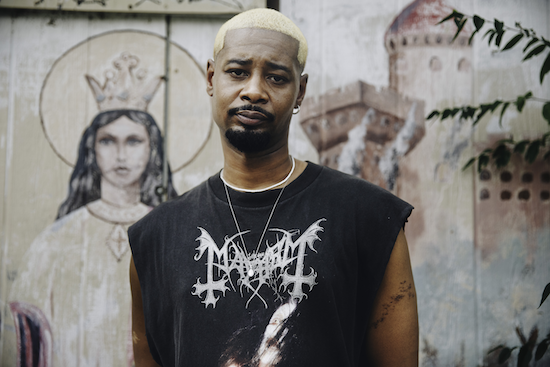
Quaranta, Brown’s sixth album, offered deep insight into where he’s currently at mentally, spiritually and emotionally. His demeanour on the record is far more stoic and reserved than on his XXX, almost as though Quaranta were the conclusion to a decade-long series about his life. “Music can definitely be influential, ‘Blinded By The Lights’ made me experiment with pills a little bit. I heard it then I lived it,” he says, with a wry laugh.
Quaranta, however, wasn’t this watershed moment where everything suddenly changed for Brown. It came in stages. First the isolation due to the pandemic, the loneliness that came with it and then the self reflection. But as widely documented recently, it wasn’t until the beginning of 2023 where he made that decision to go clean. “I think the alcohol got really bad, I would just get angry, mad and it wasn’t a good representation of who I am. I really feel bad about all that shit during that phase,” he says.
During the process of making the album, he wasn’t listening to any music and openly admits that he was a shell of himself, getting into self-induced states that weren’t healthy for him. The depression really hit him but that love for music, rap in particular, really came back for him when he was in rehab. “It was a learning experience, I can’t say I was going to meetings and shit. Some days are harder than others, I couldn’t sleep last night,” he tells me. Despite that, he sounds positive and upbeat about everything.
Nowadays he has a fresh perspective on rap overall. He’s grown accustomed to being a veteran, elder statesman. Sometimes you can’t take advice from people that haven’t been through it to emerge on the other side; Danny Brown wants to be more influential in other people’s lives, those of rappers especially.
Even weed became something he quit just. Not that it was necessarily a gateway to other, worse things, but for intrinsic reasons. He knows himself well enough and that high you get from smoking weed isn’t something he wants to feel. Times have changed. “This weed is different from the stuff I grew up with. It used to be you just smoked weed with your friends and got the munchies but now, you might as well just take some heroin.”
Hearing Danny Brown speak on two separate occasions offered some clear insights about the daily battles he has to deal with. On some days, like the one where we spoke on the phone, he’s up. Then there are others, such as his show at Village Underground, where there was a sense that he was still getting accustomed to being in recovery and performing. He’s had to change his relationship with so many things but perhaps the most challenging battle has been the one he’s had to amend with himself. A lot of that starts with how you think and feel about yourself and there’s no doubt that he’s in a very good place in that regard.
He reveals so much of himself on this most recent album that you leave with more questions than answers. This time, however, a few that ruminate and swirl around the mind like an aged wine are these; what if Danny Brown were a Londoner? How would he sound? Where would his place be in the city’s most mesmerising and important cultural export, grime?