

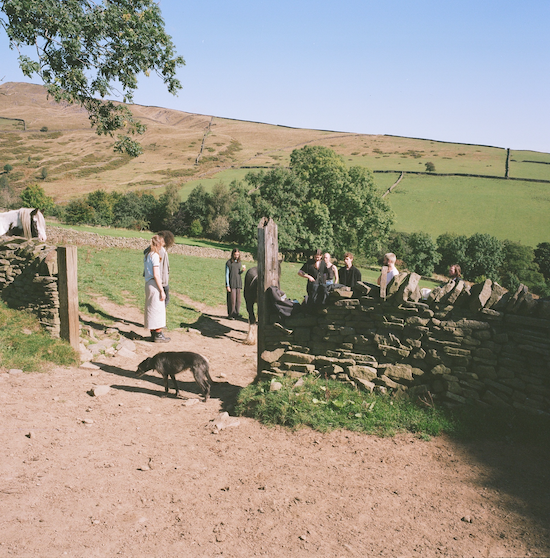
Photo by Kathryn Wood
Discourse around ‘experimental’ music can often seem cold or remote when it comes to its relationship with ‘traditional’ musical forms, framing them as archaisms to be ‘disassembled’ or ‘reinvented’, rather than seriously emotionally engaged with. We might consider how doing the latter instead, embracing the rich ideas behind them, might lead to work of tremendous vitality.
This is demonstrated by Shovel Dance Collective: a nine-piece contemporary folk ensemble who imbue traditional folksong with elements of drone, metal, and free improvisation. Though bracingly original, their music reflects a desire to stay true to folksong’s original ethos as a space for community and earnest emotion. As vocalist and guitarist Mataio Austin Dean tells me, “I think this idea that you have to see the progressive and traditional as opposites is wrong.”
Their new album The Water Is The Shovel Of The Shore, paired with a collectively penned essay under the same title, explores the roles of water in folksong. Its four long medleys collage traditional songs of work, love and death on the water, bound by stirring instrumentals and field recordings. Comprising songs of English, Irish, Scottish, and Guyanese origin, this bricolage approach yields fascinating insights into water’s bearing on our cultural and political life.
“When they talk about folk music, lots of people want to ‘change’, ‘reinvent’ or get really freaky with it. I actually think the weirdest stuff is the most ‘trad’ stuff,’” Dean suggests. “In staying true to its origins, as the music of ordinary working class people through history, that’s where the interesting experimentation happens – because that’s where it intersects with human experience. Looking at pre-capitalist histories, there’s all sorts of forms of liberation you can look for within that.”
Jacken Elswyth, who plays banjo and shruti box, relates this to the link drawn by free jazz between freedom and musical experimentation. “Maybe there’s something similar you can do with folk music – treating the source material in a way that gestures towards liberation.”
The colloquial meaning of ‘traditional’ (‘the same as it’s always been’) is often misleadingly mapped onto ‘traditional music’. The band suggest the latter is better defined by the music’s loss of fixed authorship to history, essentially making it public property which is covered, rearranged and redistributed through the generations. “Experimentation is a huge part of things in traditional music” as a result, claims harpist and whistler Fidelma Hanrahan. “It’s not frozen in time – it’s constantly changing.”
Another key idea articulated by The Water Is The Shovel Of The Shore is the duality of work and celebration in traditional folksong. This is indicated by the group’s name, with Austin Dean explaining that “labour is the ‘shovel’, and ‘dance’ is the forms of cultural life.” Songs such as ‘The Weary Whaling Ground’ (heard in the first medley) would have been developed by workers engaged in the hard, desolate and dangerous work they sing of. “Shanties made the work more bearable for you to do,’” Dean explains, but by the same token “helped the ruling class extract more surplus value from you.”
Different forms of labour have yielded different folksong traditions, with seafaring work possessing its own nuances. Elswyth explains how ‘The Wild Goose Shanty’ (featured in medley ‘III’) is a ‘foxhole shanty’ that would have been sung by workers in their breaks, rather than while engaged in pulling ropes or other repetitive labour, so is rhythmically looser than other shanties heard in the album.
By collaging songs about different forms of work (whaling, naval expeditions etc.), the album establishes a continuity that highlights the interrelation of work of leisure, inviting reflection on how this relates to contemporary working life. “Time that’s recreation is still work,” Dean suggests. “It’s still part of reproducing labour, because in that time you’re getting the relief that enables you to go back to work.”
“There’s a tendency in folk music to focus on rural, pastoral ideals” claims Daniel S. Evans, who plays guitar, cittern, and cello. “I think it’s important to bring back this idea of urban, industrial work – and the fact that work is awful sometimes.” Evans links this to the album’s treatment of the river. “It’s easy to go ‘Ah! The beautiful river!’ but actually the Thames is this murky, horrible, rat-piss infested thing. We still love it, because it’s imbued with history; in a way moreso than an idyllic rural river could ever be, because it’s got people in it.”
Beyond the world of work, The Water Is The Shovel Of The Shore also explores the presence of water in love songs. Medley ‘II’ features the songs ‘In Charlestown There Dwelled A Lass’ which laments a lover drowning, as well as ‘Lovely On The Water’ about a sailor leaving his lover to join the navy. “It’s funny, because almost all songs regarding love and water involve death,” says Evans, who was also chiefly responsible for structuring the album. While he debunks my suggestion of a deliberate thematic shift from ‘work’ to ‘love’ in the first two medleys, he seems pleased to hear this interpretation. The opacity of his bricolage technique was, in part, intended to invite different readings of the album. “There’s a demandingness to it, but something we hope is that there’s a relatability or beauty you imprint on it.”
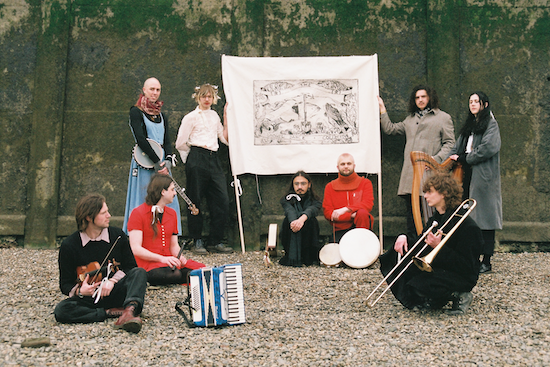
Photo by Tugce Ozbicer
One of the album’s most interesting structural decisions is the repetition of piece ‘The Bold Fisherman’ in medleys ‘I’ and ‘III’: it is heard arranged for strings, then organ. “By virtue of folk music being transferrable and ubiquitous, it allows you this playful ability to repeat versions infinitely” Evans says, noting how Shirley Collins recorded several versions of folksong ‘The Blacksmith’. “Just because the notes are the same, does that fundamentally give it the same character? I’d love to take it further, like have a whole record of only one song.”
Later in medley ‘III’, the vocals for ‘The Wild Goose Shanty’ disappear beneath a recording of water slapping under a bridge. From here, the water of this album principally becomes a grave. ‘The Drowned Sailor’ and ‘The Cruel Grave’ are heard in the later medleys, along with the dead sailor’s lament ‘Lowlands’ and ghost story ‘The Grey Crock’. “The water is this mysterious, ‘othered’ thing to place mourning upon” Evans suggests. “All over the world anonymity is perhaps the most feared way to die – so the way people deal with anonymous death at sea is massive.”
“As someone who is descended from people who crossed the Atlantic from Africa to the Caribbean, the sea is also a site of mass Black death,” says Dean, referring to his Guyanese heritage. “Millions of people have their watery grave in the Atlantic, and now we’re leaving people to die in the channel. So many people die in a racialised fashion in the sea, and have done for hundreds of years.” Race, however, is also suggested by the group to take on a more elusive, complex nature at sea. “It’s less about fixity or nationhood, and more about liminality and exchange’” Dean claims, as expressed in the album’s collaging of songs from different cultural and geographic origins. “Water facilitates this ‘brownness’ – an intermingling of whiteness and blackness.”
This highlights the open water’s scope to unsettle rigid social conventions experienced on dry land, expressed via the album’s musical experimentation. The history of seafaring is also a history of workers’ mutinies, slave uprisings and queer narratives: the album’s essay references traditional song ‘The Handsome Cabin Boy’, which describes affection for a “cabin boy who is neither man nor maid.” “As this anonymous and wild place, the sea’s also a place of emancipation.” Evans suggests. “Things are more in flux on the water, so it becomes a barrier whereby – if you cross it – things can emerge socially that wouldn’t otherwise.”
The Water Is The Shovel Of The Shore’s final note is duly one of liberation, with the medley ‘IV’ closing on the piece ‘Ova Canje Water’. A Guyanese song, recovered by folklorist Wordsworth McAndrew, it presents an enslaved person who has escaped his plantation by crossing the dangerous Canje River. “He’s over on the other side, looking at his slave comrades, and saying ‘I’m over here! I see you!’” Dean explains. “It’s amazing that exists – that there’s a song of freedom from an enslaved person”. While so much popular art deals with oppression and exploitation, “actual stories of people liberating themselves from that are quite rare – and you need to cling onto those” he suggests. “They should be a part of our history that we talk about and understand, because that is how we learn to liberate ourselves.”

For all its historical considerations, the album is crucially concerned with the present too. Traditional folksong, on account of its ubiquity through generations, might be seen to ‘flatten’ time. Shovel Dance Collective play upon this in the medleys, by interspersing the traditional songs with field recordings taken around bodies of water. In recordings of ferries, Creekside junkyards and tourists feeding gulls, the ancient water of these songs is brought into the present.
One of the most striking of these is a recording of a sermon. The ‘Blessing Of The Thames’ ceremony is held annually by Southwark Cathedral and St. Magnus The Martyr, conducted by clergy from both in the middle of the bridge between them. A clip of the sermon is heard on ‘III’, delivered through a megaphone amidst the drone of London traffic. While this introduces its own form of temporal flattening, Elswyth also notes how religion presents “another way of relating to and understanding the water.”
This invites reflection on the coming Christmas season, in which folksong enjoys enduring prominence. As they prepare for their third annual Christmas show, the band have also notably contributed music to BBC Radio 4’s With Great Pleasure At Christmas. “Folk festival is significant, and Christmas is one of those festivals that has survived the most,” Elswyth explains. “It absorbs a lot of energy that would have previously been distributed throughout the year.” At the Royal Oak pub in Borough, where the band initially suggested we conduct this interview, there is a special pre-Christmas tradition of singing folk carols.
Dean accredits folksong’s relevance at this time of year to our desire to find “solidarity with people in this thing we all share, which is the seasons.” In a world lived increasingly online, marking this time of year by sharing live music becomes “a way to bring people together around something that feels real.”
It is this deep passion for traditional folksong, and what it has to offer us, that underpins the experiments of The Water Is The Shovel Of The Shore. “Some friends I’ve sent it to have said it’s offered them ‘a way in’ to understanding why we love this material so deeply, and why it’s important beyond just sounding nice” Evans claims. “People singing together – nobody’s ever beaten it!”
The Water Is The Shovel Of The Shore is released on 1 December via Memorials Of Distinction