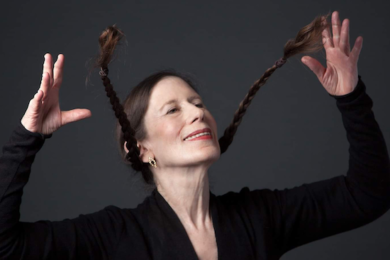
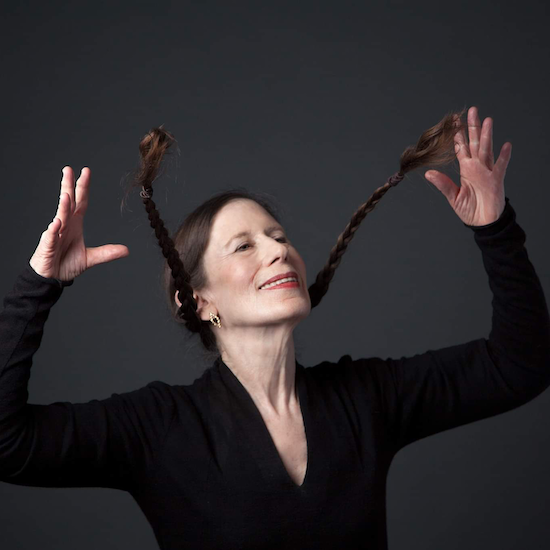
Meredith Monk by Christine Alicino
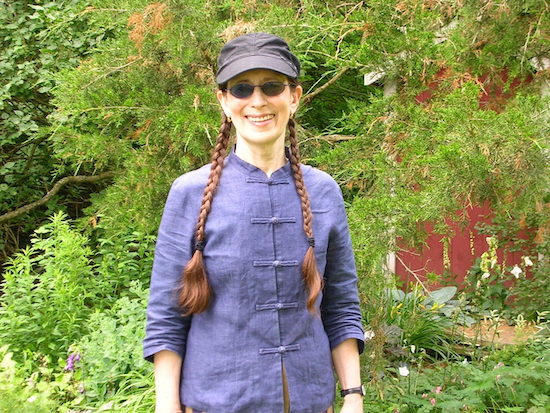
Meredith Monk greets me warmly from her apartment in New York Tribeca’s district – the same apartment she’s lived in since 1972, along with her beloved tortoise, Neutron. The artist, whose practice spans extended vocal technique, composition, piano, art, dance, film and drama, is in a reflective mood.
Monk turns 80 this year and the occasion has afforded the prolific performer time to look back – but it’s not something she likes to do too often or for too long, she quickly points out, tugging on her signature pigtail plaits. “I’m still more interested in what I’m working on now,” she laughs, explaining she’s currently busy in rehearsals for her upcoming appearance at Rewire. “The thing that’s interesting to me is that the ideas are still coming, which is all I ever wanted. I wanted to keep on working until I leave this planet and I feel very lucky that I’m still doing that. My mind is still very fertile.”
Since 1964, Monk has been tirelessly creating and evolving her art. She was a pioneer of what is now called “extended voice technique”, but when Monk first began experimenting with her voice in the sixties, the practice didn’t yet have a name. It involves the use of her voice as a singular instrument for communication, making music that sounds as primordial as it does futuristic. She conveys feelings with phonetic devices like howls, gasps, clicks, trills, whispers and yodels to create emotive sonic soundscapes that tell stories without the need for words.
While her work has influenced everyone from David Byrne to Brian Eno and Björk, earned her a Grammy nomination and a Medal of Arts from former US President Barack Obama, she says starting out with this technique in the sixties wasn’t easy and required a lot of nerve: she spent a decade largely in isolation, honing her craft. “My experience at that time was pretty alone,” Monk explains. “But maybe lonely in a good sense of the word because looking back on it, I’m happy that I did have loneliness because I was able to explore what my own voice could do and what it had to say. Up until that point, I’d been doing complex pieces that included other forms like gesture and image and I was still looking for that emotional centre to my work.”
It was a challenging time, Monk recalls, saying there were long periods of silences while ideas slowly formed. “We’re all frightened of space, aren’t we?” she says. “But these periods of what I call the desert, I realised eventually they needed to be nurtured. I had a period in the late 90s where I thought I’d never have a new idea again. I was quite depressed.”
Monk says she discovered a book by New York socialite Mabel Dodge Luhan, Winter In Taos, that helped. Dodge Luhan was living in New Mexico when she met her Native American husband, who came from the Taos Pueblo. She noticed how quiet the community there became in the winter. “Asking her husband why that was, he said: ‘Mother nature needs to rest in order to come forth’ and that helped me so much to not be fighting those times where it seemed like ideas weren’t happening. It’s a nurturing period to let those ideas come forth when they’re ready to come forth. You have to respect those periods. Inspiration comes when it comes.”
When inspiration did arrive, “it was an incredible moment”, Monk recalls, when she discovered the power of the voice, something she calls “the first instrument”. “It became the centre of my work and then everything kind of bloomed from that. I’d always made interdisciplinary works, but it took a number of years to find the core amid the mosaic, the ideas.”
Meredith Monk by Bonnie Marranca
Monk was from a musical family – her mother and grandfather were singers – and part of her time in isolation was also about figuring out where she stood artistically within that heritage too. “Music was and is like a river in my life, the music is the driving force,” Monk begins. “Coming from a singer’s family, it was such an incredible feeling on one hand coming back to my bloodline and on another hand knowing that I’d found my place in my own way. To find your place in a family like that is not always easy.”
Monk eventually combined her vocal expressions with movement and image, something she also charts back to her family. As a youngster, Monk suffered from a visual impairment called strabismus, a condition that led to issues with physical coordination. Her family sent her to classes in ‘Dalcroze Eurhythmics’, a method developed to help children learn music through their bodies. Monk thinks this is why she always saw music “so visually” and why she ultimately built performances that added in more visual elements. “I love films. Films get me from one day to the next and if I’m inspired by anything, its films. I’m a real movie buff,” she smiles.
It’s perhaps no surprise that filmmakers love Monk’s work too, connecting with the combined visual and sonic elements in her work. Filmmakers as varied as Terrence Malick, Jean-Luc Godard and the Coen brothers have all used her music in their films. She laughs recalling the Coen brothers using her track ‘Walking Song’ in The Big Lebowski to soundtrack a naked Maud Lebowski (played by Julianne Moore), swinging over The Dude (Jeff Bridges) to throw paint at a canvas. “I thought it was just terrific”, Monk laughs. “Another person that used my music who I love was Terrence Malick. I feel like he uses music in such a beautiful way. I think his way is more of a collage,” she says, relating it to her own style of creating art out of disparate elements.
Film is also important to Monk for keeping visual reminders of her work for when she comes back to revisit performances: keeping a score of her vocal sounds is a complicated affair and not something she’s often keen to do. Many of her transcriptions resemble seismic voice graphs used by phoneticians to help identify voice patterns. “I am leery about the scoring process,” she smiles, half-grimacing. “I still have a very hard time with scores. I just feel that my music exists between the bar lines or just underneath the bar-lines. With my singers, we work viscerally and sometimes we do use scores as mnemonic devices, but I basically try to get away from the papers as quickly as I can because I do think it’s an extra step where you’re memorising it visually rather than kinetically. I think of [what I do existing] more in the oral tradition.”
That oral tradition may come from Monk’s early exposure to Dalcroze, or from the folk music she gravitated to during her time at Sarah Lawrence College. Moving back to New York in 1964 (she was born there in 1942) she encountered a grittier and more experimental mood, which bled into her work. “It was a wonderful time to move to New York,” Monk says, recalling her time in “a teeny, little attic apartment” in the West Village and later Great Jones Street, which was “pretty rough in those days”, she recalls. “I loved the loft there, but it was like La Bohème with six flights of rickety stairs. One spark and that entire place would have gone.” She was burgled multiple times. “I’d come home, and my vacuum cleaner would be gone one day, something else the next!” After growing tired of carrying her electric organ and amplifier up six flights of stairs daily – and being robbed – she moved to her current apartment: she says the area was very different to the cosmopolitan centre it is now.
“This neighbourhood back then was so obscure that nobody even knew where it was, but the city had an edgy quality to it and I think you can hear that on my first album, KEY. It reflected life in New York at that time. Edwin Denby [dance critic and poet who worked with Orson Welles] heard it and said this is like Manhattan folk music."

Meredith Monk in 1998, by Jesse Frohman
Monk says New York at that time helped her to be bolder in a multi-disciplinary sense too. “The Downtown world was more experimental with artists there exploring different mediums. The poets were making music, the artists were exploring movement, and everyone was just going across the board of various art forms. I think at a certain point, people went back to their original art forms but with the added knowledge of what they had found elsewhere. It was a huge time of expansiveness. I was very supported by the generation ahead of me, the Fluxus group, people who were older than me like Dick Higgins and Jackson Mac Low. Even though they saw my artform was going to be very different, they saw a kindred spirit, really trying to weave together everything. They were fearless and that was inspiring.”
Some of Monk’s early work from that time touched on the political, like much of the folk scene were also doing, but it became much more apparent in later works like science-fiction opera The Games and her meditation on fascism, Quarry. She says looking back at her old work recently, she was struck by how many of the messages still resonate, especially in light of Russia’s recent invasion of Ukraine.
“It was very interesting to go back to some of this material, but I don’t think I would’ve done it if it didn’t feel so relevant. I think The Games was very prescient, especially during the Trump period but one could say this period as well. I think it is very prescient of the dark forces that are changing our world right now and I think these things are spirallic. From the late seventies until the early eighties, I was very concerned with reflecting the society that I was living in, art as a kind of reflection and then at that point, after The Games, I realised maybe that’s not that useful.”
Monk’s later compositions took an about turn, offering opportunities for audiences to re-imagine the world in which we live to see “the possibility of transformation” as she terms it, in order to create a better world. “I’d rather work on art as a healing force rather than a mirroring force because I think that there’s a lot of people now that are doing very overtly political work,” she explains. “I always wanted to do poetic work because I’m not analytical like say Brecht was. I feel like I can do more by continuing to offer experiences for people where they remember their basic goodness.”
In her recent trilogy of works, Oh Behalf Of Nature, Cellular Songs and Indra’s Net, Monk offers a mediation on our relationship with the natural world that encourages listeners to visualise a more connected world: one where people are kinder to one another and to the planet. They manage to be subversively political while also poetic, seemingly marrying Monk’s earlier and later artistic selves.
The works are also preoccupied with death too, the voice as the last instrument now. Monk says the death of her partner caused her to reflect on the cyclic nature of the voice. “When my partner was dying, I would be at the hospital, every day, singing for hours. I’d be singing everything I could think of, everything I ever wrote, every folk song I knew. She was in a coma, and I felt like my voice was a beacon where you know no matter where her consciousness was, she would hear that. The voice cuts through everything and it’s so fundamental to us, it’s so deeply connected to the human heart.”

Meredith Monk in 1970, photo by Gary Weis
Monk says the fragility of life felt more apparent to her in the last few years, the combined effect of losing her partner, the pandemic and her own increasing age. She’s having lots of thoughts right now of how to “pass on” her difficult-to-pin-down catalogue of vocal sounds, how to write her “memoirs” and how, she smiles, she is “now like, gee, I’m warming up for almost as long as the concert lasts… my DNA has caught up a little bit!” She’s also been ruminating on art and whether or not it can survive the detriment of the last two years. “I was having some dark thoughts during the pandemic like will art be essential? Will people appreciate how essential it is? Will they get so used to the screen that live performances will disappear?”
Monk was relieved to be back on stage recently and is currently in the middle of rehearsals for UK and European shows, including Rewire where she is performing MEMORY GAME – a collection drawn from nine of her different theatrical productions that span 1983-2006 – and the concert version of Cellular Songs from 2018. “Nothing substitutes for the live experience, nothing, because energy is very real,” she says, still on a high from a recent performance of Duet Behaviour with long-term friend and collaborator John Hollenbeck. They’d done an online version of the show during lockdown, but Monk says it wasn’t the same.
“Watching performances on screens is so flat, you don’t really get the energy that you get in live performance, the energy that just stays with the audience and the performer for a long time afterwards,” Monk says. “With a screen, it’s just, well, over and then it just kind of goes into the garbage pail with all the other online shows. Live performance seems to stay with people for much longer.”
“The live performance experience is so vulnerable – we are all in the same moment. We’re all in the now together, the performers and the audience, and so there’s a kind of exchange of energy, an interaction. I think in my case, by not using words, or using them very sparingly, it becomes even more of a direct, relatable experience for everyone – and the possibility of transformation there is powerful.”
In between preparing for her upcoming live shows, working on another album and art installation, Monk says she still listens avidly to music when not creating. She’s a huge Radiohead fan – “I love them, they’re my favourites!” – and enjoys seeing connections in her work to others. “Some of the Radiohead songs I feel I could’ve written. The first song on Kid A [‘Everything In Its Right Place’] I feel like I could’ve written. The piano chords in that, reminds me so much of my own music in a way,” she says. Björk is another artist where Monk can see touchstones. Björk has spoken about Monk’s influence on her work previously and Monk recently revealed the pair are in frequent contact.
Looking forward, Monk says she has no plans for any big birthday celebrations: she just wants to keep creating. She is happy, though, that a box set of all her recordings is being released this autumn to coincide with her birthday milestone. Listeners will be able to hear all her vocal work in one place for the first time. “I hope that it encourages people to stay curious,” she says of her body of work. “And to not be afraid. Go as far into your dream as possible and find your own unique voice. Be guided by your voice.”
A Special Focus Programme on Meredith Monk will take place April 8-10 at Rewire, The Hague, NL