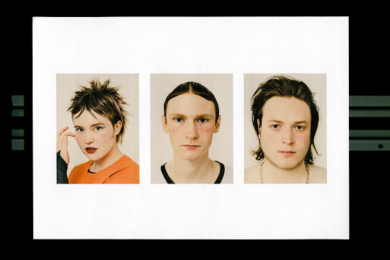

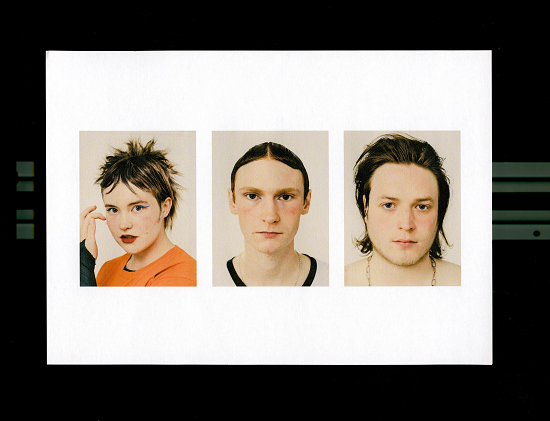
Photo: Lewis Khan
When tQ connects to PVA’s Ella Harris and Josh Baxter on Zoom, it’s release day for their new EP Toner. They’re excited, but it’s also the height of the second lockdown, so there’s not a whole lot they can do about it. “It feels like I’m just looking at my phone a lot,” says Harris from the band’s shared house in Brockley, South London. “It’s weird releasing music when you’re just stuck in your house.”
More than a lot of bands, things skidded to a dramatic halt for PVA when the coronavirus pandemic put paid to the prospect of live shows. They were due to play South By Southwest in Texas for a special showcase organised by the Brixton Windmill. Then they were to fly directly to Japan for a run of shows with Glows, then back to the UK for a spot at The Great Escape and a packed summer of festival gigs. Having built their following primarily as a live band – until Toner they had just one thumping single out, ‘Divine Intervention’ – they were honed to a razor’s edge as performers; 2020 was to be a breakout year.
“It was gonna be crazy,” says Harris wistfully. “But you know, I think actually, in some strange way, maybe it was a bit of a blessing in disguise.” Lockdown, she says, gave them a chance to take stock after a hectic schedule of ceaseless gigging; longer that they’d have liked, but a chance, nevertheless. Before March they were playing at least a gig a week, often more. “We didn’t really stop for two years,” she says. For some of that time Harris was living and working in Manchester. At least once a week she’d get the 6am Megabus to London to rehearse from midday until 3pm, soundcheck, play a gig, then get the overnight coach north to go to work the next day. “It felt very full on.”
Things were always hectic. It was just two weeks after she and Harris first met, at a house party, that PVA booked their first gig. At the party, Baxter mentioned some demos he’d recorded, Bo Diddley-esque blues and 303 acid-inspired thumping basslines, mashed up into what he calls “a kind of country techno” with added sleazy guitars plucked from the Windmill scene. “I think the demos were written with being played live in mind,” he says. As luck would have it, Harris was putting on a night called ‘Narcissistic Exhibitionism’ at The Five Bells pub in New Cross, an exhibition of painting, sculpture and photography upstairs, and a run of bands on the ground floor. In keeping with the event’s name, she put PVA on as headliners, and gave herself and Baxter a fortnight to get a set together.
PVA’s sound has changed a lot since then. “We homed in on what we really want to make,” says Baxter. Their music is no longer country techno, but a slick, steely and banging mix of dance and post-punk. They evolved in fits and spurts. Initially they played with pre-recorded synthetic percussion, but added drummer Louis Satchell, for a gig with Black Midi at Independent Venue Week. “We thought, we really need to step our game up if we’re playing with Black Midi,” Baxter remembers. The gig turned out to be a mess. “I think we pushed it a bit too hard. My guitar was out of tune. We got a good review though, maybe people thought it being out of tune was edgy or something…” Nevertheless, with Satchell on board they had the opportunity to expand their parameters even further.
“But it’s those moments that are so integral,” says Harris. “After that we put so much time in to get it together.” At first, Harris was too shy in front of a mic to sing live. “When I was 10 or 11, I was in a choir, and at one service they put me in front of the microphone. I was belting and screaming, but this man came up to me afterwards like ‘Wow… really, er, loud’. After that I thought I’m never singing in front of anyone ever again. I really enjoyed music, but as a teen the idea of even going on stage seemed like something I’d never do.” Eventually, with Baxter’s encouragement she’d begin to provide a different amount of singing in each set, sometimes backing vocals, sometimes lead, and sometimes none at all. “There have also been shows where we’re just far too drunk. It’s hard to get nervous when you’re playing at two in the morning and you’ve been there since six in the afternoon.” Progress wasn’t linear, but by the time they started writing songs like their breakout single, the phenomenal ‘Divine Intervention’, she and Harris were splitting vocal duties down the middle.
PVA’s constant gigging built them a solid following as a live act, but capturing that energy for a single provided a challenge. They tried recording ‘Talks’, the elastic, shimmering lead track from their new EP, with a number of producers, but couldn’t get it right. “Trying to mix our music can be weird,” says Baxter. “The early demos were made on Ableton with a drum machine, then we play it live with a real drummer. We’re trying to move between this drum machine sound and a more live sound, and it’s been tricky to strike that balance. I think for a while we just couldn’t figure it out.”
It was Dan Carey, head of South London indie label Speedy Wunderground, who emerged with the specific set of skills they required. He recorded ‘Divine Intervention’ for his label’s much-feted singles series, where he and a band record a track in one day with minimal takes and as few overdubs as they can, which is then mastered, pressed and sold on a run of 250 copies as soon as humanly possible. PVA were already fans when Carey approached them. “We had a trust in him,” Baxter says. “We knew he could do an amazing job, and he really managed to capture the energy really well. It was also quite stressful, but it had to have that pressure on it.” They worked together again on the Toner EP, albeit with a little more leeway when it came to post-production.
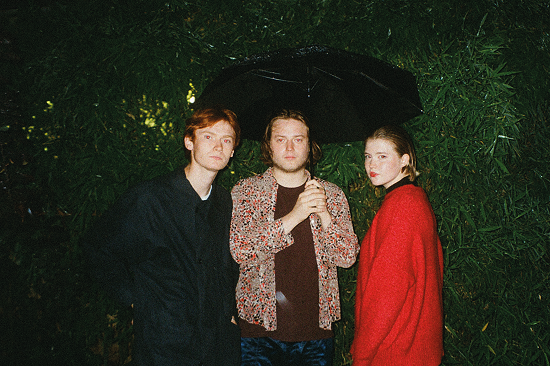
Photo by Slow Dance
In fact, Toner was the very last thing Carey recorded before the pandemic, meaning it was months until the EP could be properly mixed. The band spent the first lockdown apart from each other in opposite ends of the capital, Harris at her family’s home in North London, Satchell in Croydon with his parents, and Baxter in the Brockley house. They couldn’t meet up to rehearse, so aside from the occasional attempted session over online software, spent time working individually, or around voice notes left over from previous rehearsals. A positive side-effect was that by the time they all moved in together in September, “We had had time to think about the recordings, how we wanted to present the EP,” says Harris. “We’re writing now for future releases, like an album, and I think the time we all had to work on our individual music and just have some space from playing means that the stuff we’re writing feels more mature and more refined. We had a chance to experiment and try out new things. I think I personally have a better understanding of the sounds I can envisage us making in the future.”
Now able to rehearse as a trio once again, they’ve been performing extended jams together twice a week, recording them, poring over the results to find bits they like, mashing them up into demos, writing lyrics and melodies, then taking them back to the rehearsal room to develop new material. They’re drawing inspiration from “more modern sounds,” says Baxter, who names PC Music, Charli XCX and Shygirl. “Before we were more focussed on sounds from the 80s and 90s, rave music or post punk. I think our music definitely has a retro quality to it, but there’s also that modern element to it too, and that’s what we want to explore.”
Harris is 22, and Baxter is 23, of the generation for whom old and new music have always co-existed. Harris has been streaming since she was a child. “That’s my main access to music,” she points out. “If I really like a record, I’ll buy a physical copy, but the fact we’re all constantly listening to so much music from the past as well as more modern influences is really, really important. I think that’s why so much exciting music is being made at the moment. A new generation of musicians have grown up listening to everything, all the time, so easily.”
“I have a short but intense attention span,” says Baxter. “I’ll get excited about something for a month, a style of music or film or something, then something else will come along. I don’t know if that’s a product of the sheer amount of information we’ve got access to, but I find it really exciting. It’s like, you can just think ‘what do I enjoy’ and pick out all these colours and tools you can use for your music.”
“It’s quite beautifully overwhelming,” Harris adds. “When you’re sitting there looking at everything at once, and you’re thinking ‘what does that mean?’ I love the fact we can listen to and read and see so much so easily, and that there’s not a limitation to what we can access.”
PVA are brimming with ideas; their enthusiasm for the future is refreshing and infectious. They say that once gigs return they’d like to focus on the possibilities of modern audio-visual technology, inspired by the likes of searing Bristolian collective Scalping. When I ask what they’d do if budget were no object, Baxter takes me through his idea for a 2,000 capacity rave, each room its own interactive multimedia art installation, combining to form a complete narrative. The speed with which he answers, and level of detail he provides, tells me he’s thought about this before.
They’ve been working on the possibilities of virtual reality performances in collaboration with tech company Volta-XR, but Baxter says they already want to push things further. “There’s nothing you can replace with being at a gig, you’re with people, you’re socialising, it’s very specific, whereas a 20-minute VR experience is a different thing. There are lots of things where you can be in VR in a gig environment but that’s a waste of the technology. You have the ability to make anything you want, put people into an environment that’s completely not real, an immersive expression of music and film.”
Harris feels similarly. “We have a VR headset at our house now, and there are these gigs you can go to which is cool but its’ not quite there. You could be in space! It’s crazy, why wouldn’t you?”