

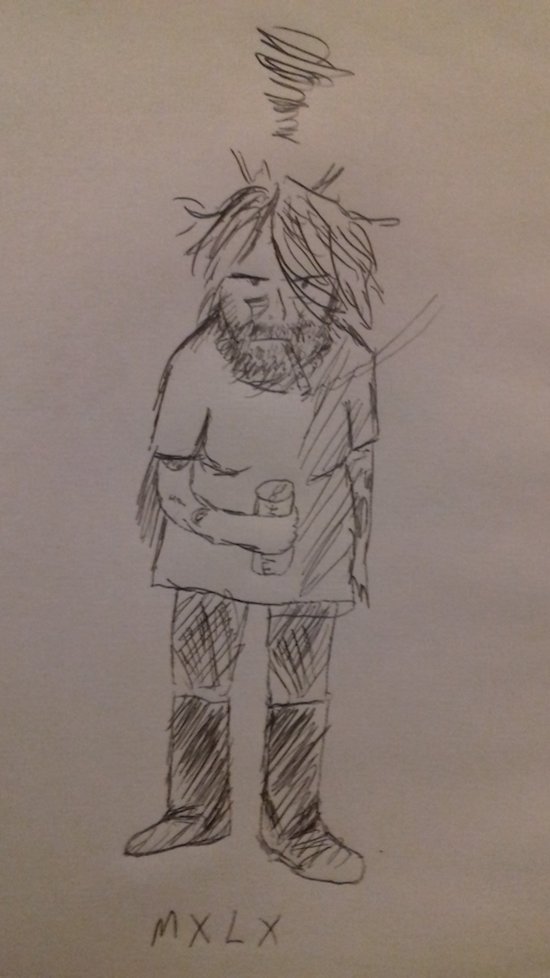
Self-portrait by Matthew Loveridge, biro on paper, 2020
In this realm of ego and tactful restraint, musicians make scarce use of the internet’s greatest gifts: a completely unrestricted platform and a fluidity of identity which enables them to be any number of artists at once.
This power is demonstrated in the chameleonic two-decade career of composer and former Beak> member Matthew Loveridge, whose insatiable conquering of new genres and disciplines has spawned over 30 full-length records under various identities: Knife Liibrary, Gnar Hest, Fairhorns, Team Brick and his principal moniker MXLX. Spanning long-form organ pieces, bludgeoning industrial and gritty piano-and-vocal compositions, it is an incomparable catalogue – in places mercilessly abrasive, in others ecstatically beautiful.
These forces of confrontation and introspection, constantly at odds in his canon, were powerfully reconciled in his 2017 masterwork Kicking Away At The Decrepit Walls Til The Beautiful Sunshine Blisters Thru The Cracks. A stunning exploration of Loveridge’s recurrent struggles with mental health and one of tQ’s Albums Of The Year, it brought wider acclaim to one of the Bristol avant-garde’s most extraordinary and quietly influential figures.
This triumph was followed, however, by personal hardship. Struggling to afford Bristol’s rising living costs, Loveridge briefly moved to Glasgow before a severe bout of depression forced his return. “I expected to land on my feet, but it didn’t pan out that way,” he says, which lead to a brush with homelessness – “not on the streets, thank God, but several sofas” – and his development into a “really volatile and difficult person”.
Finally regaining stability in 2018, moving into “a wobbly little shithole above an Iceland”, Loveridge began the process of recovering from his breakdown and creating the follow-up to Kicking Away. The resulting album, Serpent, is a phenomenal achievement. Through warped metal and coruscating electronica, the record sees Loveridge “crawl out of a period of numbness” to produce his most emotionally complex work to date.
Loveridge’s recovery from anhedonia – the inability to sense emotional pleasure – forms Serpent’s principle focus. “For the majority of 2018 I didn’t feel a single thing,” he says frankly. On ‘Mood Bruiser’, a muttered “I don’t know how I feel” opens a vortex of industrial clangs and hurtling scraps of distortion, from which a haunting organ sequence climbs and finally dissolves. Throughout Serpent, the alien and desolate are heard in conflict with soaring emotion.
These moments of lyrical prominence are part of what makes Serpent an oddity in a catalogue where Loveridge’s vocals are typically obscured or non-verbal (see 2015’s I Aim To Understand Nothing). While he dismisses questions on his lyrics, claiming they are as obligatory and “completely unconsidered” on Serpent as across his previous albums, their agency is accentuated by his highly disorientating production. Interrupting his choral chants in ‘I Am Wrong And You Are Proof’ with his own distant screams and intimate whispers, Loveridge seems to erratically materialise at different points in the room.
It’s part of his complex use of “texture where there would normally be melody” to convey emotional shifts and the narrative of recovery. Serpent’s centrepiece, ‘Flowers For The Snakes’, opens in darkness, populated by sharpening knives and malevolent laughter, before Loveridge’s declaration that “this was no affectation of misery” shifts us to a triumphant sequence of howling post-rock and synthetic drums. This narrative expression is complicated, perhaps, by his affection for extreme sonic barrages.
While some might baulk at the brutal six-minute distortion piece ‘Being A Bomb’, Loveridge reads these harsh sounds as “completely joyous and celebratory – white light and white noise are the same thing”. Interpretability is far from his first concern, however. “I’ve got a hate-boner against meaning,” he says. “I see music as just little machines with a function: tranquilisers, amphetamines or psychedelics”.
This functional outlook helps to explain Loveridge’s obsessive industriousness. He frequently cites pressure to “get the shit done”, despite working independently, and constantly challenges himself with new disciplines delineated by his various identities. As Gnar Hest, he painstakingly inputs all notes digitally with no live or MIDI instruments. MXLX songs sometimes include hundreds of layers of instrumentation performed by himself, while as Knife Liibrary he is restricted to his voice and a piano. When I question his decision to use 3D modelling to plan Serpent visually, he simply replies: “I wanted to confuse myself.”
Where he becomes overstretched, he claims his failures “have their own sort of beauty to them”, taking on lives of their own as “ugly malformed beasts I didn’t intend to create”. Loveridge attributes this unusual ethic and tendency to “think in terms of records” to his autism, having previously suggested he would have long since left music behind if he was neurotypical. He resists definition by this though, noting the industry’s “reverse hostility” towards neurodiversity in not allowing work to stand up on its own merits. “I happen to be autistic,” he says. “The ridiculous pumping out of mediocre jams is sort of a by-product."
Loveridge now faces the challenge of monetising his enormous body of recordings in a landscape increasingly hostile to artists doing so. One measure has been to reject online streaming platforms, making his music available exclusively through Bandcamp. While he believes “there is a place for stuff like Spotify, Apple, Tidal and all that”, and sees no malice in their use, “it’s generally for more popular forms of music”. He considers Bandcamp “a much more libertarian platform”, noting that he “earned $40 in 18 months on Spotify, and in the four weeks after I took everything down I made triple that”.
Elsewhere in Bristol’s vital DIY music community, many of Loveridge’s fellow experimentalists have adopted a similar tactic. The vital left-field dub label Bokeh Versions, and the sprawling Avon Terror Corps collective they belong to (alongside Giant Swan, Harrga etc.), have also made Bandcamp their sole online outlet. Loveridge notes the value of this community, claiming the increased “communication between the little pockets” of the city’s eclectic musical landscape, from noise shows to sound-system nights, has made him feel “a lot more welcome than I did ten years ago”. He claims to have drawn increasingly from this, taking “a lot more influence from trap and bass music due to being around more people doing it in really personal ways”. Compared to the “limp handshake” of contemporary guitar punk, he claims “that’s where the punk is… that’s where actual DIY culture is”.
Serpent has already been followed by the new Knife Liibrary album MARKS: Songs For Those I Have Killed, along with plans for an “ugly, digital nu-metal” record as Fairhorns and another MXLX album. When I suggest this signals a return to business as usual, Loveridge notes his recent revelation that his work “is satire”; aside from any “bratty or obnoxious” connotations, this has refreshed his focus on subverting genre tropes and inverting the spotlight. The next MXLX album, he declares, will be a techno record.
With this, the extraordinary achievement of Serpent already begins to vanish beneath the inexhaustible flow of Loveridge’s new projects. While he hopes it can “help some people”, providing “a withdrawal, or a sponge for the bad shit”, he reflects on Serpent principally as “something I had to do”: demanding its own creation without regard for any audience. “I’m not here to please people, but I’m pleased when I do.”
A satisfyingly large number of Matthew Loveridge albums are available via Bandcamp