
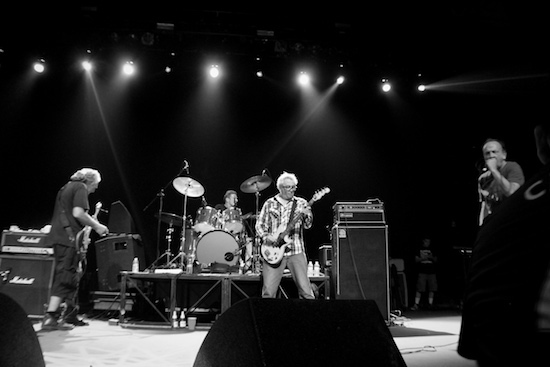
Flipper live by Nick Sternberg
Since surfacing in the San Francisco underground in 1979, Flipper have always been unrepentantly different. Coming up with the likes of Black Flag and Circle Jerks in a scene kneeling at the altar of blitzing hardcore, their loose, bass-driven chaos — not least in the early days — felt equal parts demented and delirious. Neither thrash, straight-edge nor hardcore, Flipper were punks that, truly, never entertained the idea of being pinned down.
Founded by Sleepers member Ricky Williams on vocals, Ted Falconi on guitar and former Negative Trend members Will Shatter and Steve DePace on bass and drums respectively, their drawn-out noise punk wasn’t simply proto-sludge at its slow-beating heart: it birthed an oil slick-like lineage that steadily oozed up the Pacific Coast to Montesano’s finest, Melvins, their disciples in Nirvana a few years later and beyond.
For many, the band’s wild and grimy four-decade trajectory is enshrined on their boundlessly influential debut, Generic Flipper. Released via NorCal imprint Subterranean Sounds in 1982, it found the band — with frontman Bruce “Loose” Calderwood now in tow — wielding a one-band new wave of abrasive psychedelia. On sax-and-feedback-drenched paeans like ‘Shed No Tears’ and, easily one of the most quintessential anthems of the U.S. underground, ‘Sex Bomb’, the band’s M.O. sounded unlike anything of its time. As Henry Rollins put it years later: "They were just heavy. Heavier than you, heavier than anything. When they played they were amazing.”
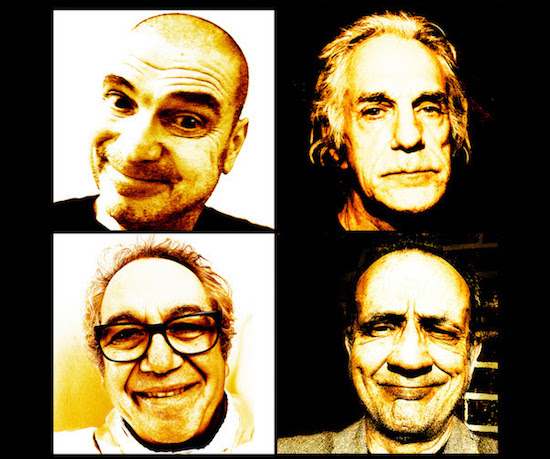
Having called it quits in 1987 after Shatter died of an accidental drug overdose, Flipper have come and gone, reforming on and off with various line-ups over the years (in 2009, they recorded their fourth studio album, Love, with Nirvana’s Krist Novoselic on bass.) But it’s now, forty years on from forming, where the band’s unhinged and iconoclastic craft is fully getting its due. In choosing to celebrate the past, all whilst pushing forward into an exciting new future, founding members DePace and Falconi have recruited two heavyweights for the occasion: Scratch Acid and The Jesus Lizard frontman David Yow on vocals (who originally performed with the band in 2015) and the Minutemen’s Mike Watt on bass. Speaking to DePace over the phone, it doesn’t take very long to appreciate just how much of an impact Flipper continue to have.
From the beginning, Flipper’s sound has long been defined by the rhythm section. Mike Watt is hands down one of the most distinctive bassists alive. How has it been essentially pairing up with him on these dates?
Steve DePace: Every show to date has been stellar. Watt was southern California, and we were northern California but we both came up in the same scene and knowing all the same people. When I reached out to him about doing this tour, he immediately recalled that Flipper and the Minutemen had done a show 38 years ago. He remembered the date and venue right off the bat. So, we’ve really known each other our whole lives, playing shows together in different bands but never together. We got together and did a week of rehearsals at his studio in San Pedro, California, played a show in southern California and then got on a plane and flew to London. There hasn’t been any issues or problems in terms of playing and learning the songs and getting in sync.
The current run doubles up as your 40th anniversary tour. You strike me as someone who doesn’t care too much for nostalgia, but is there much of a difference going from city to city nowadays compared to, say, 25, 30 years ago?
SD: I can’t really speak for the rest of them but, of course, we’re all much older now. 25, 40 years ago or whatever, we were all much younger, so we weren’t quite as worn out physically. The main difference is that I’m in a perpetual state of exhaustion. When I was in my twenties, I probably wasn’t in a perpetual state of exhaustion. I’m not drinking very much night-to-night, because I wouldn’t survive. Back in the day, I wouldn’t have had an issue there. So, I’d say those are the two main differences. The way we’ve been approaching touring in the states, just because of circumstance and the way things are, we’ve been doing three or four shows in a row, then a week off, then three or four shows in a row again – that kind of thing. In Europe, it’s different: we do as many shows as we can, so we have eight shows in a row, one day off, then six days in a row, one day off. It’s exhausting but worth it.
Going back to the late 1970s and early 1980s, I’ve long held the thought that rather than “just” being a punk band, Flipper offered up a strange new strain of punk psychedelia. You emanated it despite not being traditionally psychedelic.
SD: I agree with you. I would say that there’s elements of various different things and styles within Flipper, which ultimately leads to that. It’s been said that we’re part art performance, part art rock, noise rock, art noise, punk rock, grunge – all of those things. But we just kind of are what we are. It may change a bit here and there with different people in the band and different incarnations, but there’s a basic element that remains the same. We tend to stand out, you know?
The other night, when we were playing Rebellion Festival [in Blackpool] most of the bands on the bill were doing a straight, hardcore kind of thing. Then we got up on stage and did our thing and it stood out. It was very different. Slow, melodic, noisy and loud. The people really loved it. We played another punk festival in Ventura, with Mike Watt, before we came out. It was a punk show with bands like T.S.O.L. and, again, we really stood out in terms of our sound and style. We feel a lot of love and appreciation from these bands and the fans and the people who have been around the business and know all the bands. We’ve been doing our thing for all these years and still we really stand out. We feel really loved and appreciated after all this time. It’s pretty cool.
All things considered, are you now happy to accept your actual role as the definitive forefathers of grunge? Buzz Osborne has said it, therefore it must be true.
SD: Yes. I mean, I’m always humble and amazed about the effect that we’ve had on people and bands over the years. But I would say that, yah, apparently it seems that we were quite an influence on a number of people who ended up being in the so-called grunge scene out in Seattle. We worked with Buzz and Dale from Melvins recently on a couple of things. They talked to us about that. We did a podcast – they haven’t released it yet – but they interviewed [Flipper guitarist] Ted Falconi and myself, speaking about what kind of effect we had on them. They said that we were super, super important and a really big deal to them. And they turned the Nirvana guys on to Flipper and we had a big effect on them and so forth. So, do I accept it? Yes but with humble gratitude and all of that kind of good stuff. It’s a great and really cool feeling to have accomplished that kind of thing in a lifetime.
You mentioned collaborating with Buzz and Dale on a new release. In a way, it feels like destiny but how did it come about?
SD: When I started putting together the idea of doing a 40th anniversary tour, it was more about getting together and playing. I wanted to do a variety of things, so I reached out to lots of different people that we had worked with over the years to see about working together again in some capacity. I reached out to Mike Watt, Novoselic and others. I also reached out to Buzz [Osborne] and Dale [Crover]. In my e-mail to Buzz, I was like, “Hey, I’d like to do something with Melvins. Either a recording project or playing together or touring together or whatever it might be, I’m wide open.”
It turned out, purely by coincidence, that they were set to go into the studio and record a new album and had already intended to cover two or three Flipper songs for a Tom Hazelmyer release on Amphetamine Reptile, so he asked us to come into the studio with them to expand on that. I said, “Yeah, we can record a couple more songs” so that’s what we did: Ted and I went into the studio with them, not knowing what we were going to do. We went in and talked about it and figured out a plan. We recorded ‘Sacrifice’ [from 1984’s Gone Fishin’ ]. It’s one of their favourite songs. They’ve been performing that song live for thirty years. We recorded that with them and it turned out just epic, then we wrote and recorded a brand new song called ‘Hot Fish’ together. On the flip side, they recorded ‘Flipper Blues’ and ‘Shine’. So, we got four songs on this limited edition vinyl 10” EP and there’s a CD version as well. Right now, it’s all very limited edition with handmade covers and all of that. In the near future, we may do a wider release, but currently it’s just very limited.
Suffice to say, David Yow is very well-respected figure within the scene in which you all came up in. He’s previously mentioned that he wanted to do the music justice by performing as if he was in Flipper, rather than a Flipper cover band. How is it performing with such a formidable frontman once again?
SD: We’ve been having great shows. And we’re all enjoying it because we talk about it every single night. We discuss whether we have had fun together on stage at shows, and if we are having fun on tour. Last night was his birthday and we had a big celebration for him. We had a cake especially made for him and had a great time. David first got involved in 2015 and we did about 13 shows during that run. After that, he went on to focus on acting, which he’s been very successful at. When I heard that he had done a few Jesus Lizard reunion shows, I made a mental note that maybe he’s got more time or feeling like he can get back into music again.
When the idea of doing the 40th anniversary show tour came about, I reached out to him to see if he would be interested in working with us again. Thankfully, he was and here we are. We’ve actually done some recording with him recently, too. We sort of did a homage to the Beatles. There’s a record label called Joyful Noise Recordings based in Indianapolis in Indiana. They’ve done a lot of work with David on some of his solo recordings, so they invited us to come and do a live recording and videotaping on the rooftop of their offices. We recorded a one-sided single: a Flipper song called ‘Love Canal’, which is David’s favourite songs of ours. It’ll be the song on one side of the vinyl single and an on the flipside is going to be a silk-screened art piece. It’s actually a photograph of a bass drum. That’ll be coming out in a couple of months. Aside from that, we’ve multi-track recorded three of our live shows in the States and we’re planning a live album release with David.
The more we broach the anniversary, the more I grasp the various strands to it. It’s more than just getting up and playing every night. Obviously, that takes a lot, but you’ve clearly got a vision to time capsule right now, all while putting the past into perspective. Presumably, you’ve been working a lot behind the scenes?
SD: Very much so. It’s not a chore but it’s intense, as there’s a lot to it. There’s trying to keep everyone happy and make sure it’s all quality work and we’re not just doing it for the sake of it. There’s a lot of elements to it and there’s a variety of things that I want to do. Also, there’s trying to create new things. Some of these recordings that we’re doing, for example – not just reissuing old stuff. All of our rights have reverted back to us on all the different recordings that we’ve done over the decades, so we’re planning on doing a major reissue as part of all this. But as well, we want to do new things, hence the project with Melvins and the recordings with David Yow. We’re living in the moment but also celebrating the past and our history.
Beyond this, are there any plans to record a new album? If so, is David Yow likely to be on board?
SD: Do I envisage a new album at some point? Yes, but I don’t know who will be involved, except certainly myself and Ted. That’s the cornerstone and foundation. After that, it’ll be interesting and it’ll be good, but it might not be a full album. We might start with a single or an EP or something interesting with who knows? There’s a lot going on now but I do envisage doing more things and staying current because I love being creative. A big part of all of this is simply being creative.
Speaking of Ted, you’ve often mentioned how no guitarist plays quite like him and that you couldn’t ever figure out what he’s doing. Have you figured it out yet?
SD: No, no. I never will. I watch him, I talk to him, but I will never know what he’s doing. I’ve no idea what or why or why he’s doing what he’s doing, but he’s doing it.
Your debut album Generic Flipper is Flipper’s defining work for a lot of people. Listening back to it in 2019, can you personally perceive why it holds up as a classic?
SD: I guess if people say it’s a classic, it’s a classic. So many different people say it is and and have done for so long. From my perspective, I have no idea how we managed to create something as profound as our debut but fans, bands and critics love it. When I do get around to listening to it, I think it still holds up. I love it and I think it’s pretty damn good. I don’t listen to it often but when I do, I go, “Wow, that’s a great record.” We’re very pleased that we made it happen, and that it happened when it did. Why has it had such an effect on people? I’ll never know.
You’ve mentioned that the desire to be creative and to bridge the past with the present are big motivators for Flipper nowadays. But what is it, above all else, that keeps Flipper pushing forward and breaking new ground in 2019?
SD: It’s fun, it’s exciting and it gives me a purpose in life. It’s a great feeling, getting out and playing on stage. Along the way, currently as play from city to city, we’re getting really fantastic crowds and really enthusiastic people coming out. The fans are thanking us for coming to their town. A lot of these people haven’t had a chance to see us ever, so they’re very grateful. At its root, it’s a mutual thing: the fans want us and we really want to get out and play. The time is now, you know?
Flipper’s tour continues across Europe