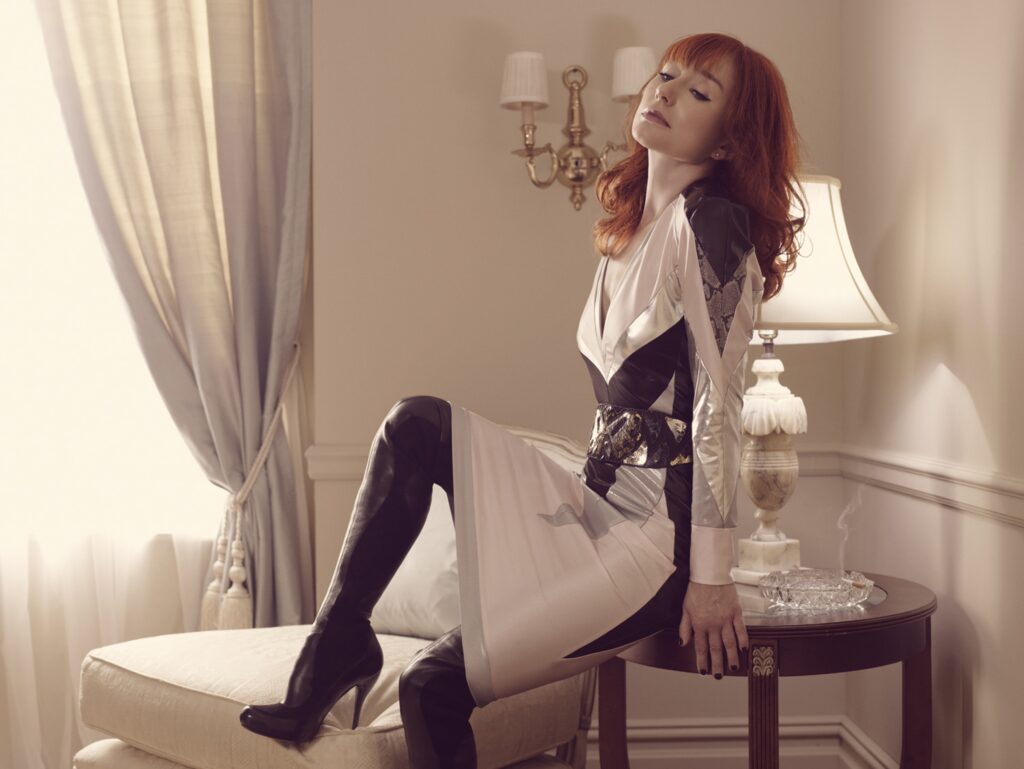
If one had to identify a single character trait running through Tori Amos’s work in the 17 years since her stunningly raw and autobiographical debut Little Earthquakes, it would surely be the vehement desire to do things on exactly her own terms. Her affinity with the UK arose from her first label’s desire to expose the singer on the club circuit prior to that album’s release. This, ironically, resulted in Amos returning later to make the UK her semi-permanent home — while at the same time escaping the prying attention of a US media to whom she’d become as accessible as a tightly closed book.
Whether this need for privacy has affected her commercial success or limited her exposure is rendered irrelevant when you consider her status as one of our generation’s greatest singer/songwriters. Her relative impenetrability, on a personal level, has added to her mystique. Never reluctant to experiment, to challenge or to relate the unpalatable, Amos has that indefinable something which makes her every career move a subject of great anticipation for those peering in from outside her ‘circle of trust’ — as well as an ability to subtly reinvent herself without ever resorting to all-out commercialism or gossip magazine hoopla.
She combines all this with life as a wife and a mother as well as a staunch campaigner against sexual assault — an issue she faced personally in the past and approached with strength and conviction on ‘Me And A Gun’ from that astonishing debut. ‘Great’ is an accolade thrown around all too readily these days, but in this case it’s surely justified. From the remote wilderness that is Cornwall, we caught up with Tori. . . .
Good afternoon Tori, I’m speaking to you on behalf of The Quietus
Tori Amos: That’s such a great name for a website!
Sadly I didn’t actually think of it…
[laughs] You know I respect you already for telling me that — most people wouldn’t admit it.
OK, living in England most of the time as you do, how different is that from the standpoint of a high profile artist?
You know, as I’m in my mid-40s, when it comes to these kinds of questions, good and bad is relative. It’s different, because let’s go back to the name, it is Quietus! I mean, we’re in Cornwall part of the time and then we’re touring part of the time, then we’re in Florida at the beach house. And, what I would say is that being in Cornwall in England, we’re in the middle of farm country with no street lights. And I think Mark [Hawley, husband] chose this intentionally because it’s away from everything and I think it’s given Tash an opportunity to really grow up in a family unit that’s very much a family, unlike one growing up in LA, or New York or even London. So from that point of view it’s a huge positive. But even when we’re in the States we’ll just get take-out and bring it in, to maintain a similar life to what we have in England.
From a purely professional point of view was it a conscious effort to distance yourself from the machinations of the music industry? Had you become disillusioned with that part of the business?
Well I think what it was that it was a conscious decision on Mark’s part to have a studio that was really difficult to get to, for record people. And I think he knew that I would be able to fly under the radar and also we would be able to just finish records before there was too much . . . interjection. So yeah I’d say it was a conscious choice.
Did your music change as a result, and did less outside pressure mean greater creativity?
I think that when you are in a major city and you’re available to record people, they are going to get involved. And sometimes they get involved for all the wrong reasons. It’s not because they love music necessarily — they might have at one point but what can happen is that they want a success, right? But ultimately nobody knows what that is — especially the people creating it. So sometimes you get reactions from people based on their fear and I’ve always said that with a lot of people in the record industry: their fear is greater than their faith.
As a traditional singer/songwriter who’s worked through the media explosion of the last ten or fifteen years, and whose work is best consumed in one album-sized gulp, do you think it’s harder to get attention given the buying public’s relatively short attention span?
Well I choose to focus on what I do and do what I do, because that’s the strongest place to come from. You can’t need anything from the outside world, you can’t need it. As a musician you have to know where you stand with yourself. Once you go through your own kind of checks and balances with those people you have your own kind of benchmarks and think-tanks.
But presumably you only get to that point after reaching a certain baseline of commercial success?
Absolutely. If I was starting out it would be really tough now. People are not interested in growing with an artist either, even if they stay for an album or two they’re usually on to the next new person. That’s a very different way of looking at well . . . art. For me, whether it was visual artists or novelists or songwriters, I’d always want to know what those people that I respected were thinking and saying.
Based on what we touched on earlier, is it hard to form a strong and fixed self-image in a world which increasingly suggests how we should be?
I think it’s tricky. But I think it’s the only way to survive this sort of world — to find a positive self-image for yourself. But that sometimes takes a bit of travelling and it might not happen in your early twenties — it’s something you come to.
You were brought up a minister’s daughter; did that expose you to some of the more negative aspects of religion at a young age?
That’s right. Well it also helped me to see how clever those that are sort of behind the scenes in religion are, and how well connected it is. I mean in the States religion is very political. A lot of media outlets are run by right wing Christian people; and a lot of these people run corporations and are very influential so there’s this interconnectedness that goes on.
You could argue that many large corporations — even governments — operate on an ideology closer to Satanism than Christianity by promoting total reliance on self.
They get you to rely on them — there’s an authority. They’re not trying to get you to be emancipated from the system and to listen to your own voice and find enlightenment and spiritual development on your own, because then you wouldn’t need the system. Whether it’s political or religious, if you’re dependent on the system then you can be controlled.
Have you battled with that? It takes a strong person to resist that kind of pressure, surely.
Well, I battled with it but then, it’s what we talked about: it’s one thing to know that you need to fight an authority that wants to subjugate the masses, but it’s another thing to know how to do that. And to really be able to accept who you are — to get to a place where it’s hard for another force to have control over you because you’re not hiding who you are, either to them or to yourself.
While we’re on Satan, where did the idea to cover Slayer’s ‘Raining Blood’ come from?
Umm . . . I was talking to Justin Meldal-Johnsen I think, who was the bass player with Beck at the time. I was doing covers of men for Strange Little Girls and he had mentioned Slayer to me — and this is when the Taliban was in full power. When I heard ‘Raining Blood’ I just had this picture at the time, of this beautiful vulva [laughs] . . . raining blood over this male abusive force. That was how ‘Raining Blood’ came about — that was the picture I saw when I recorded it, and what I see to this day when I hear it [laughs].
Did you actually like the Slayer version?
Yeah . . . but I like vulvas too. [Laughs]
That’s quite a headline!
[laughs] Yeah, leave it to Tori, the minister’s daughter.
What would you have done if you hadn’t become a musician?
Oh. You know . . . I don’t know. That’s a really good question. I mean a part of me wonders if I wouldn’t have gone undercover trying to free women who are caught in these horrible human trafficking situations. I could see myself just walking into one of my . . . you know, I did this record, American Doll Posse, and I can just see me walking into any of those five women — being them, maybe more than one in a day — and just going in and out and rescuing these women. You’d never know who I am, cause I can change identity. That’s five, I could probably do 110 more.
So that could have been your alternate career path?
Yeah: rescuing these women, cause that drives me crazy.
You’re involved in a charity related to such issues though aren’t you?
Well there’s RAINN which I started in 1994 with a few other people and it’s still going. It’s a successful charity — it supports itself and it’s the rape, abuse and incest national network in the States. It’s a free hotline, the call doesn’t get registered so if the perpetrator is in the home you’re protected. The good news is that we’ve had over one million calls and the bad news is also that we’ve had over one million calls — but yes, it seems to be beneficial.
You’re planning to release an album of winter songs later this year, am I right?
Yes, that’s still on the agenda — we’re mixing it as we speak. It’s a mixture of variations on old melodies and ancient carols; but variations o those themes, not exactly as you’ll have heard them from the Methodist church. It’ll be slightly different, but you’ll recognise some of them. Then there are new ones. So it’s a merger of old and new, with full brass, harpsichord, timpani and concert bass drums. It’s the classical side of my musicianship being allowed to do her job.
I assume you enjoy that kind of artistic freedom?
Yeah I do. It was a huge challenge and I’d like to think there’s been nothing quite like it; just because I am a minister’s daughter and I was exposed to a lot of that stuff, but at the same time I felt like I wanted to bring in another side to this which is that before there was Christmas day, cultures were celebrating the rebirth of light in darkness during the winter season. That’s been happening for thousands of years. Midwinter has been celebrated for thousands and thousands of years, even before a religion was involved and it was about rebirth of light; so it’s important to have that there as one of the layers, and then of course we have music from Christmas. The British carols differ from the Americans because they would change them based on their take on it. So it’s about having a variation on that original theme for the 21st century. It’ll be available in November.