
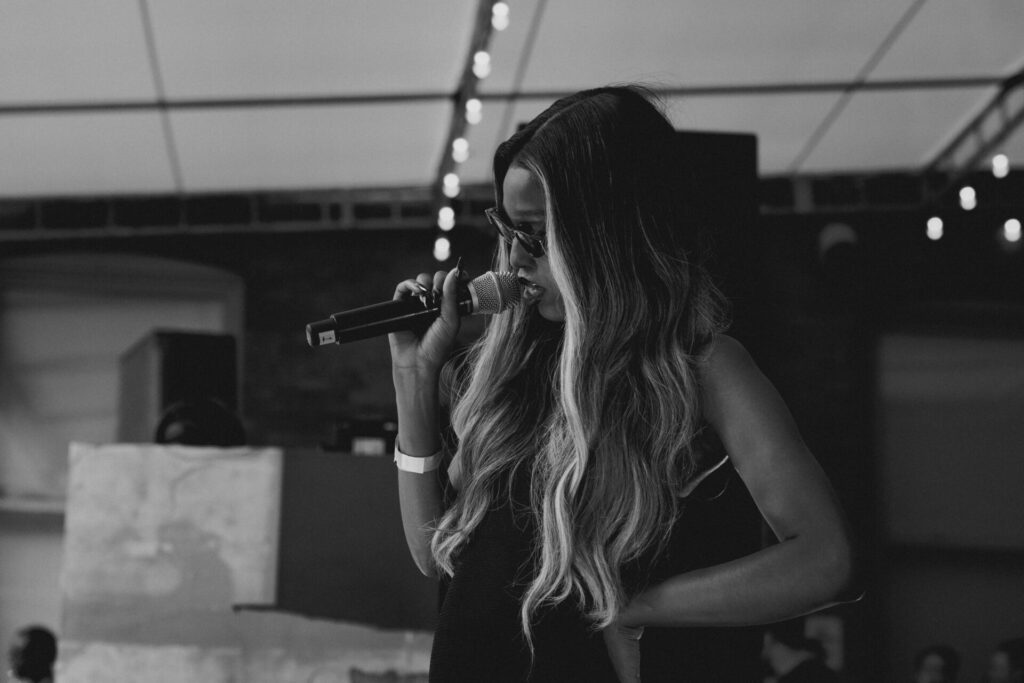
Rapper, poet and producer John Glacier’s music is something like her pseudonym: an enigmatic blend of the everyday and the ethereal. Her debut studio album Like A Ribbon sets her lyrical musings on freedom, selfhood and growing up in Hackney to a restless swirl of post punk, UK hip hop and avant-garde composition. “To me, my music sounds otherworldly,” John offers, speaking over the phone from New York, where she’s due to perform at MoMA PS1’s signature music series Warm Up – the latest stop on a sharp rise to fame that saw her write poetry for a Burberry campaign in 2023, and play Glastonbury this summer. “I started out just wanting to express myself and put it outwards. When I was younger, I would describe it as like on TV, when you see people put a note into a bottle, and then they put the bottle into the ocean. The bottles have sailed quite far now.”
Released in February 2025, and expanded last week as a deluxe edition, Like A Ribbon is her most complete work to date. “With this one I intentionally made an album,” she says of the project, which follows a number of guest appearances, low-key track releases and mixtapes. “At the beginning, it sounds like the thought of becoming, and towards the end we get to an arrival, a reaffirmation of personhood.” Characterised by John’s deadpan flow, the album is packed with sounds, perspectives and glimpses of personality – dense like the germinating flowers on its cover, but never feeling rushed or overstuffed. ‘Don’t Cover Me’ fizzes with electronics and whispering guitar, organic and elegant until a scream breaks through from the distance; the minimal guitar loops of ‘Steady As I Am’ exude the curiosity of Still House Plants and Alpha Maid; towards the end, ‘Ocean Steppin’’ is wide-open and warm, exuding her quintessential sense of balance (“Ocean steppin’ on shores / Crash the wave, then I pause / Bring it back to the land”).
John started writing poetry as a child, later posting her poems to Instagram and giving them to friends as gifts: “Throughout my life, since I was in primary school, I’ve always loved writing.” What were the themes of her early poems? “They were based on humanity as we’ve seen it throughout my lifetime,” she states, “which has just been a series of failures or illusions presented to us in terms of what freedom is, or what freedom can mean to us. Freedom is a lot wider than what we’ve been taught. Then some of them are just about the weather.” As our conversation continues, I’ll learn that this one-two of poetic introspection and levity is quite characteristic.

John started putting her words to music “about eight or nine years ago” – learning to self-produce using GarageBand and Logic and posting demos online. In 2019, British producer Joe Thornalley, aka Vegyn – best known for his work on Frank Ocean’s Blonde – came across John’s Soundcloud page. This led to him executive producing her 2021 debut full-length project SHILOH: Lost For Words, which saw once sketchy, intimate demos take more defined form. “I like the merging of two worlds,” John says of musical collaboration, which she defines as “a special, sacred art” – although she equally finds inspiration in working alone, where “there’s just a bit more freedom or range, because vocally, I know my pockets, but also sonically, when it comes to composing, I also have pockets there.” In 2023, John followed up SHILOH with the EP JGSG on esoteric NYC hip hop label Surf Gang. In 2024, she signed to Young – home to Jamie xx and FKA twigs – for Like A Ribbon.
Like a Ribbon is executive produced by Kwes Darko with additional production from the likes of Flume and, on the deluxe edition, Skrillex (on ‘Couldn’t Get Back’). It includes features from Eartheater, and Sampha, who she’s been a fan of since she was a teenager, and sees as “one of the best musicians of our time”. When I ask her who else she’d like to collaborate with in the future, she confidently rattles off a long list including Pusha T, Styles P and Jadakiss, as well as Arca and Charli xcx (“Two girls making music, it’s a vibe”). She loves collaboration and has “input across everything, which I respect about myself” – including Like A Ribbon’s artwork, hand-painted by street artist Jim Joe from her own concept, presenting opposing flowers that aren’t quite what they seem. “There’s a Duppy Gun, which sounds like a bad flower, but is actually non-poisonous,” she explains. “And then there’s an Angel’s Trumpet, which sounds nice but is actually the poisonous one.”
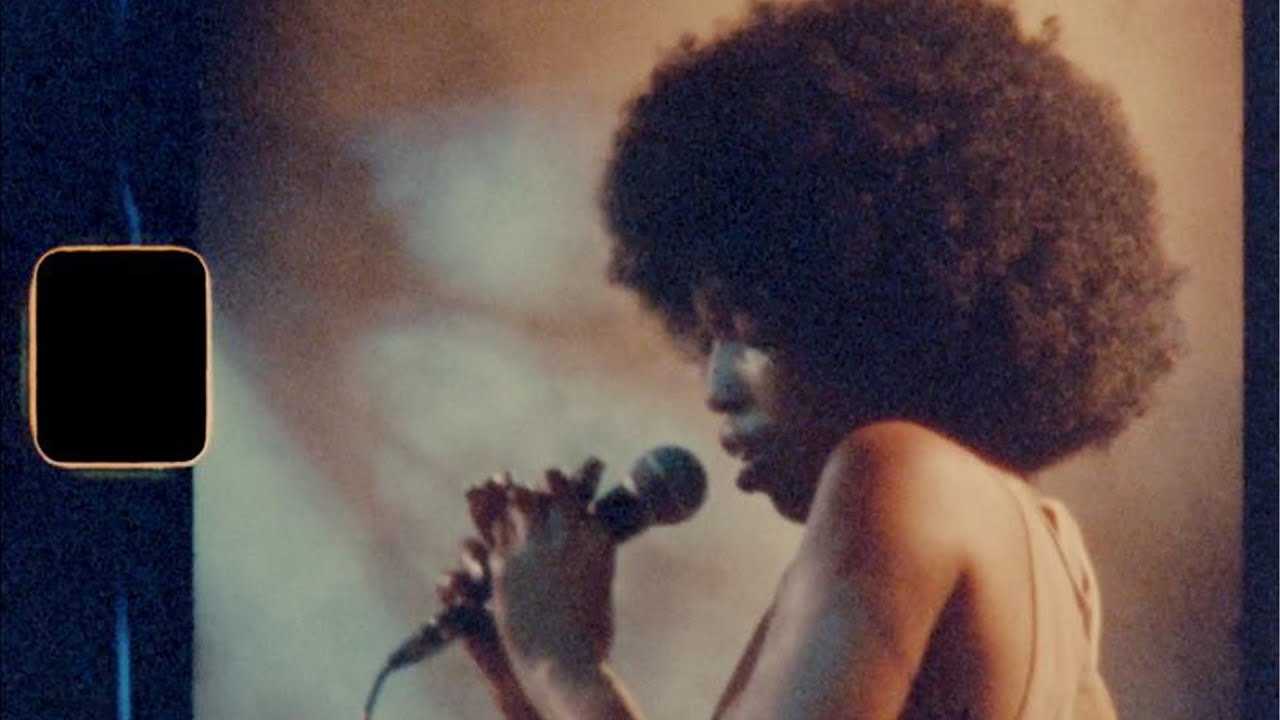
John’s musical influences draw from a childhood growing up in “a Jamaican family playing a lot of Jamaican music” in multi-cultural Hackney, where her parents had a PA system on wheels in the house. “My granddad has a crazy vinyl collection, so I’d hang out with him and listen to music there as well,” she says. “I still live in Hackney. I need to grow up, to leave my home, but it is a special place to me. The community has always triumphed over anything else in Hackney. People like to be mindful where they can. There are beautiful people there, lovely people full of life who have stories to tell. There’s been a lot of room for learning from others, which has definitely found its way into my writing.”
Hackney is in the DNA of John’s music, especially the area’s contrasting noise and extremities of experiences (“you see it all, but also in a good way”). It exists as a metaphor on ‘Satellites’ (“Like a satellite in the dark, in the light”) and is more straightforwardly present in its follow-up ‘Let The Money Fall, Let The Money Rain”, a deconstructed R&B ballad that appears on the deluxe edition of Like A Ribbon. Piano arpeggios, radio sound effects and smashing glass co-mingle in the track’s moody atmosphere, as John alternates lines about street violence and performing (“‘Copters in the sky / Wonder if a flower died / I’m on the stage / Performing ‘Satellites’). “That’s about hearing helicopters going overhead and wondering if a kid died, which shouldn’t be a normal environment for anyone,” she explains. “In Hackney, a lot of kids were failed – through turf wars, systemic displacement, overcrowding, whatever you want to say the reason is. When we talk about stabbings, which is done on a massive scale, clearly the government’s failing somewhere, that’s all I can say. And it’s predominantly kids that have died.”
John is a long-time fan of grime. Her first concert was Ghetts and Kano at the Hackney Empire in 2011. “I borrowed money from my parents – well, not borrowed because I was a child – I kindly begged my parents for some money to go to this concert,” she laughs. “Me and my friend both went and it was insane. I’m a massive, heavy fan of both of them, so to have the opportunity to see them just down the road was perfect. People might fight me, but for me, grime is inherently East London. It has traces to the Caribbean, and I’m a Jamaican girl from Hackney. To me, it’s a genre that dares to be its own entity. It has an essence, and it’s full of life.”
Although it might not seem obvious at first listen, John emphasises the influence of grime on her music, and on Like A Ribbon specifically. “People say there’s a two-step type flow on ‘Don’t Cover Me, which I hear, but it’s grime, because grime has always been about blended sounds, like Ruff Sqwad, who’ve been blending elements since I was a child.” She also credits UK road rap – grime’s darker, grittier cousin – as an influence on her offbeat juxtapositions. “People would be rapping over Florence And The Machine, or you might hear Frank Sinatra on UK road rap,” she explains. “That’s what I grew up on.” John’s music has drawn comparisons with the likes of Dean Blunt – another pseudonymed maverick – but emphasises that musical strangeness doesn’t just exist in the margins. “There’s a lot of musicians that people expect me to know. And it’s like, I’m getting there, you know? When I first came into the music industry, I was hearing more about the left-field this and that – but when I hear grime, this is what I’m also hearing.”
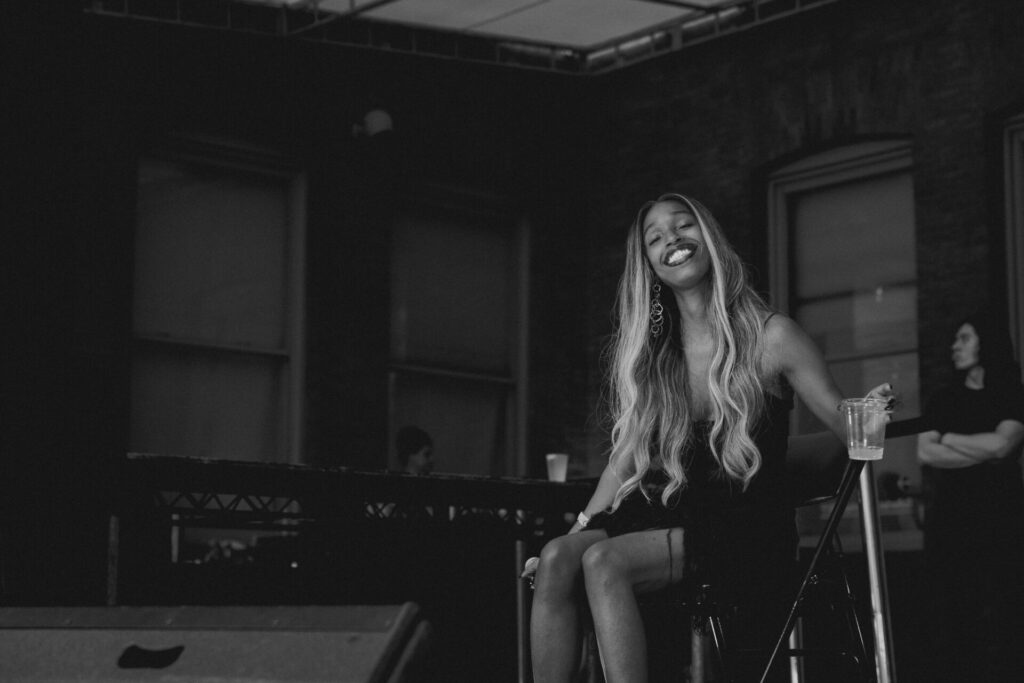
This insistence on the co-existence of the avant-garde and the down-to-earth is a microcosm of John herself, who embodies a striking dichotomy of enigma and realness. Her exact age is unknown – she told a reporter from The Guardian that she is “20,000 years old” – but she talks warmly about her childhood in Hackney. She uses an obviously fake pseudonym (with no explanation, but in ‘Emotions’ she offers, “I’m a Glacier, that′s why I look so deadly”) while preaching the benefits of being true to oneself. At first it’s difficult to parse her affable attitude with the purposefully enigmatic aspects of her public persona, but don’t we all live with inherent contradictions and concealments? Perhaps her presentation is more authentic than artists who deliberately pursue “authenticity” as an aesthetic marker.
I put this to John, positing that many people think that mystery and truthfulness can’t co-exist within the same person, or artistic work, at once. “But they can!” she says. “We’re taught to shy away from most corners of ourselves, but I feel like being yourself is beautiful.” Because of her project’s enigmatic framing, this “be yourself” talk can provoke a knee-jerk reaction of suspicion. Is this performance art? Is she mocking the language of pop psychology and TV talent shows? But her plain-speaking attitude encourages you to find the realness in her statements; to remove them from their status as meaningless platitudes.
When she talks about ‘being yourself’, she means embodying all the things that make up the self – which is reflected in her lyrics, which are “jam packed with a world of experiences. I might write one line, but that one line will be about more than one thing.” For John, this multitudinous reality is more ‘authentic’ than an aspirational model of being. “The model is you,” she says. “Be yourself, because we can’t share each other if we’re all not being ourselves. That’s one thing I always appreciate about Hackney, because it’s a place of sharing cultures. It’s not like, I understand you, so I’m taking this from you. It’s like, I understand you. Let me share part of myself with you. We all have something different to offer.” Maybe she really is 20,000 years old.
Her recent growth in fame and popularity – which, as well as music, includes her involvement in campaigns for fashion brands like Burberry – hasn’t affected her ability to express herself truthfully, but it has come with a need for adjustment. “It’s a new life,” she says. “The perception that others have of me is something that I’ve had to adjust to. A lot of people know who I am now, and a lot of people appreciate the work, which is nice. But I feel like coming from somewhere like Hackney, where most voices weren’t heard, to being heard on a mass scale… It’s a massive thing to adjust to.” She knows that her community is proud of her, but although she harbours an ambition to play at Hackney Carnival, she still feels too shy to perform in her neighbourhood. “Because that’s your neighbour rapping! But there’s billboards with my face on them, so to be fair, I should just get over it by now.”
Equally as integral to Hackney to John’s artistic identity is the fact that she suffers from Ehlers Danlos Syndrome (EDS), a group of rare connective tissue disorders with a multitude of symptoms and complications, including hypermobility, organ problems and chronic pain. “It’s so unpredictable, and because it’s an umbrella condition, you get other conditions within your own condition,” John explains. “There’s usually a lot of misdiagnoses before you reach your final diagnosis. Doctors often don’t know what to do with you, so it’s a lot of uncertainty, a lot of medical gaslighting. It is debilitating at times.” She recalls some occasions where she’s thrown up immediately before going on stage because of her symptoms, “but it’s like, I’m here, I’ve gotta get through this. There’s a lot of ‘gotta get through this moment’ with Ehlers Danlos Syndrome.”
There’s no known cure for EDS, and sufferers – the majority of whom are female – can find it difficult to access appropriate support, partially because it is “hard to express your needs when they are ever changing,” as John states. “It’s often a lot of contradictory needs. Like, I can’t sit for too long, I also shouldn’t stand for too long, and I should alternate between the two a lot.” Because of a lack of awareness, patients’ symptoms are frequently minimised – more so for women of colour, disabled women, and those from deprived backgrounds – and there remains an alarming lack of research into the condition. “There isn’t enough funding in England and most of our centres are shut down,” says John. “When you have conditions where there isn’t enough funding for medical centres, let alone for personal care at home, it’s disgusting. Then there’s the cuts that [the Government is] making to PIP [the Personal Independence Payment for disabled people]. This country is failing.”
Like many people with EDS and a lack of formal support, John must advocate for herself in unusual ways. “Sometimes on shoots, I’ll need to take a break, and if it’s hard for others to understand I will just sit down,” she laughs. “Sometimes self advocacy is completely opposing the norm when you have a disability. I’m not saying lying down and resting is always advocacy, but to me, it can be” She affirms that people struggling with EDS should feel able to, “advocate in the way that you’re able to advocate for yourself, and if people shame you or try to guilt you for it, they don’t have your experience.” She also draws a connection to her assertiveness in her artistry and career. “When you have a disability, you often have to find other ways to do stuff, within the same hours that we all have. I feel like one thing having a disability has taught me is a deeper understanding of possibilities and what possibilities can look like.”
I think of a couplet in ‘Ocean Steppin’’ – “Take the time, take it slowly / Know I like to live boldly” – at a point in Like A Ribbon where John is at her most serene and sure; when she’s reaching that “reaffirmation of personhood” at the end of the album. “With music and with my disability, I know my body, so I also clearly know my mind, despite what everyone else is telling me” she concludes. “That’s how I approach music. This is how I feel. This is my experience. This is what I would like to express.”
he new deluxe edition of John Glacier’s Like A Ribbon is out now via Young