
After the Ken Dodd statue by the doors, St. George’s Hall is the first thing of note that you see once leaving Liverpool Lime Street station – a hulking brown neoclassical slab. Originally constructed as a concert hall for the Victorian upper classes at the height of the city’s imperial pomp, today it is the ghost of a grand past (and a chequered one, given that much of that wealth was linked to the slave trade). Above the southern portico were once an elaborate set of sculptures depicting an enthroned Britannia offering an olive branch to figures representing the four corners of the globe. Today, though, that part is only a husk – the sculptures were removed in the 1950s for fears they might fall on passing pedestrians and have since been lost completely. It’s thought that they were crushed up and sold as hardcore – rubble with which to fill foundations in new buildings elsewhere.
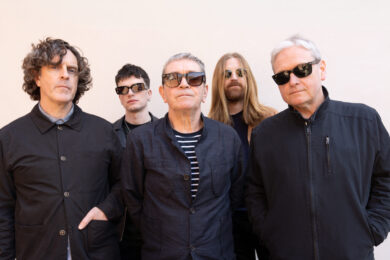
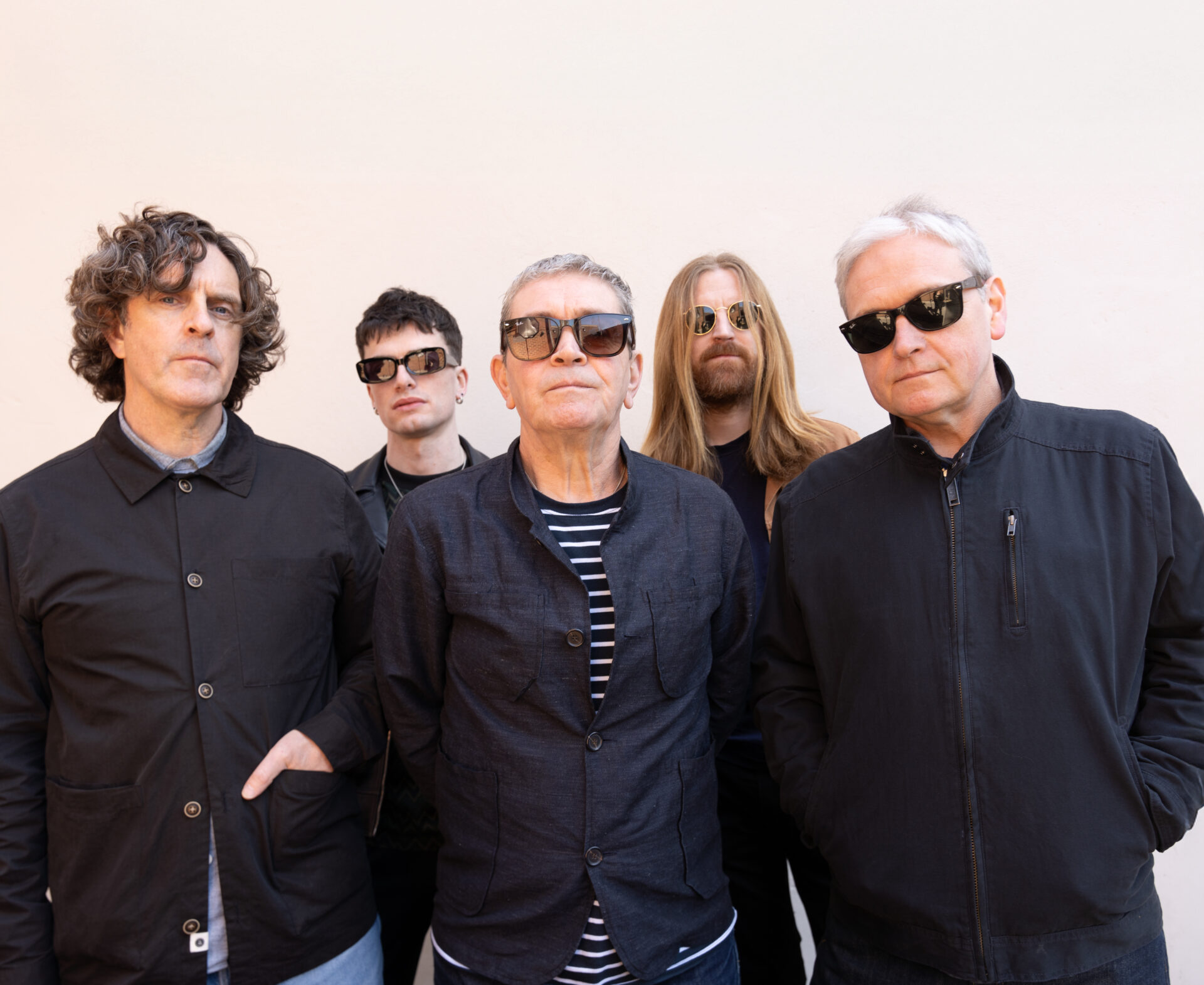
Beneath the hall, however, tucked in a corner away from the bustle of a wedding party preparing for a ceremony upstairs, we find another of Liverpool’s landmarks – this one very much alive, tied fast to the city above. Over coffee and lemonade in the basement cafe sit Peter Wilkinson and Michael and John Head, otherwise known as Shack. The band, who have not performed together properly since 2010, point out that they have never ceased to exist. Returning was “never far away, always on the cards,” says Michael. Nevertheless, the announcement of a hometown show at Liverpool’s Olympia produced genuine ripples when it was announced. Tickets sold out instantly.
“It shows that there is a lot of love for this band, and that it extends into the city and into a lot of people’s lives,” says Wilkinson. “Maybe I’m being rose-tinted glasses about it, but I always felt that I wanted everybody to experience Shack, and for everybody to be involved, and I still feel like that.” He’s also played in other big Liverpool bands, notably Echo And The Bunnymen and Cast. “And no disrespect to them, because they were brilliant for different reasons, but this one feels special. It feels bigger, more than the music.” The bassist’s excitement is palpable, to the point he sometimes comes across more as a fan, rather than a central member since 1990, when he joined aged 19.
The Head brothers are less easily drawn into such giddiness. Michael is a mercurial presence who will shift between wide-eyed passion and a pensive near-whisper throughout our conversation. John is thoughtful and measured. Though many on Merseyside consider them giants – even godlike – they seem reluctant to acknowledge the fact. “There’s a lot of respect,” is all Michael will concede. “A lot of young bands whose mums and dads came to Shack gigs and brainwashed them when they were kids.” Adds John, stiltedly: “Generally people are quite cool.” They seem much more comfortable, however, discussing the return of Shack in more intimate terms.
The first time the brothers met up to play together again, says Michael, “the only way I could think about it was all the time spent growing up at my mum’s, in the bedrooms, the kitchen, the living room, or anyone’s house with a guitar. Actually, our John would pick anything up, he’d use a cello to start playing the bass.” Some of Shack’s songs are technically intricate, he says, “but when I was playing with John again, it just came back to me. I was just watching his fingers, the way I’ve been watching his fingers since we were kids. It’s a testament to the subconscious.” So smooth was the process, says John, “that we were both in shock that it was nearer 20 years than 10 since we had actually sat with the songs and played.” All three had kept in touch in the intervening years. “We were still seeing each other, but for a while we lived in different parts of town. We’d reminisce, and our friends in the Shack orbit over the years would come and go,” says Michael, before a short pause. “A lot of the time we were at their funerals.”
In December 2022 Iain Templeton, Shack’s drummer since 1990, died. According to his sister Claire, speaking to the writer Malcom Wyatt at the time, he had “succumbed to the alcoholism that dominated his life since lockdown.” Up to that point, discussions about a Shack return had been gathering pace as John spearheaded long-awaited reissues of the band’s classic albums, a still-ongoing project to formalise the musicians’ rights to their work after a career spent skipping between different imprints and negotiating frequent instances of misfortune – perhaps most notably when all known tapes of their masterful second album Waterpistol were destroyed in a fire, with their label Ghetto Records going out of business shortly afterwards. After a surviving copy was found in the glove compartment of a rental car, the record was eventually released five years after its recording, by which time Shack had temporarily split and Michael had developed an addiction to heroin. “We talked about a few shows to tie in with [the reissues] and make people aware,” John says. “But then, when Iain died, I don’t think we even mentioned it again.”
“When that happened, there was no going forward,” adds Wilkinson. “We had to be present in what had just happened.”
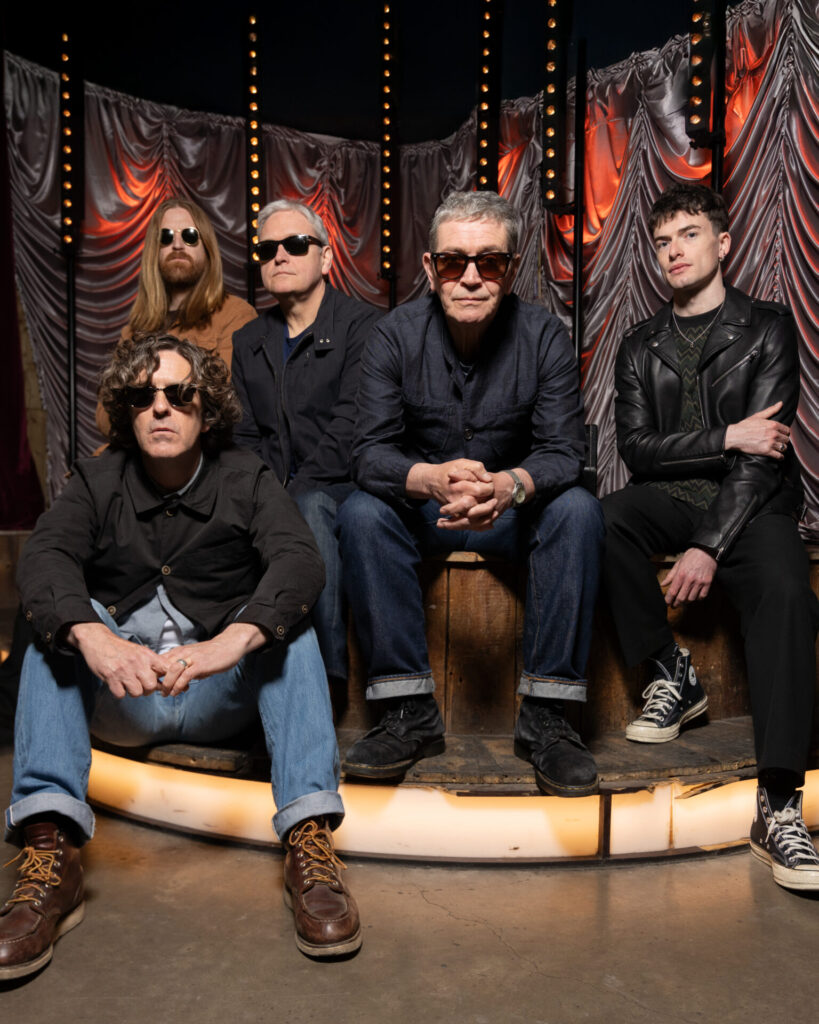
It would be another two years until the surviving band would consider picking things back up, and even then, they were only spurred to do so when an unexpected request came in from BBC Radio 6 Music, asking if they’d be interested in recording a live session for Marc Riley and Gideon Coe. “It was dead sound, enjoyable,” says Michael. “We loved The Fall [in which Riley once played] growing up, so we were chatting about The Fall, and they stuck the [football] match on a laptop for us when we were setting up.” His understatement does little justice to the magic they went on to conjure, a gentle and glistening performance, acoustic guitars intertwining with the tightness of two lifetimes’ collaboration.
After the session, they asked Wilkinson whether he’d be up for a follow-up show. “It was always a yes from me. I said ‘Fucking hell, of course! I’ve been wanting this for the last 16 years!’” They were also joined by additional guitarist Nathaniel Laurence, a member of Michael’s post-Shack project The Red Elastic Band, owing to his uncanny ability to weave his way into the Heads’ creative relationship that he demonstrated when enlisted to bolster the 6 Music session. “We were playing ‘Undecided’, and he found something that worked without being intrusive, that complemented it. He was really sensitive to the space that was available, and I just thought, ‘that could work!’” says John. Filling the role of the late Templeton, meanwhile, is The Coral’s Ian Skelly. “A lovely lad, a doer,” as Michael describes him. “He doesn’t just sit there waiting to be asked.”
“He’s slotted in,” adds Wilkinson. “Personality is as important as ability for this band, because we need to connect on a deeper level.”
Skelly also comes with the benefit of Coral Caves, his other band’s homely rehearsal space in Hoylake on The Wirral. Its relative isolation means they can work “without distraction”, and also boasts “a fantastic movie collection,” says Michael. Skelly arrives first each morning to tidy things up and sticks a film on, and the group rehearse with it in the background; it helps to draw out the subconscious, says Michael. They started with Chinatown, “and then it got darker, David Lynch, then darker. It was downhill from there.” Eventually, they were plumbing the depths of Basket Case 3: The Progeny, a critically derided 1991 horror about a man and his monstrous pram-bound brother exacting violence on the police forces of the American Deep South. “Ian had to stop it because it was so fucking grotesque,” laughs Michael.
As the three chuckle warmly about the scene, or express the simple joy of discussing the upcoming day’s work as they drive to rehearsals and their new routine of chippy supper on a Wednesday when they’ve finished (as we speak, Skelly drops a note in their WhatsApp group to remind them that tonight is the night), it feels as if I’m speaking to a band of teenagers, still bound by the camaraderie of musicians just starting out. “It’s like that, in a way, like starting again,” says Michael when I put it to him. Here comes a moment where the near-whisper suddenly shifts into intense gravity. “It’s because this is Shack getting back together with me in sobriety.”
His battles with addiction have been well-publicised throughout his career. Last year, he spoke movingly about a relapse into alcoholism in 2019 that nearly killed him, leading to regular seizures and causing the breakdown of his marriage and for a while his relationship with his daughter. After hospitalisation, a stint in rehab, then a relapse, he eventually got sober again in 2021. Shack’s wilderness period since their last full shows in 2010 has been coloured by that experience. “When we did go our separate ways, I went mine, and it was a particularly dark chapter,” he says. There were times “when I wasn’t social, I wasn’t seeing Pete, John or anyone. I was a fucking pain in the arse.”
One of the ways in which Michael was able to re-focus was guitarist Laurence’s constant encouragement to keep working on The Red Elastic Band’s album Dear Scott, eventually released to widespread acclaim in 2022. Says John: “A couple of people have asked me about what I think about him doing The Red Elastic Band [in which John’s not involved], but there was a point where the alternative was a lot worse. It’s tough, when someone you love is not well, in any situation.” Wilkinson, too, is now sober, and feels a similar sense of rebirth for that fact. “I feel almost excited as I was when I was 19,” he says, “and it does feel very different this time. There’s no cushion, no altered state. It’s just very pure.”
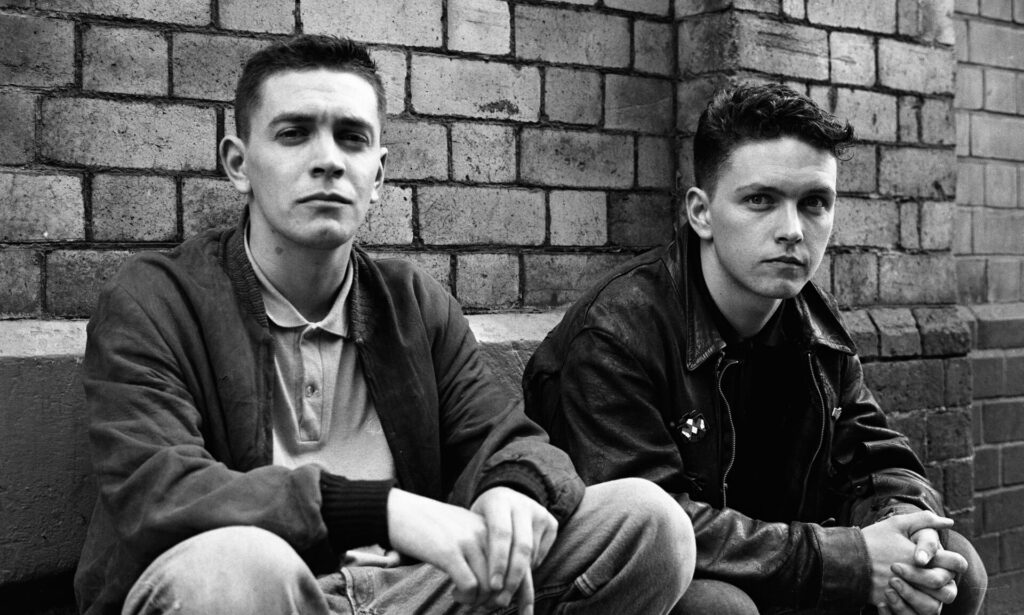
That’s not to say, however, that the band aren’t also looking backwards. They speak often of Templeton, and their desire “to be respectful” about the fact they’ll performing without him, and of the memories that are constantly being triggered by the memoirs that Michael’s working on – the time they encountered an unexpected customs checkpoint while travelling through the Alps on tour, complete with jackbooted armed police, and were forced to shove their weed into some sausage rolls in order to throw off the sniffer dogs, for instance, “had me laughing my head off,” Michael says. John (whose baby face often got him off the hook – “I’d be a great Mr. Big!”) recalls sneaking into The Haçienda to see Michael’s first band The Pale Fountains as a teenager, “standing at the stage, looking along the front row and seeing every fucking mouth, wide open all down the line,” and then how a visit to his brother in the studio led to him joining the band. “I was supposed to go back to do exams, and I said to my mum, ‘They’ve asked me to stay!’ She said, ‘As long as you’re happy lad.’” Michael smiles to himself, “That’s ma all over, that.”
Along with those efforts to finally formalise the band’s discography through the reissue project, it all feels as if this newfound sense of stability runs counter to the long-prevailing narrative of Shack as brilliant but cursed, the fame that should have been theirs forever undercut by misfortune like the Waterpistol debacle, or derailed by addiction. For years, an oft-quoted description of Michael in NME as “a lost genius” has preceded him. And yet Shack as they stand now, eyes fixed on the future (though tight-lipped on the prospect of new material), is really just the way they have always been.
Referenced artists
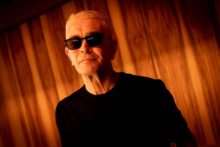
Michael Head
Magic Moments: Michael Head’s Baker’s Dozen
“When something like [the loss of Waterpistol] happened, we just went ‘Right, OK,’ and then moved on to something else,” says John. “There was never any looking back, and I always thought the album would come out somehow. Then [post-Shack band] The Strands’ journey started.”
“That’s part of the nature of Shack,” adds Michael. “The beauty of it was in the music, not dwelling on anything. You can think about the ins and outs, but we were busy being creative.”
“I liked it in a way,” John continues. “You can get complacent with music, but we’d be back in smaller venues again, happy to really get stuck into the music. Don’t get me wrong, a bit more comfort would have been nice, but when we were growing up it was all about the music, this magic that was coming out of the radio that we were so affected by. When I first heard Michael coming out of the radio singing on John Peel, that was one of the best moments of my life, and that’s never really left.” It’s fitting, then, that it was a radio session should have sparked the band’s latest step forwards – equal parts continuation and rebirth.
Shack’s tour begins at Liverpool Olympia tonight (25 April), with additional shows in Glasgow, Manchester and London between 1 and 5 May. For remaining tickets, click here.