


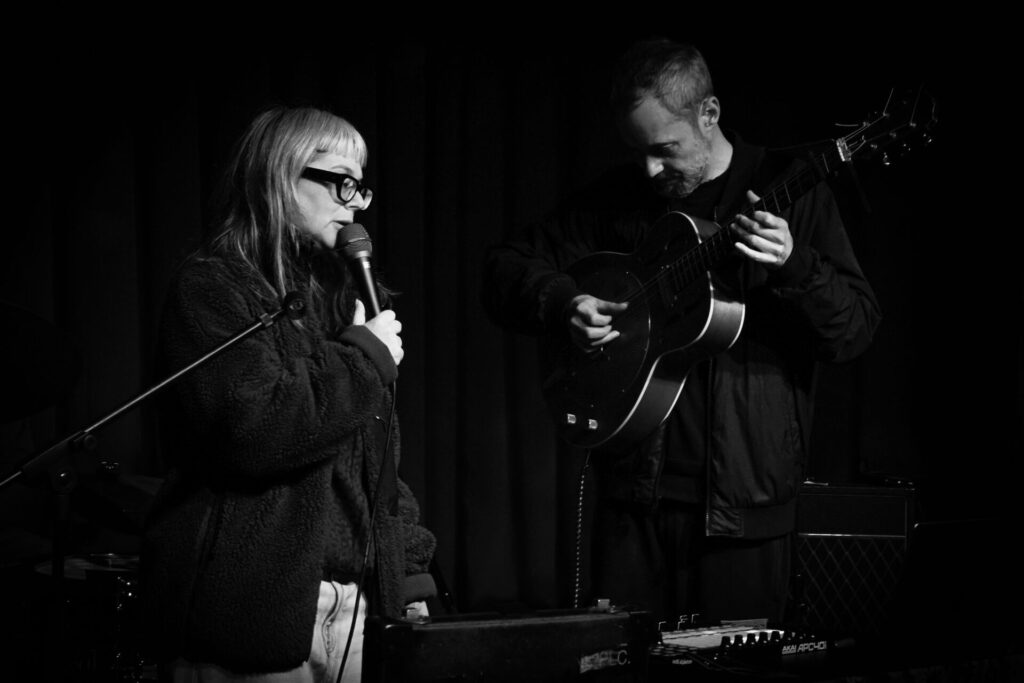
There’s a wonderful video of Nina Simone, in 1961, singing ‘When I Was In My Prime’ to sparse guitar by Al Shackman. Based on a folk song known variously as ‘The Sprig Of Thyme’, ‘Let No Man Steal Your Time’ and ‘The Seeds Of Love’ and other names, the lyrics use botanical symbolism to warn against the dangers of false lovers. Simone’s version, at once expressive and minimal, utterly haunting, sells the heartbreak and then some. Stick in The Wheel’s Nicola Kearey and Ian Carter watched the performance several times over, and eventually realised that there were certain words and phrases that Simone had seemingly omitted that appear in other versions of the song – words that themselves concern themes of exclusion. “I thought,” says Kearey, “I can do something with that.”
That which is left out was already of great significance to the duo, who also have a longstanding interest in those who were erased by the late 19th and early 20th century folk collectors. It’s from the work of such figures, travelling the country and archiving the songs that had hitherto been passed down orally that we derive much of the current folk canon. Yet Stick In The Wheel have a problem, they explain, with the way in which the collectors’ methods have minimised the roles of those from whom they heard the songs in the first place. To put it simply, the name of the public school and Cambridge-educated Cecil Sharp – perhaps the most prominent of all the collectors – is well-known; the working-class people from whose songs he built his fame have been all-but lost to history.
As Kearey explains, “These songs were collected from ordinary working people, but the book is named after the person who collected them. You could also argue that if you’re collecting something, you’re trying to control it.” After the Industrial Revolution had seen cities swell with the influx of once-rural workers, those who remained in the country were seen as untainted, noble peasants whose existence was closer to the idyllic, romanticised, prelapsarian vision of Albion. It has also been argued that many folk collectors sanitised the material they found, tactically omitting certain verses, phrases or songs in order to keep advancing this aesthetic. Nor did they have much time for the songs of those in the cities. “People viewed cities as these corrupted places, because they were full of people from everywhere, which is problematic in another sense,” says Kearey.
In this context, the opening and closing songs on Stick In The Wheel’s new album A Thousand Pokes make for fascinating framing. The first, ‘Crystal Tears’ is constructed from the words that Simone left out on ‘When I Was In My Prime’. The last, ‘Steals The Thief’, is the band’s clearest articulation on record of their issues with the old folk collectors. “He took their words, from their own / Paid them promise, all turned to dust,” sings Kearey. As well as the common themes of restoring what is absent, whether words or people, these two songs also share a striking aesthetic palette. On both, Kearey’s vocals are hardtuned so they take on a detached quality; the instrumentals are great heaving waves of transcendent noise.

The symmetry between the two songs means they serve as bookends, but the tales contained within them are quite different. With the second song, ‘Back Of The Hatch’, the focus suddenly sharpens. Now Kearey’s voice is stark and charismatic, ringing clearly atop lurching fuzzed-out guitars. “I present to you several episodes,” she declares with ringmaster’s charisma. “Periods of time in which to think whatever you want.”
Beginning with the title track, the episodes in question swing from bacchanalia to despair, hardship to humour. Tellingly, Kearey and Carter draw heavily on folk material outside of that gathered by the Victorian and Edwardian collectors – nursery rhymes, an old London street cry, a 15th century devotional treatise from nuns on the bank of the Thames, a satirical Tudor ballad – to paint a distinctly urban picture. Here, that rural romanticisation is stripped away, and folk music recentred as the sound of a chaotic, gritty, and constantly shifting city.
More specifically, Stick In The Wheel view this as a record about their native London, an imagined parallel version of the capital in which its musical continuum hasn’t been broken by the decline of its population following the two world wars, or by the more recent gentrification that saw its communities fracture. It’s important to note, as Kearey says, that this “is not in a romantic way,” and that the London on A Thousand Pokes is no utopia. Stick In The Wheel are not a musical equivalent of a nostalgia-bait Facebook group, posting photographs of 1960s fruit markets to foster comments about the ‘good old days’. Their portrait of London is still multifaceted and edgy, one where devious women are celebrated for their conning of a rich merchant, and Death is re-imagined as an East End hitman.
“Trust me, our families are from those times, and they were fucking hectic,” says Carter, who points out that the population of London in 1940 was roughly the same as today while occupying a smaller area of land. It means that rather than try and fantasise their way into history – or as Carter puts it, “think ‘what would I write if I was wearing a top hat in an alley?’” – they can instead draw on the commonalities of experience between themselves and their ancestral Londoners, and intensify the connection by repairing the links that were broken, first by the housing damage that occurred during the two world wars, destroying or damaging 1.1 million homes and making one in six Londoners homeless, and then further displacement in the later 20th century.
“It’s weird when you come from a culture that is so broken up,” adds Carter. “Being from London, the sort of culture that our grandparents grew up in, our parents to a certain extent, doesn’t exist. Everyone’s been moved around. We all suffer from pressures of gentrification. It used to be that if you wanted to change your council house for something bigger or smaller, it would be within the area you live in. Now it’s Luton or Bristol or Kent or wherever. Post-war people got moved out of the East End of London and into Essex, so the culture gets fractured.” The London of A Thousand Pokes, then, “is what we would want there to be.”
Rather than place this imagined London in a specific period, the record is hazy around the temporal edges. Drawing from material from the late Middle Ages through to the 20th century, it’s only ‘Can’t Stop’, where the narrator is haunted by PTSD after witnessing a car accident, that couldn’t apply to the experiences of an average Londoner living anywhere along that timeline – and even then, there’s something enduring in that song’s ‘just get on with it’ attitude. The title track, based on the 15th century nuns’ treatise, summons Titivillus – the patron demon of scribes said to introduce errors into their works, and to collect the words that people mumble, skip or mispronounce during church services, to later be counted against them at the gates of Hell. It’s not difficult to make the leap to the way a person’s historic social media posts, however problematic or badly-aged, are archived to be pored over today. It all speaks to the universality of experience that’s inherent in folk music, the idea that it paints the concerns of those living centuries before us as not that different to our own. As Carter puts it, “the past is just the same, but with different things. They didn’t have the internet, or electricity or whatever, but we all still had the same shit going on.”
As well as introducing the record proper, following the elegiac precursor of ‘Crystal Tears’, ‘Back Of The Hatch’ draws on the idea of charivari – rough music where members of the community who had transgressed would be harassed with the banging pots and pans outside their house, or “an old fashioned cancelling” as Stick In The Wheel refer to it, with tongue in cheek. It also contains a strikingly direct address from Kearey: “It’s your words and deeds that matter, and let me tell you, they speak volumes.”
Expanding, she tells tQ: “There a very, very few credible places or media outlets where people making traditional music can gain exposure to a wider audience, so those writing about it have a big responsibility to do so with curiosity, without their own privilege creeping in, and not to play favourites. But it can also be a more universal idea about examining your own motives and being accountable. Always we are trying to frame our work as a way to move forward, and not get stuck in past wrongs or bitterness. And certainly in a wider context, if this stuff is happening to us, it’s happening to others without even the small voice of what we have. It’s difficult for those people to bite the hand that feeds them, challenge the structural framework as often they don’t even realise that framework is there. And that invisible structural oppression is the whole trick. Like with folk songs and the folk canon, how can you even begin to work with that material without knowing why it happened and where it came from?”
Stick In The Wheel are wary about being too prescriptive. “We’re mindful that it’s important to give the listener or the audience just enough information for them to interpret the rest of it themselves,” says Kearey. And yet, one point does, perhaps, require clarity. I put it to the band that there have been arguments that those who took part in far right fuelled anti-immigrant protests across Britain this summer did so because they themselves feel as if they are the people ‘left out’ by society, seeing themselves as having been cast aside by an establishment they believe to value foreigners’ wellbeing over their own. Despite this ideology being the antithesis to Stick In The Wheel’s, are they concerned that their own exploration of excluded voices might be commandeered?
“Does it require clarity? Are we naive to think our work could be interpreted in this nefarious way? We’re absolutely not aligned with those people.” says Kearey. “I mean really. And the fact that we have to explicitly state this speaks volumes about certain peoples’ preconceptions. It’s normally middle-class people telling us we’re actually not working-class, because we drink flat whites or make sourdough, or read books, or we’re not working-class enough because we don’t appear “gritty” or we don’t have a big telly or we don’t fit the tropes they expect. We’re two weirdos making music, we happen to be working-class, that makes things tricky and precarious. I mean, we’re from London! That means we’re from everywhere, like everyone else here.”
Adds Carter: “People might identify themselves as outsiders, or feeling left out, for all sorts of reasons. Peoples’ struggles are usually intersectional. We did a piece about it for the Norfolk & Norwich Festival, commissioned by Laura Cannell, going back to the mid 1600s where people ‘out of service’, i.e. people without a household as their societal structure, were imprisoned. Of course there is a modern continuation of this today, people that operate outside of society, councils and governments don’t like it.”
Kearey continues: “With the ‘traditional’ music of this country, we feel it’s super important to be asking, why were certain subjects and peoples’ music left out of the collecting process? Like cities being ignored because that’s where ‘all types of people’ mixed. The culture was ‘low’ and quick changing, because cities are like that. So they didn’t bother with it. And we would find people try and shut us down, because we weren’t academics, so we didn’t deserve to question it. Because if they considered it, they’d have to concede that this stuff is part of a structurally oppressive framework that they are reinforcing.”

Ultimately, Stick In The Wheel’s working-class identity runs through A Thousand Pokes on a level that reflects its nuances. It’s explicit in their inclusion of ‘Watercress-o’, a song written in the 1960s by Roger Watson based on his grandmother’s memories of the 1926 general strike, and elsewhere it’s implicit. The nursery-rhyme ‘Hush-a-bye Baby’ – titled ‘Hush’ in this instance – is transposed into a minor key, its drowsiness twisted into a meditation on precariousness and whether ideas above one’s station are worth pursuing. On ‘Can’t Stop’, the song recounting a person haunted by a car crash, the instrumental takes on a jarringly jaunty 60s swing and the lyrics a deadpan sarcasm (“he’s lost his no-claim bonus”). “That song has this very dark humour, that really reminds me culturally of my family’s humour,” says Carter. “It’s not edgelord humour, it’s born out of how you just have to cope. It’s heartfelt.”
Kearey also cites the album’s instrumental palette, which other than on the opening and closing songs is sparse and direct, as a product of their background. “Our approach to making music is informed by this constant idea of scarcity, a bit like grime,” she says. “With our backgrounds, you might not have much in terms of equipment or studio time so you need to rely on making the best out of what you have. A sort of working-class minimalism born out of necessity that consistently informs our practice. Some people react to poverty by getting as much stuff as possible but for us it’s embracing that by doing minimalism.” It’s testament to their abilities that from this scarce palette, A Thousand Pokes is a record of such immense depth.
Stick In The Wheel’s new album A Thousand Pokes is out now via From Here Records. The band are touring the UK from 28 November, and you can find all dates and ticket information here.