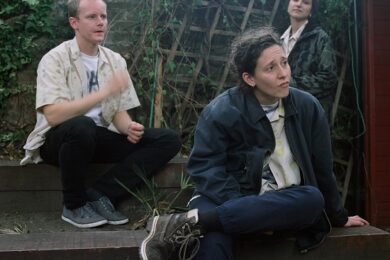

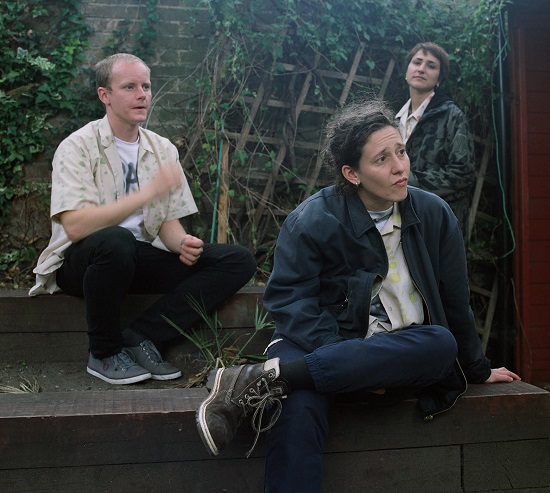
Photograph by Gabriel Green
There’s something almost institutional about the confined space of a traditional recording studio. Sure, it’s got instruments and other sound-generating technology, but where are the windows? And if you’re of the most exacting type, like a Brian Wilson, then there is no exit. When all’s said and done, it’s really a wonder that art comes out of it all.
Micachu & the Shapes, took a different path when recording new album Good Sad Happy Bad. After hitting the pub and downing a few pints, the three basically thought, “Right, maybe we should record?” And in one marathon session at a rehearsal space, with but a few instruments and a small handheld stereo recorder, they blasted out an entire album.
If this quick exit strategy and basic stereo recording set-up does anything, then it transports the listener into a very particular space where, for just a few hours, Micachu & The Shapes’ hyperkinetic experimental pop reigned. Neither lo-fi nor hi-fi, the band make Good Bad Happy Sad sound as if the listener is in that room along with them.
Shortly after the record’s release, we spoke with the band’s Mica Levi, Raisa Khan and Marc Pell about recording at warp speed.
You’ve said in recent interviews that the album sort of happened spontaneously. It wouldn’t be right to say it was an accident, yet you went into a rehearsal space to record but with no real intent to record an album. But this is exactly what you ended up with. If you weren’t setting out to record an album, what were you doing exactly?
Raisa Khan: We hadn’t really gotten together for a long time. We’d had a couple of drinks together and thought, “Okay, we’d better have a play." So, we had a play. Mark records a lot of stuff on this small recorder, so we were just recording it. A few days later he sent the work to all of us, and I guess we all liked the sound of it. But Mica thought it would be quite nice to try and write some bits on top of it and we’d have something to work with. So she wrote a few things on top and we all liked the sound of it, and then it kind of turned into the album.
So the recording wasn’t a demo at all but the album’s final output?
RK: All of the final tracks on the album are the original recordings or jams. We didn’t re-record anything. We recorded it onto a stereo track. It’s not multi-tracked.
Do you feel like not having a major intent like, “Okay, we’re going to spend a month recording the album,” worked in your favour aesthetically? Did it, in fact, unleash a different type of creativity for the band?
Mica Levi: Basically, it was different from going to record at a studio intentionally because it wasn’t planned. We basically used stuff that we already had. We couldn’t be indicative about how things are played. We didn’t have intention. We didn’t have any pressure.
Marc Pell: I’ve got an analogy. When you meet the person you’re going to spend the rest of your life with, it starts in the most simple way and place; unless you’re a stalker or very young and you planned out the way you were going to meet this person, where you have a routine and bump into them strategically. But what happens to most people is they just bump into someone and say something to them, and you just spend the rest of your life together.
RK: We did actually try learning the songs a little bit and re-record them with better song structures, but it just didn’t sound the same. So we ended up adhering to what we had originally, and that obviously had limitations in itself in terms of things that don’t sound so good. We’d never worked this way before. In the past, usually Mica would come up with a song she’d been working on.
Put us in the recording room. What was the space like and what instruments did you use?
RK: We just had drums for Marc. Mica played some guitar, mainly concentrated on singing. I did the keyboards.
ML: But sometimes I wasn’t playing anything.
RK: There was bass on a couple of tracks, but we basically tried to keep it simple. Obviously the more you have the more choices you have, so it’s a bit harder to start jamming because there are more decisions to make.
ML: We just went into play. It’s a rehearsal space more than a recording studio.
What did the space do to the recordings as far as acoustics. On the album there is a very interesting spatial sensation. It’s not exactly lo-fi but it’s not hi-fi either. The listener can feel that you were in a very particular space. An enclosed space. What did this actually do to the sound when you played and recorded?
ML: That’s an interesting point because Marc’s recorder is used for that very purpose: to be spatially sensitive, and to just get a general sense of what’s within reach of ten feet. From our perspective, certainly the actual fact of the room we were in was important, but honestly we just liked the vibe of it, and how we went about it was good for us. You know, I just sing on this really. Everything was quite clear cut as far as roles. It was nice to be quite quick about it, really.
I just finished it by singing over top of it. In my mind, people sample things all the time that are from different eras, and they have different quality in terms of how modern a recording they are or how lo-fi or hi-fi they are. Depending on context, you can fake it. But, the album sounds consistent, and that was easily achieved. There wasn’t much we could do to change it.
Not to get too technical, but what quality did Marc’s recording device give to the recording?
ML: It’s an older model. It’s a digital handheld recorder, the Zoom H2 Handy Portable Stereo Recorder. It can record in high quality. It’s discontinued now, so Marc had to buy a display model at shop in London. It seems to be pretty decent, and it’s basically just a stereo handheld. In a recording studio, you record everything individual and you get a lot of clarity out of it. But, afterward, if this is your intention, you might try to record a more live atmosphere, and you might rely more on the room microphones for that and the amplifiers. The recording we have is basically a vague impression of that but without loads of work.
When you recorded this, you realised that there was something in it — something right. At that point, did you think: "What will listeners think?" Or does that come later when arranging the tracks and mastering?
MP: The moment we realised we wanted to turn it into something was definitely after Mica had come back with some select bits of the stereo recording that she’d vibed with. Any awareness of the audience was in the latter process of collating the nearly 90 ideas we had into an album. It was an exercise in curation — each form of the album gave a different feeling.
When you sang over the files, Mica, did you do this at home?
ML: Yes. I think it’s more rare these days to record vocals in a proper recording booth. It’s more common to record vocals at home now. So, it was good.
Apart from adding the vocals, was there any editing process? Did you cut and paste or sample yourselves, or arrange the tracks into a proper tracklist, or is the finished product what you already had start-to-finish in the recording?
ML: The recording is actually quite long, so it has quite boring conversations and other stuff. So, I just tried to pick the best bits and put them in an order that felt good, you know, strongest songs out of them all and made decisions like that. Editing-wise, there wasn’t really much to do. Occasionally we covered something with something else. If it sounded really embarrassing or offensive, we’d just put something over the top of it like a plaster.
MP: Endings and beginnings were discussed and changed, but again most of the work was in curating the right mood for the album.
Was it a case of you guys entering something like a trance or maybe even a hallucinatory state when recording? I ask this because the music feels a bit like that: like a hallucination inside a very defined space. It’s a bit like how it is for a writer: you get into some sort of unusual state of mind and suddenly you’ve got a piece fiction or poetry.
MP: When you jam, you are in a kind of trance I guess. Other times you’re not in a trance and you’re completely inside your own sound, or another sound that’s happening in the room. It’s certainly a trip, jamming. And Kafri is certainly a nice relaxed place for us — bit like our living room ‘cause there’s a sofa in there and tea available.
One track, in particular, ‘Unity’, is pretty fascinating. It sounds like heavy metal, at least in parts. Maybe it’s the screaming. Mica, did you do anything to your vocals to make it sound more metal?
ML: Yeah, it’s just, “Ehhhhhhh!” No effects, bro.
RK: She was jumping around the room screaming into the mic.
ML: I’m glad you got that reference because people thought it was, like, a pig.
Well, if it were a pig then that would be interesting as well.
ML: No pigs were harmed in the making of this record. So that’s that. Yep.
Good Sad Happy Bad is out now on Rough Trade Records.