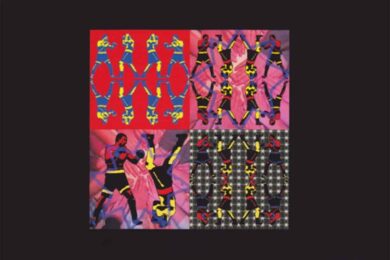
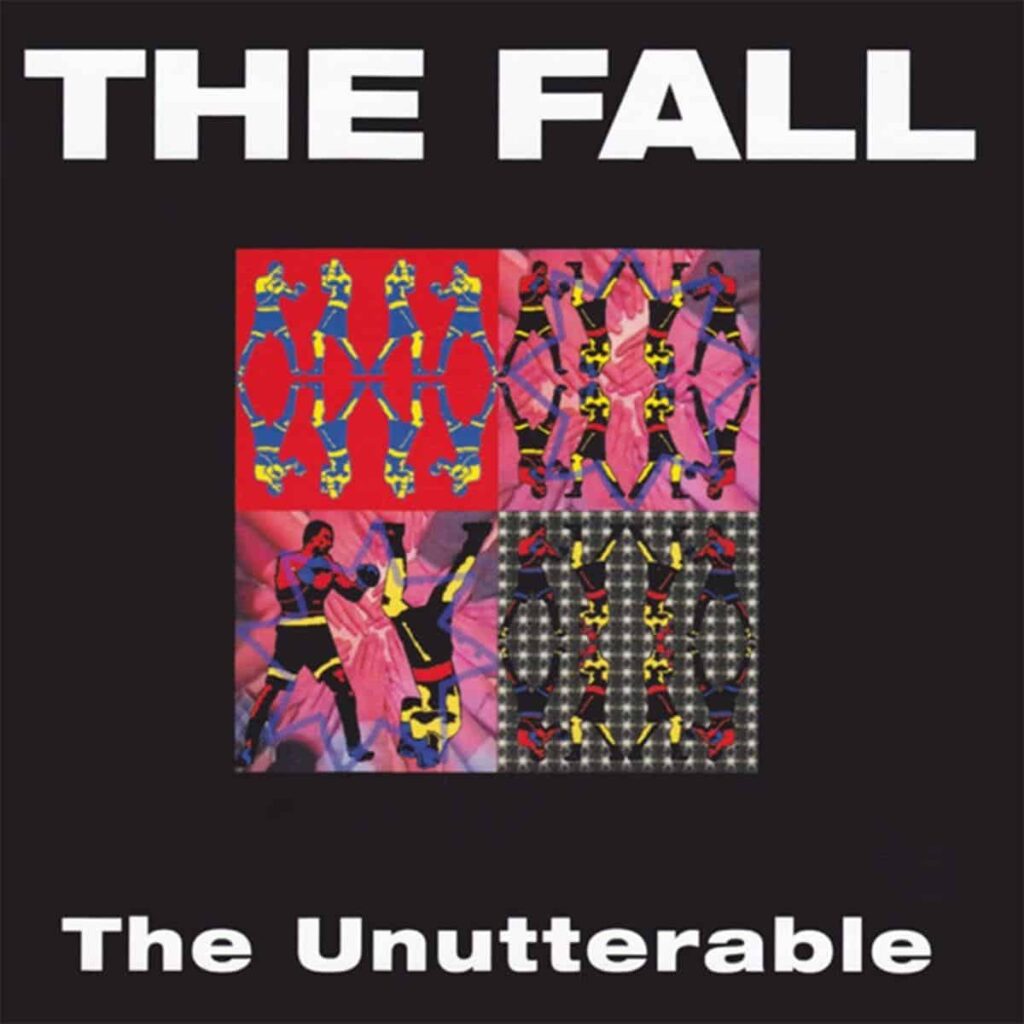
Stand on the high street of an English town centre as darkness covers the early evening, and strip-lit shops – stacked with sleek, touch sensitive tech or vaporising tobacco simulators – glow harshly amongst empty units and the sad, or simply shut, pubs. The future’s here today. In The Unutterable by The Fall, their 21st studio album and first of the 21st century, the future is a little like this: here, garish and banal. Not merely the best album that the Greater Manchester band would release this century, The Unutterable stands out as one of the most original and exciting British albums of the 2000s.
When Julia Nagle joined The Fall in 1995, they were an institution in crisis. Smith’s alcohol use had darkened, and that was before an unhappy group were served a £40,000 VAT bill, whose payment terms threatened repossession of some of their homes. Nagle, who had been the first female sound engineer at Stockport’s Strawberry Studios before forming experimental rock act What? Noise, had arrived just in time.
What had really worked about 1997’s Levitate was its metallic and abrasive iteration of drum & bass. When that lineup walked following a fight on the New York stage, only Nagle stayed, overseeing the formation of a new lineup around Mark E. Smith comprised of herself on keyboards, Neville Wilding on guitar, Adam Helal on bass and Tom Head on drums. 1999’s The Marshall Suite was an unexpected recovery, in its best moments pioneering an entirely new Fall sound of clattering jungle and menacing low-end.
Speaking to The Wire in late 1999, Smith retrospectively pitched Levitate as “a new start.” The departed musicians, Smith uncharitably claimed, “were even talking about going on strike if we used a DAT player. You’re The Fall, for Christ’s sake. It’s amazing how many times I’ve had to put up with that kind of crap. You think you’re past all that, fellas with beer bellies turning everything you do into a bloody Sex Pistols track.” The Unutterable was recorded in spring 2000 at Longsight’s tiny electronic Testa Rossa studio which, while called Moonraker, had previously been most closely associated with 808 State and A Guy Called Gerald. Overdubs and mixing then took place in London.
Two decisions were crucial. First, songwriting credits were to be split evenly between players. Second, Grant Showbiz returned to produce. Showbiz had mixed the group live and on record since the late 1970s. And by the 2000s he had developed a radical idea about Fall albums: that they should sound good.
“In the last few records, we’d been losing the great thing about Mark,” he explained in the album’s press release, pitching Smith as a vocal stylist comparable to Al Green or Captain Beefheart, “the words and the tone of his voice.” Speaking in 2021 to Oh! Brother podcast about those sessions, Showbiz described “just coaching out as much stuff as possible” out of Smith, using Teo Macero’s innovative editing on Bitches Brew as a blueprint. “Taking ideas that he might only do once and saying: this is brilliant.”
It helped, of course, that the songs were The Fall’s most conventionally strong in a generation. Modernist but rarely modern, Futurist but not futuristic, The Fall in the 1970s and 80s were never particularly concerned with what was yet to come, but The Unutterable presents an electronic, forward-looking iteration of the group that is ominous and menacing as they had ever sounded. Take opener ‘Cyber Insekt.’ Ostensibly a bright, catchy pop song – it even has the drum part from Ballroom Blitz! – it’s here rendered completely unnerving, with Nagle’s high-anxiety synth part, and glacial chorus vocals gifted from Kazuko Hohki, the Frank Chickens vocalist and wife of Grant Showbiz. ‘Two Librans’, with its bone-shaking bass and descending Stooges chorus riff, might be one of the most exciting rock songs that The Fall ever recorded, while ‘Sons Of Temperance’ keeps forgetting that it even is a rock song, slumbering instead into something closer to a fugue.
Today, there’s a line of thinking amongst Fall fans that Smith might become seen as a visionary figure, someone so unusual and exciting in their outlook, the sheer extent of it may only become visible decades down the line. Someone like William Blake. After The Fall’s 1988 version of ‘Jerusalem’ dragged Blake’s poem out of the church hall and onto the Prestwich pavement, the poet was – like Link Wray or H.P. Lovecraft – one of the few influences Smith would own up to in public. ‘WB’ began appearing on 1999 set lists simply titled ‘Blake’, using lines from the poet’s ‘A Song For Liberty’ (“Look up! Look up! O Citizen of London!”, or “the flaming hair shot like the sinking sun” are reproduced near verbatim) and those from Smith’s own pen. It’s the warm bed of Nagle’s glowing synthesisers, sustained throughout the track, that pushes it into the sublime.
And why wouldn’t he hold the example of Blake close at this point? “Mark felt lost,” explained Showbiz of The Unutterable sessions. “The gang mentality had gone by then, people knew they were in for a couple of (years)”. More so than any other Fall album, The Unutterable offers glimpses of how it might have felt being Smith at that point. Its enduring images are like stress dreams: either locked in glass boxes, or stuck circling roundabouts. Imperial Wax Solvent or This Nation’s Saving Grace are fun Fall albums: The Unutterable is no fun. This is matched by the restrained, even worn-down quality to Smith’s vocal here, sounding decades older than even a few years previous: all adenoids and ash trays.
Even the ostensibly delightful ‘Hot Runes’ (the brilliant namedrops of Alan Brazil and Derek Hatton seemingly a snapshot of one June 2000 morning on TalkSport) was born in darkness. Listen to the original Testa Rossa mix (on CD2 of the new reissue) and it contains an abandoned Smith verse read by Nagle that seems to speak directly to the crises of those years: “A sense of security, actual security / lots of money in the bank for the taxman and everyone else to try and steal / You end up trying to keep hold of it. Grab, grab / it disappears nonetheless”.
In ‘Dr Buck’s Letter’, it’s the Welfare Benefit reports and legal bills that fall through the narrator’s letterbox, bringing him down. Adam Helal began work on the song by programming what he thought was an Arabic or Egyptian sounding loop on a tiny Roland synth, which, in the final mix, is percussive, pummelling and utterly thuggish. Smith, in its second act, recites from a found text: an interview with the DJ Pete Tong originally published in Hot Lines, which was a complimentary magazine for customers on board the new Virgin Trains, who had only just begun operating the newly privatised line between Manchester and London. Here were The Fall, then, who had inventoried the old world of WMCs and bingo halls now observing the transition to something else: glitzy, self-regarding, no less sinister.
In 1999, The Fall began covering Lou Reed’s 1974 song ‘Kill Your Sons’, which regenerated quickly into something else: ‘Ketamine Sun’. Drug songs had been part of The Fall’s remit since ‘Totally Wired’ or ‘Rowche Rumble’, and where those songs were appropriately speedy and taut, ‘Ketamine Sun’ is woozy and visionary. After its surreal introduction, a drug skit built riffing on a ketamine version of 1960s sci-fi cartoon The Jetsons followed by a lo-fi Smith rap, the song climaxes to an operatic grandeur. It hails the advent of a drug that has since gone on to become the 21st century’s defining narcotic, as the ketamine sunrise stretches from Silicon Valley to depressed Lancashire towns.
But the weirdest moment on The Unutterable concerns an entirely different consumption. ‘Pumpkin Soup and Mashed Potatoes’ is built on chintzy finger clicks, lounge piano and tin whistle, and if its sonics sound like a left turn for The Fall, that’s nothing on its subject matter: a homily to the supposed pleasures of root vegetable consumption (in The Big Midweek, Steve Hanley points out that he never once, in 19 years, saw Smith eat a vegetable.) Speaking about this song in the new liner notes, Adam Helal remembers going for a 5AM piss at Smith’s Prestwich home, and catching the bandleader “in his bedroom, writing lyrics on his wall. When he was in that creative buzz, we were all in that creative buzz, it would be quite mad.” In the eighteen months leading up to recording, Smith had appeared in Mark Aerial Waller’s experimental short films Glow Boys And Midwatch, appearing in the latter as a spectral caterer haunting a 50s British naval ship. Both of these are referenced respectively on the fractured, seven-word track ‘Midwatch 1953’ and ‘Das Katerer’, essentially a solo Smith track given proper drums and sequenced electronics taken from 1992’s ‘Free Range’. (Waller also directed a short film The Sons Of Temperance in 2000.)
The Unutterable was released on 6 November 2000. It was launched with a live appearance at HMV Oxford Street (no drummer, natch), and a Smith interview in The Times. He pointed out that “there didn’t seem to be a lot of humour” in his lyrics anymore. “I think that’s what I’m trying to reflect about society. You can’t tell a joke anymore,” he argued. “There’s an English society that needs bringing out. We don’t analyse things: we reflect things. That’s why we’re called The Fall.” For this, English society rewarded them with 136 in the Official Album Charts.
“There was a good atmosphere in the band,” Nagle (today Julia Adamson) reflected to MOJO in 2017. “Then, Mark decided to fire everyone. I thought: this is going to be never ending. It was time to throw the towel in.” (Frustratingly, both live albums collected on the new reissue are from after the Unutterable group had ended.) Nagle left The Fall in 2001, neither the first nor the last woman to leave the band in far better shape than she had found it.
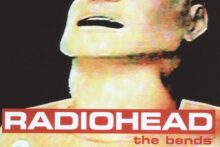
Though The Unutterable would become a completely singular album within the Fall canon (something its Lovecraft referencing title, with two neat words running symmetrical to the group’s own band name, seems to acknowledge), it was a distinctly 2000 product. Its nightmare mood of post-millennium tension could be found that same year on Chris Morris’ disturbing Channel 4 horror-comedy Jam, or the techno-apocalypse of Primal Scream’s XTRMNTR, even the big budget ennui of Radiohead’s Kid A, which glumly occupied the front pages of music magazines that November. Writing in The Wire the following year, Ian Penman argued that Radiohead’s left turn was “looting other people’s transvaluations rather than clearing a stark space of its own.” The same cannot be said for The Unutterable’s oblique experiments, and today, it’s the Greater Manchester band’s sole release that sounds like a premonition of the dark electronic terrain that 2020s North West underground releases now occupy (in fact, White Hotel maverick Tom Boogizm’s NTS mix on The Fall is completely stacked with Nagle-era material).
And as the 2000s progressed, The Fall – all debts now paid – were subject to a belated and uneasy critical consensus around their past work, at the same time as their new output forged a clear third great era. But neither really allowed much accounting for The Unutterable. It was possible to watch the hour length 2004 BBC profile on the band, or read Smith’s 2009 memoir, without knowing that it had even happened. The Unutterable is a truly great Fall album: a dark forecast of the horror to come, a fascinating reflection of a band coming out of crisis, and simply one of the most vivid and exhilarating Fall products ever stocked on shelves.